論文解説
Consistent Video-to-Video Translation via Explicit Correspondences
明示的な対応関係を用いた一貫性のあるビデオ・ツー・ビデオ変換
- 課題 スライディングウィンドウの外に出た対象を自己回帰型のビデオ変換が忘れるため、長期の一貫性が崩れます。
- 手法 入力映像のパッチ対応で過去の出力パッチを検索し、クロスアテンションでDiffusion Transformerに注入します。
- 結果 Rolling Forcingの5ステップ設定では、VACE-Benchの再訪LPIPSが0.427から0.240に下がりました(DL3DVでは0.445から0.305)。
スライディングウィンドウ外の記憶の喪失
リアルタイムのビデオ間変換は、入力を受け取りながら即座に出力する必要があるストリーミング、ゲーム、AR/VRなどの用途で使われます。自己回帰生成では、時間的な連続性を保つために過去のフレームを文脈として使う必要があります。ただし過去の出力をすべて残すと、メモリは長さに比例して増え、演算量も長さに応じて二乗に近い勢いで増えます。そのため多くの手法は、直近W個の潜在フレームだけを見るスライディングウィンドウを使います。この方式ではフレームあたりのメモリと演算量を一定に保てますが、ウィンドウの外に出た対象はモデルが再び参照できません。著者らは、この限界が入力映像で同じ領域が再び現れたときに出力の見た目が変わる形で表れると見ています。
初期フレームを大域的な文脈として残すattention sinkは、後から現れた内容を捉えられないと比較しています。この論文が扱う問いは、入力映像そのものの対応関係を使って、ウィンドウの外にある過去の出力を再び見つけられるかどうかです。
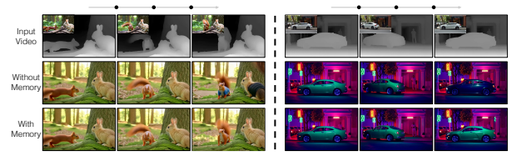
Fig.1 : Long-range consistency without long context windows.Standard auto- regressive video translation forgets content once it falls outside its context window (middle row). Our proposed methodvid2vid-long(bottom row) explicitly retrieves matching past outputs when the inputs recur, maintaining consistency over long videos. Please see the supplement for a large grid of qualitative result videos.
出典 · CC BY 4.0 · Gaurav Parmar, Zhengqi Li, Richard Zhang, Jun-Yan Zhu, Srinivasa Narasimhan, Eli Shechtman, Yotam Nitzan · Consistent Video-to-Video Translation via Explicit Correspondences · 論文の図を引用 · 元のPDFの2ページ目から図の部分を抽出しています。入力の対応関係による過去出力の検索
中心となる観察は、入力映像で互いに対応する領域は、出力でも対応しているはずだということです。vid2vid-longは、入力の潜在パッチを検索キーとし、生成された出力の潜在パッチを値とするキー・バリューメモリを用意します。キーはVAEの潜在パッチそのもので、別の特徴抽出器は使いません。メモリのサイズは映像の長さではなく、新しい視覚情報がどの程度現れるかに応じて大きくなります。つまり同じ場面が繰り返されると、新しい項目はあまり増えません。こうすると、ウィンドウの外にある対象も入力で同じ位置を見つけ、その出力値を再利用できます。

Table 10 : Ablation of the feature extractorϕ.We compare three choices for computing patch descriptors: VAE latent features, DINOv2, and CLIP. VAE latent features achieve the best reconstruction on VACE-Bench and competitive performance on DL3DV, without requiring an external feature model. All variants usek=3retrieved neighbors.
出典 · CC BY 4.0 · Gaurav Parmar, Zhengqi Li, Richard Zhang, Jun-Yan Zhu, Srinivasa Narasimhan, Eli Shechtman, Yotam Nitzan · Consistent Video-to-Video Translation via Explicit Correspondences · 論文の図を引用 · 元のPDFの22ページ目から図の部分を抽出しています。メモリの読み出しと書き込みのルール
書き込みのルールでは、新しく生成された各潜在パッチのキーについて、既存のメモリとの最大コサイン類似度を計算します。その値がτhより小さいときだけキーと値のペアを保存するため、十分に表現済みのパッチは飛ばされます。空のメモリでは、最初のブロックのすべてのパッチが保存されます。読み出しのルールでは、ブロックを生成する前に、現在の入力潜在パッチごとにメモリからコサイン類似度の上位k個を探し、類似度がτm以上の項目だけを使います。実験の設定はk=3、τh=0.75、τm=0.75です。条件を満たす項目がない場合は有効マスクが0になり、そのトークンのクロスアテンション出力も0になります。検索はブロックごとに1回行われ、その結果はすべてのデノイジングステップで再利用されます。
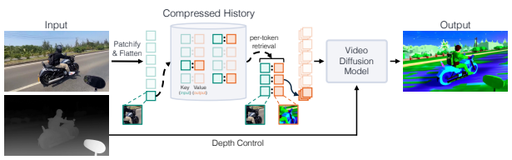
Fig.2 : Correspondence-based video translation.The memory is populated with input-output correspondence pairs from previous generations. To support the consis- tent translation of the next block of frames, we first retrieve from memory the output patcheswhosecorrespondinginputismostsimilartothecurrent.Theseoutputpatches, together with the normal input signal, is the input to our video diffusion model. Based on the new induced input-output pairs, we write to memory only those that are suffi- ciently different from existing.
出典 · CC BY 4.0 · Gaurav Parmar, Zhengqi Li, Richard Zhang, Jun-Yan Zhu, Srinivasa Narasimhan, Eli Shechtman, Yotam Nitzan · Consistent Video-to-Video Translation via Explicit Correspondences · 論文の図を引用 · 元のPDFの3ページ目から図の部分を抽出しています。
Table 7 : Hyperparameter analysis.We show the effects of varying the thresholds τh andτ m on our method. As the thresholdτh is increased, our method stores more patches in the history bankHand improves the reconstruction performance.
出典 · CC BY 4.0 · Gaurav Parmar, Zhengqi Li, Richard Zhang, Jun-Yan Zhu, Srinivasa Narasimhan, Eli Shechtman, Yotam Nitzan · Consistent Video-to-Video Translation via Explicit Correspondences · 論文の図を引用 · 元のPDFの20ページ目から図の部分を抽出しています。correspondence cross-attentionによる条件の注入
検索された出力パッチは、入力の潜在と同じパッチ埋め込みを経て履歴トークンになります。これらのトークンは、各Transformerブロックで自己アテンションとテキストのクロスアテンションの間に追加された、correspondence cross-attention層に入ります。各トークンは自分のk個の近傍にだけ注意を向け、出力に有効マスクを掛けたのち残差として加算します。出力投影Woは0で初期化されているため、学習開始時点では事前学習済みVACEの動作は変わりません。実装では、クエリとメモリのテンソルのシーケンス長をバッチ次元に移し、トークンごとに独立した1×kの演算として処理します。
distillationの学習設定
基本設定では、Rolling Forcingのdistillationを5ステップで使います。著者らはこの目的関数を変更せず、追加の損失項も入れていません。学習中も生徒モデルは、自分が先に生成したブロックの中で対応を検索し、新しいパッチを閾値のルールに従って記録します。この値は、VACE 1.3Bの生徒モデルとRolling Forcingの既定の設定です。他の自己回帰バックボーンに同じ値を適用したという記述は、確認できませんでした。
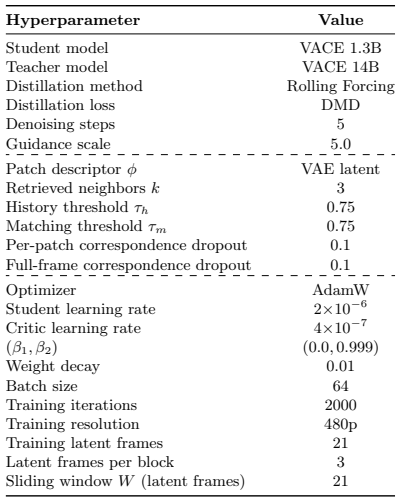
Table 9 :Training and model hyperparameters.
出典 · CC BY 4.0 · Gaurav Parmar, Zhengqi Li, Richard Zhang, Jun-Yan Zhu, Srinivasa Narasimhan, Eli Shechtman, Yotam Nitzan · Consistent Video-to-Video Translation via Explicit Correspondences · 論文の図を引用 · 元のPDFの21ページ目から図の部分を抽出しています。再訪の一貫性とV-Benchでの比較
VACE-BenchmarkのABAB構成で、Rolling Forcingの5ステップはLPIPSが0.427、DreamSimが0.172、CLIP-Simが0.905でした。同じバックボーンに対応メカニズムを加えたOurs 5ステップは、LPIPSが0.240、DreamSimが0.066、CLIP-Simが0.955でした。DL3DVでは、Rolling Forcingの5ステップのLPIPSが0.445で、Ours 5ステップは0.305でした。3つの自己回帰バックボーンにメカニズムを加えたTable 3では、VACE-BenchのLPIPSがSelf-Forcingで0.548から0.343に、LongLiveで0.511から0.272に、Rolling Forcingで0.427から0.240に下がりました。
同じ表で、Rolling ForcingのV-Bench品質平均はVACE-Benchで0.799から0.828に、DL3DVで0.806から0.821に上がっています。これらの数値は、VACE 1.3Bを基本バックボーンとし、深度条件で得られた値です。双方向のVACEベースラインとの比較では、Self-ForcingとLongLiveはVACE-Benchの長期再構成でVACEより低く、Rolling Forcingはわずかに上回りました。
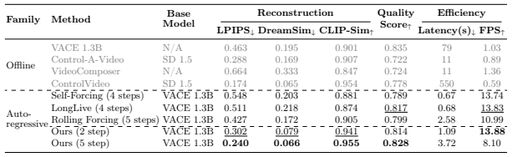
Table 1 : Quantitative evaluation on depth-to-video translation.We report long-context reconstruction metrics (LPIPS, DreamSim, CLIP-Sim), quality scores (V- Bench), and inference efficiency. Offline methods are shown in gray on the top and distillation based autoregressive methods are shown at the bottom. The best method in each column is marked in bold and the second best method is marked in underline.
出典 · CC BY 4.0 · Gaurav Parmar, Zhengqi Li, Richard Zhang, Jun-Yan Zhu, Srinivasa Narasimhan, Eli Shechtman, Yotam Nitzan · Consistent Video-to-Video Translation via Explicit Correspondences · 論文の図を引用 · 元のPDFの8ページ目から図の部分を抽出しています。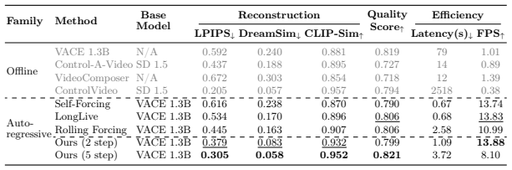
Table 2 : Quantitative evaluation on depth-to-video translation (DL3DV). We report long-context reconstruction metrics (LPIPS, DreamSim, CLIP-Sim), quality scores (V-Bench), and inference efficiency. Offline methods (gray) are shown on the top and distillation based autoregressive methods are in the bottom.The best method in each column is marked in bold and the second best method is marked in underline.
出典 · CC BY 4.0 · Gaurav Parmar, Zhengqi Li, Richard Zhang, Jun-Yan Zhu, Srinivasa Narasimhan, Eli Shechtman, Yotam Nitzan · Consistent Video-to-Video Translation via Explicit Correspondences · 論文の図を引用 · 元のPDFの9ページ目から図の部分を抽出しています。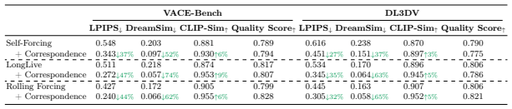
Table 3 : Sensitivity to the distillation method.Our correspondence mechanism consistently improves long-context reconstruction across all three autoregressive distil- lation methods, with minimal impact on quality. The base model used is VACE 1.3B.
出典 · CC BY 4.0 · Gaurav Parmar, Zhengqi Li, Richard Zhang, Jun-Yan Zhu, Srinivasa Narasimhan, Eli Shechtman, Yotam Nitzan · Consistent Video-to-Video Translation via Explicit Correspondences · 論文の図を引用 · 元のPDFの9ページ目から図の部分を抽出しています。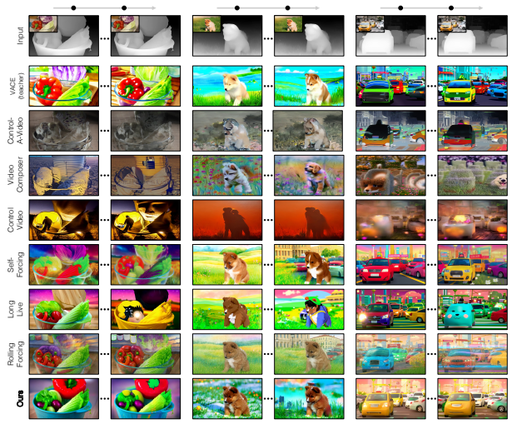
Fig.3 : Qualitative comparisons.We show two frames sampled far apart in time for three example videos (left and right). Bidirectional methods (VACE 1.3B) and Autoregressive distillation methods produce high-quality individual frames but fail to maintain object identity over long durations. Adding our correspondence mechanism preserves consistent appearance throughout the video.
出典 · CC BY 4.0 · Gaurav Parmar, Zhengqi Li, Richard Zhang, Jun-Yan Zhu, Srinivasa Narasimhan, Eli Shechtman, Yotam Nitzan · Consistent Video-to-Video Translation via Explicit Correspondences · 論文の図を引用 · 元のPDFの10ページ目から図の部分を抽出しています。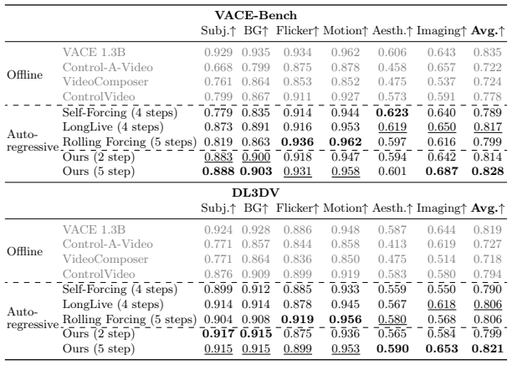
Table 12 : Per-metric V-Bench quality scores.We report individual normalized V-Bench [13] metrics for all methods on both benchmarks. The rightmost column shows the average across all six metrics (reported as the aggregate quality score in the main paper). Best among autoregressive methods isbold, second best is underlined.
出典 · CC BY 4.0 · Gaurav Parmar, Zhengqi Li, Richard Zhang, Jun-Yan Zhu, Srinivasa Narasimhan, Eli Shechtman, Yotam Nitzan · Consistent Video-to-Video Translation via Explicit Correspondences · 論文の図を引用 · 元のPDFの25ページ目から図の部分を抽出しています。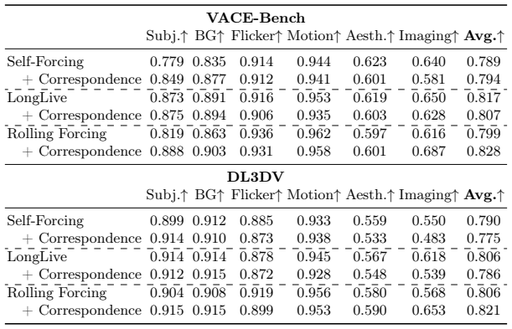
Table13 :Per-metricV-Benchqualityscoresforeachdistillationmethod.We report individual normalized V-Bench [13] metrics for each autoregressive distillation backbone with and without our correspondence mechanism. Adding correspondences maintains comparable overall visual quality across different autoregressive backbones, with some variations in individual metrics.
出典 · CC BY 4.0 · Gaurav Parmar, Zhengqi Li, Richard Zhang, Jun-Yan Zhu, Srinivasa Narasimhan, Eli Shechtman, Yotam Nitzan · Consistent Video-to-Video Translation via Explicit Correspondences · 論文の図を引用 · 元のPDFの26ページ目から図の部分を抽出しています。対応パッチの除去と代替メカニズム
対応のクロスアテンションを無効にした変種は、VACE-BenchでLPIPSが0.379、DL3DVでLPIPSが0.437でした。提案手法全体は同じ設定でそれぞれ0.240と0.305でした。品質スコアは2つの設定でほぼ同じで、VACE-Benchでは0.829対0.828、DL3DVでは0.822対0.821でした。したがってこの比較では、対応トークンは主に再構成の一貫性を変え、品質スコアはあまり変えていません。ランダム検索では、VACE-BenchのLPIPSが0.396、DL3DVのLPIPSが0.451でした。FramePackのVACE-BenchのLPIPSは0.304でした。著者らは、過去のブロックを空間的に圧縮することで細部が失われ、再構成が弱くなると解釈しています。
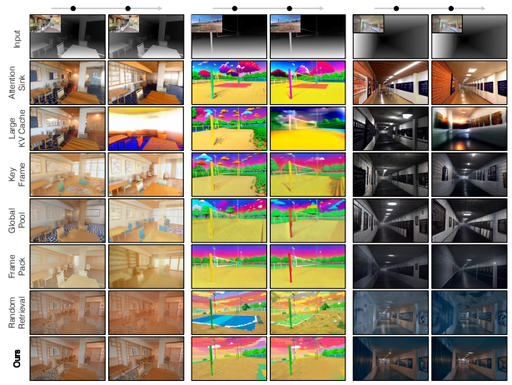
Fig.4 : Comparing to alternate consistency mechanisms.We compare different strategies for extending the temporal context beyond sliding window, including enlarg- ing the KV cache, keyframe retention, global pooling, FramePack [53] compression, and random retrieval. While these approaches provide partial improvements, they suffer for loss of details or quality degradation under long-range revisits. In contrast, our cor- respondence based method (bottom row) enables accurate reuse of historical content and preserving consistency over long time horizons.
出典 · CC BY 4.0 · Gaurav Parmar, Zhengqi Li, Richard Zhang, Jun-Yan Zhu, Srinivasa Narasimhan, Eli Shechtman, Yotam Nitzan · Consistent Video-to-Video Translation via Explicit Correspondences · 論文の図を引用 · 元のPDFの11ページ目から図の部分を抽出しています。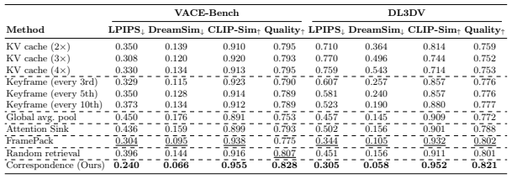
Table 4 : Comparison of alternate consistency mechanisms.We compare several strategies for extending temporal context beyond the default sliding window (W=21): increasing the KV cache window size, retaining everyN-th keyframe, maintaining a global average-pooled KV cache, Attention Sinks, and FramePack. While larger win- dows and keyframe retention provide modest reconstruction gains, our correspondence- based retrieval achieves substantially better long-range consistency.
出典 · CC BY 4.0 · Gaurav Parmar, Zhengqi Li, Richard Zhang, Jun-Yan Zhu, Srinivasa Narasimhan, Eli Shechtman, Yotam Nitzan · Consistent Video-to-Video Translation via Explicit Correspondences · 論文の図を引用 · 元のPDFの12ページ目から図の部分を抽出しています。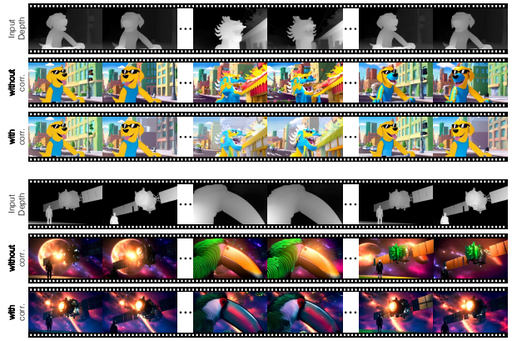
Fig.5 : Effect of correspondence pointers on long-range consistency.Without correspondence pointers, the model generates plausible but inconsistent frames. Object appearancedriftsovertime.Considerthetopexample,thedogstartsoffhavingayellow snout, but it changes to blue when it re-appears. With correspondence pointers, the model retrieves and reuses visual context from earlier frames, maintaining consistent identity throughout the video. For example in the top video, the dog snout is yellow at the beginning of the video. However it turns into a blue snout when reappearing if correspondence is not used. However it stays consistently yellow with our method.
出典 · CC BY 4.0 · Gaurav Parmar, Zhengqi Li, Richard Zhang, Jun-Yan Zhu, Srinivasa Narasimhan, Eli Shechtman, Yotam Nitzan · Consistent Video-to-Video Translation via Explicit Correspondences · 論文の図を引用 · 元のPDFの14ページ目から図の部分を抽出しています。限界と適用条件
著者らが挙げる限界は2つです。1つ目は、動きの速い映像では信頼できるフレーム間の対応を立てるのが難しく、モデルが苦戦することです。2つ目は、テキストプロンプトが入力の深度映像と合わないと、意味条件と構造条件が衝突するため失敗しうることです。提示された実験表には、速い動きだけを分けた結果はありません。実験はVACE-BenchmarkとDL3DVで、深度条件を中心に行われました。スケッチとオプティカルフローの条件は、付録で別途確認されています。メモリのサイズは新しい内容が多いほど大きくなるため、長さに関係なく一定ではありません。
論文情報
- 著者
- Gaurav Parmar, Zhengqi Li, Richard Zhang, Jun-Yan Zhu, Srinivasa Narasimhan, Eli Shechtman, Yotam Nitzan
- 学会・ジャーナル
- arXiv · プレプリント
- 公開日
- 2026年11月12日
- 登録日
- 2026年11月14日
- 更新日
- 2026年11月12日
- バージョン
- v1
- arXiv
- 2611.17298
- カテゴリ
- cs.CV · cs.AI · cs.GR · cs.LG
- ライセンス
- CC BY 4.0
- 掲載内容
- 論文情報・解説・論文の図
この解説は、Refivuの韓国語解説をAIで翻訳したものです。不正確な翻訳や誤りが含まれる可能性があります。論文と図の利用条件は各出典に従います。
アブストラクト
Interactive video-to-video applications require real-time generation while maintaining long-range temporal consistency. However, recent methods achieve speed by restricting attention to a fixed-length causal window. This limits long-range consistency whenever relevant history falls outside the context window. To address this limitation, we introduce vid2vid-long, a correspondence-based approach grounded in a simple observation. Video-to-video translation provides an explicit cross-frame reference: the regions that match in the input video should match in the output video too. Concretely, we compute patch-level correspondences in the input, guiding retrieval of previously generated outputs in the corresponding regions, and condition the model on these patches through correspondence cross-attention. Our experiments demonstrate that vid2vid-long consistently improves long-range temporal consistency across recent video models while preserving generation quality and real-time performance.
この論文を引用
Gaurav Parmar, Zhengqi Li, Richard Zhang, Jun-Yan Zhu, Srinivasa Narasimhan, Eli Shechtman, Yotam Nitzan (2026). Consistent Video-to-Video Translation via Explicit Correspondences. arXiv:2611.17298v1. https://arxiv.org/abs/2611.17298v1
BibTeX
@misc{parmar2026consistent,
  title = {{Consistent Video-to-Video Translation via Explicit Correspondences}},
  author = {Gaurav Parmar and Zhengqi Li and Richard Zhang and Jun-Yan Zhu and Srinivasa Narasimhan and Eli Shechtman and Yotam Nitzan},
  year = {2026},
  eprint = {2611.17298},
  archivePrefix = {arXiv},
  url = {https://arxiv.org/abs/2611.17298v1}
}