논문 해설
ViRA: Toward Ultra-High-Resolution Visual Agents via Cross-Input Relative Policy Optimization
ViRA: Cross-Input Relative Policy Optimization을 통한 초고해상도 시각 에이전트를 향하여
- 연구 문제 시각 에이전트는 초고해상도 사진에서 증거를 읽지 않고 상식으로 답하기 쉬우며, 최종 정답만 보는 강화학습은 이를 바로잡지 못합니다.
- 연구 방법 답이 다른 버전들로 이루어진 대조 집합을 만들고, 버전별 롤아웃 비교에 다른 버전의 정답 가중치를 곱한 CrossRPO 어드밴티지로 학습합니다.
- 주요 결과 ViRA-Bench 최대 해상도에서 CrossRPO는 집합 정확도 63.3%를 기록해 GRPO의 59.3%보다 높았습니다.
정답만 보는 강화학습의 한계
초고해상도 사진에서 질문에 답하는 시각 에이전트는 증거 영역을 확대해 읽기보다 상식으로 답하는 경우가 많습니다. 최종 정답만 보상으로 주는 강화학습에서는 증거를 읽은 답과 추측한 답이 같은 보상을 받기 때문에 이 행동을 바로잡기 어렵습니다. 한 장의 이미지에서는 추측도 정답일 수 있어 보상이 두 행동을 구별하지 못합니다.
이 논문은 한 질문에 답이 서로 다른 여러 버전의 사진을 묶은 대조 집합(contrast set)을 학습 단위로 삼습니다. 여러 버전을 모두 맞혀야만 집합을 해결하므로, 상식으로 답하는 정책은 집합 전체에서 정답을 얻기 어렵습니다.
CrossRPO의 버전별 어드밴티지
CrossRPO는 각 버전 s_v에서 n개의 롤아웃을 샘플링하고, 같은 버전 안에서 leave-one-out 차이로 어드밴티지를 계산합니다. 여기에 다른 버전들이 맞힌 확률의 곱인 교차 입력 가중치 w_v를 곱합니다. 가중치는 λ를 통해 (1+λw_v)의 형태로 작용하며, 다른 버전들이 모두 정답일수록 이 버전의 정답 롤아웃이 더 큰 신호를 받습니다.
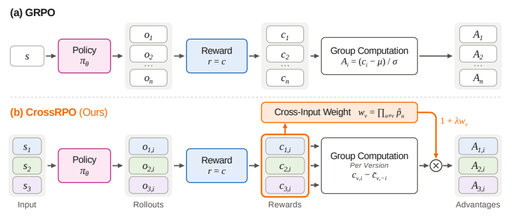
Figure 3 . GRPO and CrossRPO. The policy 𝜋𝜃 samples the rollouts, and the reward 𝑟 is the correctness 𝑐 of the answer. (a) GRPO compares the rollouts of one input 𝑠. (b) CrossRPO compares rollouts within each version 𝑠𝑣 of a set and multiplies the result by 1 + 𝜆𝑤𝑣, where 𝑤𝑣 comes from the rewards of the other versions.
원문 · CC BY 4.0 · Huawei Lin, Jinting Liu, Tongyan Wang, Xuyang Chen, Ruihua Shi, Zhichao Xu, Jiaxin Qin, Guoshenghui Zhao, Baijian Yang, Yingjie Victor Chen, Tan Yu, Weijie Zhao · ViRA: Toward Ultra-High-Resolution Visual Agents via Cross-Input Relative Policy Optimization · 원문 그림 인용 · 원본 PDF 6쪽에서 그림 영역을 추출했습니다.목적함수는 버전별 정확도의 합에 λ와 모든 버전 정확도의 곱을 더한 형태입니다. 논문은 K≤3에서 곱 항이 집합 정확도와 같다고 설명합니다. 이 항은 한 버전만 맞히고 다른 버전은 틀리는 추측에는 공동 신호를 주지 않도록 설계되었습니다. 배치 단위의 제곱평균제곱근으로 어드밴티지를 나누는 것도 함께 쓰며, 이는 배치 내 비율을 유지하면서 스텝 길이만 바꿉니다.
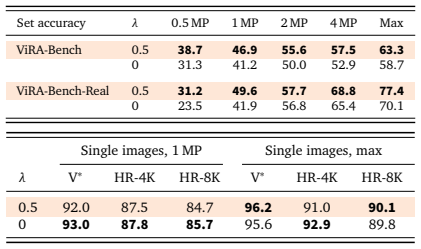
Table 9 .Effect of the joint term. CrossRPO (𝜆= 0.5, ViRA-9B) is compared with one group per image (𝜆= 0), and both are trained from Qwen3.5-9B for 227 steps. Top: set accuracy (%) on ViRA-Bench (762 sets) and ViRA-Bench-Real (78 photographed sets). Bottom: accuracy (%) on the general benchmarks V∗ (191 questions) and HR-Bench (800 each). All numbers are means of three evaluation runs. As Propositions A.38 and A.40 predict, the gain appears on sets and not on single images.
원문 · CC BY 4.0 · Huawei Lin, Jinting Liu, Tongyan Wang, Xuyang Chen, Ruihua Shi, Zhichao Xu, Jiaxin Qin, Guoshenghui Zhao, Baijian Yang, Yingjie Victor Chen, Tan Yu, Weijie Zhao · ViRA: Toward Ultra-High-Resolution Visual Agents via Cross-Input Relative Policy Optimization · 원문 그림 인용 · 원본 PDF 42쪽에서 그림 영역을 추출했습니다.ViRA-Bench와 ViRA-Train 구성
대조 집합은 Wikimedia Commons 사진에서 한 객체를 편집해 만들었습니다. 편집된 객체는 전체 사진의 중앙값 0.0075% 정도로 작아서 추론 시 확대가 필요합니다. ViRA-Bench는 762개 집합이며 각 집합은 세 버전으로 구성됩니다. ViRA-Train은 6,457개 대조 집합과 2,804개 단일 이미지로 이루어진 학습 데이터입니다.
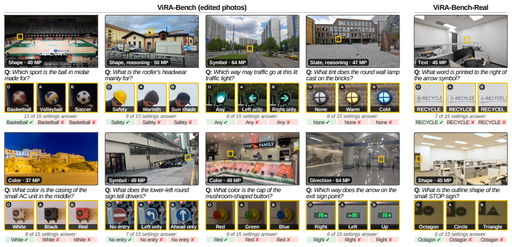
Figure 2 . Examples of ViRA-Bench and ViRA-Bench-Real.Each set shows the original photo (O, cut to 16:9) with the object in a yellow box. The insets show the object in O and the two variants (A, B), with the correct answers. Below each set are the original’s answer and the number of baseline settings, out of 15 (Appendix D.1), that give this answer to all three versions at 1MP. Questions are shortened.
원문 · CC BY 4.0 · Huawei Lin, Jinting Liu, Tongyan Wang, Xuyang Chen, Ruihua Shi, Zhichao Xu, Jiaxin Qin, Guoshenghui Zhao, Baijian Yang, Yingjie Victor Chen, Tan Yu, Weijie Zhao · ViRA: Toward Ultra-High-Resolution Visual Agents via Cross-Input Relative Policy Optimization · 원문 그림 인용 · 원본 PDF 3쪽에서 그림 영역을 추출했습니다.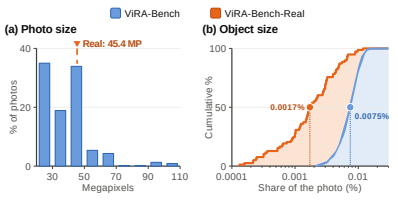
Figure 4 . Statistics of ViRA-Bench and ViRA-Bench- Real.(a) Size of the 466 ViRA-Bench photos, and every ViRA-Bench-Real photo has 45.4MP. (b) Cumulative distribution of the object’s area as a share of the photo, with dots at the medians.
원문 · CC BY 4.0 · Huawei Lin, Jinting Liu, Tongyan Wang, Xuyang Chen, Ruihua Shi, Zhichao Xu, Jiaxin Qin, Guoshenghui Zhao, Baijian Yang, Yingjie Victor Chen, Tan Yu, Weijie Zhao · ViRA: Toward Ultra-High-Resolution Visual Agents via Cross-Input Relative Policy Optimization · 원문 그림 인용 · 원본 PDF 8쪽에서 그림 영역을 추출했습니다.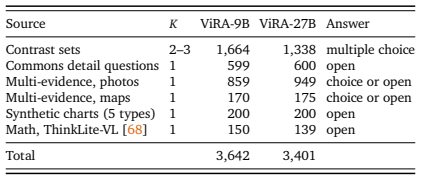
Table 13 .Training data of ViRA-9B and ViRA-27B: number of items per source. Math: 70 geometry, 40 table and 40 arithmetic problems for ViRA-9B, and 70, 29 and 40 for ViRA-27B.𝐾: number of versions of an item. Answer: form of its answer.
원문 · CC BY 4.0 · Huawei Lin, Jinting Liu, Tongyan Wang, Xuyang Chen, Ruihua Shi, Zhichao Xu, Jiaxin Qin, Guoshenghui Zhao, Baijian Yang, Yingjie Victor Chen, Tan Yu, Weijie Zhao · ViRA: Toward Ultra-High-Resolution Visual Agents via Cross-Input Relative Policy Optimization · 원문 그림 인용 · 원본 PDF 48쪽에서 그림 영역을 추출했습니다.편집 흔적이 첫 확대 위치를 안내하지 않는지 점검하기 위해, 원본과 편집 버전에서 첫 확대가 객체를 덮는 비율을 비교했습니다. 편집 버전과 원본의 차이는 대부분 2.4퍼센트포인트 이하였다고 기록되었습니다. ViRA-Bench-Real은 편집 없이 촬영한 78개 집합입니다.
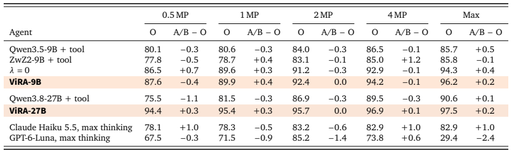
Table 12 . Editing traces and the first zoomon ViRA-Bench (762 sets). For each budget, the first column gives the share (%) of original (O) images whose first zoom covers the object, and the second gives the share on the variants (A, B) minus the share on O, in points. The three versions share the question and the position of the object, and only A and B are edited. ViRA and𝜆= 0are means of three evaluation runs. Claude Haiku 5.5 takes at most 3.8MP, so its 4MP columns repeat its max columns.
원문 · CC BY 4.0 · Huawei Lin, Jinting Liu, Tongyan Wang, Xuyang Chen, Ruihua Shi, Zhichao Xu, Jiaxin Qin, Guoshenghui Zhao, Baijian Yang, Yingjie Victor Chen, Tan Yu, Weijie Zhao · ViRA: Toward Ultra-High-Resolution Visual Agents via Cross-Input Relative Policy Optimization · 원문 그림 인용 · 원본 PDF 47쪽에서 그림 영역을 추출했습니다.집합 정확도 비교 결과
ViRA-Bench 최대 해상도에서 CrossRPO는 집합 정확도 63.3%를 기록했습니다. 같은 데이터와 보상으로 학습한 GRPO는 59.3%, 풀링(pooled) GRPO는 52.6%였습니다. 버전별로 따로 학습한 λ=0 설정은 58.7%였습니다. 학습에 쓴 모델은 Qwen3.5-9B와 Qwen3.8-27B이며 λ=0.5를 사용했습니다.

Table 3 . Ablations: set accuracy (%) on ViRA-Bench and ViRA-Bench-Real, and accuracy (%) on the general benchmarks. The column heads are pixel budgets in MP, andMaxis the maximum resolution. All models are trained from Qwen3.5-9B. Results on ViRA-Bench, ViRA-Bench-Real are means of three runs.
원문 · CC BY 4.0 · Huawei Lin, Jinting Liu, Tongyan Wang, Xuyang Chen, Ruihua Shi, Zhichao Xu, Jiaxin Qin, Guoshenghui Zhao, Baijian Yang, Yingjie Victor Chen, Tan Yu, Weijie Zhao · ViRA: Toward Ultra-High-Resolution Visual Agents via Cross-Input Relative Policy Optimization · 원문 그림 인용 · 원본 PDF 11쪽에서 그림 영역을 추출했습니다.ViRA-27B는 최대 해상도 평가에서 독점 모델 Claude Haiku 5.5와 GPT-6-Luna보다 높은 집합 정확도를 보였습니다. 표 값은 저자의 세 번 실행 평균이며 독점 모델은 같은 도구를 API로 호출한 설정입니다. 텍스트 대조 집합 실험에서는 K=4, 8, 16에서도 CrossRPO가 평균적으로 더 많은 집합을 맞혔습니다.
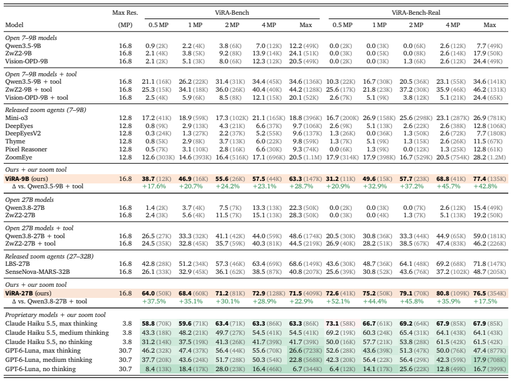
Table 1 . Set accuracy (%)at five pixel budgets, with the tokens per set in gray.Max: each model’s maximum resolution (Max Res.), which also caps the other budgets.Δ: gain of ViRA over its base model with a zoom tool. Green and red cells: ViRA-27B is more or less accurate than the proprietary model. Bold: best in each group. ViRA results are means of three runs. Tables 16 and 17 give the per-image accuracy and the ablations, and Appendix E gives the protocol.
원문 · CC BY 4.0 · Huawei Lin, Jinting Liu, Tongyan Wang, Xuyang Chen, Ruihua Shi, Zhichao Xu, Jiaxin Qin, Guoshenghui Zhao, Baijian Yang, Yingjie Victor Chen, Tan Yu, Weijie Zhao · ViRA: Toward Ultra-High-Resolution Visual Agents via Cross-Input Relative Policy Optimization · 원문 그림 인용 · 원본 PDF 9쪽에서 그림 영역을 추출했습니다.
Table 5 . Text sets with𝐾 versions(ConFiQA, Qwen3.5-9B): accuracy (%) on the test questions at the𝐾 used in training. For𝐾 > 3, the joint term of CrossRPO uses pairs of other versions (Eq. (15)). Each method is trained three times with different random seeds, and each run is evaluated three times. Cells give the mean and the standard deviation over the three training runs. Bold: best in each row and group.
원문 · CC BY 4.0 · Huawei Lin, Jinting Liu, Tongyan Wang, Xuyang Chen, Ruihua Shi, Zhichao Xu, Jiaxin Qin, Guoshenghui Zhao, Baijian Yang, Yingjie Victor Chen, Tan Yu, Weijie Zhao · ViRA: Toward Ultra-High-Resolution Visual Agents via Cross-Input Relative Policy Optimization · 원문 그림 인용 · 원본 PDF 14쪽에서 그림 영역을 추출했습니다.데이터와 적용 범위의 한계
ViRA-Bench는 편집으로 만든 사진이므로 편집 흔적이 객체 내부 정보로 답에 영향을 줄 수 있습니다. ViRA-Bench-Real은 편집이 없지만 78개 집합뿐이며 실내에서 한 카메라로 촬영되었고 주로 포스터, 표지판, 스티커, 라벨을 담고 있습니다. 질문에는 객체가 어디 있는지에 대한 설명도 들어 있어 실제보다 탐색이 쉬울 수 있습니다.
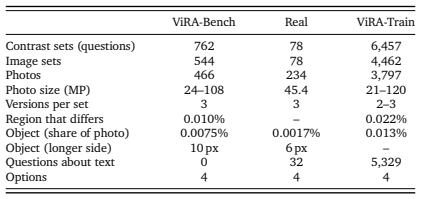
Table 11 .Dataset statistics (medians for the region and the object; the region and the object’s share are percentages of the photo, and its longer side is measured at 1MP). Real: ViRA-Bench-Real. An image set is one object with its versions, and two questions can share one image set.
원문 · CC BY 4.0 · Huawei Lin, Jinting Liu, Tongyan Wang, Xuyang Chen, Ruihua Shi, Zhichao Xu, Jiaxin Qin, Guoshenghui Zhao, Baijian Yang, Yingjie Victor Chen, Tan Yu, Weijie Zhao · ViRA: Toward Ultra-High-Resolution Visual Agents via Cross-Input Relative Policy Optimization · 원문 그림 인용 · 원본 PDF 47쪽에서 그림 영역을 추출했습니다.텍스트 실험은 한 기반 모델에서 3,000개 미만의 질문으로 수행되었습니다. 이 결과는 결합 항이 텍스트로도 옮겨질 수 있음을 보이지만, 그 규모에서 얻을 수 있는 정확도 수준까지 보여 주지는 않습니다. 논문은 이미지 집합의 버전이 최대 세 개라는 제약도 밝히고 있습니다.
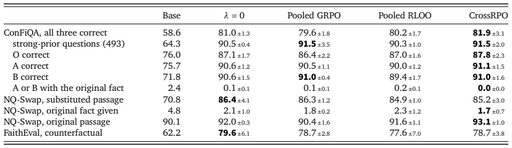
Table 4 . Text contrast sets(ConFiQA,𝐾= 3, Qwen3.5-9B): accuracy (%) and the rate of answering with the original fact (lower is better). NQ-Swap and FaithEval were not trained on. Strong-prior questions: the base model answers them correctly without the passage. Each method is trained three times with different random seeds, and each run and the base model are evaluated three times. Cells give the mean and the standard deviation over the three training runs. Bold: best in each row.
원문 · CC BY 4.0 · Huawei Lin, Jinting Liu, Tongyan Wang, Xuyang Chen, Ruihua Shi, Zhichao Xu, Jiaxin Qin, Guoshenghui Zhao, Baijian Yang, Yingjie Victor Chen, Tan Yu, Weijie Zhao · ViRA: Toward Ultra-High-Resolution Visual Agents via Cross-Input Relative Policy Optimization · 원문 그림 인용 · 원본 PDF 14쪽에서 그림 영역을 추출했습니다.논문 정보
- 저자
- Huawei Lin, Jinting Liu, Tongyan Wang, Xuyang Chen, Ruihua Shi, Zhichao Xu, Jiaxin Qin, Guoshenghui Zhao, Baijian Yang, Yingjie Victor Chen, Tan Yu, Weijie Zhao
- 학회·저널
- arXiv · 프리프린트
- 최초 공개일
- 2026년 11월 16일
- 등록일
- 2026년 11월 18일
- 수정일
- 2026년 11월 16일
- 버전
- v1
- arXiv
- 2611.21605
- 분류
- cs.CV · cs.AI
- 원문 이용 조건
- CC BY 4.0
- 제공 범위
- 논문 정보, 해설, 허용된 원문 그림
AI 해설은 논문 원문과 별개의 설명이며 오류가 있을 수 있습니다. 원문과 그림은 각 출처의 이용 조건과 따로 표시된 권리를 따릅니다.
초록
Visual agents answer questions about ultra-high-resolution photos by zooming into the relevant regions. However, existing agents often answer from common sense instead of reading the evidence. Reinforcement learning (RL) on the final answer cannot correct this, because a guess earns the same reward as reading. We propose Cross-Input Relative Policy Optimization (CrossRPO), which trains agents on contrast sets. A contrast set asks one question about several versions of an image that differ only in a small region with the evidence and have different answers, so only reading the evidence solves the whole set. CrossRPO rewards solving the whole set, and we prove that it does not reinforce a set answered from common sense. We build contrast sets for training (ViRA-Train) and evaluation (ViRA-Bench) by editing one small object in images of 21 to 120 megapixels, and we photograph further sets with real changes (ViRA-Bench-Real) to exclude editing traces. We train two Visual Reasoning Agents, ViRA-9B and ViRA-27B, with CrossRPO on only about 3,500 items of ViRA-Train each. CrossRPO achieves 63.3% set accuracy on ViRA-Bench at the maximum resolution, against 59.3% for GRPO. ViRA-9B is the most accurate open model of its size on all benchmarks, and ViRA-27B outperforms Claude Haiku 5.5 and GPT-6-Luna, both at their highest thinking level, on most benchmarks.
원문 인용
Huawei Lin, Jinting Liu, Tongyan Wang, Xuyang Chen, Ruihua Shi, Zhichao Xu, Jiaxin Qin, Guoshenghui Zhao, Baijian Yang, Yingjie Victor Chen, Tan Yu, Weijie Zhao (2026). ViRA: Toward Ultra-High-Resolution Visual Agents via Cross-Input Relative Policy Optimization. arXiv:2611.21605v1. https://arxiv.org/abs/2611.21605v1
BibTeX
@misc{lin2026vira,
  title = {{ViRA: Toward Ultra-High-Resolution Visual Agents via Cross-Input Relative Policy Optimization}},
  author = {Huawei Lin and Jinting Liu and Tongyan Wang and Xuyang Chen and Ruihua Shi and Zhichao Xu and Jiaxin Qin and Guoshenghui Zhao and Baijian Yang and Yingjie Victor Chen and Tan Yu and Weijie Zhao},
  year = {2026},
  eprint = {2611.21605},
  archivePrefix = {arXiv},
  url = {https://arxiv.org/abs/2611.21605v1}
}