Paper commentary
CertiSum: Bitwise-Identical MXFP4 Training Across Platforms and Parallelism Layouts
- Problem MXFP4 training changes bits when the parallelism layout, the GPU vendor or the kernel choice changes, and the existing fixes either leave out hardware invariance or cost several times the runtime of native execution.
- Method CertiSum checks at run time whether native FP32 accumulation of MXFP4 products is exact, using row, block and tight bounds, recomputes uncertified outputs exactly and merges partial sums without rounding.
- Results Training losses matched bit for bit between AMD MI350X and NVIDIA GB200 for 200 steps on FineWeb-Edu and The Stack v3 with one GPU and TP4, and CertiSum added 11.8–60.5% latency over its MXFP4 twin at the larger input shapes.
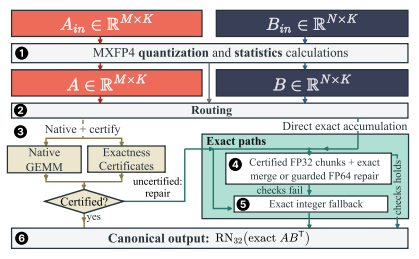
Figure 3 . CertiSum GEMM execution; steps ❶–❻ described in §4.
Original paper · CC BY 4.0 · Steve Rhyner, Yubo Gao, Stefan de Lasa, Sankeerth Durvasula, Nandita Vijaykumar · CertiSum: Bitwise-Identical MXFP4 Training Across Platforms and Parallelism Layouts · Original paper figure · Extracted the figure area from page 5 of the original PDF.Why MXFP4 training is not reproducible
The order in which a reduction adds its terms changes the rounded result, because floating-point addition is not associative. That order is set by the parallelism layout: data, tensor and context parallelism split reductions across GPUs, and kernels split them again across streaming multiprocessors. Atomic additions in the attention backward pass and kernel choices made by autotuners add further variation.
MXFP4 amplifies this sensitivity. In the Qwen3-8B-Base comparison, moving from 2 to 4 GPUs with tensor parallelism changed 18× more output tokens under MXFP4 than under BF16. Reinforcement learning with separate inference and training engines, and training audits that re-execute a published run, both depend on this kind of bit-level reproducibility.
Vendors also round low-precision GEMM intermediates differently, so fixing the summation order alone cannot give identical bits across GPU vendors.
Table 1 places prior systems against the invariances CertiSum targets. Order-fixing systems keep run-to-run and sometimes batch or TP invariance but not hardware invariance. Cross-hardware replay reaches hardware invariance at 5.2–6.8× the runtime of BF16 training in prior work. Order-free summation covers all three invariances but at up to 16× the latency of a non-reproducible GEMM.
When exact accumulation is needed
CertiSum starts from the observation that MXFP4 elements carry few significand bits under a shared block scale, so exact accumulation is usually cheap to certify. The remaining outputs need more bits and are the ones that must be handled differently.
Each nonzero row is written in a common power-of-two unit λ, so each element becomes an integer multiple of that unit, with x_k = λ_x a_k and y_k = λ_y b_k. If the sum of absolute integer products, T, stays below the 24-bit limit, every partial sum of the dot product fits in FP32 whatever the reduction tree.
It assumes native kernels that zero-initialize each accumulator, pass exactly representable products and sums unchanged, and apply the final conversion without a BF16 intermediate rounding.
Computing T directly needs the K products of every output, so CertiSum collects row statistics during quantization: the sum of absolute values L_v, the maximum absolute value M_v and the sum of squares Q_v. These give the row bound, an upper bound on T built from the minimum of three expressions. \[ B_{\text{row}} = \min\left\{ L_a M_b,\; M_a L_b,\; \sqrt{Q_a Q_b} \right\} \]
When the row bound fails, block bounds apply the same three expressions to 32-element blocks along K, sum each expression over the blocks and take the minimum of the three sums.
The statistics, products, accumulation and output conversion all round, so each bound is evaluated conservatively.
Recomputing uncertified outputs and merging exactly
An output that fails certification is recomputed from the same quantized operands by one of three routes. The first splits the reduction into chunks that pass the native check, sums each chunk natively and merges the chunk sums exactly. The second accumulates the products in FP64 when a capacity check confirms that no partial sum rounds. The third, the integer path, accumulates in multi-word integers in a superaccumulator and serves as the fallback when the other two fail.
\[ Z_r = \sum_{k \in J_r} a_k b_k, \qquad c_{32} = RN_{32}\!\left( \lambda \sum_r Z_r \right) \]
A capacity check bounds the sum of the absolute partial values for a signed int32 accumulator or for an FP64 accumulator, so none of the additions rounds. Integer addition is associative and commutative, so the outcome is the same for any partition size, merge order or reduction tree.
Holding the products fixed across layouts
Exact merging only helps if every layout sums the same products, and the MX block an element belongs to sets its scale. If blocks were formed inside each device's shard, the shard layout would change scales and products, so CertiSum assigns blocks by global tensor positions, including the token-dimension blocks used for weight-gradient operands.
Attention merges partial sums across key partitions and ends with a division, so the numerator and the denominator are both merged exactly before a single rounding. For query i and key j, with quantized unnormalized weight w_ij and value vector v_ij, the output is formed as follows, with masked or pruned keys having w_ij = 0.
Execution route for one GEMM
Activation quantization produces the MXFP4 elements, block scales and certificate statistics together, so the operand reads needed for quantization are reused. Weight statistics are cached between optimizer updates, since weights change only at those updates.
Outputs left uncertified go to repair. Failing certification does not show that a value is wrong, and in-stream repair reads flags stored on the GPU and returns at once when no repair is needed. The chunked native and FP64 paths handle most repairs, the integer path can also be selected directly, and the certified or exact result supplies the GEMM output.
Cross-platform and elastic training results
The cross-platform test trains Qwen3-8B-Base for 200 AdamW steps on FineWeb-Edu and The Stack v3. Each run starts from identical model and optimizer states and consumes identical token batches in the same order, on AMD MI350X and NVIDIA GB200 with one GPU and with TP4 on each platform. The vendor MXFP4 baseline serves as the comparison.
The vendor baseline differs between AMD and NVIDIA from step 0 onward, with median relative loss differences of 0.75% on FineWeb-Edu and 1.19% on The Stack v3, reaching 13.34% and 20.10%.
The elastic test changes layout every 40 steps, following 1 GPU, DP4, CP2, TP4 and DP2 on AMD MI350X with a global batch of 4×4096. Each segment resumes from checkpoints, and the one-GPU controls resume at the same boundaries while staying on one GPU, so checkpointing is separated from the layout changes.
The non-exact MXFP4 twin diverges at step 41, after the first layout change, and stays different thereafter, reaching 4.2% on FineWeb-Edu and 3.0% on The Stack v3. Both one-GPU controls reproduce the uninterrupted loss bits, so checkpointing alone does not explain the twin's divergence.
Inference tokens under batching and tensor parallelism
The MXFP4 twin matches 31 of 32 sequences with batch 4 on one GPU and 0 of 32 with TP4, while deterministic BF16 matches 29 and 25.
Training-step latency overhead
At the larger shapes, 4×4096 and 1×16384, CertiSum adds 11.8–60.5% latency over the MXFP4 twin.
Against the faster ordinary BF16 reference at these shapes, CertiSum's latency is 0.81–1.00×, a speedup of up to 1.24×. Qwen3-14B-Base with TP4 nearly matches that reference, at 992.3 ms against 994.6 ms.
At smaller shapes, the overhead over the twin is 15.4–77.3%, and the advantage over ordinary BF16 can reverse. The authors attribute the reversal to fixed per-GEMM costs of certification and routing, which become a larger share of the step as the GEMMs shrink.
Where the traced runtime goes
Moving from FineWeb-Edu to The Stack v3 raised CertiSum's traced step time by 16–22%, while the twin and BF16 changed by less than 0.5%.
The traces include profiling overhead, so these durations are not the untraced latencies reported in the overhead section.
Limitations
Latency overhead is largest at smaller input shapes, where CertiSum can run slower than ordinary BF16. The overhead study runs only on AMD MI350X with FineWeb-Edu.
The cross-vendor check covers one model, Qwen3-8B-Base, for 200 steps, with one GPU and TP4 on each platform.
The 99.2% figure comes from GEMM outputs of Qwen3-8B-Base over 200 steps on FineWeb-Edu, so it does not establish the same share for other models or datasets. The authors note that MXFP6, NVFP4 and MXFP8 would need format-specific bounds and kernels, and the paper does not implement them.
Paper info
- Authors
- Steve Rhyner, Yubo Gao, Stefan de Lasa, Sankeerth Durvasula, Nandita Vijaykumar
- Venue
- arXiv · Preprint
- First published
- 2026-11-16
- Added
- 2026-11-18
- Updated
- 2026-11-16
- Version
- v1
- arXiv
- 2611.21584
- Category
- cs.LG · cs.DC
- Original paper terms
- CC BY 4.0
- What we show
- Paper info, commentary and permitted figures from the original paper
AI commentary is a separate explanation from the original paper and may contain errors. The original paper and figures follow each source's terms of use and any rights noted separately.
Abstract
Training with MXFP4, a 4-bit microscaling format, is non-deterministic: identical inputs can produce different results across parallelism layouts and GPU vendors. These differences complicate debugging and training audits and can cause training and inference engines to disagree. We present CertiSum to make MXFP4 training bitwise invariant across runs, parallelism layouts, and GPU vendors. Its key insight is that native FP32 accumulation of MXFP4 products is often already exact for every summation order. CertiSum collects statistics during quantization to certify native matrix multiplication results, recomputes uncertified outputs exactly, and uses exact kernels directly where certification rarely succeeds. CertiSum keeps quantization blocks unchanged across layouts and merges partial sums without rounding, including in attention and weight-gradient computation. In 200-step Qwen3-8B-Base experiments, CertiSum preserves training states bit for bit across AMD MI350X and NVIDIA GB200 and across changes in data, tensor, and context parallelism on MI350X. Across three 8B--14B models on FineWeb-Edu using MI350X, it adds 11.8--60.5% to training-step latency relative to its non-exact MXFP4 counterpart at the larger evaluated input shapes, with speedups of up to $1.24\times$ over BF16 and $1.70\times$ over deterministic BF16.
Quote from the paper
Steve Rhyner, Yubo Gao, Stefan de Lasa, Sankeerth Durvasula, Nandita Vijaykumar (2026). CertiSum: Bitwise-Identical MXFP4 Training Across Platforms and Parallelism Layouts. arXiv:2611.21584v1. https://arxiv.org/abs/2611.21584v1
BibTeX
@misc{rhyner2026certisum,
  title = {{CertiSum: Bitwise-Identical MXFP4 Training Across Platforms and Parallelism Layouts}},
  author = {Steve Rhyner and Yubo Gao and Stefan de Lasa and Sankeerth Durvasula and Nandita Vijaykumar},
  year = {2026},
  eprint = {2611.21584},
  archivePrefix = {arXiv},
  url = {https://arxiv.org/abs/2611.21584v1}
}