Paper commentary
Taking Apart and Putting Together: Tracking Objects Through Physical Transformations
TIPO tracks objects through splits and merges without extra training
- Problem Foundation trackers like SAM 2 keep one identity through motion but cannot revise it when an object splits or merges. Prior work handles only disassemblies, and its searches run only after tracking fails.
- Method TIPO is a training-free framework that generates split and merge proposals from the current frame's masks. It scores them by overlap, then asks an MLLM Judge to verify the top candidate and an MLLM Labeler to name it.
- Results On the VISTA benchmark, TIPO scored 44.7 TF1 with SAM 2.1, compared to 12.5 for TubeletGraph.
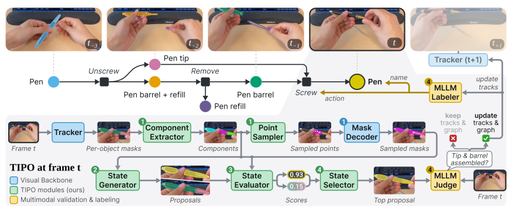
Figure 2 .Overview of TIPO.At each frame It, the tracker provides the set of per-object masks. The pipeline operates in four stages(1–4): (1)extraction of the disjoint components and mask sampling,(2)generation of all possible assembly and disassembly states,(3)evaluation of the state proposals based on mask overlap metrics,(4)validation of the highest-scoring proposal by the MLLM Judge and semantic labeling. Lastly, the state graph and the tracker are updated with the validated state.
Original paper · CC BY 4.0 · Davide Gardenal, Mingxuan Liu, Flavio Vella, Quentin Guimard, Elisa Ricci · Taking Apart and Putting Together: Tracking Objects Through Physical Transformations · Original paper figure · Extracted the figure area from page 3 of the original PDF.Why trackers lose identity at a split
Take a Moka pot apart and the collector comes off, the filter is pulled out, and one object becomes three within seconds. Foundation trackers such as SAM 2 are built to keep one entity alive through complex motion. They have no mechanism to revise an identity when the object divides or merges, so in the authors' example SAM 2.1 either keeps one ID across the split or drops the fragments.
TubeletGraph handles isolated splits, but it has three limits for the full task. Its search for parts starts only after track loss, so it misses the initial split and detects only later fragments. It is also restricted to disassemblies, and it tracks dense candidate regions across the scene, which the authors' numbers put at 0.2 FPS with SAM 2.1.
The task therefore needs a system that tracks objects through transformations and keeps part-whole links up to date.
How TIPO reads splits from the current frame
The key idea is that a split or merge is already visible in the frame being processed, because the tracked mask breaks into disconnected pieces. So TIPO doesn't scan back through the video to recover lost parts, and the authors argue that this keeps it fast. It runs a generate, evaluate and judge pipeline at every frame, with no additional training.
The first step splits each tracked mask into spatially disjoint components using Parallel Union-Find. A point sampler then prompts the mask decoder with a single random point per query, and 32 such queries per component are merged into one sampled mask. Generation enumerates every partition of a object's components as a disassembly candidate, and every partition of the tracked objects as an assembly candidate.
Evaluation scores these candidates, and the highest-scoring one above the threshold moves on to validation.
Because random sampling can produce high-scoring false positives, the MLLM Judge checks the selected candidate. It sees historical frames sampled 5s, 3s and 1s before, plus the current frame with the proposed regions outlined. If the Judge confirms the change, the MLLM Labeler names the new objects and the action, and the tracker and graph are updated.
Calling the MLLM only on the top candidate keeps the number of expensive queries small.
Why inner and external recall are both needed
Each candidate gets a score that multiplies an inner term by one minus an external term, group by group. Inner recall asks whether each sampled mask covers the whole group, so a group that really is one object scores high. External recall asks how much a group's sampled masks leak into components that belong to other groups, and the score penalizes that leak.
For a disassembly, the inner term compares each sampled mask against the union of the group's components, which stops a few tiny outliers from skewing the value. For an assembly, the inner term multiplies each mask's recall against every other sampled mask in the group, so the decoder has to agree on one object whichever part is prompted.
Assemblies use sampled masks rather than tracks, because a tracker may follow only part of a newly merged object, and that would make both terms unreliable.
What VISTA adds and how it is scored
VISTA contains 50 sequences with 124 assembly events and 132 disassembly events, drawn from more than 26,000 frames. Its videos come from Assembly101, IKEA ASM and custom recordings, and it more than doubles the annotated transformations of VOST-TAS, which has 108.
The authors argue that VOST-TAS annotates only the resulting parts, so it can't check which object transformed. Because the recall-based scores then reward over-prediction, the metric favours methods that make more guesses. On VOST-TAS, AlwaysPredict makes 14× to 15× more transformations than TubeletGraph, against a ground truth of 108 transformations.
TF1 counts a match only when the input and output object counts agree, the temporal boundaries are correct, and object-level IoU is above 0.5. Jtr is the average IoU over the final 25% of frames, which measures how well tracks survive transformations. HF1 adds semantic matching of object names and action labels, so it scores the fully labeled graph.
TIPO against TubeletGraph and the baselines
With SAM 2.1, TIPO scored 44.7 TF1 on VISTA, compared to 12.5 for TubeletGraph. With SAM 3 the gap is wider: TIPO scored 42.5 TF1, compared to 3.3 for TubeletGraph. The authors attribute part of the tracking gain to native handling of assemblies and to avoiding heavy temporal search, which raises Jtr by 5.2 points with SAM 2.1.
The price is speed: full TIPO runs at 1.8 FPS with SAM 2.1, compared to 0.2 for TubeletGraph. The judge-free variant runs at 3.0 FPS in the same setting, so the Judge adds cost. Across the two trackers, the authors report TIPO as 6× to 15× faster than TubeletGraph.
AlwaysPredict keeps strong tracking, with J at 90.3 on SAM 2.1, but reaches only 9.1 TF1. It also drops tracking below vanilla SAM and runs 2.0× and 2.4× slower.
The disassembly-only split
To match TubeletGraph's abilities, the authors kept all 132 disassemblies and dropped the assemblies, leaving 41 clips. TIPO with SAM 2.1 scores 39.8 TF1 here, 14.2 points ahead.
With SAM 3 the gap grows to 45.3 points. Even TIPO without the Judge keeps gains of 11.9 and 41.9 points over TubeletGraph, with SAM 2.1 and SAM 3 respectively. The authors read this as showing that the advantage comes from per-frame proposal evaluation, not only from handling assemblies. The split has no assemblies, so it says nothing about assembly accuracy.
Which design choices carry the result
Sampling four points per component instead of one lowers TF1 by 11.7 with the Judge and by 11.3 without it. The authors explain that extra points force the decoder onto the sampled component, which removes the ambiguity that lets SAM choose the whole object. The setting is SAM 3 with Qwen 3.5 35B as the Judge, the default for this table.
The authors' example is a hand holding a pen, where a split into two components scores as high as the intact pen under inner recall alone. External recall penalizes each part leaking into the other, which is why it stays in the score.
Adding the MLLM Judge raises TF1 by 8.0 to 9.1 points across the two trackers. The judge-free configuration still exceeds 33.0 TF1, which the authors present as the option for strict compute budgets.
Limits and open checks
Each event is capped at seven items, while VISTA's most complex assembly has two inputs and its most complex disassembly has three outputs. Going beyond that cap grows the search quickly, since the partition count follows the Bell numbers, and the authors report 877 proposals at the bound.
The judge-free threshold of 0.8 was chosen by repeated cross-validation over the 50 VISTA sequences, because VISTA has no separate validation split. The value 0.8 was picked in 97 of 100 folds, though the folds still come from the benchmark the numbers are reported on.
The default labeler is the closed-source GPT-5.4, and the open-weight pipeline is covered only in the appendix.
Paper info
- Authors
- Davide Gardenal, Mingxuan Liu, Flavio Vella, Quentin Guimard, Elisa Ricci
- Venue
- arXiv · Preprint
- First published
- 2026-11-20
- Added
- 2026-11-23
- Updated
- 2026-11-20
- Version
- v1
- arXiv
- 2611.27398
- Category
- cs.CV · cs.AI
- Original paper terms
- CC BY 4.0
- What we show
- Paper info, commentary and permitted figures from the original paper
AI commentary is a separate explanation from the original paper and may contain errors. The original paper and figures follow each source's terms of use and any rights noted separately.
Abstract
We introduce Transformation Tracking and Understanding (TTU), extending video object tracking to environments where objects undergo physical assemblies and disassemblies. TTU requires continuously tracking objects through transformations, identifying new entities, maintaining a state graph of their relationships, and assigning semantic labels to transformations. While foundation models (e.g., SAM 2/3) maintain tracklets through appearance changes, they cannot update semantic identities as objects physically evolve. Prior work addresses only disassemblies, relying on expensive searches triggered only when tracking fails. We propose Tracking Instances via Proposals and Overlaps (TIPO), a training-free framework that continuously infers transformations via a generate-evaluate-judge pipeline. TIPO generates split and merge proposals from disjoint mask components, scores them against mask-decoder priors using inner and external overlap, and queries an MLLM on the top proposal for visual verification and semantic labeling. To benchmark TTU, we curate Video Instances, States, and Transformation Annotations (VISTA), a dataset including state graphs with 124 assembly and 132 disassembly events across 50 sequences and over 26,000 frames. TIPO achieves state-of-the-art tracking and state-graph accuracy on VISTA, while operating $6\times$ to $15\times$ faster than prior methods. Project page: https://davidegardenal.github.io/tipo-tracking
Quote from the paper
Davide Gardenal, Mingxuan Liu, Flavio Vella, Quentin Guimard, Elisa Ricci (2026). Taking Apart and Putting Together: Tracking Objects Through Physical Transformations. arXiv:2611.27398v1. https://arxiv.org/abs/2611.27398v1
BibTeX
@misc{gardenal2026taking,
  title = {{Taking Apart and Putting Together: Tracking Objects Through Physical Transformations}},
  author = {Davide Gardenal and Mingxuan Liu and Flavio Vella and Quentin Guimard and Elisa Ricci},
  year = {2026},
  eprint = {2611.27398},
  archivePrefix = {arXiv},
  url = {https://arxiv.org/abs/2611.27398v1}
}