Paper commentary
Represented but misread: Post-training changes how language models read out what they represent
Post-training changes how models read out what they already represent
- Problem Post-training is assumed to change only the answers, not the representations behind them. Yet answers about whether a text is human or AI often ordered texts inversely, even when linear probes separated the classes well.
- Method The authors compare linear probes with the models' own answers, scored with signal detection theory, across six open-weight base models and their post-trained versions. They then swap internal states between checkpoints to locate where the change happens.
- Results Post-training lowered the sensitivity of the answers on average by Δd′ = −0.34 across model families. On truth of negated statements, post-training repaired answers that did not use the decodable truth.
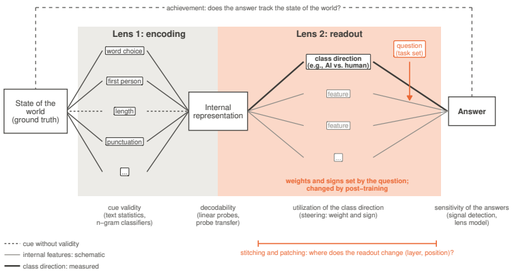
Figure 1 . Brunswik’s lens model, applied to a language model as judge and extended by an internal lens. A state of the world (Brunswik’s distal criterion; the ground truth, here whether a text was written by an AI, whether a statement is true, or whether a review is genuine) is reflected in observable cues of the text, some of which are valid and some of which are not (dashed). In the first lens (encoding), the model integrates these cues into its internal representation; whether the ground truth can be decoded from this representation is measured with linear probes, and whether two checkpoints represent it in the same way with probe transfer. In the second lens (readout), the representation is read out into an answer to the question by weighting internal features. Only one of these features was measured directly: the class direction, i.e., the direction that separates the two classes in the representation; its relation to the answer was examined with steering at the answer position (Appendix D). The other features are schematic. Achievement, i.e., the agreement of the answer with the state of the world, requires both lenses. Post-training changes mainly the second lens (orange), and in several cases also the first (Sections 3.4 and 3.6); model stitching and activation patching locate the change in depth and in the prompt. Splitting the judge side of the lens model has precedents in personality judgment (detection vs. utilization of cues; Funder, 1995) and in neuroscience (information encoded in a neural population vs. read out for behavior; Panzeri et al., 2017). Note: for the authorship corpora, probes were fitted both on the text positions and on the last prompt position; for the truth and review sets, only on the last prompt position.
Original paper · CC BY 4.0 · Jochen Laubrock · Represented but misread: Post-training changes how language models read out what they represent · Original paper figure · Extracted the figure area from page 4 of the original PDF.Why answers can diverge from representations
A common view holds that post-training adds format and style to a model's answers while leaving its knowledge largely alone. If that view is right, the representations inside the model should stay intact, and only the step from representation to answer should change. This matters for honesty, because a model whose answers drift from its own representation has a gap that the answers alone do not reveal.
Testing this needs a judgment where the right answer is known, the representation can be checked, and the point of divergence can be located.
The label is fixed for each text, the cues sit in the input the model reads before it answers, and simple text statistics can show whether those cues exist. Public data cannot carry the authorship case, so the authors add the truth of negated statements as a second judgment that can be reproduced in full.
Language models asked directly whether a text is human or AI are weak judges, and their errors lean one way in ways that differ between models. In a pilot with German chat messages, four commercial models recognized almost none of the AI messages, with at most 16% called AI under any prompt version. Confidence ratings from the smallest model ordered the messages below chance, with AUC between .20 and .34.
Signal detection theory separates sensitivity, the ability to tell signal from noise, from the criterion, the tendency to give one answer over the other. A bias toward answering human shifts the evidence for every text alike, so sensitivity below chance cannot come from bias alone and means the evidence is ordered the wrong way round. For a language model the use of cues can be examined directly, which the authors do by adding an internal lens between the text's cues and the answer.
How the two lenses are measured
The key idea is to ask two separate questions of each model: whether the authorship information is inside its internal state, and whether its answer uses that information. The first question is answered with probes, and the second with the log-odds of the two answer words, with AI texts treated as the signal. The decision variable is \( dv = \log P(\text{KI}) - \log P(\text{Mensch}) \), averaged over both orders of the answer options.
Sensitivity is \( d' = \sqrt{2}\, z(\mathrm{AUC}) \), where AUC is the area under the ROC curve of dv. The criterion c is computed at dv = 0 with a log-linear correction, so it captures response bias and leaves sensitivity unchanged.
Probes are scored out of fold with 10-fold cross-validation, and all texts derived from one human original stay in the same fold. The chat corpus has 300 texts from 61 groups, the newspaper corpus has 103 segments from 14 articles, and the textbook corpus has 238 texts in 119 pairs.
Authorship answers ignore the signal
At two thirds of the network depth, the median d′ was 1.35 for the chats, 2.66 for the newspaper segments and 3.70 for the textbook summaries. Word n-gram classifiers matched or beat the probes on the chats, with d′ = 1.73, so the signal is largely lexical and stylistic.
The answers did not use this signal. Gemma 3 12B scored −0.81 and −1.09 on chats, so several models ordered the texts inversely. In 23 of the 36 plain-prompt conditions the binary answer hardly varied, so these d′ values describe the graded evidence behind the answer rather than the yes or no decision.
The cues are also specific to the corpus. A probe trained on the newspaper segments and applied to the chats gave the wrong sign, with median d′ = −0.46 at the last prompt position for Gemma 3. Base models usually moved by less than that, and most post-trained models moved by more, though this held less generally relative to their spread.
Where the readout changes between checkpoints
Stitching without an adapter is justified here because both checkpoints derive from the same pretrained weights, and linear CKA at the text positions stayed between 0.97 and 0.999. At the answer position the same measure fell to between 0.44 and 0.99, so the representation of the answer changed far more than that of the text.
For Apertus, base lower layers with SFT upper layers scored +0.59 d′, close to the base model's +0.43. The first 8 SFT layers under base upper layers reversed the discrimination, and the first 6 SFT layers sufficed for the full deficit of −0.48 in OLMo 2. Hybrids sometimes fell outside their parents, with the first 8 SFT layers under base upper layers scoring −0.50 against −0.04 for the SFT model itself.
Activation patching exchanges internal states from one checkpoint into the other at chosen positions and layers. From mid-depth onward, the positions after the text carried the change between checkpoints, while the text states did not.
Truth judgments and the training study
Truth judgments on the statement sets of 748 matched pairs offer the reverse case, and anyone can reproduce them from public data. Probes decoded truth at or near ceiling in every model, yet several base models' answers did not use it, and post-training repaired those answers. In OLMo 2 the representation of the statement contributed up to 82% of the repair below mid-depth, and in the other models 19 to 45%.
Each run shared the same 20,000 background conversations and differed only in the added judgments: 1,994 authorship judgments with correct, stereotype or random labels, an unrelated judgment, or none.
Limitations
The models have 4 to 12 billion parameters, so the below-chance answers may be weaker or absent in larger models. Stitching and patching for authorship covered only two models, the two with stage-wise checkpoints that showed a clear change. Patching across layers used one authorship corpus and 100 statement pairs. The newspaper segments come from 14 articles, so bootstrap intervals that resample articles are likely too narrow for that corpus.
The authorship prompts were German, and English prompts were not tested for authorship. The training study used one base model and LoRA adapters, and its stereotype labels correlated with text length, topic and generator. For the deceptive reviews, the effects of post-training were small, and steering did not explain them.
Paper info
- Authors
- Jochen Laubrock
- Venue
- arXiv · Preprint
- First published
- 2026-11-19
- Added
- 2026-11-23
- Updated
- 2026-11-19
- Version
- v1
- arXiv
- 2611.26584
- Category
- cs.CL · cs.LG
- Original paper terms
- CC BY 4.0
- What we show
- Paper info, commentary and permitted figures from the original paper
AI commentary is a separate explanation from the original paper and may contain errors. The original paper and figures follow each source's terms of use and any rights noted separately.
Abstract
Does post-training change what a language model represents, or how this representation is read out into an answer? We compared linear probes with the models' own answers, analyzed with signal detection theory, in six open-weight base models and their post-trained versions. For judgments of whether German texts were written by a human or an AI, probes and word n-gram classifiers separated the classes well, but the answers did not and often ordered the texts inversely. Post-training lowered the sensitivity of the answers on average ($Δd' = -0.34$ across model families; -0.29 across three prompts). It also changed the use of a stated base rate: Base models shifted their log-odds by less than the stated change in prior odds, most post-trained models by more. In two models with stage-wise checkpoints, the change occurred during supervised fine-tuning, model stitching implicated the early layers, and from mid-depth on internal states at positions after the text, not those of the text, transferred the change between checkpoints. Our corpora cannot be shared, so we add a case reproducible from public data, the truth of negated statements. Here, post-training acted in the opposite direction: Probes decoded truth at or near ceiling in every model, the answers of several base models did not use it, and post-training repaired them; by mid-depth the repair resided at the positions after the statement; below it, the representation of the statement contributed, strongly in one of four models. In a training study, adding 2,000 correctly labeled authorship judgments of news texts to otherwise identical fine-tuning data improved the answers on our newspaper and textbook corpora and inverted them on the chats, where they followed a news-trained probe of the base model. Post-training thus changed how a judgment is read out of what a model represents, and a small training signal can set its direction.
Quote from the paper
Jochen Laubrock (2026). Represented but misread: Post-training changes how language models read out what they represent. arXiv:2611.26584v1. https://arxiv.org/abs/2611.26584v1
BibTeX
@misc{laubrock2026represented,
  title = {{Represented but misread: Post-training changes how language models read out what they represent}},
  author = {Jochen Laubrock},
  year = {2026},
  eprint = {2611.26584},
  archivePrefix = {arXiv},
  url = {https://arxiv.org/abs/2611.26584v1}
}