論文解説
Represented but misread: Post-training changes how language models read out what they represent
事後学習で変わるのは表現か読み出しか、著者性判定で切り分ける
- 課題 モデルは内部の表現に正解の情報を持っているのに、回答にはそれを使えないことがあります。事後学習がこの食い違いを変えるのか、これまで切り分けられていませんでした。
- 手法 本研究は、判定を表現を作る段階と回答に読み出す段階の二つに分けて測ります。線形プローブで表現を、回答の対数確率の差で読み出しを比べます。
- 結果 事後学習後は、著者性判定の感度が平均で下がりました。
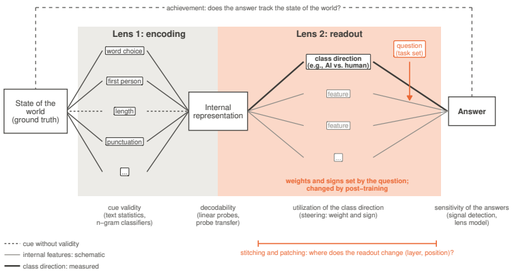
Figure 1 . Brunswik’s lens model, applied to a language model as judge and extended by an internal lens. A state of the world (Brunswik’s distal criterion; the ground truth, here whether a text was written by an AI, whether a statement is true, or whether a review is genuine) is reflected in observable cues of the text, some of which are valid and some of which are not (dashed). In the first lens (encoding), the model integrates these cues into its internal representation; whether the ground truth can be decoded from this representation is measured with linear probes, and whether two checkpoints represent it in the same way with probe transfer. In the second lens (readout), the representation is read out into an answer to the question by weighting internal features. Only one of these features was measured directly: the class direction, i.e., the direction that separates the two classes in the representation; its relation to the answer was examined with steering at the answer position (Appendix D). The other features are schematic. Achievement, i.e., the agreement of the answer with the state of the world, requires both lenses. Post-training changes mainly the second lens (orange), and in several cases also the first (Sections 3.4 and 3.6); model stitching and activation patching locate the change in depth and in the prompt. Splitting the judge side of the lens model has precedents in personality judgment (detection vs. utilization of cues; Funder, 1995) and in neuroscience (information encoded in a neural population vs. read out for behavior; Panzeri et al., 2017). Note: for the authorship corpora, probes were fitted both on the text positions and on the last prompt position; for the truth and review sets, only on the last prompt position.
出典 · CC BY 4.0 · Jochen Laubrock · Represented but misread: Post-training changes how language models read out what they represent · 論文の図を引用 · 元のPDFの4ページ目から図の部分を抽出しています。事後学習で何が変わるのか
言語モデルは、事前学習の後に教師ありファインチューニング(SFT)や選好最適化などの事後学習を経て、アシスタントとして振る舞うようになります。従来は、事後学習が知識をほとんど加えず、応答の形式や文体を教えるだけだという見方が有力で、これは表面的アライメント仮説と呼ばれます。この仮説が正しければ、事後学習後も内部表現はほぼ保たれ、変わるのは表現を回答に変える読み出しだけになります。
ただし、この二つを切り分けるには、正解が分かっていて、表現と回答の両方を同じ正解に照らして測れる課題が必要です。テキストが人間によって書かれたかAIによって生成されたかを問う著者性判定は、この条件を満たします。テキストは入力として全体が読まれるため、判定に必要な情報は原理的に存在し、記憶からの想起にも頼りません。一方、モデルに直接尋ねると、誤りは一方向に偏り、正答率が機会水準を下回った例もあります。
では、情報は表現にあるのに、なぜ回答に届かないのかが問題になります。この理由は、これまで明らかになっていません。
二段のレンズで判定を分ける
本研究の中心は、言語モデルの判定を二つのレンズの直列とみなすことです。第一のレンズでは、テキストの手がかりが内部表現に符号化され、第二のレンズでは、その表現が問いへの回答に読み出されます。この分け方は、心理学のブルンスウィックのレンズモデルを言語モデルの内部にまで広げたものです。人間の判定では読み出しを直接観察できませんが、言語モデルでは内部表現にアクセスできるため、両方を測れます。
各位置の状態は、それより前の位置の状態しか参照できないため、テキストの情報は後続の位置を通ってしか回答に届きません。そこで、テキストの位置、質問の位置、最後の位置を分けて、どこに情報があるかを調べます。第一のレンズは線形プローブで測ります。プローブは最後の位置の活性化に対して各層で学習され、真偽や著者性が表現に含まれるかを示します。回答の側は、「KI」と「Mensch」の対数確率の差 \( dv = \log P(\text{KI}) - \log P(\text{Mensch}) \) で表し、両方の選択肢の順序で平均します。
感度には d′ を使い、AI文を信号として、AUCから \( d' = \sqrt{2}\, z(\mathrm{AUC}) \) で計算します。d′ は判断基準の位置に依存しないため、回答が「Mensch」に偏っていても、テキストの順序がどれだけ正しいかを測れます。d′ が負なら、AI文が人間文よりAIらしくないと判定されていることを意味します。基準率の影響は、事前オッズの変化 ln 16 = 2.77 nats と比べて測ります。
コーパスとモデル群の設定
チャットデータは、実験心理学の授業で学生が書いた短いメッセージと、AIが同じ話題で生成した文章からなります。AI文は、単純なプロンプト、文体を合わせたプロンプト、学生のフィードバックによる修正の三段階で作られました。25語に切り詰めた結果、300文(人間61、AI239)になりました。同じ元の文から派生した文は一つの群にまとめ、交差検証と再サンプリングの単位にします。
ニュースの断片は、地方紙の記事と、GPT-5.4で生成した対応記事からなり、103の断片(人間38、AI65)があります。教科書の要約は、ドイツ語教科書の119章について、人間の要約とChatGPTの要約を対にしたもので、238文です。これらのコーパスは共有できないため、同じ分析を公開データの真偽判定でも行います。
モデルは6つのオープンウェイトの基底モデルで、Gemma 3、Qwen3、OLMo 2、OLMo 3、Apertusを含みます。OLMo 2 7B、Apertus 1.5 8B、OLMo 3 7Bは事後学習の各段階のチェックポイントが公開されているため、段階ごとに変化を追えます。判定は、質問への回答を次の単語の確率から読み取り、生の補完形式とチャット形式の二通りで行いました。
情報はあるのに回答が使わない
その結果、中央値は、チャットでd′ 1.35、ニュースで2.66、教科書要約で3.70となり、どのモデルとコーパスでも分離できました。ラベルをグループ内で並べ替えるとAUCは.50、つまり機会水準まで下がり、プローブが訓練文を覚えただけではないと分かります。
同じ課題を単語頻度の分類器で解くと、チャットではd′ 1.73となり、プローブと同じかそれ以上でした。入力埋め込みだけを使うプローブもd′ 1.48で、深い層のプローブと同程度です。つまり、判定に使える情報は、モデルの処理より前の語彙や文体の規則性に多くが由来すると考えられます。外部の検出器EditLensは、チャットではAUC .57にとどまり、コーパスごとに差がありました。
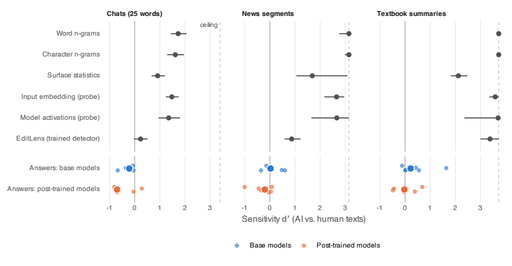
Figure 3 . The authorship information is available but not used. Sensitivity (d′) for separating AI from human texts in the three corpora. Upper rows: classifiers on word and character n-grams and on sur- face statistics, probes on the average input embedding and on the internal activations at two thirds of the network depth, and an externally trained detector (EditLens). Lines show 95% bootstrap confidence intervals, except for the two probe rows, where they show the range across models. Lower rows: sen- sitivity of the models’ own answers (raw prompt), one small dot per model, large dot = median. The dashed line marks the maximum d′ that can be estimated with the given number of texts.
出典 · CC BY 4.0 · Jochen Laubrock · Represented but misread: Post-training changes how language models read out what they represent · 論文の図を引用 · 元のPDFの18ページ目から図の部分を抽出しています。情報はコーパスに固有でもあります。このため、AIらしさを表す単一の方向は存在せず、あるコーパスで機会水準を上回る判定規則が、別のコーパスでは下回ることがあります。
では、モデルの回答はこの情報を使っているのでしょうか。Gemma 3 12Bの教科書要約では、基底モデルのd′ +1.64に対し、事後学習版は+0.68となりました。多くの条件では回答がほぼ固定されていたため、d′は二値の答えではなく、確率の差から計算した順序を測っています。負のd′は、人間文の方がAIへの好みが強く、判定の順序が逆になっていることを意味し、単なる基準のずれでは起こりません。
同じ生のプロンプトで比べると、18の比較のうち14で事後学習版の感度が基底モデルより低くなりました。平均では Δd′ = −0.34 で、プロンプトを三通りに変えても −0.29 でした。チャット形式との比較は形式そのものが交絡するため、主張の根拠には同じ生の形式の比較だけを使います。
基準率への反応
判定の基準率が20%のAI文から80%のAI文に変わると、理想的な観測者の事後ログオッズは ln 16 = 2.77 nats だけ動きます。基底モデルでは、回答のログオッズの変化がこの値より小さく、多くの事後学習モデルでは大きくなりました。ただし、ログオッズの広がりと比べると、この傾向は一般には言えません。
つまり、事後学習は、判定に与えられた事前情報への感受性も変えています。この変化も、表現の読み出しの問題として見ると一貫した結果になります。
変化が起きる層と位置
まず、基底モデルとSFTモデルの表現の変化を、線形CKAで測りました。テキストの位置の表現はCKAが0.97から0.999と高く、回答の位置は0.44から0.99と大きく違っていました。ただしCKAは偏って高く出るため、1に近い値は同一性の弱い証拠にすぎません。層を組み替えたモデルも流暢な文を出し、パープレキシティは6.0から6.7と8.2から9.4の範囲に収まりました。
最上層だけが変化を担うなら、上位層の組み合わせで判定が決まるはずですが、結果は違いました。Apertusでは、下位8層を基底モデル、上位をSFTモデルにすると d′ +0.59 となり、基底モデルの +0.43 と同程度に保たれました。逆に、下位8層だけをSFTモデルにすると、上位が基底モデルでも判定能力が −0.50 まで失われました。OLMo 2でも下位の変化が判定を決めていて、変化は一つの層ではなく初期の複数の層にわたって徐々に現れます。ただし、組み合わせたモデルは両親の間に収まらないことがあり、Apertusの下位8層では回答がむしろ悪化しました。
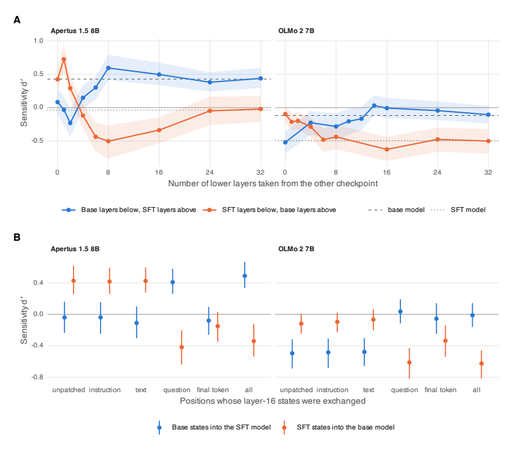
Figure 5 . Authorship: model stitching and activation patching at layer 16. (A) Model stitching between base and SFT checkpoints (textbook summaries; the numbers of layers that were tested differ between the two directions and between the models). The x-axis gives the number of lower layers taken from the other checkpoint. Blue: base layers below, SFT layers above; orange: SFT layers below, base layers above. Dashed and dotted lines mark the sensitivity of the unmodified base and SFT models; bands are 95% bootstrap confidence intervals. (B) Activation patching at layer 16: sensitivity after exchanging the internal states at the indicated positions. Blue: base model’s states inserted into the SFT model; orange: SFT model’s states inserted into the base model. “Unpatched” shows the recipient model without any exchange. Error bars are 95% bootstrap confidence intervals. Patching at layer 8 (more mixed; text positions contribute somewhat) is shown in Supplementary Figure S1.
出典 · CC BY 4.0 · Jochen Laubrock · Represented but misread: Post-training changes how language models read out what they represent · 論文の図を引用 · 元のPDFの25ページ目から図の部分を抽出しています。次に、層16で、テキストの位置と後続の位置の状態をチェックポイント間で入れ替えました。中間層以降では、質問や回答の位置の状態が変化を伝え、テキストの位置の状態は伝えませんでした。下位層では、Apertusではテキストの状態が変化の一部を担い、OLMo 2ではまったく担わず、どちらでも命令の位置が一部を担いました。
否定文の真偽判定での逆向きの変化
公開データの真偽判定では、Marks & Tegmarkの748組の文を使い、否定を含む文でも同じ分析を行いました。一部の基底モデルは、真偽の情報がほぼ天井で表現されているのに、回答にそれを使っていませんでした。ここで事後学習は、プローブが天井に近いまま、回答を修復しました。
修復の位置を層ごとに調べると、中間層以降では文の後の位置の状態が修復を担っていました。その下では文の表現そのものも寄与し、4つのモデルすべてで見られ、OLMo 2では修復の最大82%を占めました。他のモデルでは、その寄与は19から45%にとどまりました。
Gemma 3の基底モデルは、回答の確率が18%と25%と低かったため、この分析では例外として扱いました。したがって、著者性判定と真偽判定では、事後学習で変わる場所が逆向きに現れます。
訓練信号が読み出しの向きを決める
追加の判定は、正しいラベル、形式性のステレオタイプに沿ったラベル、ランダムなラベルを比べ、判定を加えない条件と、無関係な判定を加えた条件も置きました。ステレオタイプのラベルは、真の著者性とは独立に、形式的な文を「KI」とするものです。
学習後の回答は、3つの著者性コーパスと400件のニュース保持データで評価しました。さらに、基底モデルで学習したニュース用プローブをチャットに当てはめ、回答との順位相関を調べました。
正しいニュースのラベルは、ニュースと教科書要約では判定を改善し、チャットでは逆転させました。ニュース項目の回答は、表層分類器よりも、基底モデルで学習したプローブに近い形で追従しました。これは、少量の訓練信号が読み出しの向きを決めうることを示唆します。ステレオタイプのラベルは文の長さや話題、生成元と相関しており、その交絡は学習後に気づいたものです。
限界
本研究で扱ったモデルは中規模の6系統で、大きなモデルでは機会水準を下回る判定が弱まるか消える可能性があります。感度は回答の対数確率の差から計算しており、二値の回答がほとんど変わらない条件では、d′は確率の順序の性質を表します。利用されなかった情報は語彙や文体が中心なので、深い表現としての著者性理解を示すものではありません。
著者性のスティッチングとパッチングは、段階ごとに変化があるチェックポイントを持つ2モデルに限られます。層ごとのパッチングは、著者性の1つのコーパスと100組の文ペアで行われ、計算時間の制約によるものです。訓練研究は1つの基底モデルと低ランクのアダプタに限られ、別の生成元と別のジャンルのテキストを使っています。ニュース断片は14の記事に由来するため、記事単位の再サンプリングによる信頼区間は狭すぎる可能性があります。著者性判定はドイツ語のプロンプトで行い、英語での検証は行っていません。ステアリングは一部のモデルとコーパスに限られ、方向の一致を調べるだけで、変化の全体を説明するものではありません。
論文情報
- 著者
- Jochen Laubrock
- 学会・ジャーナル
- arXiv · プレプリント
- 公開日
- 2026年11月19日
- 登録日
- 2026年11月23日
- 更新日
- 2026年11月19日
- バージョン
- v1
- arXiv
- 2611.26584
- カテゴリ
- cs.CL · cs.LG
- ライセンス
- CC BY 4.0
- 掲載内容
- 論文情報・解説・論文の図
この解説は、Refivuの韓国語解説をAIで翻訳したものです。不正確な翻訳や誤りが含まれる可能性があります。論文と図の利用条件は各出典に従います。
アブストラクト
Does post-training change what a language model represents, or how this representation is read out into an answer? We compared linear probes with the models' own answers, analyzed with signal detection theory, in six open-weight base models and their post-trained versions. For judgments of whether German texts were written by a human or an AI, probes and word n-gram classifiers separated the classes well, but the answers did not and often ordered the texts inversely. Post-training lowered the sensitivity of the answers on average ($Δd' = -0.34$ across model families; -0.29 across three prompts). It also changed the use of a stated base rate: Base models shifted their log-odds by less than the stated change in prior odds, most post-trained models by more. In two models with stage-wise checkpoints, the change occurred during supervised fine-tuning, model stitching implicated the early layers, and from mid-depth on internal states at positions after the text, not those of the text, transferred the change between checkpoints. Our corpora cannot be shared, so we add a case reproducible from public data, the truth of negated statements. Here, post-training acted in the opposite direction: Probes decoded truth at or near ceiling in every model, the answers of several base models did not use it, and post-training repaired them; by mid-depth the repair resided at the positions after the statement; below it, the representation of the statement contributed, strongly in one of four models. In a training study, adding 2,000 correctly labeled authorship judgments of news texts to otherwise identical fine-tuning data improved the answers on our newspaper and textbook corpora and inverted them on the chats, where they followed a news-trained probe of the base model. Post-training thus changed how a judgment is read out of what a model represents, and a small training signal can set its direction.
論文の図
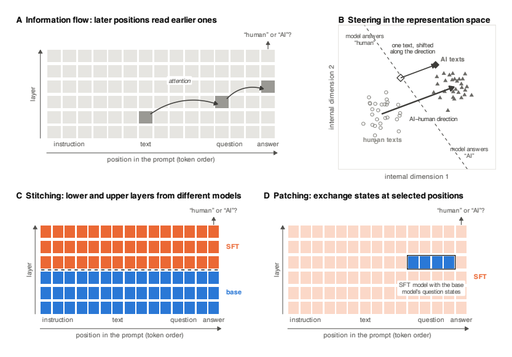
Figure 2 . How the interventions work. In panels A, C, and D, the horizontal axis shows the positions of the prompt in reading order (the instruction, the text to be judged, the question, and the position at which the answer is produced), and the vertical axis shows the layers of the network. (A) Information flow: through attention, later positions read information from earlier ones. The answer is produced at the last position. Information from the text reaches it through the positions after the text: the question (dark tiles) and the last position itself, which also reads the text directly at every layer (the schematic shows only the route via the question). (B) Steering, sketched in a two-dimensional version of the high- dimensional representation space: human texts (open circles) and AI texts (triangles) differ along an AI–human direction (arrow between the class means). Steering moves the state of one text along this direction (diamonds) and measures how the model’s answer changes; the dashed line marks where the answer switches. The two need not be orthogonal: the angle between the AI–human direction and the model’s decision boundary determines how strongly a shift along the direction changes the answer. If the model read the direction correctly, a shift toward the AI texts would move the answer toward “KI” . (C) Model stitching combines the lower layers of one checkpoint (here the base model, blue) with the upper layers of another (here the SFT model, orange). (D) Activation patching replaces the internal states of one model (here SFT) at selected positions and one layer with those of the other model (here the base model’s states at the question positions).
出典 · CC BY 4.0 · Jochen Laubrock · Represented but misread: Post-training changes how language models read out what they represent · 論文の図を引用 · 元のPDFの5ページ目から図の部分を抽出しています。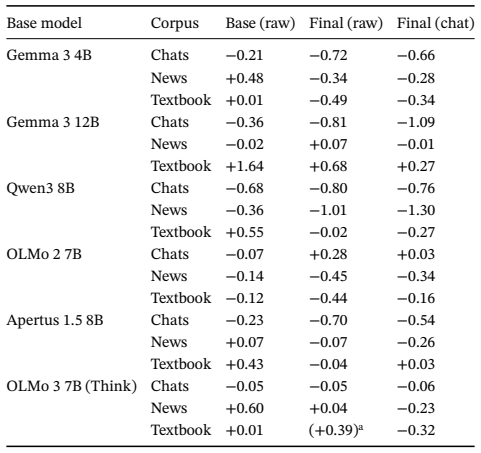
Table 2 . Sensitivity (d′) of the models’ answers. Base models were queried with a plain completion prompt (“raw”); post-trained models with the same prompt and with their chat template (“chat”). Conditions in which a model placed less than 30% of its probability on the two answer words are marked.
出典 · CC BY 4.0 · Jochen Laubrock · Represented but misread: Post-training changes how language models read out what they represent · 論文の図を引用 · 元のPDFの19ページ目から図の部分を抽出しています。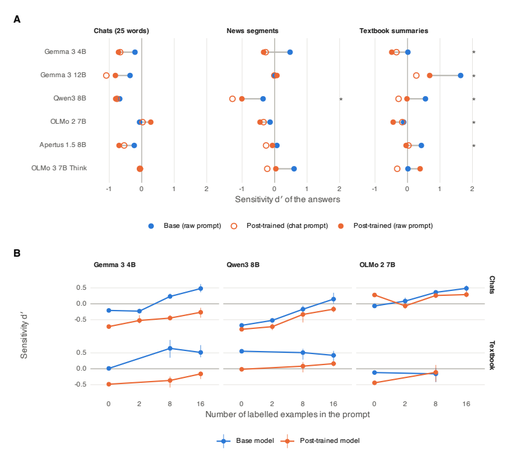
Figure 4 . Post-training mostly lowers the sensitivity of the answers; with 16 labelled examples, most models improve. (A) Sensitivity of the base model (blue) and of the final post-trained model with the identical raw prompt (filled orange) and with its chat template (open orange), per model and corpus. Asterisks mark differences between the base and the final model on the identical raw prompt that sur- vive Holm correction within the family of 18 final-vs-base comparisons; all of them are decreases. The increases of OLMo 2 on the short chats and of OLMo 3 Think on the textbook summaries are significant only without correction or under false-discovery-rate control (the latter in a condition with low answer probability, ≈ .30). Multilevel random-effects summary across all 18 comparisons: Δd′ = −0.33 [−0.53, −0.13]. (B) Sensitivity as a function of the number of labelled examples placed before each text (raw prompt; base vs. final post-trained model). Points show the mean of d′ computed separately for each of four example sets; vertical lines show their range. Whether base models profit more than post-trained models (difference of gains, 0 vs. 16 examples) is tested in the supplement: the base model gained more in four of five comparisons, reliably only for OLMo 2 on the chats; for Qwen3 on the textbook sum- maries, the post-trained model gained more. On the textbook summaries, only 0, 8, and 16 examples were tested; for OLMo 2 only 0 and 8, because 16 textbook summaries exceed its context window of 4,096 tokens.
出典 · CC BY 4.0 · Jochen Laubrock · Represented but misread: Post-training changes how language models read out what they represent · 論文の図を引用 · 元のPDFの22ページ目から図の部分を抽出しています。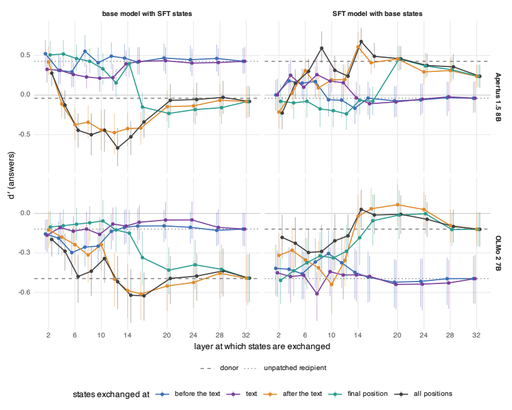
Figure 6 . Authorship: activation patching across layers (textbook summaries, 238 texts; error bars: 95% grouped-bootstrap confidence intervals). Sensitivity (d′) of the recipient checkpoint after its residual stream was replaced by the donor’s at one set of positions and one layer: the instruction before the text, the tokens of the text, the question and answer cue after the text, the final position only, or all positions. Note that the two rows have different scales. Horizontal lines show the unpatched recipient (dotted) and the donor (dashed). In OLMo 2, the text states had no effect at any layer; in Apertus, they carried part of the difference between the checkpoints up to layer 12. The instruction positions carried part of it in the lower layers of both models. From layer 14 onward, the states after the text carried it in both models. Hybrids can lie outside the range of the two checkpoints.
出典 · CC BY 4.0 · Jochen Laubrock · Represented but misread: Post-training changes how language models read out what they represent · 論文の図を引用 · 元のPDFの29ページ目から図の部分を抽出しています。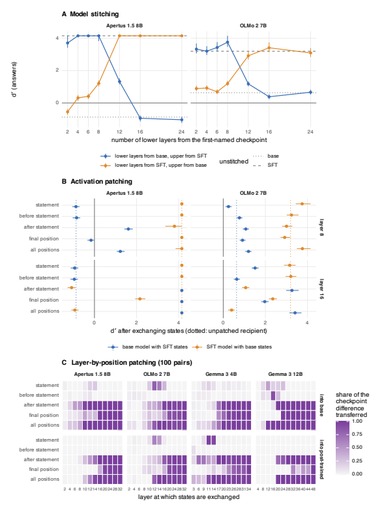
Figure 7 . Negated statements: where supervised fine-tuning repairs the readout (300 statement pairs; error bars: 95% grouped-bootstrap confidence intervals). (A) Model stitching: sensitivity (d′) of the an- swers of hybrids that take the first ℓ layers from one checkpoint and all layers above from the other; horizontal lines show the unstitched base (dotted) and SFT (dashed) checkpoints. (B) Activation patch- ing at layers 8 and 16: d′ of the recipient checkpoint after its residual stream was replaced by the donor’s at one set of positions (the statement, the instruction before it, the question and answer cue after it, the final position only, or all positions); dotted lines show the unpatched recipients. Note that in the truth prompt the question precedes the statement, so that the positions after the statement contain only the answer instruction and cue. (C) The same exchange at 12 layers (100 statement pairs), for base and SFT model of OLMo 2 and Apertus and for base and final post-trained model of Gemma 3 4B and 12B: share of the difference between the two checkpoints that the exchange transferred (values below 0 and above 1 are clipped). Upper row: the base model receives the states of the post-trained model (“into base”); lower row: the post-trained model receives the states of the base model.
出典 · CC BY 4.0 · Jochen Laubrock · Represented but misread: Post-training changes how language models read out what they represent · 論文の図を引用 · 元のPDFの33ページ目から図の部分を抽出しています。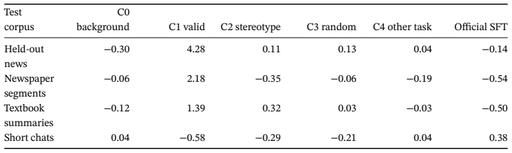
Table 4 . Training study: sensitivity (d′) of the answers of OLMo 2 7B after fine-tuning with background conversations only (C0) or with additional authorship judgments with correct (C1), stereotyped (C2), or random labels (C3), or with an unrelated topic judgment in the same layout (C4), and of the official SFT checkpoint. Held-out news: 400 items from the distribution of the training texts. d′, mean over three seeds (per-seed d′, both answer orders averaged). C0 and C4 did not learn the answer words of the authorship question (probabil- ity of the two answer words .65–.76, vs. ≈ 1.0 in C1–C3); C3 therefore serves as a further baseline (see text).
出典 · CC BY 4.0 · Jochen Laubrock · Represented but misread: Post-training changes how language models read out what they represent · 論文の図を引用 · 元のPDFの36ページ目から図の部分を抽出しています。この論文を引用
Jochen Laubrock (2026). Represented but misread: Post-training changes how language models read out what they represent. arXiv:2611.26584v1. https://arxiv.org/abs/2611.26584v1
BibTeX
@misc{laubrock2026represented,
  title = {{Represented but misread: Post-training changes how language models read out what they represent}},
  author = {Jochen Laubrock},
  year = {2026},
  eprint = {2611.26584},
  archivePrefix = {arXiv},
  url = {https://arxiv.org/abs/2611.26584v1}
}