논문 해설
Represented but misread: Post-training changes how language models read out what they represent
표현되어 있으나 잘못 읽히다: post-training이 언어 모델이 표현한 내용을 읽어내는 방식을 바꾼다
- 연구 문제 post-training은 모델의 내부 표현을 바꾸는지, 아니면 그 표현을 답으로 읽어내는 방식을 바꾸는지 작성자 판단 과제로 검증합니다.
- 연구 방법 렌즈 모델로 나눈 프로브, 신호 검출 민감도, 스티칭과 활성 패칭을 함께 사용합니다.
post-training은 무엇을 바꾸는가
언어 모델은 대규모 pre-training 뒤에 지도 fine-tuning(SFT)과 선호 최적화(DPO) 같은 post-training을 거칩니다. 널리 알려진 표층 정렬 가설은 post-training이 지식을 거의 더하지 않고 응답 형식과 스타일만 바꾼다고 봅니다. 이 논문은 그 구분을 시험하려면 모델이 무엇을 표현해야 하는지 알고 있고, 표현을 측정할 수 있으며, 표현과 답이 어디서 갈라지는지 짚을 수 있는 판단이 필요하다고 설명합니다. 저자들은 텍스트가 사람이 썼는지 AI가 썼는지 가려내는 작성자 판단이 이 조건을 충족한다고 봅니다. 정답이 모든 텍스트마다 알려져 있고, 판단에 쓰이는 단서가 입력 텍스트에 있으며, 단순한 텍스트 통계로 독립적으로 확인할 수 있기 때문입니다.
이 질문이 중요한 이유는 모델의 답이 내부 표현을 반영하지 않으면, 모델이 무엇을 알면서도 다르게 말하는 상황이 생기기 때문입니다. 논문은 이를 정직성 평가의 문제로도 연결합니다.
렌즈 모델로 나눈 판단 과정
저자들은 Brunswik의 렌즈 모델을 언어 모델에 적용합니다. 첫 번째 렌즈는 텍스트의 단서가 모델 내부 표현으로 부호화되는 과정이고, 두 번째 렌즈는 그 표현이 질문에 대한 답으로 읽히는 과정입니다. 표현에 정답이 들어 있는지는 선형 프로브로 재고, 답이 표현을 얼마나 쓰는지는 신호 검출 이론의 민감도와 편향으로 평가합니다.
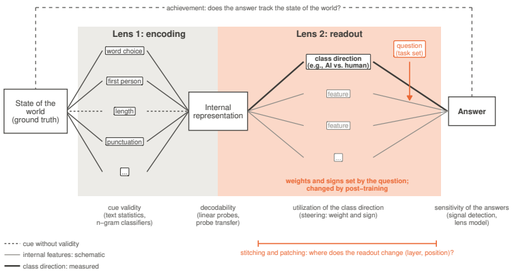
Figure 1 . Brunswik’s lens model, applied to a language model as judge and extended by an internal lens. A state of the world (Brunswik’s distal criterion; the ground truth, here whether a text was written by an AI, whether a statement is true, or whether a review is genuine) is reflected in observable cues of the text, some of which are valid and some of which are not (dashed). In the first lens (encoding), the model integrates these cues into its internal representation; whether the ground truth can be decoded from this representation is measured with linear probes, and whether two checkpoints represent it in the same way with probe transfer. In the second lens (readout), the representation is read out into an answer to the question by weighting internal features. Only one of these features was measured directly: the class direction, i.e., the direction that separates the two classes in the representation; its relation to the answer was examined with steering at the answer position (Appendix D). The other features are schematic. Achievement, i.e., the agreement of the answer with the state of the world, requires both lenses. Post-training changes mainly the second lens (orange), and in several cases also the first (Sections 3.4 and 3.6); model stitching and activation patching locate the change in depth and in the prompt. Splitting the judge side of the lens model has precedents in personality judgment (detection vs. utilization of cues; Funder, 1995) and in neuroscience (information encoded in a neural population vs. read out for behavior; Panzeri et al., 2017). Note: for the authorship corpora, probes were fitted both on the text positions and on the last prompt position; for the truth and review sets, only on the last prompt position.
원문 · CC BY 4.0 · Jochen Laubrock · Represented but misread: Post-training changes how language models read out what they represent · 원문 그림 인용 · 원본 PDF 4쪽에서 그림 영역을 추출했습니다.여기서 민감도 d′는 AUC로부터 d′ = √2 · z(AUC)로 계산됩니다. 이 값은 판단 점수가 AI 텍스트를 인간 텍스트보다 얼마나 높게 정렬하는지를 나타내며, 임계값의 위치에 따라 달라지지 않습니다. 음수 d′는 AI 텍스트가 인간 텍스트보다 덜 AI답게 판단되었다는 뜻입니다. 반면 편향 c는 자연 임계값 dv = 0에서 계산되므로, 모든 텍스트에 같은 방향으로 작용하는 응답 기울기만 나타냅니다. 따라서 민감도가 우연 수준보다 낮다면 증거가 역방향으로 정렬되어 있다고 해석할 수 있습니다.
작성자 판단에서 답이 정보를 쓰지 않는 현상
세 가지 코퍼스를 사용했습니다. 채팅 메시지 300개, 지역 신문 기사 조각 103개, 교과서 요약 238개로, 각 인간 원문과 파생 텍스트가 하나의 그룹을 이룹니다. 세 코퍼스 모두에서 선형 프로브는 AI와 인간 텍스트를 잘 구분했습니다. 중앙값 d′는 채팅에서 1.35, 신문에서 2.66, 교과서에서 3.70이었습니다. 단어 빈도 분류기도 비슷하거나 더 높은 민감도를 보였습니다.
반면 모델에게 직접 묻는 답은 같은 정보를 쓰지 않았습니다. 여러 모델은 텍스트를 AI 쪽으로 정렬하는 방향이 역전되어 있었습니다. 이 음수 값은 이진 답이 거의 변하지 않은 조건에서도 나타났으므로, 단순한 임계값 문제로만 설명되지 않습니다.
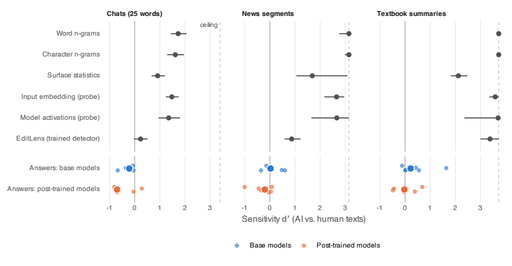
Figure 3 . The authorship information is available but not used. Sensitivity (d′) for separating AI from human texts in the three corpora. Upper rows: classifiers on word and character n-grams and on sur- face statistics, probes on the average input embedding and on the internal activations at two thirds of the network depth, and an externally trained detector (EditLens). Lines show 95% bootstrap confidence intervals, except for the two probe rows, where they show the range across models. Lower rows: sen- sitivity of the models’ own answers (raw prompt), one small dot per model, large dot = median. The dashed line marks the maximum d′ that can be estimated with the given number of texts.
원문 · CC BY 4.0 · Jochen Laubrock · Represented but misread: Post-training changes how language models read out what they represent · 원문 그림 인용 · 원본 PDF 18쪽에서 그림 영역을 추출했습니다.post-training 후 민감도 감소
단계별 체크포인트를 제공하는 OLMo 2와 Apertus에서는 SFT 단계에서 변화가 생겼습니다. 이후의 선호 최적화 단계는 대체로 이 변화를 더 키우지 않았습니다.
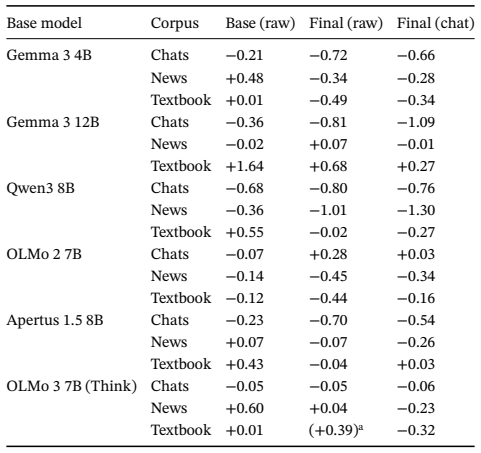
Table 2 . Sensitivity (d′) of the models’ answers. Base models were queried with a plain completion prompt (“raw”); post-trained models with the same prompt and with their chat template (“chat”). Conditions in which a model placed less than 30% of its probability on the two answer words are marked.
원문 · CC BY 4.0 · Jochen Laubrock · Represented but misread: Post-training changes how language models read out what they represent · 원문 그림 인용 · 원본 PDF 19쪽에서 그림 영역을 추출했습니다.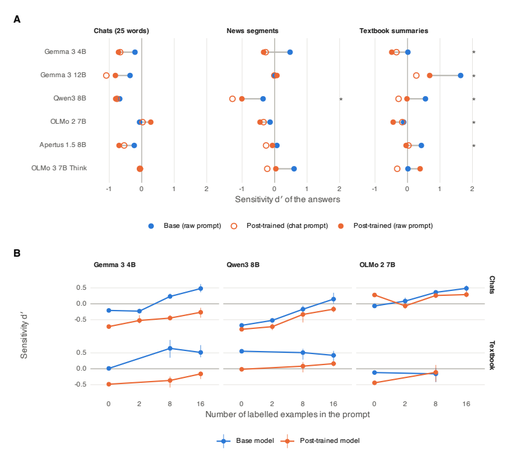
Figure 4 . Post-training mostly lowers the sensitivity of the answers; with 16 labelled examples, most models improve. (A) Sensitivity of the base model (blue) and of the final post-trained model with the identical raw prompt (filled orange) and with its chat template (open orange), per model and corpus. Asterisks mark differences between the base and the final model on the identical raw prompt that sur- vive Holm correction within the family of 18 final-vs-base comparisons; all of them are decreases. The increases of OLMo 2 on the short chats and of OLMo 3 Think on the textbook summaries are significant only without correction or under false-discovery-rate control (the latter in a condition with low answer probability, ≈ .30). Multilevel random-effects summary across all 18 comparisons: Δd′ = −0.33 [−0.53, −0.13]. (B) Sensitivity as a function of the number of labelled examples placed before each text (raw prompt; base vs. final post-trained model). Points show the mean of d′ computed separately for each of four example sets; vertical lines show their range. Whether base models profit more than post-trained models (difference of gains, 0 vs. 16 examples) is tested in the supplement: the base model gained more in four of five comparisons, reliably only for OLMo 2 on the chats; for Qwen3 on the textbook sum- maries, the post-trained model gained more. On the textbook summaries, only 0, 8, and 16 examples were tested; for OLMo 2 only 0 and 8, because 16 textbook summaries exceed its context window of 4,096 tokens.
원문 · CC BY 4.0 · Jochen Laubrock · Represented but misread: Post-training changes how language models read out what they represent · 원문 그림 인용 · 원본 PDF 22쪽에서 그림 영역을 추출했습니다.스티칭과 활성 패칭으로 찾은 위치
모델 스티칭은 기반 체크포인트의 하위 층과 post-training 체크포인트의 상위 층을 조합해 변화가 어느 깊이에 있는지 확인합니다. 활성 패칭은 선택한 프롬프트 위치에서 내부 상태를 다른 체크포인트의 상태로 바꿔 전달되는 변화를 측정합니다. 교과서 요약에서 Apertus의 하위 8개 층을 SFT 모델에서 가져오면 기반 모델의 판단 능력이 사라졌습니다. 반대로 기반 모델의 하위 8개 층을 쓰면 SFT 모델에서도 판단이 기반 수준으로 돌아왔습니다. 이 변화는 여러 초기 층에 걸쳐 점진적으로 나타났습니다.
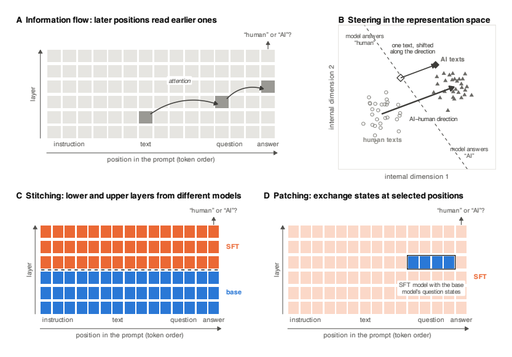
Figure 2 . How the interventions work. In panels A, C, and D, the horizontal axis shows the positions of the prompt in reading order (the instruction, the text to be judged, the question, and the position at which the answer is produced), and the vertical axis shows the layers of the network. (A) Information flow: through attention, later positions read information from earlier ones. The answer is produced at the last position. Information from the text reaches it through the positions after the text: the question (dark tiles) and the last position itself, which also reads the text directly at every layer (the schematic shows only the route via the question). (B) Steering, sketched in a two-dimensional version of the high- dimensional representation space: human texts (open circles) and AI texts (triangles) differ along an AI–human direction (arrow between the class means). Steering moves the state of one text along this direction (diamonds) and measures how the model’s answer changes; the dashed line marks where the answer switches. The two need not be orthogonal: the angle between the AI–human direction and the model’s decision boundary determines how strongly a shift along the direction changes the answer. If the model read the direction correctly, a shift toward the AI texts would move the answer toward “KI” . (C) Model stitching combines the lower layers of one checkpoint (here the base model, blue) with the upper layers of another (here the SFT model, orange). (D) Activation patching replaces the internal states of one model (here SFT) at selected positions and one layer with those of the other model (here the base model’s states at the question positions).
원문 · CC BY 4.0 · Jochen Laubrock · Represented but misread: Post-training changes how language models read out what they represent · 원문 그림 인용 · 원본 PDF 5쪽에서 그림 영역을 추출했습니다.층 16에서의 패칭은 텍스트 토큰을 바꿔도 거의 변화가 없고, 텍스트 뒤의 질문 위치와 최종 위치의 상태를 바꿨을 때 차이가 전달됨을 보여 주었습니다. 저자들은 중간 깊이 이후 변화가 텍스트 뒤의 위치에 있다고 해석합니다. 다만 스티칭 결과는 변화를 담는 가중치가 어디 있는지를 보여 줄 뿐, 그 변화가 실제로 계산되는 자리를 증명하지는 않습니다.
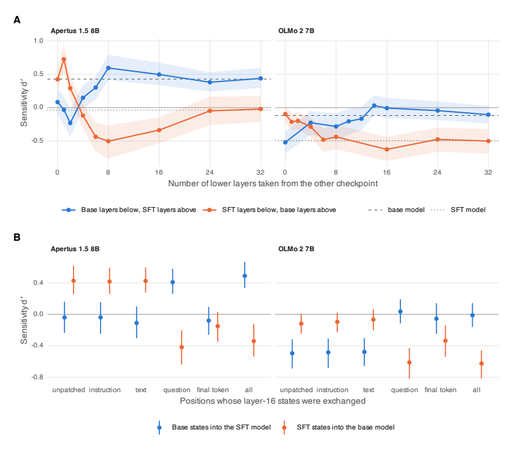
Figure 5 . Authorship: model stitching and activation patching at layer 16. (A) Model stitching between base and SFT checkpoints (textbook summaries; the numbers of layers that were tested differ between the two directions and between the models). The x-axis gives the number of lower layers taken from the other checkpoint. Blue: base layers below, SFT layers above; orange: SFT layers below, base layers above. Dashed and dotted lines mark the sensitivity of the unmodified base and SFT models; bands are 95% bootstrap confidence intervals. (B) Activation patching at layer 16: sensitivity after exchanging the internal states at the indicated positions. Blue: base model’s states inserted into the SFT model; orange: SFT model’s states inserted into the base model. “Unpatched” shows the recipient model without any exchange. Error bars are 95% bootstrap confidence intervals. Patching at layer 8 (more mixed; text positions contribute somewhat) is shown in Supplementary Figure S1.
원문 · CC BY 4.0 · Jochen Laubrock · Represented but misread: Post-training changes how language models read out what they represent · 원문 그림 인용 · 원본 PDF 25쪽에서 그림 영역을 추출했습니다.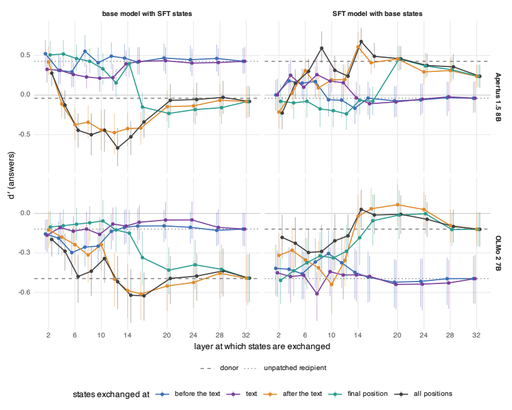
Figure 6 . Authorship: activation patching across layers (textbook summaries, 238 texts; error bars: 95% grouped-bootstrap confidence intervals). Sensitivity (d′) of the recipient checkpoint after its residual stream was replaced by the donor’s at one set of positions and one layer: the instruction before the text, the tokens of the text, the question and answer cue after the text, the final position only, or all positions. Note that the two rows have different scales. Horizontal lines show the unpatched recipient (dotted) and the donor (dashed). In OLMo 2, the text states had no effect at any layer; in Apertus, they carried part of the difference between the checkpoints up to layer 12. The instruction positions carried part of it in the lower layers of both models. From layer 14 onward, the states after the text carried it in both models. Hybrids can lie outside the range of the two checkpoints.
원문 · CC BY 4.0 · Jochen Laubrock · Represented but misread: Post-training changes how language models read out what they represent · 원문 그림 인용 · 원본 PDF 29쪽에서 그림 영역을 추출했습니다.부정문 진술에서의 반대 방향 변화
작성자 코퍼스는 공유할 수 없으므로, 공개 데이터인 참·거짓 진술 판단을 같은 분석으로 재현했습니다. 이 경우 post-training은 반대 방향으로 작용했습니다. 여러 기반 모델은 부정문 진술의 진리를 프로브로 거의 완벽히 해독할 수 있었지만, 답은 그 정보를 잘 쓰지 못했습니다. 예를 들어 OLMo 2 기반 모델의 d′는 0.80이었고, Apertus 기반 모델은 −0.88이었습니다. SFT는 이 답을 고쳤으며, 프로브는 최대치에 머물렀습니다.
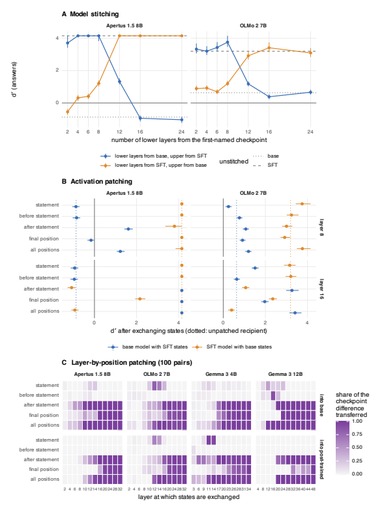
Figure 7 . Negated statements: where supervised fine-tuning repairs the readout (300 statement pairs; error bars: 95% grouped-bootstrap confidence intervals). (A) Model stitching: sensitivity (d′) of the an- swers of hybrids that take the first ℓ layers from one checkpoint and all layers above from the other; horizontal lines show the unstitched base (dotted) and SFT (dashed) checkpoints. (B) Activation patch- ing at layers 8 and 16: d′ of the recipient checkpoint after its residual stream was replaced by the donor’s at one set of positions (the statement, the instruction before it, the question and answer cue after it, the final position only, or all positions); dotted lines show the unpatched recipients. Note that in the truth prompt the question precedes the statement, so that the positions after the statement contain only the answer instruction and cue. (C) The same exchange at 12 layers (100 statement pairs), for base and SFT model of OLMo 2 and Apertus and for base and final post-trained model of Gemma 3 4B and 12B: share of the difference between the two checkpoints that the exchange transferred (values below 0 and above 1 are clipped). Upper row: the base model receives the states of the post-trained model (“into base”); lower row: the post-trained model receives the states of the base model.
원문 · CC BY 4.0 · Jochen Laubrock · Represented but misread: Post-training changes how language models read out what they represent · 원문 그림 인용 · 원본 PDF 33쪽에서 그림 영역을 추출했습니다.Apertus에서는 진술 뒤 위치의 상태가 차이의 대부분을 옮겼습니다. 두 모델은 수복이 중간 깊이 이후 진술 뒤 위치에 있다는 점에서는 같았지만, 진술 자체의 표현이 기여한 정도는 달랐습니다.
훈련 신호가 읽기 방향을 정하는가
OLMo 2 7B 기반 모델을 같은 대화 데이터에 더해진 작은 판단 집합만 달리하여 미세조정했습니다. 올바른 라벨의 뉴스 작성자 판단 2,000개를 더한 조건(C1)은 뉴스 보류 세트에서 d′를 4.28로 높였고, 다른 텍스트 코퍼스의 민감도도 개선했습니다. 그러나 같은 조건은 짧은 채팅에서 d′ = −0.58로 우연 수준보다 낮아졌습니다. 무작위 라벨(C3)이나 관련 없는 과제(C4)와 비교해도 이 차이는 뚜렷했습니다.
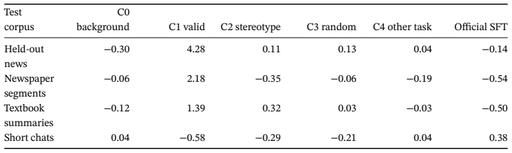
Table 4 . Training study: sensitivity (d′) of the answers of OLMo 2 7B after fine-tuning with background conversations only (C0) or with additional authorship judgments with correct (C1), stereotyped (C2), or random labels (C3), or with an unrelated topic judgment in the same layout (C4), and of the official SFT checkpoint. Held-out news: 400 items from the distribution of the training texts. d′, mean over three seeds (per-seed d′, both answer orders averaged). C0 and C4 did not learn the answer words of the authorship question (probabil- ity of the two answer words .65–.76, vs. ≈ 1.0 in C1–C3); C3 therefore serves as a further baseline (see text).
원문 · CC BY 4.0 · Jochen Laubrock · Represented but misread: Post-training changes how language models read out what they represent · 원문 그림 인용 · 원본 PDF 36쪽에서 그림 영역을 추출했습니다.반면 대조 조건의 상관은 거의 없었습니다. 이는 훈련 신호가 읽기 방향을 정할 수 있음을 보여 주지만, 공식 SFT의 같은 방향성 감소를 완전히 재현하지는 못했다는 한계도 함께 남깁니다.
남은 문제
연구 대상은 4B에서 12B 파라미터 규모의 모델이며, 더 큰 모델에서 같은 낮은 수준의 판단이 나타나는지는 확인되지 않았습니다. 스티칭과 패칭의 작성자 분석은 체크포인트가 단계별로 공개된 두 모델에 한정되었습니다. 훈련 연구는 하나의 기반 모델과 저랭크 어댑터로 수행되었고, 배경 조건은 공식 SFT의 감소를 재현하지 못했습니다. 또한 무작위 라벨과 고정 시드 사이의 교란 요인은 학습 실행 후에야 확인되었습니다.
프로브는 정보가 해독될 수 있음을 보여 줄 뿐 모델이 실제로 쓰는지를 증명하지 않으므로, 저자들은 변화의 주장을 스티칭과 패칭 결과에 기대고 있습니다.
논문 정보
- 저자
- Jochen Laubrock
- 학회·저널
- arXiv · 프리프린트
- 최초 공개일
- 2026년 11월 19일
- 등록일
- 2026년 11월 23일
- 수정일
- 2026년 11월 19일
- 버전
- v1
- arXiv
- 2611.26584
- 분류
- cs.CL · cs.LG
- 원문 이용 조건
- CC BY 4.0
- 제공 범위
- 논문 정보, 해설, 허용된 원문 그림
AI 해설은 논문 원문과 별개의 설명이며 오류가 있을 수 있습니다. 원문과 그림은 각 출처의 이용 조건과 따로 표시된 권리를 따릅니다.
초록
Does post-training change what a language model represents, or how this representation is read out into an answer? We compared linear probes with the models' own answers, analyzed with signal detection theory, in six open-weight base models and their post-trained versions. For judgments of whether German texts were written by a human or an AI, probes and word n-gram classifiers separated the classes well, but the answers did not and often ordered the texts inversely. Post-training lowered the sensitivity of the answers on average ($Δd' = -0.34$ across model families; -0.29 across three prompts). It also changed the use of a stated base rate: Base models shifted their log-odds by less than the stated change in prior odds, most post-trained models by more. In two models with stage-wise checkpoints, the change occurred during supervised fine-tuning, model stitching implicated the early layers, and from mid-depth on internal states at positions after the text, not those of the text, transferred the change between checkpoints. Our corpora cannot be shared, so we add a case reproducible from public data, the truth of negated statements. Here, post-training acted in the opposite direction: Probes decoded truth at or near ceiling in every model, the answers of several base models did not use it, and post-training repaired them; by mid-depth the repair resided at the positions after the statement; below it, the representation of the statement contributed, strongly in one of four models. In a training study, adding 2,000 correctly labeled authorship judgments of news texts to otherwise identical fine-tuning data improved the answers on our newspaper and textbook corpora and inverted them on the chats, where they followed a news-trained probe of the base model. Post-training thus changed how a judgment is read out of what a model represents, and a small training signal can set its direction.
원문 인용
Jochen Laubrock (2026). Represented but misread: Post-training changes how language models read out what they represent. arXiv:2611.26584v1. https://arxiv.org/abs/2611.26584v1
BibTeX
@misc{laubrock2026represented,
  title = {{Represented but misread: Post-training changes how language models read out what they represent}},
  author = {Jochen Laubrock},
  year = {2026},
  eprint = {2611.26584},
  archivePrefix = {arXiv},
  url = {https://arxiv.org/abs/2611.26584v1}
}