論文解説
Portable Active Recovery under Timed and Position-Dependent Visual Outages
既存制御器の前に回復層を置き、映像途絶からドローンを復帰させる
- 課題 従来のドローン制御では、映像が途切れた原因が時間で戻るものか位置で戻らないものか区別できず、止まるか進むかのどちらか一方では両方の場合を完了できません。
- 手法 本研究は、既存制御器の前に回復モジュールを置き、制御器を変えずに付けます。遮蔽を検出すると急ブレーキをかけて後退し、視覚が戻るかを確かめます。
- 結果 新しい48シーンの確認実験で、最悪条件完了率が88.5%となり、比較した外部手法を上回りました。
定時の遮蔽と位置依存の遮蔽が見分けられない問題
ステレオカメラとIMUを使うクアッドロータは、使える画像が途切れると、IMUの積分だけで状態を推定し続けます。追従制御器はずれていく推定値を見て動き続けるため、空中で止まっているだけでは任務の回復になりません。問題は、遮蔽の原因が2種類あるのに、遮蔽が始まった時点ではその違いを区別できないことです。定時遮蔽(T8、8 s)では、時間が経てばカメラが自動で戻ります。一方、位置依存の暗所(SLONG、1.35 m弧)では、機体が領域の外へ出るまで映像は戻りません。
この2つは、正反対の対応を求めます。止まって待つ方法はT8で93/96の飛行を完了しますが、SLONGでは0/96で、13件がハードフェイルになります。逆に予定どおり進み続けると、SLONGの多くの区間は通れても、定時遮蔽では外部トラッカーで7–12件のハードフェイルが起きます。そのため、遮蔽の仕組みが分からないまま任務を完了するには、止まるか進むかを判断する能動的な層が必要になると著者らは考えています。
最悪条件完了率による評価
本研究の着想は、既存制御器の参照信号の手前に回復層を置き、遮蔽の種類が分からなくても回復を進められるようにすることです。回復層はホストの重みを変えず、展開可能な信号と参照だけを扱います。ホストが位置と速度の参照を追従できれば、同じ層をどの制御器にも付けられる構成です。
評価では、T8とSLONGのそれぞれの完了率のうち小さい方を取り、最悪条件完了率Wとします。式で書くと、W(a)=min{Cctrl(a,T8), Cctrl(a,SLONG)}です。ここでaは比較する手法、Cctrlは制御器の位置推定で判定した完了率を表します。片方の遮蔽だけに特化した手法は、この最小値で低く出るため、両方の遮蔽を見る評価になります。完了の判定は、ハードフェイルを避け、公称の遮蔽開始位置s0から0.25、0.50、0.75、1.0 mの下流ゲートを31 sより前に通過し、最終区間の経路誤差を0.30 m以下に保つことが条件です。Cctrlはさらに、視覚の再ロックと0.15 m以内の位置誤差を、制御器が使う推定位置ploc上で要求します。
実験の舞台は半径1.0 mの円軌道で、速度0.1925 m/s、32 sの周回です。シミュレータは20 Hzのステレオ画像と500 HzのIMUを生成し、画像が見えるときだけBasalt VIOに渡します。
止まる距離と後退プローブの解析
遮蔽を検出するまでに進んでしまう距離があり、そこから急減速して止まる分も加わります。減速の時間T*(v)は、最大加速度と最大躍度の上限から決まる最短の時間で、速度を0にする五次の速度遷移(quintic)として与えます。止まるまでの侵入深さは次のように書け、検出の遅れτdetと監視の遅れδが効きます。 \[ d_{stop}(v,\delta)=v(\tau_{det}+\delta)+\tfrac{1}{2}vT^*(v) \]
後退プローブの予算Lpが dstop+drelock より大きければ、機体は入口側の境界を抜けて視覚が戻ります。この解析で使う定数は、amax=0.5 m/s²、jmax=0.7 m/s³、τdet=0.15 s、Δttick=0.5 sです。その結果、侵入深さは1.0×で0.20 m、1.25×で0.27 mとなり、計画した0.50 mの予算の内側に収まります。
解析上の評価では、4 sの保持から進む方法は11.5〜12.2 sの盲目区間になるのに対し、後退して戻る方法は中央値7.2 sとなります。ただし、これは1次元の運動学モデルによる解析で、実機の値ではありません。また、周回経路は1.34×付近で次の周回の遮蔽領域に入るため、速度を上げられる範囲にも上限があります。
遮蔽検出から合流までの状態遷移
図1は、回復参照rrecと帰還位置pfbを出力するモジュールの構成を示しています。観測器は、視覚更新の経過時間が0.15 sを超えたときに遮蔽を宣言し、そのときの最後の視覚時刻を遮蔽予算の起点として保持します。監督器は50 Hzで位置と速度を見ながら、2 Hz(0.5 s)ごとに状態を切り替えます。遮蔽が始まると、まず急ブレーキをかけ、ログした経路を逆向きに0.50 mまで戻る後退プローブに入ります。後退中に視覚が戻れば、空間的な遮蔽を見たとして spatial_seen を立て、以後の遮蔽では前進を続けます。後退しても視覚が戻らないT8のような場合は、停止して保持し、6 s後に前進へ移ります。
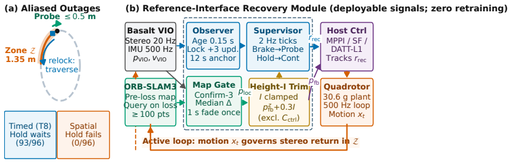
Figure 1 .Problem structure and portable recovery architecture. (a) Timed (T8) and spatial (SLONG) outages are observationally aliased at loss onset under online telemetry; a bounded backward probe (0.50 m planned budget) exits Z to restore KLT tracking and latch spatial_seen. (b) The recovery module operates solely on deployable telemetry and references without modifying host controller weights, outputting recovery reference rrec and feedback position pfb (with optional support- and consistency-gated ORB-SLAM3 translationα∆).C ctrl scoresp loc before height-integral trim;C VIO scores rawp VIO.
出典 · CC BY 4.0 · Jinyuan Zhang, Shengshuo Jiao · Portable Active Recovery under Timed and Position-Dependent Visual Outages · 論文の図を引用 · 元のPDFの4ページ目から図の部分を抽出しています。HOLDから視覚が戻ると、速度が0.20 m/s以下の状態が0.5 s続くまで待ち、3 s以上かけて五次の滑らかな接続で公称経路へ戻ります。前進中の再ロックでは、位置のずれが0.30 mを0.5 s以内に超えるとブレーキをかけて整定し、それ以外は公称経路を続けます。遮蔽が12 sを超えて続く場合は、終端状態のEXHAUSTEDに入ります。
シミュレーションのMPPIとLOTFでは、鉛直加速度が公称の飛行パラメータより約1.2 m/s²高く出るため、積分項で鉛直方向の帰還を補正します。積分項は、200回の有効な問い合わせのあとに動き、クランプ付きで pzfb=pzloc+0.3I として帰還に加えます。この補正はCctrlの判定からは外されています。
地図分岐では、遮蔽前に作った地図を使い、ORB-SLAM3の並進候補 δ=pmap−pVIO を求めます。候補が3回続けて0.05 m以内で揃うと、その座標ごとの中央値Δを採用し、最初の確定では1.0 sかけてαを0から1へ線形に上げます。地図は制御器の位置推定plocにのみ作用し、生のVIO位置には入りません。
EV4での完了率と既存手法との差
EV4は新しい48シーンでの確認実験で、各条件は48シーンと2実行の計96フライトです。完全な手法(MPPI+モジュール+地図)は、T8で93/96、SLONGで85/96を完了し、最悪条件完了率は88.5%(95%区間は[81.2, 94.8])となりました。事前に決めた主要比較H1は、この値と開発段階で選んだDATT-L1 C7の最悪条件完了率との差で、+29.2 pp[17.7, 40.6]です。この差は、開発シーンで選んだ既存設定と比べても、最悪条件での差が正の側に残ることを示しています。
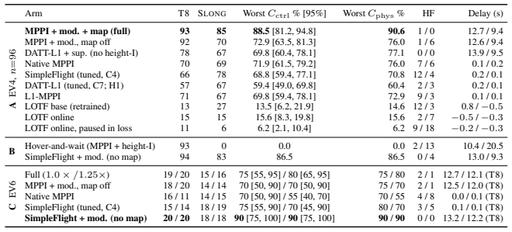
Table 1 .Task completion across confirmatory EV4 (A, 48 fresh scenes × 2 execs, n= 96 /cell), paired follow-up batches on EV4 scenes/seeds (B), and two-speed EV6 (C, 10 fresh scenes, n= 20 /cell, analyzed separately). Slash notation denotes T8/SLONGinA–B (HF and Delay) and 1.0×/1.25× inC(HF sums both outages per speed; Delay shows T8). “Mod.” = supervisor + height-I; DATT-L1 uses supervisor alone. Worst Cctrl reports 95% scene-cluster intervals; Delay is median end-of-flight true-progress lag (s) on non-failed runs. FullC VIO and contrasts appear in Section E.
出典 · CC BY 4.0 · Jinyuan Zhang, Shengshuo Jiao · Portable Active Recovery under Timed and Position-Dependent Visual Outages · 論文の図を引用 · 元のPDFの5ページ目から図の部分を抽出しています。止まって待つ方法(HLD5)は、T8で93/96と完全な手法と同等ですが、SLONGでは0/96で、13件がハードフェイルです。探索してから前進を続ける仕組みを入れると、地図なしでもSLONGは0/96から70/96に上がり、差は+72.9 pp[63.5, 81.2]です。つまり、定時遮蔽では止まることが有効で、位置依存の遮蔽では戻るための後退が欠かせない、という役割分担が見えます。
地図分岐を加えると、MPPIのSLONGは70/96から85/96になり、Cctrlで+15.6 pp[5.2, 26.0]の差です。一方、生のVIO位置で数えたCVIOの集計は70/96のまま変わらず、地図の効果は制御器の位置推定を通じたものだと読めます。外部の6つの比較対象との差は、Bonferroni補正後の99.17%区間でもすべて0より大きくなりました。ネイティブMPPIとの差は+16.7 pp[4.2, 32.3]です。ただし、比較対象の設定は開発シーンで選び、評価は確認用の新しいシーンで行っています。
視覚復帰時の再獲得の差
著者らは、停止が効く理由を盲目中の慣性ドリフトを抑えるからだとする直感を、軌道の診断で確かめています。4 sの時点で、MPPIとSimpleFlightのドリフトの差は1 cm以下で、MPPIの角速度の励起は4.4倍あります。ドリフトの大きさは行動の違いによらず似ているため、差は視覚が戻る瞬間にあると解釈できます。
止まるか既知のテクスチャへ戻った場合、BasaltのKLT光学フローが直ちに追跡を戻し、蓄積した盲目誤差の2–8%しか残りません。悪い再獲得はMPPIとDATT-L1では13–29%、SimpleFlightでは6–11%のフライトで起きました。同じ遮蔽でも、戻った先の映像の質が完了を左右していると見られます。
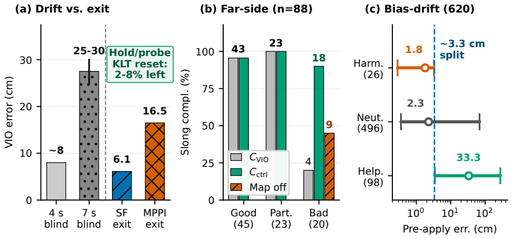
Figure 4 .Archived-trace mechanistic diagnostics. (a) Absolute VIO position error (cm): blind drift grows similarly across actions and hosts (≈8 cm at 4 s, ≤1 cm MPPI vs. SF gap despite 4.4× rate excitation; 25–30 cm at 7 s); after hold/probe, KLT retains only 2–8% of blind error (callout), whereas SLONGfar-side exits leave higher median error on MPPI + module (16.5 cm) than SF + module (6.1 cm). (b) EV4 SLONGfull-system runs with a classified far-side transition ( n= 88 of 96; 8 unclassified): on the 20 bad-class flights, completion rises from 4/20 (CVIO) to 18/20 (Cctrl), vs. 9/20 for paired map-off (+45 pp [11, 71]). (c) Offline pre-apply VIO error across 620 applied map segments (EV3+EV4+SWP5): all 26 harmful (≤3.25 cm) and all 98 helpful (≥3.44 cm) separate cleanly at 3.3 cm (496 neutral span both sides).
出典 · CC BY 4.0 · Jinyuan Zhang, Shengshuo Jiao · Portable Active Recovery under Timed and Position-Dependent Visual Outages · 論文の図を引用 · 元のPDFの8ページ目から図の部分を抽出しています。悪い再獲得の20フライトでは、地図分岐がCctrlでの完了を4/20から18/20に上げ、地図なしの同じ文脈では9/20でした。適用した620の地図区間では、98区間で制御器の誤差が3 sで5 cm以上減り、26区間で増えました。著者らは、VIOのずれが位置合わせの偏りを上回るときに地図補正が効き、KLTが誤差をリセット済みだと偏りを加えると解釈しています。
ホストの変更と速度の変更での結果
同じ回復部品を、MPPI、SimpleFlight、DATT-L1の3つの制御器に、重みを変えずに付けています。
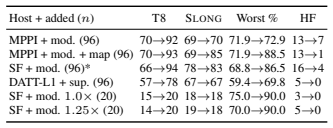
Table 2 .Zero-retraining host transfer: host alone → with re- covery components (Cctrl counts, worst %, and combined hard failures acrossbothoutages: nHF = 192 in EV4/PSF4, 40 in EV6). *Paired batch PSF4 on EV4 scenes/seeds.
出典 · CC BY 4.0 · Jinyuan Zhang, Shengshuo Jiao · Portable Active Recovery under Timed and Position-Dependent Visual Outages · 論文の図を引用 · 元のPDFの7ページ目から図の部分を抽出しています。1.25×(0.240625 m/s)では、ネイティブMPPIの最悪条件完了率は55.0%まで下がり、T8のハードフェイルは7件です。1.25×では監督付きの3手法がいずれもT8を20/20で完了し、完全な手法の最悪条件完了率は80.0%([65.0, 95.0])となりました。SimpleFlight+モジュールは両速度で90.0%([75.0, 100.0])となり、ハードフェイルは0/80です。EV6は10シーン、各条件20フライトなので、区間は広く、速度方向の検証は補助的に見るのが妥当です。
限界と未解決の課題
回復には代償があり、完全な手法では終端の進捗が遅れ、T8で12.7 s、SLONGで9.4 sの遅れが出ます。回復動作は飛行時間を約9〜14 s延ばすため、実機では障害物回避と物理的な飛行検証が前提になります。
評価は円軌道、2速度(0.193と0.241 m/s)、クリーンなステレオのフレーム欠落、ゼロ起動のIMUバイアス、ワークステーション上の実行に限られています。障害物の多い非円形の経路や、部分的な視覚劣化、実機の飛行はまだ検証していません。定時遮蔽の対照として、待ってから進む方法を同じ条件で比べる実験も、今後の課題として挙げられています。
EuRoCの再生実験では、1 sの遮蔽で誤差が0.092から0.160 mに増え、4 sでは0.196から0.173 mに減りました。シミュレーションの3件の地図あり失敗は、ドリフトに基づいて地図を切り替える仕組みがまだないため、残された課題です。ルール選択では学習型の監督を単一の学習シードでしか比べていないため、複数シードでの検証は今後の課題です。
論文情報
- 著者
- Jinyuan Zhang, Shengshuo Jiao
- 学会・ジャーナル
- arXiv · プレプリント
- 公開日
- 2026年11月20日
- 登録日
- 2026年11月23日
- 更新日
- 2026年11月20日
- バージョン
- v1
- arXiv
- 2611.27121
- カテゴリ
- cs.AI · cs.RO
- ライセンス
- CC BY 4.0
- 掲載内容
- 論文情報・解説・論文の図
この解説は、Refivuの韓国語解説をAIで翻訳したものです。不正確な翻訳や誤りが含まれる可能性があります。論文と図の利用条件は各出典に従います。
アブストラクト
When a camera blackout depends on physical position rather than elapsed time, stable hovering prevents visual recovery and mission completion. On stereo visual-inertial quadrotors without external localization, an exogenous timed blackout and an endogenous position-dependent dark zone appear identical at loss onset yet require opposite responses: hover-and-wait completes 93/96 timed blackouts but 0/96 spatial outages (13 hard failures), whereas blind continuation traverses many spatial zones yet fails heavily during timed blackouts. We formulate visual-outage recovery as a worst-condition active-observability problem and introduce a portable recovery module at the reference interface of an unchanged host controller with zero retraining. Using deployable telemetry alone, the module coordinates visual-loss detection, jerk-limited braking, bounded backward probing, settled rejoining, height-integral trim, and an optional gated prior-map branch. On a preregistered 48-scene benchmark (1,920 flights), our full MPPI configuration reaches 88.5% [81.2, 94.8] worst-condition completion, outperforming development-selected DATT-L1 by +29.2 pp [17.7, 40.6] and exceeding all six external baselines after Bonferroni correction. Attached without retraining to SimpleFlight, the module lifts worst-condition completion by +17.7 pp [7.3, 28.1] to 86.5% (and 90% across 1.0x/1.25x speeds, 0/80 hard failures). Trace diagnostics reveal that survival hinges on visual-inertial re-acquisition asymmetry at vision return -- not blind IMU drift suppression - and uncover a bias-drift map crossover confirmed on 72 held-out EuRoC windows.
論文の図
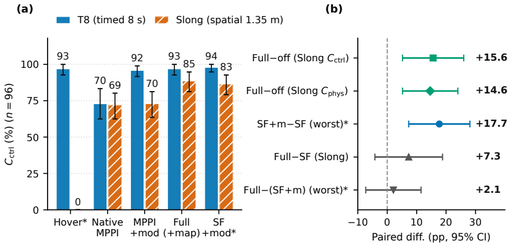
Figure 2 .Evaluated recovery configurations. (a) Per-condition Cctrl completions (n= 96 ) with exact 10,000-resample 95% scene-cluster bootstrap intervals. Asterisks (*) mark paired follow-up batches on EV4 scenes and seeds (HLD5 hover-and-wait on MPPI + height-I; PSF4 SimpleFlight + module without map). (b) Paired 95% scene-cluster contrasts (pp); confirmatory tests use worst-condition Cctrl (Table 1).
出典 · CC BY 4.0 · Jinyuan Zhang, Shengshuo Jiao · Portable Active Recovery under Timed and Position-Dependent Visual Outages · 論文の図を引用 · 元のPDFの6ページ目から図の部分を抽出しています。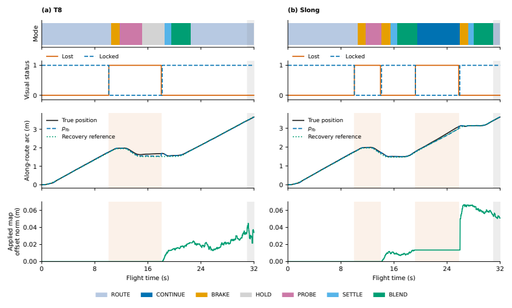
Figure 3 .Archived EV4 full-system flight timelines (first EV4 scene, execution 6; fixed index). Orange shading: observed visual loss; grey shading: final scoring window [31,32] s. (a) T8: brake, backward probe, hold until images return, settle, quintic blend, and one-time 1 s map fade. (b) SLONG: backward probe exits Z and restores KLT lock (latching spatial_seen); on re-entry, the vehicle traverses ZinCONT, re-locks on the far side, applies a step map update atα= 1, and completes the task.
出典 · CC BY 4.0 · Jinyuan Zhang, Shengshuo Jiao · Portable Active Recovery under Timed and Position-Dependent Visual Outages · 論文の図を引用 · 元のPDFの7ページ目から図の部分を抽出しています。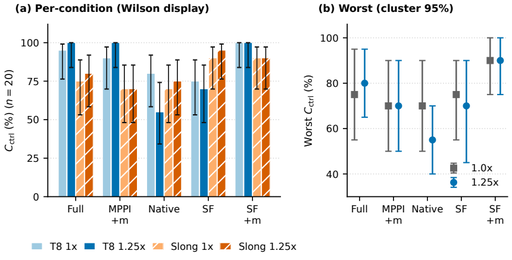
Figure 5 .EV6 transfer across two cruise speeds on ten fresh scenes ( n= 20 per cell). (a) Per-condition Cctrl completion with 95% Wilson display intervals. (b) Worst-conditionC ctrl with 95% scene-cluster bootstrap intervals fromEV6_readout.json.
出典 · CC BY 4.0 · Jinyuan Zhang, Shengshuo Jiao · Portable Active Recovery under Timed and Position-Dependent Visual Outages · 論文の図を引用 · 元のPDFの9ページ目から図の部分を抽出しています。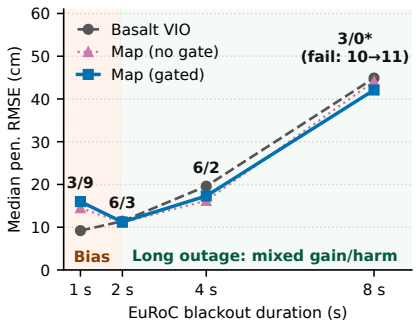
Figure 6 .Open-loop real-data EuRoC MA V replay across 72 held-out blackout windows (18 per duration; 7 unseen sequences). Labels show windows where the gated map lowers vs. raises penal- ized 10 s RMSE relative to raw Basalt VIO; *at 8 s, three improve and zero worsen among seven jointly scored windows while total failures move from 10/18 to 11/18.
出典 · CC BY 4.0 · Jinyuan Zhang, Shengshuo Jiao · Portable Active Recovery under Timed and Position-Dependent Visual Outages · 論文の図を引用 · 元のPDFの9ページ目から図の部分を抽出しています。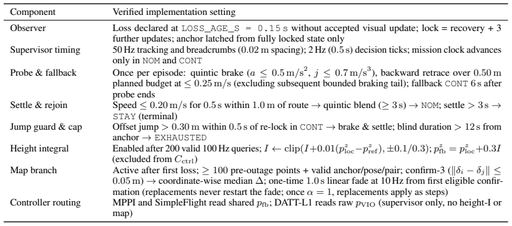
Table 5 .Frozen constants of the recovery module (verified against source code and frozen run records).
出典 · CC BY 4.0 · Jinyuan Zhang, Shengshuo Jiao · Portable Active Recovery under Timed and Position-Dependent Visual Outages · 論文の図を引用 · 元のPDFの16ページ目から図の部分を抽出しています。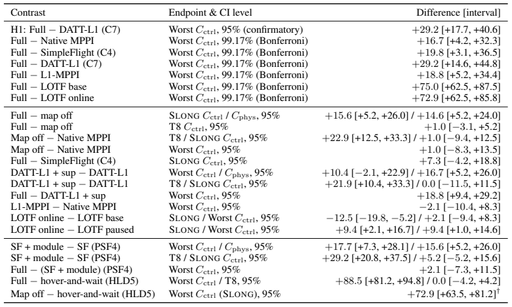
Table 8 .Complete EV4 confirmatory (top block) and descriptive EV4 / paired follow-up contrasts (middle and bottom blocks), in percentage points with 10,000-resample scene-cluster bootstrap intervals. †Paired follow-up bootstrap against hover-and-wait (0/96 in SLONG); the single-arm EV4 map-off interval is[63.5,81.3].
出典 · CC BY 4.0 · Jinyuan Zhang, Shengshuo Jiao · Portable Active Recovery under Timed and Position-Dependent Visual Outages · 論文の図を引用 · 元のPDFの17ページ目から図の部分を抽出しています。
Table 11 .EuRoC MA V held-out open-loop estimator replay (72 windows across 7 unseen sequences, 18 per duration; frozen summary GATE100_TEST_SUMMARY.md). Penalized 10 s RMSE medians and lower/higher window counts (within-window thresholded comparison against raw Basalt VIO; remaining windows are neutral or failed).
出典 · CC BY 4.0 · Jinyuan Zhang, Shengshuo Jiao · Portable Active Recovery under Timed and Position-Dependent Visual Outages · 論文の図を引用 · 元のPDFの19ページ目から図の部分を抽出しています。この論文を引用
Jinyuan Zhang, Shengshuo Jiao (2026). Portable Active Recovery under Timed and Position-Dependent Visual Outages. arXiv:2611.27121v1. https://arxiv.org/abs/2611.27121v1
BibTeX
@misc{zhang2026portable,
  title = {{Portable Active Recovery under Timed and Position-Dependent Visual Outages}},
  author = {Jinyuan Zhang and Shengshuo Jiao},
  year = {2026},
  eprint = {2611.27121},
  archivePrefix = {arXiv},
  url = {https://arxiv.org/abs/2611.27121v1}
}