Paper commentary
Portable Active Recovery under Timed and Position-Dependent Visual Outages
Portable recovery module lets quadrotors survive timed and position-dependent camera blackouts
- Problem Hovering fails when a camera blackout depends on position, because frames return only after the vehicle leaves the dark zone.
- Method The portable recovery module plugs into an unchanged host tracker's reference interface. It brakes, probes backward along its recorded path, and holds or continues depending on whether vision returns.
- Results Full MPPI reaches 88.5% worst-condition completion, outperforming DATT-L1 by +29.2 pp across 48 scenes.
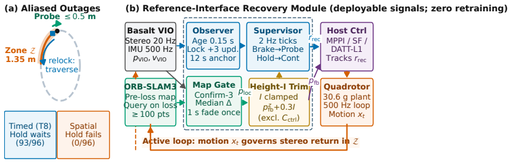
Figure 1 .Problem structure and portable recovery architecture. (a) Timed (T8) and spatial (SLONG) outages are observationally aliased at loss onset under online telemetry; a bounded backward probe (0.50 m planned budget) exits Z to restore KLT tracking and latch spatial_seen. (b) The recovery module operates solely on deployable telemetry and references without modifying host controller weights, outputting recovery reference rrec and feedback position pfb (with optional support- and consistency-gated ORB-SLAM3 translationα∆).C ctrl scoresp loc before height-integral trim;C VIO scores rawp VIO.
Original paper · CC BY 4.0 · Jinyuan Zhang, Shengshuo Jiao · Portable Active Recovery under Timed and Position-Dependent Visual Outages · Original paper figure · Extracted the figure area from page 4 of the original PDF.Why holding still is not enough
A stereo visual-inertial quadrotor that loses usable frames can keep hovering, but hovering alone does not finish a mission. Learned and adaptive controllers track well while pose estimates are available, yet a multi-second blackout leaves the tracker acting on inertial states that drift. Two blackouts look the same at onset: a timed blackout (T8, 8 s) returns frames on its own clock, while a position-dependent dark zone (SLONG, 1.35 m arc) returns them only after the vehicle physically leaves it.
Holding still suits T8, because the interval expires while the vehicle waits, and it completes 93/96 flights. The same hold fails in SLONG, completing 0/96 flights with 13 hard failures, because the vehicle stays inside the zone and vision never returns. Continuing along the schedule fixes the spatial case but produces 7-12 timed-outage hard failures across external trackers.
Neither fixed response works in both cases, so the controller has to act without knowing which outage it faces. The authors treat this as an active-observability decision layer that sits above low-level tracking, in the spirit of Simplex runtime assurance.
A probe that tests the outage
The key idea is to let the vehicle's own motion reveal the outage type: it brakes, then retraces its recorded path backward toward texture it has already seen. If vision returns during the probe, the zone is spatial and the flight can continue, while a probe that ends without vision leads the module to hold and continue later, as it does in T8.
The authors expect this to work for kinematic reasons: the stopping depth stays short enough that a 0.50 m probe can exit the zone.
The module sits at the reference interface between stereo VIO and an unchanged host tracker. It exchanges only deployable telemetry and trajectory references, so the host's weights never change. Its parts are a visual-loss observer, a supervisor with braking and probing logic, a height-integral trim and an optional prior-map translation branch.
Figure 1 places the two aliased outage classes beside this loop.
Stopping depth and probe budget
A one-dimensional arc-length model is used to answer this: the supervisor brakes with an exact quintic velocity transition whose minimum duration is T*(v). The minimum duration is \[ T^*(v)=\max\left(\frac{15v}{8a_{\max}},\ \sqrt{\frac{10v}{\sqrt{3}\,j_{\max}}}\right), \] where a_max and j_max are the acceleration and jerk limits. The penetration depth is \( d_{stop}(v,\delta)=v(\tau_{det}+\delta)+\tfrac{1}{2}vT^*(v) \), where τ_det is the detection delay and δ is the supervisor tick delay.
With the frozen constants, a_max of 0.5 m/s², j_max of 0.7 m/s³, τ_det of 0.15 s and a 0.5 s tick, the mid-tick depths are 0.20 m at 1.0× and 0.27 m at 1.25×. Both depths sit inside the 0.50 m planned probe budget, which is what lets the probe exit the zone.
The lemma says that when d_stop is below the zone length, a probe whose budget exceeds d_stop plus d_relock exits the entry boundary and restores vision. A hold-then-continue policy instead crosses the zone blind in one stretch, so its blind exposure is longer than the module's. In the analytical 4 s case, hold-then-continue gives 11.5-12.2 s of contiguous blindness, against a 7.2 s median for the module.
These bounds assume exact tracking of the quintic transition and the one-dimensional model, so they are analytical checks rather than closed-loop measurements.
How the supervisor runs an outage
Loss is declared when the age of the last accepted visual update exceeds 0.15 s. The episode anchors its blind budget at the last visual timestamp, and re-lock needs the recovery plus three more accepted visual updates.
The supervisor runs at 50 Hz on the feedback position and VIO velocity, but it changes mode only on 2 Hz ticks. On loss with spatial_seen unset, it brakes with a jerk-limited quintic (a at most 0.5 m/s², j at most 0.7 m/s³) and retraces the breadcrumbs backward over a 0.50 m planned budget at no more than 0.25 m/s. If vision returns during the probe, the supervisor latches spatial_seen and holds, so later losses continue along the route instead of probing again.
After re-lock in HOLD, the vehicle settles and then blends back to the nominal route with a quintic of at least 3 s. Re-lock in CONT triggers a jump guard, and blind exposure beyond 12 s from the anchor sends the episode to the terminal EXHAUSTED state.
On the MPPI and LOTF interfaces the plant produces about 1.2 m/s² more vertical acceleration than nominal hover parameters, which is why a trim is added.
After the first loss, the optional branch queries the retained pre-outage map with ORB-SLAM3 for translation candidates on frames with at least 100 map points. Three consecutive candidates that agree within 0.05 m confirm a coordinate-wise median offset, and α ramps from 0 to 1 over 1.0 s at 10 Hz. Later confirmations update the offset without restarting the fade.
Benchmark completion on EV4
On EV4, 48 fresh scenes with two executions each, the full MPPI configuration completed 93/96 T8 flights and 85/96 SLONG flights. Its worst-condition Cctrl is 88.5%, with a scene-cluster interval of 81.2 to 94.8, and the SLONG rate sets that minimum. Figure 2 plots the per-condition completion of each configuration beside its paired contrasts.
The preregistered contrast against development-selected DATT-L1 is +29.2 pp [17.7, 40.6]. All six external comparisons stay above zero under Bonferroni-adjusted 99.17% intervals, with the smallest being native MPPI at +16.7 pp [4.2, 32.3]. Physical completion agrees, at 90.6% for full MPPI.
Hover-and-wait matches the full system on T8 at 93/96 but collapses to 0/96 in SLONG. Adding the probe-and-continue supervisor without a map lifts SLONG from 0 to 70/96, which is the change that carries the spatial case.
On MPPI, adding the prior-map branch lifts SLONG completion from 70 to 85 of 96 flights, with +15.6 pp [5.2, 26.0] in Cctrl. Aggregate CVIO stays at 70/96, so the authors read the map as acting through the controller localization state rather than raw VIO.
Transfer to other hosts and speeds
Attached without retraining to SimpleFlight, the module raises worst-condition Cctrl by +17.7 pp [7.3, 28.1] to 86.5% in the paired batch on EV4 scenes and seeds. Combined hard failures across both outages fall from 16 to 4. The authors tie this gain to cleaner far-side exits on SimpleFlight.
DATT-L1 runs on raw VIO and has no height-integral trim, so this is a supervisor-only result.
EV6 uses ten fresh scenes at 1.0× and 1.25× cruise speed with n = 20 per cell, so its intervals are wide. Native MPPI drops to 55.0% worst-condition Cctrl at the faster speed, while full MPPI reaches 80.0% [65.0, 95.0]. SimpleFlight with the module reaches 90.0% [75.0, 100.0] at both speeds, with 0/80 hard failures.
What decides survival at vision return
Open-loop IMU drift grows quadratically and differs by at most 1 cm at 4 s between MPPI and SimpleFlight with the module. That holds despite 4.4× higher body-rate excitation on MPPI, so the stopping benefit does not come from slower drift.
After hold or backward probing back into seen texture, KLT optical flow re-anchors and leaves 2-8% of the accumulated blind error. The median error at loss-flag clear is higher on MPPI, at 0.165 m against 0.061 m on SimpleFlight across 96 paired SLONG runs.
On the 20 bad-class flights, the map branch raises same-flight completion from 4/20 under CVIO to 18/20 under Cctrl and Cphys. Paired map-off runs on the same 20 contexts complete 9/20, a gain of +45 pp [11, 71] for the map.
When map correction adds bias
Across 620 applied map segments in EV3, EV4 and SWP5, 98 cut controller error by more than 5 cm at 3 s, 26 raised it by more than 5 cm, and 496 were neutral. Offline pre-apply VIO error separates them at 3.3 cm: every harmful segment is at most 3.25 cm, and every helpful one is at least 3.44 cm.
The authors read this as map correction helping when VIO drift exceeds the alignment bias. When KLT has already reset the error, the same correction only adds bias.
Open-loop replay on 72 held-out EuRoC windows, scored by penalized 10 s RMSE, shows the same crossover. After 1 s blackouts the map raises RMSE from 0.092 m to 0.160 m, but after 4 s it lowers RMSE from 0.196 m to 0.173 m. Because this replay is open-loop, it measures real-data error rather than mission completion.
Limits and open steps
Active recovery adds end-of-flight progress lag, 12.7 s for T8 and 9.4 s for SLONG on full MPPI. The paper reports 9-14 s of progress lag in exchange for completion and safety gains, along with 0.89 to 1.06 m of added time-indexed tracking error.
All closed-loop runs use a circular trajectory at 0.193 and 0.241 m/s.
The authors list next steps: timer-only wait-then-continue ablations, probabilistic outage-regime inference that would replace the spatial_seen latch, and online drift-conditioned map gating.
Paper info
- Authors
- Jinyuan Zhang, Shengshuo Jiao
- Venue
- arXiv · Preprint
- First published
- 2026-11-20
- Added
- 2026-11-23
- Updated
- 2026-11-20
- Version
- v1
- arXiv
- 2611.27121
- Category
- cs.AI · cs.RO
- Original paper terms
- CC BY 4.0
- What we show
- Paper info, commentary and permitted figures from the original paper
AI commentary is a separate explanation from the original paper and may contain errors. The original paper and figures follow each source's terms of use and any rights noted separately.
Abstract
When a camera blackout depends on physical position rather than elapsed time, stable hovering prevents visual recovery and mission completion. On stereo visual-inertial quadrotors without external localization, an exogenous timed blackout and an endogenous position-dependent dark zone appear identical at loss onset yet require opposite responses: hover-and-wait completes 93/96 timed blackouts but 0/96 spatial outages (13 hard failures), whereas blind continuation traverses many spatial zones yet fails heavily during timed blackouts. We formulate visual-outage recovery as a worst-condition active-observability problem and introduce a portable recovery module at the reference interface of an unchanged host controller with zero retraining. Using deployable telemetry alone, the module coordinates visual-loss detection, jerk-limited braking, bounded backward probing, settled rejoining, height-integral trim, and an optional gated prior-map branch. On a preregistered 48-scene benchmark (1,920 flights), our full MPPI configuration reaches 88.5% [81.2, 94.8] worst-condition completion, outperforming development-selected DATT-L1 by +29.2 pp [17.7, 40.6] and exceeding all six external baselines after Bonferroni correction. Attached without retraining to SimpleFlight, the module lifts worst-condition completion by +17.7 pp [7.3, 28.1] to 86.5% (and 90% across 1.0x/1.25x speeds, 0/80 hard failures). Trace diagnostics reveal that survival hinges on visual-inertial re-acquisition asymmetry at vision return -- not blind IMU drift suppression - and uncover a bias-drift map crossover confirmed on 72 held-out EuRoC windows.
Quote from the paper
Jinyuan Zhang, Shengshuo Jiao (2026). Portable Active Recovery under Timed and Position-Dependent Visual Outages. arXiv:2611.27121v1. https://arxiv.org/abs/2611.27121v1
BibTeX
@misc{zhang2026portable,
  title = {{Portable Active Recovery under Timed and Position-Dependent Visual Outages}},
  author = {Jinyuan Zhang and Shengshuo Jiao},
  year = {2026},
  eprint = {2611.27121},
  archivePrefix = {arXiv},
  url = {https://arxiv.org/abs/2611.27121v1}
}