Paper commentary
Scalable Evaluation of Medical AI using Evidence-based Practice Recommendations
Automated pipeline turns clinical guidelines into verified medical AI test cases
- Problem Hand-written clinical benchmarks are costly to build and struggle to cover regional differences and updated guidelines. Each new branch of care needs more physician authoring.
- Method The method extracts criteria and decision trees from BMJ Best Practice monographs, then verifies them. Gemini 3 Flash writes patient scenarios from the verified records, and an autorater grades plans.
- Results Across Gemini models, adding web search raised adherence by 0.8 percentage points and multi-sample synthesis by 2.2 points, and the gains combined to 2.8 points.
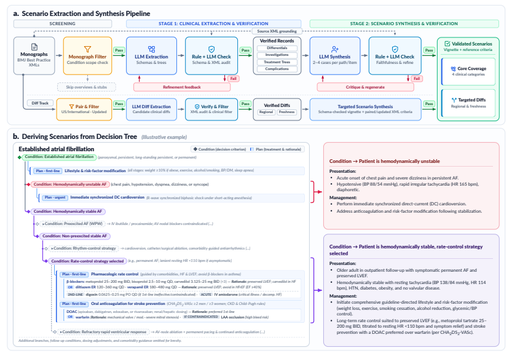
Figure 2 | Automated guideline extraction pipeline and decision-tree scenario generation. a. Scenario extraction and synthesis pipeline: raw guidelines undergo LLM-based structured extraction, and rule- plus LLM-based faithfulness checks grounded against the source XML to produce verified clinical records, followed by vignette synthesis and iterative verification. Separately, pairs of clinical monographs (paired regional and updated editions) are processed with automated XML verification and clinical filtering to contribute additional targeted scenarios alongside the core set of scenarios.b. Summarized illustrative example of deriving clinical scenarios from a branching treatment decision treeforEstablishedatrialfibrillation(abridgedforvisualclarity; fullschemasandpromptsinSectionA), showing how different conditional branches (e.g., an unstable presentation requiring synchronized direct-current cardioversion versus a stable outpatient presentation managed with rate control, oral anticoagulation, and risk-factor modification) map to distinct patient presentations and management criteria. Note: this example decision tree was condensed to illustrate the branching and was extracted from an earlier timepoint’s clinical monograph. The actual contents may not necessarily reflect accurate, up-to-date medical information.
Original paper · CC BY 4.0 · Teya Bergamaschi, Bijal Rajput, Akshay Goel, Matthew Thompson, Jacqueline Shreibati, Dave Steiner, Ashley Carrick, Mahvish Nagda, Dale R. Webster, Avinatan Hassidim, Katherine Chou, Yossi Matias, Po-Hsuan Cameron Chen, Christina Chen, Mike Schaekermann, Yun Liu, Anil Palepu · Scalable Evaluation of Medical AI using Evidence-based Practice Recommendations · Original paper figure · Extracted the figure area from page 7 of the original PDF.Why hand-written benchmarks stall
Open-ended benchmarks of clinical management depend on people writing each case and its rubric by hand. Multiple-choice sets scale easily, but they reduce a clinical decision to picking one option. Newer open-ended suites still rely on physician-authored rubrics or static case banks, so each new branch of care costs more authoring.
The gap matters most when practice differs by country or shifts over time. Models trained mostly on US text may default to US thresholds, and retrieved text can conflict with what a model already learned. Comparing longitudinal revisions and regional editions of one guideline offers a direct way to test both problems. The authors start from BMJ Best Practice, which already maintains regional editions and continuous evidence updates.
Turning monographs into verified scenarios
The key idea is to let the guideline supply both the patient cases and the criteria used to grade answers. Gemini 3 Flash parses each monograph into records for differential diagnosis, investigations and complications, plus treatment decision trees. Branch nodes hold patient states, treatment entries hold prioritized interventions, and child nodes hold follow-up steps.
Each path through a tree gives a different presentation, which is how the method reaches conditional branches of care.
Before any vignette is written, every record faces a verification stage. Deterministic rules catch structural faults such as cycles in a tree, empty required fields and duplicate entries. An LLM critique and a separate direct XML audit then check clinical accuracy, safety and grounding in the source text. Flagged records are refined against the same XML, so only verified records move on.
From each verified item or tree path, Gemini 3 Flash writes 2–4 candidate scenarios, including atypical and high-acuity presentations. Rule checks strip explicit guideline mentions, and an LLM verifier regenerates a candidate for up to 5 retries when it finds drift from the source. Each vignette comes with an open-ended prompt and reference grading criteria.
The authors sample a balanced 3,200-scenario core benchmark, 800 scenarios per clinical category. A separate 200-scenario set, 50 per category, serves physician evaluation and autorater calibration.
The corpus and the three suites
The corpus holds 436 BMJ Best Practice monographs, 354 US editions and 82 International editions. The International editions cover topics where regional recommendations differ and draw on US, UK, European and other global guideline producers. Core and physician evaluations use a July 2026 snapshot, while the targeted suites use a September 2026 snapshot.
The Temporal Freshness suite has 630 scenarios drawn from 140 of 283 revised US topics. Together with the core benchmark, the three suites total 4,561 scenarios.
Grading plans on a four-tier scale
Each plan receives one of four scores, from 4 for Adherent / Acceptable down to 1 for Major Deviation. Guideline adherence is the share of plans rated 4. Before scoring, the autorater matches the plan's key actions against the reference criteria and writes a short rationale.
The autorater was calibrated against physician ratings of standalone AI plans on the 200-scenario set. Test-retest exact agreement was 98.5%, and changing prompt order or response length moved exact agreement only between 95.5% and 97.0%.
Search and synthesis on the core benchmark
Against baseline, web search raised average adherence by 0.8 percentage points, and four-sample synthesis raised it by 2.2 percentage points. So the two gains add up rather than overlap.
Conditioning on corpus guidelines raised adherence further, but dynamic retrieval trailed the oracle setting for every model. This matters because a full monograph places competing branches in context at once.
Major Deviations stay between 0.18% and 0.87% across all configurations. Flash Lite models gain little from web search, unlike the standard Flash models.
Retrieval recall and long-context limits
Dynamic retrieval, a form of retrieval-augmented generation (RAG), selects titles from the closed corpus by the vignette.
Recall gains beyond K=3 were largely offset by extra competing monographs in context.
Updated and regional guidance
Temporal Freshness scenarios test whether a model follows guidance revised between corpus snapshots. Ungrounded models scored 70.9% on average across models. Web search added 4.6 percentage points on average across seven models. Supplying the revised edition added 15.0 percentage points, while supplying the superseded edition pulled adherence below baseline.
On Regional Specificity, models scored higher on US scenarios than on paired International ones, by 11.1 percentage points on average. The authors suggest base models encode US-centric clinical knowledge more strongly, which would explain this asymmetry.
Physicians before and after AI plans
Nine primary care physicians each wrote a plan for one of the 200 scenarios, first without AI and then after viewing an AI plan. The AI plan came from Gemini 3 Flash with Search + Synth-4. Their gaps were mostly omitted workups, first-line or subspecialty therapies and safety checks.
After AI assistance, adherence rose to 70.0%. Physicians left plans unchanged more often in primary care (22.1%) than in specialist care (7.5%).
Tier upgrades were 25.5% (51/200) and downgrades were 3.0% (6/200). Detrimental edits were rare: 4.0% added an inappropriate test or treatment, and 3.5% dropped a required diagnostic test. Most additions were diagnostic workups, treatments, counseling and referrals. The authors point out that these additions carry implications for utilization and cost.
Limitations
Scenarios are single-turn text vignettes with pre-compiled histories and test results. They don't capture iterative history-taking, multimodal inputs or follow-up management. The authors also saw occasional setting ambiguities and parsing artifacts in decision trees.
Both regional editions come from one publisher and mostly reflect high-income health systems. The autorater's calibration used AI-generated plans with only one physician-rated Major Deviation. Blinded validation on physician-authored plans and on severe errors is still needed. Guidelines are also an imperfect proxy for individualized care, because real practice departs from pathways for patient preferences and local resources.
Paper info
- Authors
- Teya Bergamaschi, Bijal Rajput, Akshay Goel, Matthew Thompson, Jacqueline Shreibati, Dave Steiner, Ashley Carrick, Mahvish Nagda, Dale R. Webster, Avinatan Hassidim, Katherine Chou, Yossi Matias, Po-Hsuan Cameron Chen, Christina Chen, Mike Schaekermann, Yun Liu, Anil Palepu
- Venue
- arXiv · Preprint
- First published
- 2026-11-20
- Added
- 2026-11-23
- Updated
- 2026-11-20
- Version
- v1
- arXiv
- 2611.27007
- Category
- cs.AI · cs.HC
- Original paper terms
- CC BY 4.0
- What we show
- Paper info, commentary and permitted figures from the original paper
AI commentary is a separate explanation from the original paper and may contain errors. The original paper and figures follow each source's terms of use and any rights noted separately.
Abstract
Rigorously evaluating medical artificial intelligence (AI) requires testing open-ended clinical management across diverse presentations and stages of care. However, existing benchmarks rely on manual expert authoring, limiting coverage across conditions, conditional care pathways, and evolving guidelines. We develop an automated pipeline that extracts and verifies structured clinical criteria and branching decision trees from practice recommendations to generate scenarios spanning the care continuum, including nuanced presentations and practice variations across regions and guideline editions. Applied to 436 BMJ Best Practice clinical monographs (354 US, 82 International), this yields 3,200 scenarios spanning differential diagnosis, investigations, treatment, and complications, plus targeted suites for regional specificity (731 US/International pairs) and temporal freshness (630 scenarios). To grade responses, we develop a clinician-calibrated autorater that scores management plans on a 4-point rubric stratifying deviations by clinical severity. Across Gemini models, scaling improves adherence, while web search (+0.8 percentage points [pp] on average) and multi-sample synthesis (+2.2 pp) combine additively (+2.8 pp). In context, full monographs consistently trail condensed excerpts. On targeted suites, web search narrows international performance gaps (+4.2 pp) and improves adherence to newly updated guidance (+4.6 pp). In a study with Primary Care Physicians (n = 9) across 200 scenarios, AI assistance raises adherence from 50.5% to 70.0%, driven largely by fewer clinical omissions. Overall, our results demonstrate a scalable evaluation setup using an evidence-based corpus originally written to guide human clinical decision-making, and demonstrate its viability to assess medical AI and its assistance on clinician decision-making.
Quote from the paper
Teya Bergamaschi, Bijal Rajput, Akshay Goel, Matthew Thompson, Jacqueline Shreibati, Dave Steiner, Ashley Carrick, Mahvish Nagda, Dale R. Webster, Avinatan Hassidim, Katherine Chou, Yossi Matias, Po-Hsuan Cameron Chen, Christina Chen, Mike Schaekermann, Yun Liu, Anil Palepu (2026). Scalable Evaluation of Medical AI using Evidence-based Practice Recommendations. arXiv:2611.27007v1. https://arxiv.org/abs/2611.27007v1
BibTeX
@misc{bergamaschi2026scalable,
  title = {{Scalable Evaluation of Medical AI using Evidence-based Practice Recommendations}},
  author = {Teya Bergamaschi and Bijal Rajput and Akshay Goel and Matthew Thompson and Jacqueline Shreibati and Dave Steiner and Ashley Carrick and Mahvish Nagda and Dale R. Webster and Avinatan Hassidim and Katherine Chou and Yossi Matias and Po-Hsuan Cameron Chen and Christina Chen and Mike Schaekermann and Yun Liu and Anil Palepu},
  year = {2026},
  eprint = {2611.27007},
  archivePrefix = {arXiv},
  url = {https://arxiv.org/abs/2611.27007v1}
}