Paper commentary
GRACE: Controlled Evidence Interventions for Diagnosing and Improving Knowledge Integration in GraphRAG
GRACE tests whether GraphRAG answers come from the supplied graph or memory
- Problem Aggregate accuracy cannot show whether GraphRAG failures come from missing paths, distractors, or conflicts with the model's own knowledge. Existing robustness tests mostly perturb passages, so they miss failures caused by graph structure.
- Method GRACE holds each question fixed and varies its evidence graph across five controlled states. Each state severs a support path, adds distractors, attaches hubs, or swaps in a counterfactual answer.
- Results QCFSE-SA improves controlled-state accuracy from 57.17% to 62.78% over Full-KG plain. Its broken-state accuracy rises from 55.41% to 67.85%.
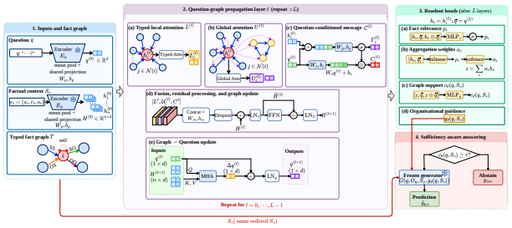
Fig. 2 .QCFSE-SA architecture. Typed local attention follows fact-graph edges, global attention compares all facts, and question-conditioned messages couple the two repre- sentations. Separate readouts estimate fact relevance, aggregation weights, and graph support before sufficiency-aware answering.
Original paper · CC BY 4.0 · Minh Pham, Quang Nguyen, Phong Kieu, Cong Tran · GRACE: Controlled Evidence Interventions for Diagnosing and Improving Knowledge Integration in GraphRAG · Original paper figure · Extracted the figure area from page 8 of the original PDF.Why one accuracy score hides the failure
A GraphRAG system mixes what the language model already knows with evidence pulled from a graph. If the system answers Euro, the model may have produced that answer from memory while ignoring the graph. The harder cases are graphs with relevant facts that still don't suffice, plausible distractors such as French franc, and hub entities that look salient without bearing on the question.
A single end-to-end score merges all of these failure modes into one number.
Earlier robustness tests mostly perturb passages, so they miss failures that come from the structure of a graph. Adaptive retrieval policies decide from the question or the model's confidence before any evidence is seen. An error therefore can't be traced to routing, evidence organisation or a missed insufficiency check.
Building five matched evidence states
The authors keep the question, the four options and their letters fixed, and change only the graph and its target. Questions and SPARQL queries come from LC-QuAD 2.0, and the queries are executed on Wikidata. The pipeline resolves the answer and its supporting path, maps identifiers to English labels, and extracts a clean subgraph around that path.
Each question yields five states: clean, broken, type matching, topological and swapping. The broken state removes one critical edge on the gold path, so the correct option becomes Insufficient information to answer. The swapping state replaces the supported answer with a distinct entity, which tests whether the model follows the supplied graph over its memory.
Each option tuple holds the factual answer, the swapped entity, the insufficient-information option and one extra distractor. The target letter changes with the state, and the controlled average also rewards abstention after evidence removal. Of 6,046 candidates, 4,028 pass every check, which gives 20,140 observations with complete five-state coverage.
Why relevance alone can't justify an answer
The authors split the graph problem into two decisions: which facts matter for the question, and whether those facts jointly complete a proof. A fact can stay relevant after the decisive path is removed, so relevance by itself can't justify an answer. Their key idea is to keep question-conditioned organisation and add a separate sufficiency check for the graph as a whole.
QCFSE organises the complete supplied graph under the question, while QCFSE-SA also estimates whether the graph as a whole supports an answer. The generator stays frozen, so any change in the answer has to come from the evidence side.
How the typed attention and readouts work
Each KG triple becomes a fact node, and two nodes are linked when a subject or object endpoint of one matches an endpoint of the other. The edge type records which endpoints match, using SS, SO, OS, OO, self or no edge. A frozen encoder embeds the question and the verbalised triples, and a learned projection turns them into initial states.
At each layer, typed local attention scores only neighbouring facts and adds a learned bias for each edge type, so structural role can matter apart from meaning. Global attention runs over all facts with no adjacency mask, so it can compare facts that share no endpoint. A question gate injects the question into each fact, and the local, global and question messages are fused before the transformer block.
After the last layer, a question-conditioned softmax gives weights \(\alpha_i\) and a graph summary \(z\) built from the fact states. A per-fact head predicts relevance \(p_i\), and a separate graph head predicts the support probability \(c_\theta(q, S_v)\). The authors keep these roles apart: the weights aggregate facts, the per-fact scores flag critical facts and the graph score judges the whole graph.
The metadata passed to the generator contains no option letters, candidate answers or generator outputs.
Training the support head and setting its threshold
Training uses only questions and paired clean and broken graphs, with no answer options or generator responses. A fact loss marks the facts removed by severing, and two margin losses push the support score of the clean graph above the broken graph and above a mismatched question. The question-mismatch term stops the support head from treating generic graph completeness as support for the question.
The threshold is chosen on a disjoint set of 300 questions by maximising controlled-state accuracy, then frozen before testing. Both arms receive the same serialised context, and only the guidance is appended for QCFSE-SA.
Question-only routing gates
The authors trained two DeBERTa-v3-base probes to predict answerability from the question alone. The open-ended gate scored 1.40 points above always retrieving and saved 11.59% of calls. The option-aligned gate saved 68.42% of calls, but it lost 2.32 points on average compared to always retrieving.
Most of the option-aligned loss sits on swapping, where accuracy fell 9.66 points. The gate sees only the question, so it applies the same route to every state and can suppress context exactly when the graph must override memory.
What the retrieval-framework runs show
GraphRAG, LightRAG, RAPTOR and a FAICO-style retriever start from the supplied state graph and feed their context to a common MCQ generator. RAPTOR had the highest average among the completed general-purpose baselines, at 53.48, and its weakest state was swapping at 40.47. GraphRAG and LightRAG did not complete every state, so the authors don't rank the frameworks from these runs.
The FAICO-style retriever was conservative on broken graphs, with 69.86, but weak on intact and conflicting evidence. The authors read this as connectivity-based abstention that doesn't reflect accurate use of the evidence.
Whether sufficiency control repairs the broken state
QCFSE raised every supported state, with the largest gain on swapping at +7.55 points. Its broken-state accuracy fell from 55.41% to 47.39%, because relevance guidance amplified residual clues that no longer complete a proof. The same result shows that a fact can be useful yet still fail to support the answer jointly.
QCFSE-SA reached controlled-state accuracy of 62.78, compared to 57.17 for Full-KG plain, a gain of +5.61 points. The question-clustered 95% CI is [+5.04,+6.17], and broken-state accuracy rose to 67.85 from 55.41. The authors read this as a correction of the mismatch between the training objective and the answer.
The gate also abstains on some answerable type matching graphs, which drops that state to 60.10 from 62.14. The authors attribute this to the difficulty of telling an incomplete proof from a complete but hard graph.
Limitations
The benchmark is built from one KGQA source, LC-QuAD 2.0 over Wikidata, and one query form, SELECT. It uses one paired generator, and the incomplete LightRAG and GraphRAG runs prevent a final framework ranking. Swapping measures consistency with the supplied evidence, not truth about the external world.
About 99% of broken serialisations contain an Unknown entity cue, which the method might exploit without seeing the state name. Over-abstention on semantic distractors is still an open problem for the gate.
Paper info
- Authors
- Minh Pham, Quang Nguyen, Phong Kieu, Cong Tran
- Venue
- arXiv · Preprint
- First published
- 2026-11-20
- Added
- 2026-11-23
- Updated
- 2026-11-20
- Version
- v1
- arXiv
- 2611.27350
- Category
- cs.AI
- Original paper terms
- CC BY 4.0
- What we show
- Paper info, commentary and permitted figures from the original paper
AI commentary is a separate explanation from the original paper and may contain errors. The original paper and figures follow each source's terms of use and any rights noted separately.
Abstract
GraphRAG combines a language model's parametric knowledge with retrieved graph evidence, yet aggregate accuracy cannot show whether failures stem from missing paths, distractors, or conflicts with model knowledge. We introduce GRACE, a benchmark built by executing LC-QuAD 2.0 queries over Wikidata and applying four controlled interventions to each evidence subgraph: severing a support path, adding type-compatible distractors, attaching high-degree hubs, and replacing the supported answer with a counterfactual entity. Questions and option positions remain fixed across the five states. The validated benchmark contains 4,028 questions and 20,140 question-graph pairs. These comparisons reveal that question-only routing cannot distinguish evidence states, while relevance guidance can improve answerable states yet hurt when the support path is severed: relevant facts may not jointly suffice to answer. We propose QCFSE-SA, which combines typed local attention, global graph attention, and question-conditioned evidence guidance with a calibrated graph-support gate. With the factual context and generator held fixed, it improves controlled-state accuracy from 57.17% to 62.78% (+5.61 points; question-clustered 95% CI [+5.04, +6.17]) and broken-state accuracy from 55.41% to 67.85%. Over-abstention on semantic distractors remains an open challenge.
Quote from the paper
Minh Pham, Quang Nguyen, Phong Kieu, Cong Tran (2026). GRACE: Controlled Evidence Interventions for Diagnosing and Improving Knowledge Integration in GraphRAG. arXiv:2611.27350v1. https://arxiv.org/abs/2611.27350v1
BibTeX
@misc{pham2026grace,
  title = {{GRACE: Controlled Evidence Interventions for Diagnosing and Improving Knowledge Integration in GraphRAG}},
  author = {Minh Pham and Quang Nguyen and Phong Kieu and Cong Tran},
  year = {2026},
  eprint = {2611.27350},
  archivePrefix = {arXiv},
  url = {https://arxiv.org/abs/2611.27350v1}
}