Paper commentary
CreditFilter: Calibrated Token Weights over the Within-Response Entropy Rank for RLVR
- Problem Critic-free RLVR gives every token of a response the same advantage, and entropy-based reweighting rules do not measure how much a token's choice changes the chance of a correct answer.
- Method Weights each token's advantage by an exponential window over its within-response entropy rank, with the width calibrated to the measured fork-probability envelope of each response class.
- Results Averaged over three seeds, CreditFilter's late averages lead DAPO by 7.7 points on MATH500, 10.5 points on AIME24 and 9.1 points on AIME25 for Qwen3-8B-Base.
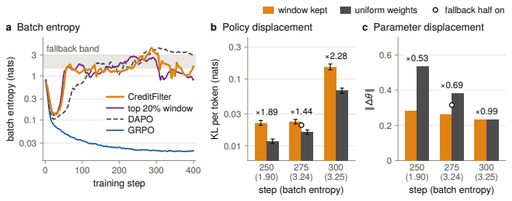
Figure 2 : Training dynamics and local displacement. (a) Batch entropy as a five-step moving av- erage, with the fallback band of 1.5–3 nats shaded: GRPO collapses and DAPO stays above 3 nats after step 263. (b, c) Five-step continuations from three checkpoints of the CreditFilter run, each labeled with its step and batch entropy. Keeping the window moves the policy 1.4–2.3 times further in KL than uniform weights in (b), and moves the parameters,∥∆θ∥=∥θ t+5 −θ t∥2, no further in (c). Numbers: window/uniform ratio; error bars: 95% prompt-bootstrap intervals, all listed in Table 26; open circle: a third continuation at step 275, with the fallback half on,m gov ≈0.5.
Original paper · CC BY 4.0 · Hanqing Zhao, Liuyue Xie, Rong-Cheng Tu, Xu Zhang, Davide Modolo, Dacheng Tao · CreditFilter: Calibrated Token Weights over the Within-Response Entropy Rank for RLVR · Original paper figure · Extracted the figure area from page 9 of the original PDF.Why uniform credit and batch-wide masks fall short
In critic-free RLVR, the scalar reward of a response is turned into one shared advantage that every token of that response inherits. The 80/20 mask rescales this shared advantage by keeping the top 20% highest-entropy tokens of a batch, and its coefficient is non-negative, so each token keeps the sign of its response's advantage. Entropy in this rule serves only as a proxy for forking potential, and the rule never measures how much a token's choice changes the probability of a correct answer.
The method described in the paper addresses both gaps: it measures the forking value of tokens and ranks them within each response.
Forking value and its factorization
The forking value at a position is the spread, over the policy's next-token choices, of the success probability after each choice, written as \(\nu_t=\mathrm{Var}_{x\sim\pi(\cdot\mid s_t)}\,Q(s_t,x)\). Summed along a response, the expected forking values equal the reward variance \(V_1(1-V_1)\), where \(V_1\) is the prompt's success probability.
This total is fixed only in expectation over a prompt's responses, not for each response, so it motivates moving credit between tokens inside one response rather than between responses.
How the window weights tokens
Each token's advantage is multiplied by \(w_c(q)=\max\{2^{-q/\lambda_c},\varepsilon_c\}\), where \(q\) is the token's within-response entropy rank, so small \(q\) marks the most uncertain positions of the response. The floor \(\varepsilon_c\) is applied only to correct responses.
The widths come from a log-linear fit of the class envelope \(\mathbb{E}[C\mid q,c]\) over ten rank bands, and CreditFilter uses 0.10 for correct and 0.14 for wrong responses, rounded from the measured 0.111 and 0.155. With those widths a floor of 0.1 on correct responses brings the two class masses to 0.196 and 0.200.
Difficulty damping scales responses with a positive advantage by one minus the pass rate of their group, so prompts the policy mostly solves receive a smaller update. An entropy-gated fallback blends the weights toward uniform credit as the batch mean entropy rises, with the blend running between 1.5 and 3.0 nats. CreditFilter-D re-estimates each class width from every batch and updates it with an exponential moving average with \(\alpha=0.1\).
What the window is calibrated to
Among non-negative weights, the mean-square error of the token-level credit is minimized by the positive part \(\max\{0,N(o)/D(o)\}\), where \(N(o)=\mathbb{E}[\delta_t A\mid o]\) and \(D(o)=\mathbb{E}[A^2\mid o]\). Under Assumption 2, which says the later tokens counted by the rank and the response length add no information about the current increment once the prefix and outcome are known, this optimal weight is proportional to the value-weighted forking spectrum within each class.
If the mean fork consequence within a class is constant in rank and in the fork probability (condition K), the target becomes proportional to the class envelope \(\mathbb{E}[C\mid q,c]\). The window leaves out the value factor \(1/V_t\) or \(1/(1-V_t)\) that appears in the target.
Measured forking spectrum of the base model
On Qwen3-8B-Base the fork probability decays exponentially with the within-response entropy rank, with fitted widths of 0.111 for correct responses and 0.155 for wrong responses.
The envelope recurs on other models, with widths from 0.071 to 0.108 on the Qwen models and 0.267 on Llama-3.1-8B-Instruct.
Since the envelope moves during training, the fixed window keeps a squared cosine of at least 0.83 with the moving envelope.
Results against DAPO and other baselines
On that seed CreditFilter also leads the 80/20 mask by 4 to 5 points and exceeds STARE and SC-GRPO on all three sets.
Entropy dynamics and local displacement
GRPO's batch entropy collapses, while DAPO stays above 3 nats after step 263.
To measure local displacement, three checkpoints at steps 250, 275 and 300 each start two five-step continuations, one with the window and the fallback off and one with uniform weights and damping and clipping kept. The token-level KL from the starting policy is measured on the starting policy's own rollouts, and the parameter displacement is the norm of the change over the five steps.
Keeping the window moves the policy 1.4 to 2.3 times further in KL than uniform weights, while the parameter displacement is no larger.
Which components carry the gain
Table 3 lists these ablations with the late and step-400 columns for each change.
Ranking across the batch instead of within each response gives a late MATH500 average of 0.826, a change of -5.0 points from CreditFilter's 0.876.
Dropping the floor costs 1 and 2 points on MATH500 and AIME25, and rescaling the class masses at fixed widths costs 4 points on MATH500.
Paper info
- Authors
- Hanqing Zhao, Liuyue Xie, Rong-Cheng Tu, Xu Zhang, Davide Modolo, Dacheng Tao
- Venue
- arXiv · Preprint
- First published
- 2026-11-20
- Added
- 2026-11-23
- Updated
- 2026-11-20
- Version
- v1
- arXiv
- 2611.27227
- Category
- cs.LG · cs.AI
- Original paper terms
- CC BY 4.0
- What we show
- Paper info, commentary and permitted figures from the original paper
AI commentary is a separate explanation from the original paper and may contain errors. The original paper and figures follow each source's terms of use and any rights noted separately.
Abstract
Critic-free reinforcement learning with verifiable rewards (RLVR) typically assigns a uniform advantage to every token. Token-reweighting heuristics like the 80/20 mask favor high-entropy tokens, but fail to measure a token's actual impact on the outcome. We formalize this impact as the forking value: the variance of the success probability over the policy's next-token choices. The expected forking values along a response sum exactly to the reward variance. Token credit is thus, in expectation over a prompt's responses, a fixed budget spent at the forks. This motivates weights that redistribute credit within a response. The forking value factorizes into a fork consequence, which requires costly continuations to estimate, and a fork probability, which the softmax provides. On Qwen3-8B-Base, this fork probability decays exponentially with a token's within-response entropy rank at class-specific rates, revealing that most tokens carry negligible forking value. CreditFilter weights each token by an exponential window over the same rank. The window is calibrated to this fork-probability envelope, under an approximately flat fork consequence. CreditFilter needs no extra forward passes and is stabilized by difficulty damping and an entropy-gated fallback. Averaged over three seeds, it outperforms DAPO by 7.7 points on MATH500 and by 10.5 and 9.1 points on AIME24 and AIME25. Its dynamically adaptive variant matches it. The ablations show that both parts matter: ranking tokens within each response rather than across the batch, and matching the window's decay rate to the envelope. Code is available at https://github.com/yoctta/CreditFilter.
Quote from the paper
Hanqing Zhao, Liuyue Xie, Rong-Cheng Tu, Xu Zhang, Davide Modolo, Dacheng Tao (2026). CreditFilter: Calibrated Token Weights over the Within-Response Entropy Rank for RLVR. arXiv:2611.27227v1. https://arxiv.org/abs/2611.27227v1
BibTeX
@misc{zhao2026creditfilter,
  title = {{CreditFilter: Calibrated Token Weights over the Within-Response Entropy Rank for RLVR}},
  author = {Hanqing Zhao and Liuyue Xie and Rong-Cheng Tu and Xu Zhang and Davide Modolo and Dacheng Tao},
  year = {2026},
  eprint = {2611.27227},
  archivePrefix = {arXiv},
  url = {https://arxiv.org/abs/2611.27227v1}
}