논문 해설
Taking Apart and Putting Together: Tracking Objects Through Physical Transformations
분해하고 다시 조립하기: 물리적 변형을 거치는 객체 추적
- 연구 문제 조립과 분해가 섞인 장면에서 트래커는 객체 식별자와 부품-전체 관계를 함께 갱신하지 못합니다.
- 연구 방법 학습 없이 트래커 마스크를 구성요소로 나누고, 상태 제안을 중첩 재현율로 점수화한 뒤 상위 제안만 MLLM으로 검증합니다.
- 주요 결과 VISTA의 SAM 2.1 설정에서 TIPO는 TF1 44.7을 기록해 TubeletGraph의 12.5보다 높았습니다.
조립과 분해를 함께 추적하는 문제
예를 들어 모카 포트를 분해할 때 트래커는 분리된 부품 중 하나의 ID를 고집하거나 일부 조각을 임의로 버립니다. 선행 방법인 TubeletGraph는 분해만 다루며, 추적 손실이 생긴 뒤에야 부품을 탐색하므로 초기 분할 시점을 놓치고 0.2 FPS로 느립니다. 이 논문은 이러한 상황을 TTU, 즉 Transformation Tracking and Understanding으로 정식화하고, 조립과 분해를 모두 다루는 것을 목표로 합니다.
TIPO의 네 단계 갱신 절차
TIPO는 학습 없이 사전 학습된 분할 트래커와 MLLM을 조합하는 프레임워크입니다. 매 프레임마다 트래커가 낸 객체 마스크를 Parallel Union-Find로 공간적으로 분리된 구성요소로 나눕니다. 이어서 각 구성요소에 대해 무작위 점을 하나씩 뽑아 마스크 디코더에 넣고, 같은 점 수준의 샘플링을 여러 번 반복해 마스크를 앙상블합니다. 그다음 분해 후보는 구성요소의 분할로, 조립 후보는 추적 객체의 분할로 열거합니다. 각 후보는 내부 재현율과 외부 재현율로 점수화합니다. 내부 재현율은 그룹의 샘플링 마스크가 그룹 전체를 얼마나 덮는지를 보고, 외부 재현율은 그룹의 마스크가 그룹 밖 요소로 얼마나 새는지를 봅니다.
상위 제안이 임계값 이상일 때만 MLLM Judge가 과거 프레임과 현재 프레임을 보고 전이가 실제로 일어났는지 확인하며, 이후 MLLM Labeler가 객체와 동작의 이름을 붙입니다.
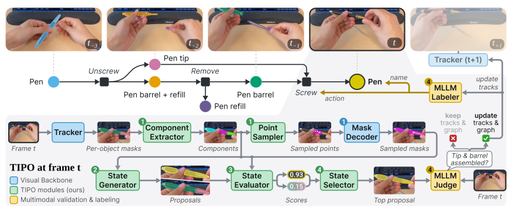
Figure 2 .Overview of TIPO.At each frame It, the tracker provides the set of per-object masks. The pipeline operates in four stages(1–4): (1)extraction of the disjoint components and mask sampling,(2)generation of all possible assembly and disassembly states,(3)evaluation of the state proposals based on mask overlap metrics,(4)validation of the highest-scoring proposal by the MLLM Judge and semantic labeling. Lastly, the state graph and the tracker are updated with the validated state.
원문 · CC BY 4.0 · Davide Gardenal, Mingxuan Liu, Flavio Vella, Quentin Guimard, Elisa Ricci · Taking Apart and Putting Together: Tracking Objects Through Physical Transformations · 원문 그림 인용 · 원본 PDF 3쪽에서 그림 영역을 추출했습니다.내부·외부 재현율 점수의 역할
분해 후보의 점수 D(h)는 그룹 안의 각 구성요소에 대해 내부 재현율을 곱하고, 외부 재현율의 보수 1−Φex를 곱하는 방식으로 계산됩니다. 내부 재현율이 높으면 그룹의 모든 구성요소가 한 물리 객체에 속한다고 볼 수 있어 점수가 올라가고, 외부 재현율이 높으면 그룹의 샘플링 마스크가 다른 그룹으로 새어 나간 것이므로 점수가 내려갑니다. 조립 후보도 같은 구조를 따르되 내부 재현율은 샘플링 마스크 쌍에 대한 곱으로 계산되어, 디코더가 어떤 객체를 프롬프트하든 같은 물체를 가리킬 때만 값이 유지됩니다. 저자들은 분해 평가에서 추적 결과가 아니라 샘플링 마스크를 쓰는 이유를, 조립된 객체에 대해 트래커가 일부 영역만 전파하면 추적 결과로는 신뢰할 수 없게 되기 때문이라고 설명합니다.
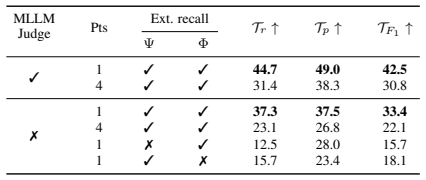
Table 5 .Validating the design of TIPO.Experiments are con- ducted on VISTA using SAM 3 as the tracker and Qwen 3.5 35B as the MLLM Judge. Minimal point sampling prevents spatial over-conditioning on local sub-parts, and external mask recall for both assembly (Ψ) and disassembly (Φ) state evaluation is essential to penalize incorrect grouping.
원문 · CC BY 4.0 · Davide Gardenal, Mingxuan Liu, Flavio Vella, Quentin Guimard, Elisa Ricci · Taking Apart and Putting Together: Tracking Objects Through Physical Transformations · 원문 그림 인용 · 원본 PDF 8쪽에서 그림 영역을 추출했습니다.VISTA 벤치마크와 평가 지표
VISTA는 50개 시퀀스, 26,000장 이상의 프레임, 조립 124건과 분해 132건으로 이루어진 상태 그래프 주석 데이터셋입니다. VOST-TAS가 분해만 다루고 결과 부품만 표시하는 것과 달리, VISTA는 입력과 출력 객체를 모두 연결합니다. 주 상태 그래프 지표인 TF1은 예측 전이와 정답 전이를 이분 매칭하며, 입력과 출력 객체 수, 시간 경계, 그리고 전후 객체의 IoU 0.5 초과 조건을 모두 만족할 때만 참 양성으로 셉니다. HF1은 같은 구조 매칭에 의미 정확도 조건을 더합니다. 추적 품질은 J로 측정하고, 마지막 25% 프레임에서의 J를 Jtr로 따로 보고합니다.
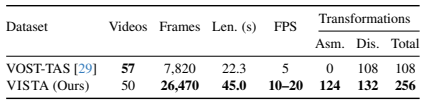
Table 1 .Comparison between VISTA and VOST-TAS datasets. VISTA adds complex assembly events, doubles the number of transformations, and includes longer video sequences.
원문 · CC BY 4.0 · Davide Gardenal, Mingxuan Liu, Flavio Vella, Quentin Guimard, Elisa Ricci · Taking Apart and Putting Together: Tracking Objects Through Physical Transformations · 원문 그림 인용 · 원본 PDF 2쪽에서 그림 영역을 추출했습니다.VISTA에서의 비교 결과
VISTA의 SAM 2.1 설정에서 TIPO는 TF1 44.7을 기록해 TubeletGraph의 12.5보다 높았습니다. SAM 3 설정에서도 TIPO는 TF1 42.5를 기록해 TubeletGraph의 3.3보다 높았습니다. Judge를 뺀 TIPO도 SAM 2.1에서 TF1 36.7을 기록해, MLLM 검증 없이도 상태 그래프 정확도가 높았습니다. AlwaysPredict는 추적 품질이 높게 나왔지만 TF1은 SAM 2.1에서 9.1, SAM 3에서 8.5에 머물렀습니다. 이는 추적 신호만으로는 전이를 가려내기 어렵다는 결과로 해석됩니다. 분해 전용 분할에서도 TIPO는 TubeletGraph보다 높은 TF1을 기록했습니다.
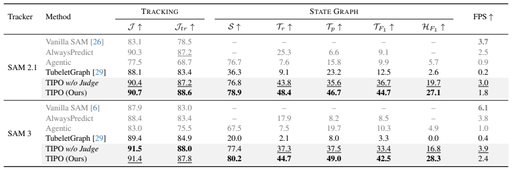
Table 2 .State-of-the-art comparison on VISTA.We evaluate pure tracking and state-graph generation using two different foundational trackers. Best results per tracker are inbold, and second-best are underlined .
원문 · CC BY 4.0 · Davide Gardenal, Mingxuan Liu, Flavio Vella, Quentin Guimard, Elisa Ricci · Taking Apart and Putting Together: Tracking Objects Through Physical Transformations · 원문 그림 인용 · 원본 PDF 6쪽에서 그림 영역을 추출했습니다.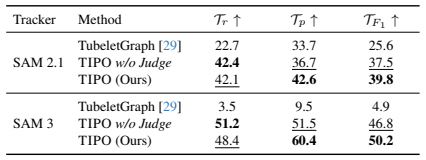
Table 4 .Disassembly-only comparison on VISTA.We evaluate the methods on the disassembly-only split of VISTA to match the capabilities of TubeletGraph. We report results using two different foundational trackers. Best results per tracker are inbold, and second-best are underlined.
원문 · CC BY 4.0 · Davide Gardenal, Mingxuan Liu, Flavio Vella, Quentin Guimard, Elisa Ricci · Taking Apart and Putting Together: Tracking Objects Through Physical Transformations · 원문 그림 인용 · 원본 PDF 6쪽에서 그림 영역을 추출했습니다.온라인 처리의 한계
TIPO는 온라인 스트리밍 방식으로 동작하므로, 상태 그래프에 한 번 추가된 잘못된 전이를 이후 프레임에서 소급해 고치지 못합니다. 저자들은 이 한계가 TubeletGraph와도 공유된다고 설명합니다. 다만 TIPO에서는 잘못된 전이가 이후 제안의 평가를 오염시키지 않으므로 장면과 다시 일치하는 상태로 돌아올 수 있다고 봅니다. 마지막 프레임의 재현율은 56.7로 정밀도 93.4보다 낮은데, 이는 전이 중에 트래커가 잡지 못한 작은 부품 때문이라고 설명됩니다.
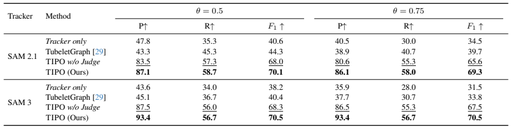
Table 14 .Last-frame object identity on VISTA.Predicted tracks and ground-truth objects are matched one-to-one on the last frame of each video with Hungarian matching on mask IoU if greater than θ. Precision (P ), recall (R) and F1 are micro-averaged over all objects. We report results using two different foundational trackers. Best results per tracker are inbold, and second-best are underlined .
원문 · CC BY 4.0 · Davide Gardenal, Mingxuan Liu, Flavio Vella, Quentin Guimard, Elisa Ricci · Taking Apart and Putting Together: Tracking Objects Through Physical Transformations · 원문 그림 인용 · 원본 PDF 22쪽에서 그림 영역을 추출했습니다.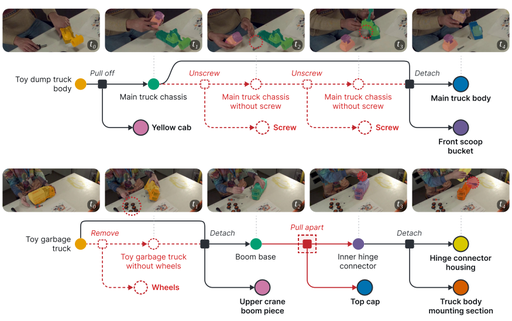
Figure 17 .Failure cases of TIPO on the VISTA benchmark.We present two disassembly sequences from the Assembly101 [ 27] subset with their corresponding state-graph predictions. The top row shows the disassembly of a toy dump truck, while the bottom row features the complex disassembly of a toy garbage truck. Dashed red circles and boxes denote false negatives,i.e., objects and transformations present in the ground truth but undetected, such as the missed screws and wheels. A red action in a dashed red box denotes a false positive,i.e., a transformation incorrectly predicted by the pipeline, such as the hallucinated separation of the top cap.
원문 · CC BY 4.0 · Davide Gardenal, Mingxuan Liu, Flavio Vella, Quentin Guimard, Elisa Ricci · Taking Apart and Putting Together: Tracking Objects Through Physical Transformations · 원문 그림 인용 · 원본 PDF 29쪽에서 그림 영역을 추출했습니다.논문 정보
- 저자
- Davide Gardenal, Mingxuan Liu, Flavio Vella, Quentin Guimard, Elisa Ricci
- 학회·저널
- arXiv · 프리프린트
- 최초 공개일
- 2026년 11월 20일
- 등록일
- 2026년 11월 23일
- 수정일
- 2026년 11월 20일
- 버전
- v1
- arXiv
- 2611.27398
- 분류
- cs.CV · cs.AI
- 원문 이용 조건
- CC BY 4.0
- 제공 범위
- 논문 정보, 해설, 허용된 원문 그림
AI 해설은 논문 원문과 별개의 설명이며 오류가 있을 수 있습니다. 원문과 그림은 각 출처의 이용 조건과 따로 표시된 권리를 따릅니다.
초록
We introduce Transformation Tracking and Understanding (TTU), extending video object tracking to environments where objects undergo physical assemblies and disassemblies. TTU requires continuously tracking objects through transformations, identifying new entities, maintaining a state graph of their relationships, and assigning semantic labels to transformations. While foundation models (e.g., SAM 2/3) maintain tracklets through appearance changes, they cannot update semantic identities as objects physically evolve. Prior work addresses only disassemblies, relying on expensive searches triggered only when tracking fails. We propose Tracking Instances via Proposals and Overlaps (TIPO), a training-free framework that continuously infers transformations via a generate-evaluate-judge pipeline. TIPO generates split and merge proposals from disjoint mask components, scores them against mask-decoder priors using inner and external overlap, and queries an MLLM on the top proposal for visual verification and semantic labeling. To benchmark TTU, we curate Video Instances, States, and Transformation Annotations (VISTA), a dataset including state graphs with 124 assembly and 132 disassembly events across 50 sequences and over 26,000 frames. TIPO achieves state-of-the-art tracking and state-graph accuracy on VISTA, while operating $6\times$ to $15\times$ faster than prior methods. Project page: https://davidegardenal.github.io/tipo-tracking
원문 인용
Davide Gardenal, Mingxuan Liu, Flavio Vella, Quentin Guimard, Elisa Ricci (2026). Taking Apart and Putting Together: Tracking Objects Through Physical Transformations. arXiv:2611.27398v1. https://arxiv.org/abs/2611.27398v1
BibTeX
@misc{gardenal2026taking,
  title = {{Taking Apart and Putting Together: Tracking Objects Through Physical Transformations}},
  author = {Davide Gardenal and Mingxuan Liu and Flavio Vella and Quentin Guimard and Elisa Ricci},
  year = {2026},
  eprint = {2611.27398},
  archivePrefix = {arXiv},
  url = {https://arxiv.org/abs/2611.27398v1}
}