論文解説
Taking Apart and Putting Together: Tracking Objects Through Physical Transformations
分割と結合で変わる物体を追跡し状態グラフを作る手法
- 課題 従来の追跡器は、物体が割れたり合わさったりするとIDを保てません。既存手法は分解しか扱えず、組立は扱えませんでした。
- 手法 TIPOは、追跡マスクが離れた部分に割れたら分割、重なったら結合の候補を作り、重なり具合で評価します。上位の候補だけをMLLMに見せて確かめ、状態グラフを更新します。
- 結果 VISTAでTF1を比べると、TIPOが44.7で、TubeletGraphの12.5を上回りました。
既存の追跡器が組立と分解で止まる理由
SAM 2やSAM 3のような基盤トラッカーは、物体が動いたり見た目が変わったりしても、同じIDを追い続けることに強みがあります。しかし、物体が割れたり合わさったりする場面では、この前提が崩れます。Moka potの例では、蓋を外した時点で1つのIDを保つか、外れた部品を落とすかのどちらかになり、組み直したときにどの部品として扱うべきかも曖昧になります。
そこで本研究は、追跡に加えて変換を記述する課題としてTransformation Tracking and Understanding(TTU)を定式化しました。TTUでは、組立と分解を通して物体を追い、ID、意味ラベル、部品と全体の関係を時刻ごとに更新します。出力は物体マスクと一つの状態グラフで、状態グラフは物体の状態をノード、時刻間の変換をエッジとして表す有向グラフです。
既存の代表例であるTubeletGraphは分解だけを扱い、トラックが失われたあとに部品を探し直すため、最初の分割を逃します。組立は扱えず、候補領域を画面全体で追跡するため、処理速度は0.2 FPSにとどまります。
分割と結合は現在フレームの幾何に現れるという発想
本研究の鍵は、分割や結合は現在フレームの形状にすでに現れている、という単純な観察です。追跡中のマスクが互いに離れた連結成分に割れていれば、それが分解の手がかりになるため、後から失われた部品を探す必要はありません。蓋を外したとき、追跡マスクが切れ切れになるのは、まさにこの現象です。
TIPOはこの考えを、generate–evaluate–judgeという三段階の流れにまとめます。実装では、成分の抽出とサンプルマスク、状態提案の生成、評価、選択とMLLM検証とグラフ更新の四段階に分けて処理し、各段階の出力を次の段階に渡します。全体の流れは図で示されています。
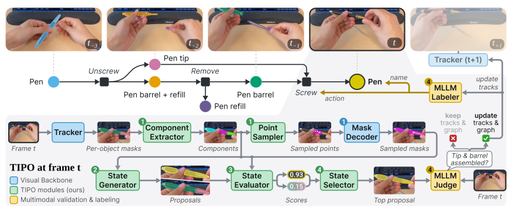
Figure 2 .Overview of TIPO.At each frame It, the tracker provides the set of per-object masks. The pipeline operates in four stages(1–4): (1)extraction of the disjoint components and mask sampling,(2)generation of all possible assembly and disassembly states,(3)evaluation of the state proposals based on mask overlap metrics,(4)validation of the highest-scoring proposal by the MLLM Judge and semantic labeling. Lastly, the state graph and the tracker are updated with the validated state.
出典 · CC BY 4.0 · Davide Gardenal, Mingxuan Liu, Flavio Vella, Quentin Guimard, Elisa Ricci · Taking Apart and Putting Together: Tracking Objects Through Physical Transformations · 論文の図を引用 · 元のPDFの3ページ目から図の部分を抽出しています。TIPOはトラッカーとMLLMという既存モデルを組み合わせる枠組みで、追加の学習は行いません。既定ではMLLM JudgeにQwen 3.5 35B、MLLM LabelerにGPT-5.4を用います。
成分とサンプルマスクから状態提案を採点する
まず各追跡マスクを、Parallel Union-Findで空間的に離れた成分に分けます。各成分には単一点のプロンプトを与えてマスクを作り、その出力を集めて頑健なサンプルマスクにします。点を一つにするのは、SAMが一点から最もありそうなマスクを選ぶ性質を借りるためです。既定値では、一つの成分につき32回の試行を行い、SAMの品質スコアが0.8未満のマスクは除きます。
分解の候補は成分の分割、組立の候補は追跡物体の分割として列挙します。組み合わせは爆発するため、扱う要素数は7までに制限され、その範囲でも状態提案は877通りです。この上限は一回の変換で部品が最大7つまでという意味で、追跡できる物体の総数は制限しません。
評価の式は、各グループの内部被覆と外部漏れの積で与えられます。\[ D(h)=\prod_{C_n\in h}\Phi_{in}(C_n)\,(1-\Phi_{ex}(C_n)) \]R(a,b)は\(|a\cap b|/|a|\)で、aの面積のうちbに覆われる割合を表します。内部リコールΦinは成分の和集合に対する被覆率で、外部リコールΦexはグループ外の成分へのはみ出しを測ります。分解では実際のトラックと比べ、組立ではサンプルマスクと比べるのは、部分的にしか伝播しないトラックでは評価が不安定になるためです。
上位候補のMLLM検証とグラフ更新
評価後は、スコアが閾値τを超える候補のうち最大のものを選びます。既定のτは0.5で、閾値を超える候補がなければ、組立も分解もない状態を選びます。ランダムなサンプリングは高スコアの誤りも生むため、MLLM Judgeが過去の5秒、3秒、1秒前のフレームと現在のフレームを照らし合わせて検証します。
Judgeは、組立か分離かを答えるJSON形式の判定を返し、YESと答えた変換だけを採用します。検証を通った変換には、MLLM Labelerが物体名と動作名を付け、その結果を状態グラフに追加します。MLLMを評価の後段に置くのは、高価な問い合わせの回数を抑えるためです。
Judgeを外したTIPOw/o Judgeでは、閾値を0.8に上げ、MLLMの判定の代わりに重なりだけで候補を絞ります。
VISTAベンチマークの構成と指標
VOST-TASは変換後の部品だけを注釈しており、どの物体がどう変わったかは評価できません。VISTAは50シーケンスで、組立124件と分解132件を含み、変換は合計256件、フレーム数は26,470です。映像はAssembly101から17本、IKEA ASMから8本、独自録画から25本を集めています。
マスクは注釈者がSAM 3の支援を受けて作成し、変換は専門家が手で記録して状態グラフを作りました。各シーケンスは一人が注釈し、もう一人が独立に確認して、食い違いは両者が合意するまで話し合いました。
追跡品質はフレームごとのIoUのJで、Jtrは最後の25%のフレームで計算します。TF1は二部マッチングで、入力と出力の物体数、正しい時間境界、物体レベルのIoUが0.5を超えることの三条件をすべて満たした一致だけを数えます。HF1は、TF1の構造的な一致に意味的な正しさを加えた、ラベル付き状態グラフ全体のF1です。
VISTAでの追跡と状態グラフの精度
SAM 2.1を基盤にしたとき、TF1はTIPOが44.7、TubeletGraphが12.5で、差は32.2ポイントです。SAM 3では、TIPOが42.5、TubeletGraphが3.3で、差は+39.2ポイントです。著者らは、TubeletGraphの低下を、探索がトラックの喪失時にしか起きず、強いトラッカーではその機会が減ることによると説明しています。
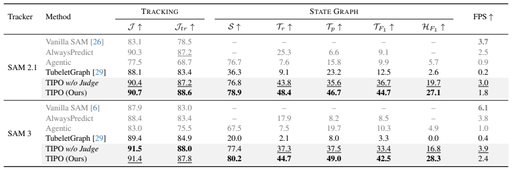
Table 2 .State-of-the-art comparison on VISTA.We evaluate pure tracking and state-graph generation using two different foundational trackers. Best results per tracker are inbold, and second-best are underlined .
出典 · CC BY 4.0 · Davide Gardenal, Mingxuan Liu, Flavio Vella, Quentin Guimard, Elisa Ricci · Taking Apart and Putting Together: Tracking Objects Through Physical Transformations · 論文の図を引用 · 元のPDFの6ページ目から図の部分を抽出しています。処理速度はSAM 2.1で比べると、TIPOが1.8 FPS、TubeletGraphが0.2 FPSです。ただし、トラッカー単体の3.7 FPSより遅く、速さは検証の分だけ落ちます。
分解だけを残したVISTAでは、SAM 2.1でTIPOのTF1が39.8、TubeletGraphが25.6です。SAM 3では、TIPOが50.2、TubeletGraphが4.9で、差は+45.3ポイントです。TIPOw/o Judgeも分解だけの条件でTubeletGraphを上回ったので、組立を扱えることだけが利点ではないと読めます。
MLLM Judgeを加えると、TF1はSAM 2.1で36.7から44.7へ、SAM 3で33.4から42.5へ上がりました。その差は+8.0から+9.1ポイントです。つまり、Judgeは最後のフィルタとして効きますが、Judgeを外した構成でも33.0を超えるTF1が得られます。
VOST-TASで見えた評価指標の弱点
AlwaysPredictは、マスクが割れるたびに分解を、重なるたびに組立を予測するだけの単純なベースラインです。VOST-TASでは、予測数が900(SAM 2.1)と569(SAM 3)で、TubeletGraphの65と38より14倍から15倍多い変換を出します。それでもHSTはSAM 2.1で13.9となり、TubeletGraphの13.0を上回ります。
HSTのように出力の重なりと時刻だけを見る指標は、どの入力から出力が来たかを評価しません。VISTAでは状態グラフ全体を照合するため、AlwaysPredictのTF1は9.1と8.5にとどまり、TIPOw/o Judgeの36.7と33.4より低くなります。この結果は、トラッカーの手がかりだけでは変換を検出しきれないことを示しています。
設計要素ごとの効き方
サンプルの点を増やすと、SAMは全部の点を覆うマスクを作るため、マスクが成分の境界から外れにくくなります。K=4にすると、TF1はMLLM Judgeありで11.7、なしで11.3低下します。
たとえば、手が持つペンが二つの成分に割れた場合、内部リコールだけでは誤った分割も一体のペンと同じくらい高く評価されてしまいます。
MLLM Labelerでは、GPT-5.4が動作名のSAで90.0、Qwen 3.5 35Bが80.2です。GPT-5.4 miniは動作名で92.6ですが、物体名のSOは73.8にとどまります。
限界
速さの面では、既定のTIPOは1.8 FPSで、SAM 2.1単体の3.7 FPSより遅い点が残ります。Judgeを外したTIPOw/o Judgeは3.0 FPSまで上がります。
VISTAには別の検証用分割がないため、閾値の選び方は評価に使うシーケンスに依存する形になっています。部品数の上限7や、K≥2で点を増やすと分解があいまいさを失うという設計上の制約も残ります。
MLLM Judgeは本文の比較でQwen 3.5 35Bだけを使っており、別のJudgeとの比較は本文には含まれていません。VISTAの注釈はSAM 3の支援を受けているため、SAM 3を基盤にした手法の評価には偏りがあり得ると考えられます。
論文情報
- 著者
- Davide Gardenal, Mingxuan Liu, Flavio Vella, Quentin Guimard, Elisa Ricci
- 学会・ジャーナル
- arXiv · プレプリント
- 公開日
- 2026年11月20日
- 登録日
- 2026年11月23日
- 更新日
- 2026年11月20日
- バージョン
- v1
- arXiv
- 2611.27398
- カテゴリ
- cs.CV · cs.AI
- ライセンス
- CC BY 4.0
- 掲載内容
- 論文情報・解説・論文の図
この解説は、Refivuの韓国語解説をAIで翻訳したものです。不正確な翻訳や誤りが含まれる可能性があります。論文と図の利用条件は各出典に従います。
アブストラクト
We introduce Transformation Tracking and Understanding (TTU), extending video object tracking to environments where objects undergo physical assemblies and disassemblies. TTU requires continuously tracking objects through transformations, identifying new entities, maintaining a state graph of their relationships, and assigning semantic labels to transformations. While foundation models (e.g., SAM 2/3) maintain tracklets through appearance changes, they cannot update semantic identities as objects physically evolve. Prior work addresses only disassemblies, relying on expensive searches triggered only when tracking fails. We propose Tracking Instances via Proposals and Overlaps (TIPO), a training-free framework that continuously infers transformations via a generate-evaluate-judge pipeline. TIPO generates split and merge proposals from disjoint mask components, scores them against mask-decoder priors using inner and external overlap, and queries an MLLM on the top proposal for visual verification and semantic labeling. To benchmark TTU, we curate Video Instances, States, and Transformation Annotations (VISTA), a dataset including state graphs with 124 assembly and 132 disassembly events across 50 sequences and over 26,000 frames. TIPO achieves state-of-the-art tracking and state-graph accuracy on VISTA, while operating $6\times$ to $15\times$ faster than prior methods. Project page: https://davidegardenal.github.io/tipo-tracking
論文の図
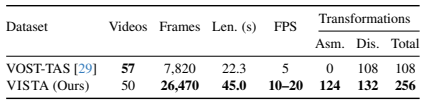
Table 1 .Comparison between VISTA and VOST-TAS datasets. VISTA adds complex assembly events, doubles the number of transformations, and includes longer video sequences.
出典 · CC BY 4.0 · Davide Gardenal, Mingxuan Liu, Flavio Vella, Quentin Guimard, Elisa Ricci · Taking Apart and Putting Together: Tracking Objects Through Physical Transformations · 論文の図を引用 · 元のPDFの2ページ目から図の部分を抽出しています。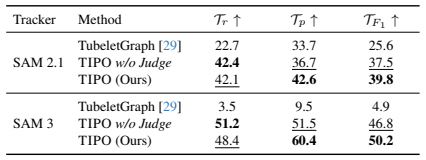
Table 4 .Disassembly-only comparison on VISTA.We evaluate the methods on the disassembly-only split of VISTA to match the capabilities of TubeletGraph. We report results using two different foundational trackers. Best results per tracker are inbold, and second-best are underlined.
出典 · CC BY 4.0 · Davide Gardenal, Mingxuan Liu, Flavio Vella, Quentin Guimard, Elisa Ricci · Taking Apart and Putting Together: Tracking Objects Through Physical Transformations · 論文の図を引用 · 元のPDFの6ページ目から図の部分を抽出しています。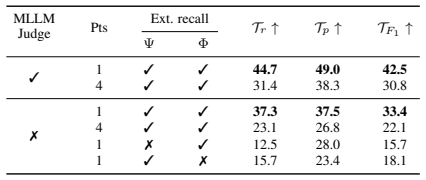
Table 5 .Validating the design of TIPO.Experiments are con- ducted on VISTA using SAM 3 as the tracker and Qwen 3.5 35B as the MLLM Judge. Minimal point sampling prevents spatial over-conditioning on local sub-parts, and external mask recall for both assembly (Ψ) and disassembly (Φ) state evaluation is essential to penalize incorrect grouping.
出典 · CC BY 4.0 · Davide Gardenal, Mingxuan Liu, Flavio Vella, Quentin Guimard, Elisa Ricci · Taking Apart and Putting Together: Tracking Objects Through Physical Transformations · 論文の図を引用 · 元のPDFの8ページ目から図の部分を抽出しています。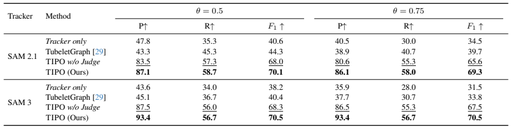
Table 14 .Last-frame object identity on VISTA.Predicted tracks and ground-truth objects are matched one-to-one on the last frame of each video with Hungarian matching on mask IoU if greater than θ. Precision (P ), recall (R) and F1 are micro-averaged over all objects. We report results using two different foundational trackers. Best results per tracker are inbold, and second-best are underlined .
出典 · CC BY 4.0 · Davide Gardenal, Mingxuan Liu, Flavio Vella, Quentin Guimard, Elisa Ricci · Taking Apart and Putting Together: Tracking Objects Through Physical Transformations · 論文の図を引用 · 元のPDFの22ページ目から図の部分を抽出しています。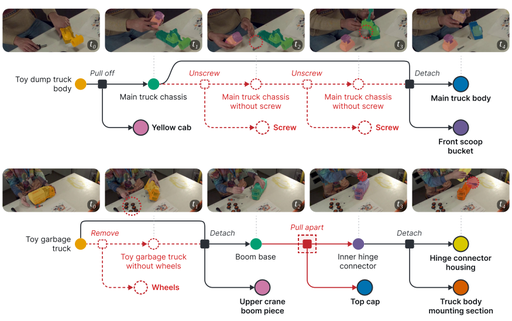
Figure 17 .Failure cases of TIPO on the VISTA benchmark.We present two disassembly sequences from the Assembly101 [ 27] subset with their corresponding state-graph predictions. The top row shows the disassembly of a toy dump truck, while the bottom row features the complex disassembly of a toy garbage truck. Dashed red circles and boxes denote false negatives,i.e., objects and transformations present in the ground truth but undetected, such as the missed screws and wheels. A red action in a dashed red box denotes a false positive,i.e., a transformation incorrectly predicted by the pipeline, such as the hallucinated separation of the top cap.
出典 · CC BY 4.0 · Davide Gardenal, Mingxuan Liu, Flavio Vella, Quentin Guimard, Elisa Ricci · Taking Apart and Putting Together: Tracking Objects Through Physical Transformations · 論文の図を引用 · 元のPDFの29ページ目から図の部分を抽出しています。この論文を引用
Davide Gardenal, Mingxuan Liu, Flavio Vella, Quentin Guimard, Elisa Ricci (2026). Taking Apart and Putting Together: Tracking Objects Through Physical Transformations. arXiv:2611.27398v1. https://arxiv.org/abs/2611.27398v1
BibTeX
@misc{gardenal2026taking,
  title = {{Taking Apart and Putting Together: Tracking Objects Through Physical Transformations}},
  author = {Davide Gardenal and Mingxuan Liu and Flavio Vella and Quentin Guimard and Elisa Ricci},
  year = {2026},
  eprint = {2611.27398},
  archivePrefix = {arXiv},
  url = {https://arxiv.org/abs/2611.27398v1}
}