Paper commentary
Single-Transformer Latent Diffusion
UNIFIED folds the latent diffusion decoder into one shared transformer
- Problem Latent diffusion uses three separate networks: an encoder, a generator and a decoder. UNITE merged the first two, but its decoder stayed separate.
- Method UNIFIED runs encoding, generation and decoding through one shared backbone, unlike the three networks used before. A mode token and the timestep tell the passes apart.
- Results UNIFIED reaches 2.08 gFID on ImageNet-1K at 256 by 256, compared with 2.23 for UNITE at the same size.
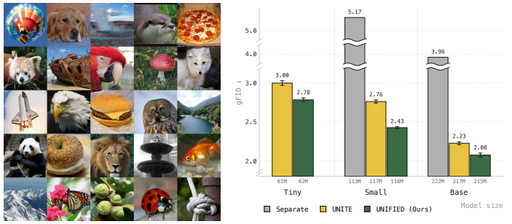
Figure 1 :(Left)Selected samples from UNIFIEDon ImageNet-1K256×256(CFG scale4.0). (Right)Full unification is not merely feasible but beneficial.gFID (↓) at three sizes; bar labels give the total trainable parameters. UNIFIED improves on UNITE at every size, and Tiny UNI- FIED nearly matches Small UNITE with about half the parameters (2.78at62M vs.2.76at117M). Separate is a standard three-network pipeline (Figure 2a), trained at Small and Base. UNITE and UNIFIED: mean over five evaluation seeds (Table 14).
Original paper · CC BY 4.0 · Hao-Yu Hsu, Shenlong Wang, Alexander G. Schwing · Single-Transformer Latent Diffusion · Original paper figure · Extracted the figure area from page 2 of the original PDF.Why three networks are hard to merge
Latent diffusion usually trains an autoencoder first and then freezes it while a generator is fit to its latents. That order fixes the representation before the sampler is trained, and the capacity given to each network is hard to predict in its effect on generation.
Most single-stage methods still keep the tokenizer and the generator as separate networks. A few use one network but reserve parts of it for each mode, such as LDM-is-AE, which splits one DiT by depth, and DSD, which adds a dedicated diffusion head and relies on DINO alignment.
UNITE is the closest step: it trains one generative encoder for tokenization and generation, but a standalone decoder remains.
One backbone and aligned sequences
The central idea is to make all three modes map sequences of the same length, so that one sequence index always points at the same image location. A pixel patch, a clean latent token and a noised latent token at index i then describe the same place, so attention doesn't have to move content between pixels and latents. A mode token at position 0 and the timestep are what tell the passes apart.
The backbone is a stack of DiT blocks with RoPE, and the timestep and class label reach every block through AdaLN. Four lightweight heads handle the translation between values and backbone width, and three of them are carried over unchanged from UNITE's generative encoder. The mode-specific parameters, namely the heads, the mode tokens and the learned decoding timestep, make up 1.63% of the Base model at about 215M.
Aligning the sequences removes that detour, but it ties the latent length K to the patch count N, so each pass has N+1 tokens instead of 1+K+N.
What a training step runs
The encoding pass takes the image patches after the encoding mode token and reads the latent from the patch positions. Encoding uses the clean timestep and a null class label, which the authors write as follows. \[ E_\theta(x)=P^{out}_z\,T_\theta\big([q_{enc};\,P^{in}_x(x)],\,t_{enc},\varnothing\big) \]
The generation pass starts from a noised latent built by rectified-flow interpolation, with the timestep sampled uniformly. \[ z_t = t\,z + (1-t)\,\epsilon,\quad \epsilon\sim\mathcal N(0,I),\quad t\sim U[0,1] \] The loss treats the clean latent as a constant, so the generation loss can't push the encoder toward a trivial latent.
The decoding pass reconstructs images from a latent that is perturbed with noise before it enters the decoder, which makes decoding robust. Decoding is conditioned on the learned decoding timestep t_dec = −1 instead of the clean timestep. \[ L_{rec}=\mathbb{E}_{x,\epsilon_r}\big[\lVert \hat x-x\rVert_1+\lambda_{perc}\,\mathrm{LPIPS}(\hat x,x)\big] \] \[ L=\lambda_{rec}L_{rec}+\lambda_{gen}L_{gen} \]
At inference, generation starts from Gaussian noise at t = 0 and integrates the learned flow to t = 1 with repeated generation passes.
Which choices make full sharing work
Its gFID gets worse, rising to 2.31, so the layout alone doesn't explain the gain.
The authors attribute the worse gFID to a mismatch: the encoder now reads clean image patches, yet a timestep of 0 still labels them as pure noise. Setting the encoding timestep to 1 brings gFID to 2.15 and rFID to 0.97, which beats UNITE's 2.23 and 1.41 on both metrics.
The authors read this as an output conflict, since decoding outputs pixel features while encoding and generation output the latent. CKA only locates where the passes diverge, and the ablations are what measure the effect on generation.
At Base this also gives the best gFID and rFID in the path, 2.08 and 0.95.
ImageNet results at matched size
On ImageNet-1K at 256 by 256, the Base UNIFIED model with the learned decoding timestep scored 2.08 gFID and 314.4 IS. UNITE at the same size scored 2.23 gFID and 282.1 IS, and the UNITE and UNIFIED rows are means over five seeds.
Text-to-image results
After pretraining on the same data and text encoder, UNIFIED-L (554M) scores 0.527 GenEval, compared to 0.516 for JiT (615M). On DPG-Bench it scores 0.794, compared to 0.782 for JiT, and the UNIFIED-B model at 218M scores 0.471 GenEval, compared to 0.430 for UNITE-B at 219M. After fine-tuning, UNIFIED-L scores 0.878 GenEval, compared to 0.841 for DiT DH-XL with a FLUX-V AE.
Those baseline numbers are taken from their papers, so this is a comparison across papers rather than a controlled run.
Limitations
The latent has one token per patch, so the latent length can't be chosen separately from the image grid. Position alignment is what ties the two together, which is the cost the authors accept for the shared sequence.
Several rows are single runs, including the separate pipeline at Small and Base and the aligned variant with encoding timestep 0. Table 4 mixes protocols: UNITE was trained under the authors' protocol, and the other baselines are not described that way. The 512 by 512 comparison reports only GenEval and DPG-Bench.
Paper info
- Authors
- Hao-Yu Hsu, Shenlong Wang, Alexander G. Schwing
- Venue
- arXiv · Preprint
- First published
- 2026-11-21
- Added
- 2026-11-24
- Updated
- 2026-11-21
- Version
- v1
- arXiv
- 2611.29064
- Category
- cs.CV
- Original paper terms
- CC BY 4.0
- What we show
- Paper info, commentary and permitted figures from the original paper
AI commentary is a separate explanation from the original paper and may contain errors. The original paper and figures follow each source's terms of use and any rights noted separately.
Abstract
Latent generative models typically rely on three separate networks: an encoder that tokenizes pixels, a generator that models the latent distribution, and a decoder that maps latents back to pixels. UNITE recently merged the first two into a single generative encoder trained in one stage, but its decoder remains a separate network. We ask whether this last network can be folded in too, so that one diffusion transformer encodes, generates, and decodes. Simply letting the shared backbone decode does not help. What makes it work is to cast all three modes as position-aligned sequence maps over one fully shared backbone, distinguished only by a mode token and the timestep. The resulting model, UNIFIED, is simple: one network trained from scratch in a single stage with only reconstruction and flow-matching losses, without adversarial losses or pretrained encoders (e.g., DINO). On ImageNet-1K 256x256 at matched parameters, UNIFIED improves gFID over UNITE at three sizes (~60M, ~115M, and ~215M) and reaches 2.08 with 215M parameters, the lowest among compared models under 250M parameters. On text-to-image generation, UNIFIED-B (218M) reaches a GenEval score of 0.87 at 512x512, exceeding single-stage pixel diffusion models with around one billion parameters. Full unification of latent diffusion is thus not merely feasible but beneficial.
Quote from the paper
Hao-Yu Hsu, Shenlong Wang, Alexander G. Schwing (2026). Single-Transformer Latent Diffusion. arXiv:2611.29064v1. https://arxiv.org/abs/2611.29064v1
BibTeX
@misc{hsu2026single,
  title = {{Single-Transformer Latent Diffusion}},
  author = {Hao-Yu Hsu and Shenlong Wang and Alexander G. Schwing},
  year = {2026},
  eprint = {2611.29064},
  archivePrefix = {arXiv},
  url = {https://arxiv.org/abs/2611.29064v1}
}