Paper commentary
Certify, Then Select: Viability-Aware Runtime Steering of Frozen Diffusion Policies
- Problem Not stated in the paper.
- Method CAST draws several action chunks from the frozen policy, keeps those that pass a barrier certificate, and executes the one a critic ensemble ranks highest; CAST-V ranks by the viability of future certified samples instead.
- Results On robomimic Can with effort budget b = 0.15, CAST reached 0.53 joint success against 0.16 for select-then-filter.
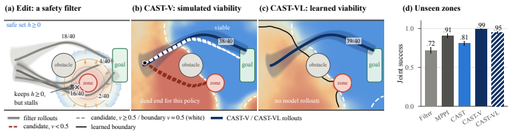
Figure 1 :Edit or select.A keep-out zone, unseen in training, blocks one of the two routes of a
Original paper · CC BY 4.0 · Angelo Moroncelli, Loris Roveda · Certify, Then Select: Viability-Aware Runtime Steering of Frozen Diffusion Policies · Original paper figure · Extracted the figure area from page 2 of the original PDF.Why an edit is not enough
A diffusion policy trained on demonstrations has no knowledge of a constraint that appears only at run time, such as a new obstacle, a shelf mounted above the workspace or an effort budget. Retraining for every such request is impractical, so the question becomes how to enforce it on a policy whose weights stay fixed.
The usual remedy is a safety filter, which takes the sampled action and changes it as little as needed until a certificate such as a control barrier function holds. That edit answers whether the action is safe, not whether the task can still be completed.
A small edit leaves the policy about as good as it was, but a large edit, for example under a tight effort budget or when a zone cuts the policy's route, can carry the robot into a region where the policy has no training data, and the robot then stalls. In the authors' experiments, no method that keeps the policy and uses no critic reliably beats the plain output filter on joint task-and-request success.
Certify, then rank: one decision of CAST
CAST handles each decision in three steps: sample, certify and select. It draws N latent noises and decodes the matching chunks from the frozen policy in one batch, which takes 15 ms per decision on Can. The main protocol uses N = 8 samples.
A chunk is certified when the barrier, evaluated at the predicted robot position and at the forecast hazard over the chunk's T steps and a further H backup steps, stays nonnegative after the margins for prediction error are subtracted. The margin term shrinks the required barrier value geometrically with the step index, through a rate α in (0, 1], and it is zero after the chunk ends.
For a budget, a chunk is certified when the accumulated effort plus its own effort stays within the cap b(k + 1).
The critic is an ensemble of J = 5 small networks that regresses the discounted task success of the frozen policy's rollouts, and it is fitted before any request is known. When a request changes which behaviour succeeds, the critic can be conditioned on the request parameters, with rollouts relabelled under randomly drawn requests.
If no sample is certified, CAST falls back to the output filter's correction of a sample or to the backup. Select-then-filter reverses the order, so its edit lands on the critic's favourite chunk, which may then be executed without ever having been scored.
Keeping future control authority in view
A chunk can pass its certificate and still lead to a state where the policy almost never produces a certified follow-up, for example at the mouth of a zone that blocks the route already taken.
CAST-V estimates viability online: from the candidate's end state it runs M model rollouts and takes the fraction that keep finding certified samples. It executes the highest-valued candidate whose estimate is at least v_min, and the most viable candidate when none qualifies. No critic is retrained, and the extra cost is at most N M m L samples per decision.
An ensemble fitted to these labels then stands in for the rollouts, and its only model is the one-chunk prediction of the certificate.
What the guarantees cover
Under the assumption that, at each executed step, the robot stays within δ of its predicted position and the hazard stays within q of its forecast, every executed certified step keeps the request. The forecast margins can be calibrated once, with conformal prediction over whole episodes, and the bound on the violation probability then adds the probability of a prediction error above δ.
Let β be the feasible fraction, the probability that one policy sample is certified; a batch of N independent samples contains a certified one with probability 1 − (1 − β)^N, which is the availability. Among distributions that produce only certified chunks, the policy conditioned on certification is the closest to the policy in relative entropy, at distance log(1/β).
Theorem 3 writes the closed-loop gain of ranking over critic-free selection as a sum over visited states, weighted by availability. Within each state the gain depends on the spread of certified values, which grows at most as the square root of N, and on the critic's error on the target, which grows with N. So ranking helps only where a certified sample exists, the certified samples differ in value and the critic is reliable for the right target; with a weak critic a small N is preferable.
Proposition 4 bounds the safe control authority of a selection-only controller with N samples by what the policy samples with positive probability, so more samples help only up to π-null sets. The viability of CAST-V is at most this authority, which is why the estimate can be read as a finite-sampling quantity.
Editing versus selecting on robomimic Can
Table 1 reports joint success on five requests on Can, with 200 paired episodes per request.
The other methods without a critic stay within 0.08 of the filter, except under the budget, where they change how the constraint is met but not how well the task is done. CAST reaches 0.70 to 0.89 and violates in at most 0.5 % of episodes. Over the filter, CAST gains +0.32 on six new Can geometries and +0.08 under two Square effort budgets.
Shuffling the critic's scores removes the gain, which points to the ranking as its source; the authors quote the removed gain as +0.32 and +0.34 on Can and +0.16 on Square. Select-then-filter is close to CAST for obstacles and keep-out volumes, at 0.88 against 0.88 on the six new geometries. Under a budget the order decides: on the two new budgets CAST reaches 0.68 against 0.46 for select-then-filter, and at b = 0.15 CAST reaches 0.53 against 0.16.
Which conditions make ranking pay off
Figure 3 varies the obstacle radius, the effort budget, the number of samples and the camera-only policy on Can, with 200 shared scenarios per point.
CAST keeps a lead of +0.22 to +0.31 over the filter at every obstacle size, while select-then-filter is level for small obstacles and falls behind at 9 and 12 cm. As the budget tightens, select-then-filter falls to plain scaling, while CAST executes a chunk that fits whenever one exists.
The camera-only policy gains most where the edit costs most, but its certified chunks are nearly interchangeable, so spread limits the gain. When the lever is weak the gain disappears: on robomimic Lift every certified controller reaches 0.94 to 0.97.
Blocked routes and viability
Figure 1 contrasts the unicycle safety filter, whose rollouts stall at a keep-out zone, with the viability map of CAST-V from simulation and the boundary learned from logs by CAST-VL.
Select-then-filter reaches 0.86 against 0.81 for CAST, because its edit slides along the zone.
A critic that knows the request lifts CAST to 0.98, which is +0.16 over a matched task critic. CAST-V with the task critic and L = 8 reaches 0.99 and stalls in 0.4 % of episodes, beating CAST by +0.18. The lookahead matters: L = 1, 2 and 4 give 0.82, 0.83 and 0.80.
Learned from logs, CAST-VL reaches 0.95, which is +0.14 over CAST, and stays within 0.03 of model-based CAST-V when the actuators are 15 to 30 % weaker than modelled. With 100 logged episodes, viability keeps 0.89 while the success critic reaches 0.76.
Quadrotor and humanoid under energy and effort limits
Figure 4 summarises outcomes for the quadrotor no-fly zone, unseen zones, the energy budget and the humanoid effort budget. On the quadrotor no-fly zone the filter's thrust edits keep the vehicle out of the zone but crash it in 56 % of episodes, reaching 0.44. CAST with the task critic reaches 0.68, CAST-V with the same critic and L = 16 reaches 0.93, and the request-conditioned critic reaches 1.00.
Figure 6 shows rendered rollouts of edit and select on Can, the quadrotor and the humanoid, with the barrier-gradient field alongside. Under an effort budget, scaling the torques makes the humanoid fall in 74 % of episodes, while CAST gains +0.53 over the filter across four budgets and CAST-V adds +0.09 over CAST. On the quadrotor energy budget, CAST beats select-then-filter by +0.09 and the filter by +0.36.
On the pedestrian task, using the certified backup and calibrating the forecast over whole episodes gave no contact during a certified step, and the authors call the remaining contacts passive safety.
Limits of selection and of the safety claim
Selection cannot create behaviour the policy never samples, and it does not help a policy that already succeeds.
The safety claim is passive and covers hazards that ignore the robot, applying to certified chunks and their backup rather than to a hazard that reaches a robot at rest. The tests are simulated.
Paper info
- Authors
- Angelo Moroncelli, Loris Roveda
- Venue
- arXiv · Preprint
- First published
- 2026-11-14
- Added
- 2026-11-17
- Updated
- 2026-11-14
- Version
- v1
- arXiv
- 2611.19047
- Category
- cs.RO · cs.LG · eess.SY
- Original paper terms
- CC BY 4.0
- What we show
- Paper info, commentary and permitted figures from the original paper
AI commentary is a separate explanation from the original paper and may contain errors. The original paper and figures follow each source's terms of use and any rights noted separately.
Abstract
Diffusion policies, which generate short action sequences by denoising random noise, are a leading way to learn robot skills from demonstrations. Once deployed, they meet constraints the demonstrations never contained, and retraining for each is impractical. A safety filter edits the policy's action to satisfy them, but the edit ignores the task, and a large edit can leave the policy where it cannot continue. We propose CAST (Certified Action Selection at Test time): draw a few action chunks from the frozen policy, certify each with a barrier condition, and execute the certified chunk that a learned value ensemble ranks highest. We prove that a certified step is safe whatever the critic does; that, whenever a certified sample exists, the executed chunk stays within log N nats of the policy conditioned on feasibility, while a safety-filter projection can be singular to it; and that an exact closed-loop identity splits the gain of ranking into availability, spread and the critic's target. Certifying the next chunk is not enough: a generative controller can have safe actions available now and none later. We characterise the safe control authority of a frozen policy under finite sampling, and CAST-V preserves it through a policy-conditioned viability, estimated with a model under a finite-sample guarantee or learned from the controller's own logs (CAST-VL). On robomimic manipulation, a planar quadrotor, a MuJoCo humanoid and a unicycle, with frozen policies, CAST raises joint task-and-constraint success above the output filter in nearly every setting; certifying before ranking is decisive where a filter's edit is large, and viability removes most dead ends that one-step certification cannot see. Project page: https://clmoro.github.io/cast.
Quote from the paper
Angelo Moroncelli, Loris Roveda (2026). Certify, Then Select: Viability-Aware Runtime Steering of Frozen Diffusion Policies. arXiv:2611.19047v1. https://arxiv.org/abs/2611.19047v1
BibTeX
@misc{moroncelli2026certify,
  title = {{Certify, Then Select: Viability-Aware Runtime Steering of Frozen Diffusion Policies}},
  author = {Angelo Moroncelli and Loris Roveda},
  year = {2026},
  eprint = {2611.19047},
  archivePrefix = {arXiv},
  url = {https://arxiv.org/abs/2611.19047v1}
}