Paper commentary
Empowering Masked Diffusion Models to Self-Correct with Leave-One-Out Transformers
- Problem Standard masked diffusion models keep each revealed token fixed and compute their training loss only at masked positions, so earlier errors persist and visible tokens receive no direct supervision.
- Method LOOT predicts each token from its context with three streams that merge left and right context at every layer, and it trains on all positions with a lower-variance NELBO estimator.
- Results LOOT reaches 26.83 validation perplexity on OpenWebText against 25.20 for MDLM, and its Blocked Gibbs sampler reaches MAUVE 0.408 at 256 NFE against 0.348 for ReMDM at 2048 NFE, at matched sample entropy.
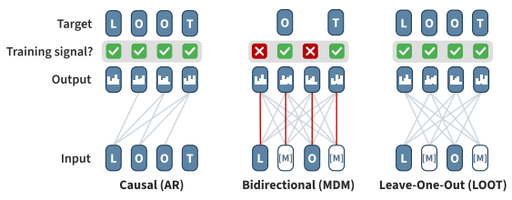
Figure 1 : Dependencies of output tokens on input tokens in causal, bidirectional, and leave-one-out models. Unlike standard bidirectional MDMs, the output of LOOTat index i does not depend on the input at indexi, enabling loss optimization even on unmasked tokens.
Original paper · CC BY 4.0 · Sofian Zalouk, Vincent Counathe, Paul Jünger, Daniel Cao, Daniel Zlotnick, Kilian Q. Weinberger, Christopher De Sa · Empowering Masked Diffusion Models to Self-Correct with Leave-One-Out Transformers · Original paper figure · Extracted the figure area from page 2 of the original PDF.Why standard masked diffusion models stay fixed and under-supervised
Standard masked diffusion models generate text by filling [MASK] positions with predictions over several steps. Once a position is filled it keeps that value, so a wrong early choice shapes everything generated after it. The training loss has the same gap: it is computed only at masked positions, so visible tokens give no direct learning signal.
The obstacle is the bidirectional transformer that MDMs use. Each prediction can read every input token, including the token it is meant to predict. If the loss were extended to visible tokens, the model could copy the answer from its input instead of predicting it from context.
The authors avoid this by modeling p_θ(x_i | x_{-i}) at every position, so the prediction for position i never receives the token at i as input. Every token, masked or visible, then becomes a real prediction problem that can be trained, and earlier outputs can be revised during inference.
Hollow transformers as the starting point
Hollow transformers satisfy the leave-one-out property by construction, so one forward pass yields a conditional at every position. Sun et al. use a forward stream that reads earlier tokens and a backward stream that reads later tokens, and they merge the two only at the final layer.
HollowDiff adds a third output stream that merges left and right context at intermediate layers. Its own results show weaker performance than a standard MDM, and its best results come from using it as a corrector for a separate MDM predictor, which adds training and inference cost.
The authors aim to close this gap with two changes: more frequent merging of left and right context, and a lower-variance estimator of the MDM NELBO.
Training on every position
Because the LOOT prediction at position i is the same whether position i is masked or visible, the masking probability at each position can be marginalized out. The identity behind this is \( p_\theta(x_i \mid x_{[M_t]}) = p_\theta(x_i \mid x_{[M_t \cup \{i\}]}) \), which holds for any mask set M_t.
Summing over all positions gives the objective \[ \mathcal{L}_{\mathrm{LOOT}}(\theta)=\mathbb{E}_{t,x,M_t}\Big[\alpha'_t\sum_{i=1}^{N}\log p_\theta(x_i \mid x_{[M_t]})\Big] \], where α'_t is the derivative of α_t with respect to t. The sum runs over every position, not only the masked ones, and the objective is a valid MDM likelihood bound whenever the leave-one-out property holds.
With the log-linear schedule α_t = 1 − t, the weight α'_t is the constant −1, so the standard MDLM weight 1/(1 − α_t), which diverges as α_t approaches 1, does not appear. HollowDiff and PGM use a half-and-half loss that averages the masked and unmasked losses, and its weights diverge at both ends of the schedule. The authors present their objective as a Rao-Blackwellization of that loss, which marginalizes the masking probability at each position.
For a LOOT model on LM1B, the proposed NELBO improves validation perplexity by 3.1 over the half-and-half loss.
Three streams and merging at every layer
A single attention layer with the diagonal removed keeps the property, but stacking layers lets information loop back: a neighbor reads token i in one layer and passes it back to position i in the next. The fix keeps the two causal streams of Sun et al. and adds an output stream that performs the merge.
The forward stream at position i attends to positions 1 through i, and the backward stream attends to positions i through N, with both updated layer by layer. The output stream attends to forward keys before position i and backward keys after it, so its context excludes the token at i. The output stream merges at every layer rather than once, and the authors argue that each layer's contribution accumulates in the residual stream.
The forward and backward streams start from the partially masked sequence, while the output stream starts from the [MASK] embedding so that its predictions keep the leave-one-out property.
The merge can be written as sliding-window attention: the backward and forward streams are concatenated into one key-value tensor, and each output query attends to a window of length N − 1. Each LOOT layer uses two FlashAttention calls and needs no custom kernel.
Resampling from leave-one-out conditionals
Sampling has two stages: S_init standard unmasking steps produce an initial sequence, and then R self-correction steps revise it. Each correction step uses one LOOT forward pass to obtain the conditional at every position, so the total NFE is S_init + R.
Blocked Gibbs partitions the positions into G groups and, at each step, resamples one group in parallel from the leave-one-out conditionals of its positions. Metropolis-Hastings proposes z_i from p_θ(· | x_{-i}) and accepts it with probability min(1, p_θ(z_i | x_{-i}) / p_θ(x_i | x_{-i})). A proposal that fits its context better than the current token is accepted outright, while one that fits worse is accepted only some of the time.
Improvement-based policies compare the best alternative token with the current one through the gap Δ_i = max over v ≠ x_i of log p_θ(v | x_{-i}) minus log p_θ(x_i | x_{-i}). Positions with Δ_i > 0 are locally improvable; a greedy variant edits the position with the largest Δ_i, and a stochastic variant samples positions in proportion to Δ_i.
ReMDM-style remasking needs several forward passes per correction, and choosing which tokens to remask depends on conditionals that a standard MDM cannot evaluate cheaply. A standard MDM would need N minus the number of masked positions passes to obtain the conditionals of the visible tokens, whereas LOOT returns all N conditionals in one pass.
Language modeling perplexity on LM1B and OpenWebText
LM1B is run at sequence length 128 for 1M steps and OpenWebText at sequence length 1024 for 250K steps, following the training setup of Sahoo et al.
PGM reaches 31.04 ± 0.09, so LOOT matches PGM within evaluation-seed variation.
Lower perplexity is better, so LOOT trails both on OpenWebText, and the authors describe a modest gap that remains at longer sequence lengths.
What drives the gap: objective, architecture and merge frequency
Three OpenWebText models were trained at N=128 and N=1024 with all other settings fixed: standard MDLM, the LOOT architecture with the MDLM loss, and LOOT with the all-position objective. Holding the architecture fixed, the all-position objective lowers perplexity by 2.9 at N=128 and by 2.8 at N=1024.
Holding the MDLM loss fixed, the leave-one-out architecture costs 2.2 perplexity at N=128 and 4.4 at N=1024. The objective more than offsets this cost at N=128 but does not fully close the gap at N=1024, which the authors read as a length-dependent capacity gap between hollow and bidirectional transformers. At N=128, LOOT outperforms MDLM on both OpenWebText and LM1B.
In shorter LM1B runs, merging more often consistently improves perplexity, and per-layer merging gives the best result. The merge-once architecture of Sun et al., trained with the proposed objective, reaches 41.07, still above the bidirectional DiT baseline at 39.80. Per-layer merging reaches 36.23, below the bidirectional DiT baseline at 39.80.
Against the half-and-half loss used by earlier hollow work, the proposed NELBO improves validation perplexity on LM1B by 3.1 for a LOOT model.
Self-correction on OpenWebText sampling
Generative perplexity uses GPT-2 Large on 512 samples per configuration, and MAUVE uses 5,000 samples at temperatures matched to the entropy of OpenWebText validation text, with nucleus sampling at p = 0.9.
At 256 NFE, LOOT-Blocked-Gibbs reaches MAUVE 0.408 with sample entropy 5.40 and generative perplexity 20.1. ReMDM at 2048 NFE reaches MAUVE 0.348 with entropy 5.40 and generative perplexity 31.2, so the entropies match.
LOOT-Baseline, which samples without correction, reaches MAUVE 0.010 at 256 NFE, below MDLM at 0.014. Adding Blocked Gibbs raises MAUVE to 0.408 and Metropolis-Hastings to 0.312, while Best Improvement reaches only 0.035. The authors take this as evidence that the gain comes from self-correction and that the choice of sampling algorithm matters.
The 256 NFE Blocked Gibbs run uses 8× fewer forward evaluations than ReMDM at 2048 NFE and 3.5× fewer inference FLOPs, after accounting for the 2.2× cost of a LOOT forward pass. At 512 NFE, LOOT uses 1.7× fewer inference FLOPs than ReMDM at 2048 NFE, and the authors report that it improves both metrics at that budget. The authors also report that, on the same hardware, LOOT at 256 NFE is about 8× faster in wall-clock time than ReMDM at 2048 NFE.
Cost of a LOOT forward pass
Counting matmul and attention FLOPs at N=1024, a LOOT forward pass costs 2.24× a standard MDM of the same size.
Measured with torch.compile, the forward plus backward cost ratio of LOOT to MDM is 1.25× at small batch sizes, where both models are launch-bound, and 2.22× at large batch sizes with N=1024, where both are compute-bound. The authors state that this per-pass overhead is recovered at inference, where one LOOT pass returns all N leave-one-out conditionals used by the correction steps.
Adapting a pretrained MDM checkpoint
Starting from an MDM checkpoint pretrained for 200K steps, the authors compare 50K more steps of standard MDM training with converting the checkpoint to LOOT and fine-tuning it with the all-position objective for the same duration. The LOOT run uses about 2.2× the per-step FLOPs, which gives 1.25× the total training FLOPs over the same number of tokens.
The fine-tuned LOOT keeps comparable generation quality without correction, and self-correction gives substantial gains over continued MDM training.
Limits of the current evidence
The perplexity gap to bidirectional MDMs grows with length: under the MDLM loss the architecture costs 4.4 at N=1024, and the all-position objective does not fully close it. Each LOOT forward pass also costs about 2.2× the FLOPs of a standard MDM, so the cost per step is higher even though sampling uses fewer evaluations.
The self-correction results depend strongly on the correction algorithm: the three LOOT correction methods range from 0.035 to 0.408 MAUVE at 256 NFE. The sampling comparisons use OpenWebText at N=1024, with nucleus sampling at p = 0.9 in the main results; quality–diversity frontiers for p = 1.0 are given in an appendix. The authors list understanding the length-dependent gap, developing better correction methods and exploring hybrid training and inference as open directions.
Paper info
- Authors
- Sofian Zalouk, Vincent Counathe, Paul Jünger, Daniel Cao, Daniel Zlotnick, Kilian Q. Weinberger, Christopher De Sa
- Venue
- arXiv · Preprint
- First published
- 2026-11-14
- Added
- 2026-11-17
- Updated
- 2026-11-14
- Version
- v1
- arXiv
- 2611.19127
- Category
- cs.LG · cs.CL
- Original paper terms
- CC BY 4.0
- What we show
- Paper info, commentary and permitted figures from the original paper
AI commentary is a separate explanation from the original paper and may contain errors. The original paper and figures follow each source's terms of use and any rights noted separately.
Abstract
Masked diffusion models (MDMs) have emerged as a promising paradigm for language modeling, enabling parallel token generation with competitive performance. Yet standard MDMs suffer from two fundamental limitations: (1) inability to revise tokens, and (2) sparse training signal. We revisit hollow transformers, which address both limitations by predicting each token from its surrounding context, independently of the input at that position. We introduce the Leave-One-Out Transformer (LOOT), a more efficient and expressive architecture that advances hollow transformers through two complementary advances. First, we redesign the merging mechanism to enable frequent interaction between left and right contexts, substantially improving predictive performance over prior hollow transformers. Second, we derive a lower-variance estimator of the MDM NELBO that supervises all tokens and improves validation perplexity. Together, these advances yield a competitive standalone diffusion language model capable of effective self-correction during inference. On LM1B, LOOT matches the strongest dense-supervision MDM baseline in validation perplexity. On OpenWebText, LOOT achieves higher MAUVE and better generation quality-diversity tradeoffs than prior remasking methods, using $8\times$ fewer forward evaluations and $3.5\times$ fewer inference FLOPs.
Quote from the paper
Sofian Zalouk, Vincent Counathe, Paul Jünger, Daniel Cao, Daniel Zlotnick, Kilian Q. Weinberger, Christopher De Sa (2026). Empowering Masked Diffusion Models to Self-Correct with Leave-One-Out Transformers. arXiv:2611.19127v1. https://arxiv.org/abs/2611.19127v1
BibTeX
@misc{zalouk2026empowering,
  title = {{Empowering Masked Diffusion Models to Self-Correct with Leave-One-Out Transformers}},
  author = {Sofian Zalouk and Vincent Counathe and Paul Jünger and Daniel Cao and Daniel Zlotnick and Kilian Q. Weinberger and Christopher De Sa},
  year = {2026},
  eprint = {2611.19127},
  archivePrefix = {arXiv},
  url = {https://arxiv.org/abs/2611.19127v1}
}