Paper commentary
SAE-Audit: Clinical-Trial Prediction via Inference-Time Optimization of Black-Box LLMs Audited by Sparse Autoencoder Evidence
SAE-Audit lets a black-box LLM revise clinical-trial predictions using sparse autoencoder evidence
- Problem Prompted LLMs predict clinical-trial outcomes only modestly above chance, and their rationales are hard to check. Self-critique from the model adds no outside information, so it cannot fix this.
- Method SAE-Audit turns a probe's measured concept associations into text evidence. The black-box LLM then revises its draft answer against that evidence, with no weight changes.
- Results On trial completion, deepseek-v4-flash's balanced accuracy rose from 61.0 to 71.2 with SAE-Audit, beating Self-Refine, debate and TextGrad.
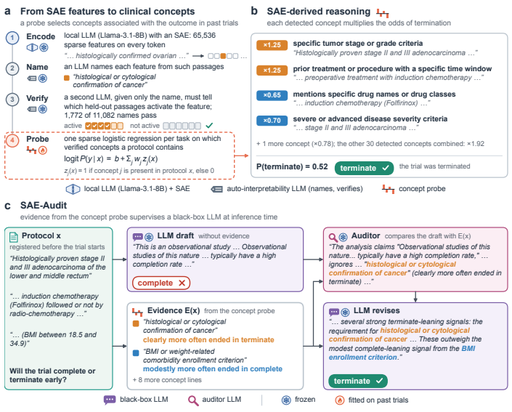
Figure 1 :Overview of SAE-Audit, with SAE concept dictionary build-up, SAE probes module which can serve as both a direct reasoner and predictor, and SAE-Audit that takes evidence from SAE probes for inference-time optimization on LLMs.a, A frozen SAE on Llama-3.1-8B-Instruct is turned into a vocabulary of clinical concepts, and one sparse probe per task is fitted on which concepts past protocols contain.b, SAE-derived reasoning: the probe’s prediction is an exact product of factors, one per detected concept, each tied to the passage of the protocol on which the concept is most active.c, SAE-Audit in the draft-first setting with the auditor: the concepts detected by the probe are written as evidence E(x); the auditor checks the LLM’s draft against the evidence, and the LLM revises its answer, here fromcomplete(wrong) toterminate(correct).
Original paper · CC BY 4.0 · Junbo Shen · SAE-Audit: Clinical-Trial Prediction via Inference-Time Optimization of Black-Box LLMs Audited by Sparse Autoencoder Evidence · Original paper figure · Extracted the figure area from page 2 of the original PDF.Why trial-outcome prediction stays hard for LLMs
A registered trial has to be forecast from its protocol alone, years before anyone knows how it ends. LLMs read these long documents fluently, but asking them for the outcome gives weak answers.
Every answer arrives with a fluent rationale, but those rationales often hallucinate or misstate how the model got there. In clinical trial work a reader can't faithfully check them, so the answer carries no audit trail. Self-correction looks like the obvious fix, but a critique from the model itself or from another LLM adds no outside information.
Prior work found that self-correction doesn't improve reasoning unless external feedback is available.
A second line of work reads the model's hidden activations, and a linear probe on them sometimes beats prompted LLMs. The catch is that such a probe outputs a score that can't be inspected. Nobody had used them to refine another model's answer at inference time, and that is the gap this study targets.
The key idea: evidence from past trials instead of self-critique
The key idea is to let a probe on a small open model pass what it learned from past trials to a black-box LLM as text. The open model runs locally, and its concept-outcome findings are written into the prompt so that the LLM can check them against the protocol. No weights of the black-box LLM change, so the approach works at inference time only.
Self-Refine and similar methods already revise a draft, but their feedback is the model's own critique. SAE-Audit keeps the same draft-and-revise step and swaps in evidence that was measured on past trials. The authors expect this to change what the LLM checks against: its draft is tested against associations in data rather than against its own beliefs.
The authors also argue that each piece of evidence is checkable, which is what makes the revision auditable. The authors expect the LLM to follow evidence that points the right way, and to be hurt by evidence that points the wrong way.
How the pipeline runs, from SAE feature to evidence line
The offline stage starts from Llama-3.1-8B-Instruct and a frozen SAE trained on its layer-19 activations, giving 65,536 sparse features per token. An LLM, deepseek-v4-flash, names each feature from passages on which it is active and passages on which it is not. A second LLM then sees only that name and must pick out held-out passages where the feature is active.
A name survives only if this check reaches a Matthews correlation of at least 0.7, which left 1,772 of 11,082 named features as concepts.
For each task, a protocol becomes a vector of binary indicators, one per concept, set to 1 when the concept is active anywhere in it. An L1-regularised logistic regression is fitted on past trials, written as \(\operatorname{logit} P(y=1 \mid x) = b + \sum_{j \in S} w_j z_j(x)\). The set S keeps only the concepts with nonzero weight, which gave 162 concepts for trial completion.
For a new protocol, the concepts the probe detects become evidence, with no LLM call. Because each line rests on a verified name and a measured effect, the LLM has something concrete to check.
The full procedure fits into a short algorithm with an offline part and an online part. At inference, the black-box LLM is called in one of two settings. In draft-first, the LLM answers alone and then revises that draft against the evidence. In evidence-first, the LLM reads the evidence before answering, in a single call. An optional auditor, the same LLM under different instructions, first ties the evidence to the protocol and may not predict the outcome.
Each auditor remark must name a concept, keep its stated direction and strength, and quote the text it refers to.
Does the audited LLM actually get better?
The main test uses deepseek-v4-flash on five tasks, each scored on 250 random test protocols. Balanced accuracy rose by 9.6 to 12.0 points on every task, and every interval excluded zero. Each gain is a paired difference between the LLM with SAE-Audit and the LLM alone, so both sides use the same protocols.
Self-Refine, debate and TextGrad scored 54.7, 61.4 and 58.2 on that task, compared to 61.0 for the LLM alone. The authors read the gap as coming from the content of the evidence, not from an extra revision pass.
Audited, the LLM also beat the concept probe on trial completion, scoring 71.2 compared to 65.2 for the probe. Unaided, the LLM sat 8.8 points below the probe on average. The authors take this as evidence that the concept-level content adds something beyond the probe's own answer.
Inverting every evidence line pushes accuracy below the unaided LLM, by 18.2 points on trial completion. Removing the evidence but keeping the instruction to revise leaves accuracy unchanged, at +0.3 points. Giving only the probe's predicted label scored 65.7, close to the probe's own 65.2 and well below 71.2 with the evidence.
Self-Refine moved the LLM by -5.7 points on average, while debate and TextGrad gained +1.0 and +1.7 points. Feeding in only the concept names, without their measured directions and strengths, gave -0.7 points, compared to +10.6 with the evidence. The missing measurement is what makes the difference, since names alone carry no direction. Biomni, a general-purpose biomedical agent, scored 70.9 on trial completion while using about 146,000 tokens per protocol.
LLM plus SAE-Audit scored 71.2 with about 6,900 tokens, roughly a twentieth as many.
The evidence doesn't depend on which LLM receives it. On GPT-5.6-terra, the same evidence moved trial completion from 62.9 to 70.8, a gain of 8.0 points with interval +1.9 to +14.0. The stronger model changed its answer on 18% of protocols when revising, compared to 41% for deepseek-v4-flash. With inverted evidence, GPT-5.6-terra gained nothing, while deepseek-v4-flash lost 8.1 points.
Is the probe's own explanation faithful?
It reports the five largest contributions and combines the rest into one term. Each factor is tied to the passage of the protocol where the concept is most active.
Faithfulness is tested by deletion: comprehensiveness is the mean change in the prediction when the cited passages are removed, and sufficiency the mean change when only they are kept. Each is divided by the same measure for random passages, so a ratio above 1 means the cited passages matter more than random ones. The probe's cited passages change its predicted probability 2.6 times as much as random passages, compared to 1.4 for deepseek-v4-flash and 1.2 for GPT-5.6-terra.
Every quotation the probe cites is verbatim, whereas 16-19% of the LLMs' quotations can't be located in the protocol. The probe generates no tokens for its explanation, while the LLMs generate 640 to 1,090.
Why the SAE basis makes concepts nameable
The authors ask whether the SAE basis is what makes features nameable, by repeating the procedure with two other feature sets. The alternatives are the dense neurons, ReLU(h), and a random dictionary of the same size as the SAE, ReLU(Rh), with a random matrix R and no training. For the probe they keep only the k largest activations per token, with k set to 24 for the SAE and the random dictionary and to 2 for the 4,096 neurons.
The best single feature of each basis, chosen on half the trials and scored on the other half, detects 58 attributes with F1 above 0.5 for SAE features. The random dictionary does this for 19 attributes and dense neurons for 5.
An LLM names each feature that the probe selects, and a second LLM checks the name against passages. On trial completion, 46% of SAE features pass the standard test, compared to 25% of neurons and 20% of random directions. In the harder test, which includes passages where the feature is only weakly active, 25% of SAE features pass, compared to 7% and 4%.
The authors read the gap as a property of the SAE basis rather than of the naming step, since the same LLM and tests were used for every basis.
The SAE basis doesn't reduce probe accuracy. On trial completion, the SAE probe scored 7.9 points above the dense-neuron probe and at least matched the random-dictionary probe. On the same task the three probes scored 64.8, 56.9 and 62.9.
Limited labels and the direct predictor
With fewer labelled trials the probe weakens. Fitted on 750 trials, the probe scored 59.1, compared to 61.0 for the unaided LLM, whereas the audited LLM scored 63.6. Averaged over the four label counts, the audited LLM beat the probe by 4.7 points, with a 95% interval of -0.1 to 9.6. That interval includes zero, so this gap is not firmly established.
The concept probe scored 64.8 on trial completion using binary concept indicators. That auxiliary probe's predictions can't be explained, so the concept probe is the one that supplies both the explanations and the evidence.
Limitations
Each LLM result uses 250 random test protocols per task, because the API calls are expensive. All results come from one SAE at one layer of one 8B model.
The audit setting shown for each task is the one that suits its evaluation protocols best.
Concept names were verified only on eligibility-criterion passages. Clinical utility has not been evaluated prospectively.
Paper info
- Authors
- Junbo Shen
- Venue
- arXiv · Preprint
- First published
- 2026-11-22
- Added
- 2026-11-24
- Updated
- 2026-11-22
- Version
- v1
- arXiv
- 2611.29368
- Category
- cs.AI · cs.CL · cs.LG
- Original paper terms
- CC BY 4.0
- What we show
- Paper info, commentary and permitted figures from the original paper
AI commentary is a separate explanation from the original paper and may contain errors. The original paper and figures follow each source's terms of use and any rights noted separately.
Abstract
Clinical trials are costly and often take years to complete, making early outcome prediction valuable for trial planning. Large language models (LLMs) are increasingly used to forecast clinical-trial outcomes, yet their predictions remain unreliable and their rationales may not faithfully reflect the evidence underlying their answers. On tasks such as predicting whether a registered clinical trial will complete or terminate early, frontier LLMs perform only modestly above chance in our experiments. We introduce SAE-Audit, which optimizes a black-box LLM at inference time with evidence obtained from a deployable open model. A frozen sparse autoencoder (SAE) on Llama-3.1-8B-Instruct is converted into a vocabulary of clinical concepts. Sparse probes fitted on past trials determine which concepts are associated with the outcome. For a new protocol, the concepts detected by the probe are written as evidence, each with the direction and strength of its association with the outcome, and the LLM being audited optimizes its answer in the light of this evidence. Without additional training, SAE-Audit raises balanced accuracy of deepseek-v4-flash by 9.6--12.0 points on five clinical-trial prediction tasks and raises GPT-5.6-terra by 8.0 points on trial completion, exceeding other agentic inference-time optimization methods by a large margin. As an auxiliary, SAE probes module within SAE-Audit is itself accurate and auditable, providing natural-language explanations directly derived from verified concept contributions and protocol evidence, without requiring additional LLMs at inference time. SAE-Audit provides verifiable, concept-level evidence for more accurate and auditable clinical-trial prediction. It can also be embedded into biomedical AI agents such as Biomni to optimize their performance.
Quote from the paper
Junbo Shen (2026). SAE-Audit: Clinical-Trial Prediction via Inference-Time Optimization of Black-Box LLMs Audited by Sparse Autoencoder Evidence. arXiv:2611.29368v1. https://arxiv.org/abs/2611.29368v1
BibTeX
@misc{shen2026audit,
  title = {{SAE-Audit: Clinical-Trial Prediction via Inference-Time Optimization of Black-Box LLMs Audited by Sparse Autoencoder Evidence}},
  author = {Junbo Shen},
  year = {2026},
  eprint = {2611.29368},
  archivePrefix = {arXiv},
  url = {https://arxiv.org/abs/2611.29368v1}
}