Paper commentary
Multimodal Abstention That Preserves Acquired Correct Answers
ReFrain vetoes low-confidence answers to abstain without losing correct ones
- Problem Adding abstention to a task-adapted multimodal model can turn its correct answers into errors. Net accuracy hides these losses, because corrections and regressions cancel out.
- Method ReFrain keeps the frozen answer model and scores each input with a linear probe on first-token logits. It sets a threshold on held-out image clusters, then swaps outputs below it for the displayed none-of-the-above option.
- Results At zero budget, ReFrain loses no original correct answers on 5,626 Standard records. At a 0.5% budget it reaches 74.05% correct abstention with 8 losses, against 64.65% and 62 losses for CLIP-UP EmbLoRA.
Why abstention after adaptation can cost correct answers
A multimodal model is usually adapted to its task first and taught to abstain only afterwards. The order matters because adaptation has already made the model answer some questions correctly, and some of those answers were only just corrected. The authors call adding abstention to an already-adapted answer model abstention repair, and they measure its cost against the records that model answered correctly.
Net accuracy hides this cost because losses and corrections can cancel each other. For CLIP-UP EmbLoRA, the Standard accuracy sits only 0.37 percentage points below the starting point, yet that difference contains 62 lost original correct answers and 41 corrections.
The authors therefore state the problem as maximizing the correct-abstention rate on unanswerable questions under a budget ε on the original-correct loss. That loss is the negative flip rate from the model-update literature, so the constraint targets record-level regressions rather than the net score. Users encounter these record-level regressions, so a small net change can still break the specific answers they depend on.
Every scheme starts from the same answer-SFT checkpoint B1, which makes the changed answers comparable record by record. The authors fix the starting point so that losses, corrections, and SFT-gained records can be counted against B1. The SFT-gained set R contains the records that B0 got wrong and B1 got right. The gain retention rate measures how many of these records a scheme keeps, showing whether abstention erodes what SFT just taught.
The protocol uses 677 Standard records for SFT and 1,354 training records overall, while selection happens only on the calibration set.
A veto that only ever outputs NOTA
ReFrain keeps the frozen answer model unchanged and only ever swaps an output for the none-of-the-above option that is already displayed in the question. It works in three steps: score each input, calibrate a threshold against a loss budget, and veto the outputs whose score falls below that threshold. Because the substitute is always the displayed NOTA option, an output can only move to abstention and never to another substantive answer.
Calibration picks the largest candidate threshold whose empirical original-correct loss on the calibration set stays within the budget, \( \tau_\varepsilon = \max\{\tau \in \mathcal{T} : \hat{L}_{C_M}(g_\tau;f) \le \varepsilon\} \). At ε = 0.5%, the 2,406 Standard calibration records allow at most 12 losses, and the default scorer attains 11.
So the threshold is set by how many correct answers may be lost, not by a classifier's default probability cutoff. Changing the budget only moves this threshold, so the method doesn't need retraining when the budget changes.
What the veto rule guarantees and where it stops
Veto-only execution gives ReFrain two properties that hold for any scorer. Because the substitute is always the displayed NOTA option, a veto can't correct an error of the frozen model f. On Standard records the correction count is zero, so the net accuracy change equals minus L. On UPD records the correct-abstention rate can't fall below the starting model at any threshold.
As the threshold rises, the vetoed set only grows, so loss and correct abstention never decrease. Together these make the whole method a frontier indexed by the threshold, and the budget picks one point on it.
The loss depends only on the score distribution of the Standard records that f answers correctly. Calibration therefore needs only answerable records with their original labels, while unanswerable examples only train the scorer. Changing the budget means choosing the threshold again, so ReFrain doesn't need retraining. At zero budget the threshold sits at or below the lowest score among the correctly answered CM Standard records.
Property 3 is the only one of the three that needs a sampling assumption, because it concerns a new image cluster. It assumes the K calibration clusters and the new cluster are exchangeable, given the training set and everything else that fixes f and the scorer. With K = 183, the bound 1/(K+1) gives about 0.54% for the probability of at least one loss in a new cluster.
It says nothing about ReFrain at ε = 0.5%, and it doesn't cover data from another source such as the confirmation set. For E, the expected number of the 416 clusters with a loss is at most about 2.26, while the observed count is 0 for B1. The authors call this observed count a descriptive check rather than a test of the bound, since both sets shaped the method.
One-sidedness also means ReFrain gives up correction, so its Standard accuracy can't be higher than that of f.
Results on the shared B1 checkpoint: what ReFrain keeps and gives up
On the Qwen2.5-VL-3B answer-SFT checkpoint B1, the zero-budget ReFrain loses no original correct answer on the 5,626 Standard evaluation records. Under the authors' criterion, this is a gain without a regression, which is what the zero-budget target was built to guarantee on calibration data.
ReFrain doesn't correct the answer model's errors at all, because the veto can only replace an output with NOTA. That is the cost of its one-sided design, and the paper reports the point estimates of the trained branches as positive on the confirmation set. At the 0.5% budget, ReFrain (ε=0.5%) loses 8 original correct answers and still retains 55 of the 57 SFT-gained records.
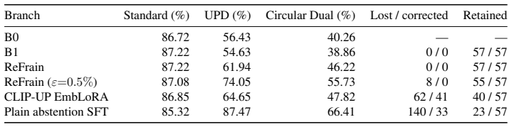
Table 4 : Abstention branches from the common starting point B1, on E. Lost and corrected answers are counted relative to B1 among the 5,626 Standard records; retained records are out of the 57 SFT-gained records.
Original paper · CC BY 4.0 · Jinyuan Zhang · Multimodal Abstention That Preserves Acquired Correct Answers · Original paper figure · Extracted the figure area from page 12 of the original PDF.Plain abstention SFT, trained on the same B1 starting point, reaches 87.47% correct abstention but loses 140 correct answers. It also corrects 33 old errors and keeps only 23 of the 57 SFT-gained records. That branch doesn't pass the joint criterion on the evaluation set, so its higher abstention comes with greater regression.
CLIP-UP EmbLoRA is the parameter-update comparison that ReFrain beats on retention, and it sits between the two. EmbLoRA reaches 64.65% correct abstention with 62 losses, 41 corrections, and 40 retained SFT gains. Its gain retention rate is 96.49% against 70.18%, a direct difference of 26.32 pp.
Changing the scorer and the base model
The scorer comparison keeps the calibration rule and the executor fixed, and only the score changes. At ε = 0 the cross-validated probe is 2.06 percentage points higher in correct abstention than the probe with fixed C = 1, with an interval of [1.58, 2.58]. At ε = 0.5%, the fixed C = 1 probe is 1.35 percentage points higher, with an interval of [0.86, 1.84], but it loses 5 more original correct answers.
So the regularization strength acts as a choice of operating point rather than a fixed improvement. Both learned logits probes reach higher correct-abstention rates than MSP and the negative entropy at these operating points.
The default threshold is the main contrast to calibration for the logits score. A CLIP correlation-vector classifier at its default threshold loses 1162 original correct answers, and its calibrated version at ε = 0.5% loses 8. The logits probe at its default threshold of p = 0.5 loses 298 correct answers, and calibration brings it to a passing operating point.
Calibration also lowers abstention coverage, so the logits probe keeps more of the gain in correct abstention at the calibrated point.
The base-model experiment asks whether the same pipeline works when fitted separately on original base models without answer SFT. On Qwen2.5-VL-3B and InternVL3-8B, the zero-budget points lose 2 and 4 original correct Standard answers. Their correct-abstention rates are 2.04 and 2.85 pp above EmbLoRA. CLIP-UP EmbLoRA passes the joint criterion on both base models, while CLIP-UP Emb degrades markedly on InternVL3-8B under the common prompt.
The budget curve and post-training shifts
The budget curve shows how the default probe trades abstention against lost answers on the evaluation set E. The correct-abstention rate of the default scorer on E is 61.94% at zero budget, 66.83% at 0.1%, 71.81% at 0.25%, 74.05% at 0.5%, and 82.90% at 1%. Over the same budgets, the number of original correct answers lost rises as 0, 0, 5, 8, and 70.
A wider budget increases abstention coverage, and it also increases the realized loss.
Calibration on CM doesn't force the evaluation losses below the nominal level. At the 1% budget, the realized loss rate on E is 1.24%, which sits above the nominal budget. Figure 2 marks the dashed line where the realized loss equals the nominal budget, and the authors note that empirical calibration doesn't push the evaluation points below it.
The same first-token logits pipeline gives a lower correct-abstention rate on B1 than on B0. At zero budget the rate falls from 67.85% on B0 to 61.94% on B1. At the 0.5% budget it drops from 80.56% to 74.05%, so the abstention layer has to be evaluated again after answer adaptation.
Failure types show different trade-offs, and ReFrain (ε=0.5%) has its advantage over EmbLoRA concentrated in AAD and IASD. On IVQD, EmbLoRA has the higher correct-abstention rate and corrects 9 errors of B1. ReFrain (ε=0.5%) retains all 13 SFT-gained records there, but it loses 1 original correct answer.
Independent confirmation on AI2D images
The confirmation set is built from AI2D images that the development of this project never touched. Its construction removed earlier MM-UPD and CLIP-UP images, the official AI2D test images, and exact and near-duplicate images. The final set has 271 images, 912 Standard records, and 816 UPD records. The semantic review didn't read any branch's predictions, so the confirmation can't be tuned on the evaluation outputs.

Table 11 : Frozen confirmation on I. UPD is given as the micro-average over the 816 UPD records and as the macro-average over the failure types. The joint criterion is relative to B1; lost and corrected answers are counted among the 912 Standard records, and retained records are out of the 8 SFT-gained records.
Original paper · CC BY 4.0Under these frozen settings, neither operating point of ReFrain lost an original correct answer on the 912 Standard records. The correct-abstention rate rose by 20.10 and 44.36 percentage points at the two operating points. Relative to EmbLoRA, ReFrain (ε=0.5%) reaches 32.72 percentage points more correct abstention, with a paired interval of [27.13, 38.53].
The trained branches do lose and correct answers on this set. EmbLoRA loses 7 and corrects 13, so its net Standard accuracy sits 0.66 percentage points above ReFrain. Plain abstention SFT loses 4 and corrects 5, and it passes the joint criterion. Its correct-abstention rate is 4.90 percentage points above ReFrain (ε=0.5%), with an interval of [1.34, 8.49].
The ReFrain (ε=0.5%) point keeps every original correct answer, so the trade-off is retention against abstention coverage.
The confirmation covers only AI2D science diagrams, so it doesn't establish results on other image types. B1 has only 8 SFT-gained records in 7 clusters on this set. Those retention counts don't support a new statistical conclusion. The AI2D images may still overlap with public data seen during pretraining or instruction tuning.
Limitations of the shared-SFT and confirmation evidence
The shared answer-SFT setting uses a single training seed and 677 Standard training records. The 57 SFT-gained records lie in 28 image clusters, so the interval for the difference in gain retention is wide. The image-cluster intervals measure sampling variation under fixed checkpoints, and they don't include the randomness of retraining. Retention conclusions therefore rest on one training setup, and the paper doesn't test other seeds.
The independent confirmation covers only AI2D science diagrams, so its results don't generalize to other diagram or image types. The confirmation set has only 8 SFT-gained records in 7 clusters. Its retention counts therefore don't support a new statistical conclusion. The three failure types also have different sample sizes, and the questions were reviewed by rules and a multimodal model rather than by two human annotators.
Base models might have seen public AI2D data during pretraining or instruction tuning, even though the images weren't used in development.
The zero loss on the confirmation set falls outside that guarantee, so it gives no population-level claim.
The results on retention after post-training come only from Qwen2.5-VL-3B. The ACR-MCQ controls were run after the main results were observed, so they are extension experiments.
Paper info
- Authors
- Jinyuan Zhang
- Venue
- arXiv · Preprint
- First published
- 2026-11-10
- Added
- 2026-11-12
- Updated
- 2026-11-10
- Version
- v1
- arXiv
- 2611.14311
- Category
- cs.AI · cs.CV · cs.LG
- Original paper terms
- CC BY 4.0
- What we show
- Paper info, commentary and permitted figures from the original paper
AI commentary is a separate explanation from the original paper and may contain errors. The original paper and figures follow each source's terms of use and any rights noted separately.
Abstract
Adding abstention to a task-adapted multimodal model can discard correct answers, including capabilities acquired during adaptation. We formulate abstention repair as maximizing correct abstention on unanswerable questions under a budget on newly lost correct answers. We propose ReFrain (Regression-Free Abstention), which combines a linear probe on first-token logits, threshold calibration on held-out image clusters, and a deterministic veto that replaces rejected outputs with the displayed "none of the above" option while preserving all other responses. "Regression-free" denotes zero loss on the calibration set at the zero-budget target. All abstention methods in our main comparison start from the same answering-SFT checkpoint; we separately track lost correct answers, repaired errors, and retained SFT gains. On Qwen2.5-VL-3B, ReFrain at zero budget retains all 57 SFT-gained answers with no losses and improves correct abstention by 7.30 percentage points. At a 0.5% calibration budget, it reaches 74.05% correct abstention with 8 losses and retains 55 gains; CLIP-UP EmbLoRA reaches 64.65% with 62 losses, 41 repairs, and 40 retained gains. The same probe at its default threshold loses 298 correct answers. With models and thresholds frozen, confirmation on 228 independent question clusters yields 66.05% correct abstention and no losses at the 0.5% point, exceeding EmbLoRA by 32.72 percentage points. Ordinary refusal SFT achieves higher correct abstention at greater regression cost. Code and reproduction materials: https://github.com/ModeLiberaL/ReFrain.
Quote from the paper
Jinyuan Zhang (2026). Multimodal Abstention That Preserves Acquired Correct Answers. arXiv:2611.14311v1. https://arxiv.org/abs/2611.14311v1
BibTeX
@misc{zhang2026multimodal,
  title = {{Multimodal Abstention That Preserves Acquired Correct Answers}},
  author = {Jinyuan Zhang},
  year = {2026},
  eprint = {2611.14311},
  archivePrefix = {arXiv},
  url = {https://arxiv.org/abs/2611.14311v1}
}