Paper commentary
Colors in Context: A Pragmatic Neural Model for Grounded Language Understanding
Pragmatic neural listeners identify colors from descriptions more accurately than literal models
- Problem Color descriptions depend on the other colors on screen, but literal listeners read only the words and ignore that context. Close colors are the hardest case, and literal models struggle with them.
- Method The authors blend a neural base listener with listeners derived from a neural speaker. The speaker is sampled to form alternative utterances, and the listener reasons about why the speaker chose its words.
- Results The final ensemble reached 86.98 test accuracy, compared to 85.08 for the base listener. Most of the gain appears in the close and split conditions.
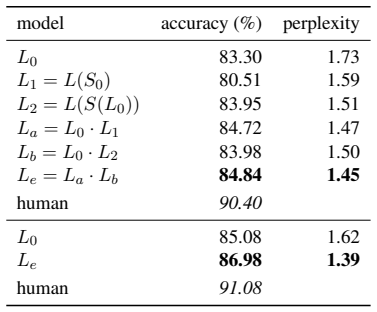
Table 3 : Accuracy and perplexity of the base and prag- matic listeners and various blends (weighted averages, denotedA·B). Top: dev set; bottom: test set.
Original paper · CC BY 4.0 · Will Monroe, Robert X. D. Hawkins, Noah D. Goodman, Christopher Potts · Colors in Context: A Pragmatic Neural Model for Grounded Language Understanding · Original paper figure · Extracted the figure area from page 9 of the original PDF.Why a literal listener struggles with color references
Color descriptions depend on the other colors on screen as much as on the target itself. In the paper's examples, the same target color receives different words as the distractors change. The speaker S0, by contrast, has learned that drab fits the grayish green target better than the yellowish distractor.
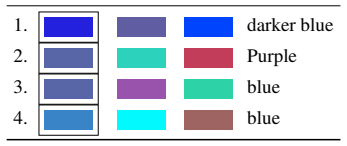
Table 1 : Examples of color reference in context, taken from our corpus. The target color is boxed. The speaker’s description is shaped not only by this target, but also by the other context colors and their relationships.
Original paper · CC BY 4.0Human listeners find close colors hardest, so accuracy drops as the distractors crowd the target. Human listeners reached 97% accuracy in the far condition, 90% in split and 83% in close. The authors ask whether a learned model can close that gap by reasoning about how the speaker chose the words. They frame the test as a language understanding task, where the listener must identify the target from the description.
Recursive reasoning over learned literal agents
The core idea keeps the Rational Speech Acts recursion and replaces its hand-written literal semantics with learned neural agents. Because these agents are learned from data, the approach scales to large sets of varied utterances instead of a fixed grammar. Hand-specified message sets are the obstacle, since the denominator of the speaker normalization must sum over all messages.
The base listener L0 is an LSTM encoder that reads a description word by word. A linear transformation of the final LSTM output produces the parameters µ and Σ of a quadratic form. Each context color enters as an RGB vector, which is Fourier-transformed as in Monroe et al. (2016) before scoring. The scores are normalized in log space over the K context colors, and the form is not guaranteed to be negative definite, yet it is for more than 95% of inputs.
The base speaker S0 encodes the context colors with an LSTM, after reordering them to place the target color last. A second LSTM decodes the description token by token, and each step receives the context state concatenated with the previous token's embedding. The authors use S0 for two jobs: a speaker-based listener and a source of sample utterances that avoid enumerating the intractably large utterance space.
The pragmatic speaker S1 normalizes the base listener's probability of the target over a set of candidate utterances. The full sum over all possible utterances is exponentially large and might not even be finite, so the authors sample instead. For each referent, they draw m samples from S0 and add the actual utterance from the test example.
They set m to 8 and average the resulting probabilities over n = 8 repeated samplings to reduce noise.
A second listener, L1, is formed by normalizing the base speaker's probability over the context colors, which inverts S0 rather than L0. The authors expect L1 to be less accurate than L0 or L2, yet its training objective can give strengths that complement the listener-based agents. Blends then combine the listeners as weighted products, such as La ∝ L0^βa · L1^(1−βa).
Setting βb to 0 gives back the pragmatic listener L2, and setting it to 1 gives back the base listener L0.
A corpus of color reference games
The authors built their training and test data from a new corpus of human color reference games. They recruited 967 unique participants on Amazon Mechanical Turk to play 1,059 games of 50 rounds each. The games ran on the open-source framework of Hawkins (2015), which placed each dyad in a shared environment. Participants were sorted into dyads and randomly assigned the role of speaker or listener.
Each round showed an array of three color patches, and one was highlighted as the target for the speaker. The speaker typed in a chat box, and the listener clicked one color to advance to the next trial.
Each round came from one of three conditions, which the authors interspersed in equal numbers. In the split condition, one distractor lies within θ of the target while the other lies farther than θ. In the far condition, all colors lie farther than θ from one another. The authors used the CIEDE standard to measure color differences, set θ = 20, and required differences of at least ϵ = 5.
Colors were rejection sampled uniformly from RGB space to meet these constraints.
After filtering out long messages, incomplete games, and confused or non-native participants, the corpus held 948 games. The filtered corpus contains 53,365 speaker utterances across 46,994 rounds. The close, split and far conditions have 15,519, 15,693 and 15,782 trials, so they are nearly equally represented. The authors split the corpus into train, dev and test sets of 15,665, 15,670 and 15,659 trials.
Trials from the same dyad appear in only one split, so no pair of players crosses between training and evaluation.
Preprocessing lowercases the text and splits off punctuation and the endings -er, -est and -ish for the listener. The authors also remove listener utterances and concatenate speaker utterances that share a context. They release the filtered corpus together with the raw, pre-filter data.
Does blending beat the base listener
The listener results in Table 3 compare the base listener L0 with the pragmatic and blended models on dev and test sets. Blending L1 with L0 gives La at 84.72, which does not drag L0's performance down but improves on both original models. The authors read this as consistent with listener-based and speaker-based models having complementary strengths.
Accuracy differences are significant for all pairs except L2/Lb and La/Le, using an approximate permutation test with Bonferroni correction.
L2 reached 83.95 on dev, and the authors observe that it significantly outperforms its own base model L0. That result shows that pragmatic reasoning on its own contributes positively, even without the speaker-based agent. Blending the pragmatic models with the base listener improves over both individually, though Lb over L2 is not significant.
The full ensemble Le scored 84.84 on dev and 86.98 on test, compared to 83.30 and 85.08 for L0. On the test set, the final ensemble improves significantly over the base model on both metrics.
Human listeners scored 90.40 on dev and 91.08 on test, so a gap remains between the best model and people. Figure 4 shows that the gain from the pragmatic models sits mostly in the close and split conditions.
Do the speakers match human language patterns
The authors ask whether the speaker agents shift their language across conditions the way people do. Human speakers wrote more words as colors got closer, with mean word counts of 1.7 in far, 2.7 in split and 3.3 in close. Participants used significantly more words in the split context (t = 45.85) and the close context (t = 73.06) than in the far context.
The pragmatic speaker S1 shows the same increase in utterance length, with t = 18.07 for split and t = 35.77 for close, compared to far. S1's word counts rise from 2.0 in far to 2.8 in split and 3.7 in close, so the pattern mirrors the human data.
Comparatives rise for humans from 1.7 in far to 14.2 in split and 12.8 in close. S1 rises from 4.2 to 9.0 and 13.7, so its direction matches the human data. Superlatives also rise as colors get closer, from 2.2 for humans in far to 6.1 in split and 16.7 in close. S1's superlatives go from 4.8 in far to 10.3 in split and 16.6 in close.
S1 does not reproduce the peak in comparative use in the split condition that humans show. The authors read this as the model simulating the human strategy at some level, with subtler patterns still needing attention. S1 did not differ qualitatively from the base speaker S0 on any of these metrics. High-specificity rates rise in split and close for humans, from 7.0 in far to 7.6 and 7.4.
How the pragmatic and speaker-based pieces fix individual errors
The blue example shows where the base listener fails on a prototypical color. The base listener L0 assigns 91% probability to the bright cyan when it hears blue. The authors suggest the extreme saturation of the cyan may strongly activate parts of the network. When the pragmatic model samples alternatives from S0, the listener picks the cyan for true blue and light blue with more than 89% confidence.
So the base listener finds it hard to point to the ordinary blue with these words.
Pragmatic reasoning gets around this, because only two alternatives put real probability on the true target. The actual utterance blue and the sampled alternative true blue both carry that mass. The authors tie this reasoning to conversational implicature (Grice, 1975). The same reasoning can hurt when the referent is a distractor, since the listener may overweight it.
The drab green example shows the opposite case, where the speaker-based listener L1 corrects both listeners. In this context, the target is a grayish green, with a grayish blue-green distractor and a yellowish green distractor. The human speaker's utterance drab green not the bluer one presumably aims to exclude the brighter yellowish green.
L0 puts most of its probability near distractor 2, the brighter green, although that color would fit the description outside this context. S0 has learned that drab fits the grayish green better than the yellowish one, so L1 predicts the true target with more confidence than L0 or L2. The blends La and Le then prefer the true target, so the speaker's perspective overrides the listener's.
Limits the authors state
The pragmatic listener can overweight a distractor when the referent is one of the distractors. The authors call this a likely reason for the small performance difference between L0 and L2. L2 is still more accurate overall, and the negative value of beta_b found in grid search suggests the pragmatic reasoning adds value on its own.
The pragmatic agents rely on enumerating the set of possible referents, and the authors call avoiding this enumeration a challenging theoretical problem for RSA-like models. Listener performance could be limited by representing utterance semantics as a Gaussian distribution in referent representation space. Training removes listener utterances and concatenates speaker utterances on the same context, and interactive dialogue is left to future work.
The alternative sets are a sampling approximation, with m set to 8 samples per referent. The n = 8 repetitions of alternative-set sampling are a compromise between effectiveness and computation time. Enforcing a true set through rejection sampling hurt model performance somewhat, so the authors didn't pursue that route.
How this work differs from earlier pragmatic models
Earlier pragmatic models mostly sit on the speaker side, generating descriptions rather than interpreting them. Golland et al. (2010) built a pragmatic speaker, S(L0), whose listeners are log-linear models fit to human spatial descriptions in virtual worlds. Tellex et al. (2014) applied a similar technique, called inverse semantics, to build a robot that asks humans for help.
Monroe and Potts (2015) built an end-to-end speaker, S(L(S0)), to generate referring expressions in a reference game.
Many of these models enumerate every possible utterance for each context. That enumeration is infeasible when utterances vary as much as they do in this corpus. Our pragmatic agents still need to enumerate the set of possible referents, which the authors call a challenging theoretical problem.
Andreas and Klein (2016) pair neural speakers with neural listeners in reference games, which makes their work the closest to this paper. This paper shows that these sampling techniques also help in listener tasks.
The authors approach pragmatics from the listener side by inverting the reasoning or by adding one more recursive step. The first route derives a listener from a speaker, and the second yields a two-level derived model, L(S(L0)). The authors report that both routes contribute to an effective listener.
Paper info
- Authors
- Will Monroe, Robert X. D. Hawkins, Noah D. Goodman, Christopher Potts
- Venue
- arXiv · Preprint
- First published
- 2017-3-29
- Added
- 2026-11-6
- Updated
- 2017-5-16
- Version
- v2
- arXiv
- 1703.10186
- Category
- cs.CL
- Original paper terms
- CC BY 4.0
- What we show
- Paper info, commentary and permitted figures from the original paper
AI commentary is a separate explanation from the original paper and may contain errors. The original paper and figures follow each source's terms of use and any rights noted separately.
Abstract
We present a model of pragmatic referring expression interpretation in a grounded communication task (identifying colors from descriptions) that draws upon predictions from two recurrent neural network classifiers, a speaker and a listener, unified by a recursive pragmatic reasoning framework. Experiments show that this combined pragmatic model interprets color descriptions more accurately than the classifiers from which it is built, and that much of this improvement results from combining the speaker and listener perspectives. We observe that pragmatic reasoning helps primarily in the hardest cases: when the model must distinguish very similar colors, or when few utterances adequately express the target color. Our findings make use of a newly-collected corpus of human utterances in color reference games, which exhibit a variety of pragmatic behaviors. We also show that the embedded speaker model reproduces many of these pragmatic behaviors.
Quote from the paper
Will Monroe, Robert X. D. Hawkins, Noah D. Goodman, Christopher Potts (2017). Colors in Context: A Pragmatic Neural Model for Grounded Language Understanding. arXiv:1703.10186v2. https://arxiv.org/abs/1703.10186v2
BibTeX
@misc{monroe2017colors,
  title = {{Colors in Context: A Pragmatic Neural Model for Grounded Language Understanding}},
  author = {Will Monroe and Robert X. D. Hawkins and Noah D. Goodman and Christopher Potts},
  year = {2017},
  eprint = {1703.10186},
  archivePrefix = {arXiv},
  url = {https://arxiv.org/abs/1703.10186v2}
}