Paper commentary
On Lipschitz Explosion in Deep Neural Networks with Normalization: Consequences for Optimization and Adversarial Robustness
Batch normalization can make deep networks exponentially unstable despite norm control
- Problem Layer-wise norm bounds don't reveal how sensitive a deep normalized network can be. Its input and parameter Lipschitz constants can grow exponentially with depth, which makes stability guarantees vacuous.
- Method The authors pair a rank-deficient input with a nearby full-rank one and track how normalization pushes them apart across layers. Each layer keeps its weight norm at most one.
- Results The authors prove that the input Lipschitz constant grows exponentially with depth under orthogonal weights, even for linear activations.
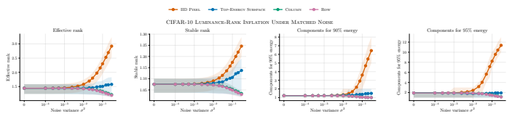
Figure 7 : Rank inflation under matched-energy perturbations on CIFAR-10 luminance images. The plots show effective rank, stable rank, and the number of components required to capture 90% and 95% of the spectral energy. IID pixel noise substantially increases all rank-based measures as σ2 grows, whereas same-subspace and structured row or column perturbations have a much milder effect.
Original paper · CC BY 4.0 · Ashkan Soleymani, Reyhaneh Hosseinpourkhoshkbari, Hadi Daneshmand, Patrick Jaillet · On Lipschitz Explosion in Deep Neural Networks with Normalization: Consequences for Optimization and Adversarial Robustness · Original paper figure · Extracted the figure area from page 28 of the original PDF.Why a layer-wise norm check is not enough
A deep network has two Lipschitz constants that matter, depending on whether the input or the weights are perturbed. The input constant LipX bounds how much the output moves when the data move, and it appears in margin-based generalization and stability arguments.
Batch normalization is usually credited with stabilizing training, so it is rarely suspected of causing instability. The authors prove that stacking such layers can make both constants exponentially large, even when every weight matrix has operator norm at most one. Each layer looks well behaved on its own, so the blow-up stays invisible to layer-wise norm bounds alone.
The lower bounds hold even for linear activations, so the growth does not come from a nonlinearity.
For nonsmooth training objectives, Goldstein-stationarity guarantees scale polynomially in the Lipschitz constant L. The paper's lower bound shows L can be exp(Ω(d)) for deep normalized architectures, where d is the parameter dimension. A rate that looks dimension-free therefore turns into exponential dependence on the parameter dimension d.
The authors argue that the same concern applies to generalization and robustness certificates, which become vacuous as depth grows.
The rank-separation idea and the network setup
Normalization can pull apart two nearby inputs when one is low rank and the other is full rank but nearly rank-deficient. The two inputs are close in norm, yet normalization can amplify their separation across layers, leading to exponential growth in the input Lipschitz constant. The authors expect perturbations that introduce new singular directions to be amplified much more strongly than perturbations that stay within the original singular subspace.
Same-subspace Gaussian noise doesn't produce this separation, even at a much higher magnitude.
The batch normalization operator divides each column of a matrix by its Euclidean norm, so every nonzero column ends up with unit norm. With D(X) the diagonal matrix of squared column norms, the column-wise map is BN(X) := X D(X)^(-1/2), with entries Xij divided by the column norm. The authors omit mean subtraction for convenience, following prior formulations and theoretical studies of batch normalization.
For a regularized variant, BN_ε uses D(X) + εI_k, and the lower bound proof still holds for it with the same qualitative conclusion.
A depth-m network starts from an input matrix X(0) with n rows, the batch size, and k0 columns. At each layer ℓ, the network multiplies the previous iterate by a weight matrix W_ℓ and then applies batch normalization, giving X(ℓ) = BN(X(ℓ-1) W_ℓ). The authors use linear activations because they give a conservative setting, so any growth must come from the interaction between weights and normalization.
They expect the same mechanism to persist for standard nonlinearities, and they test ReLU networks in Appendix B.9.
The input theorem restricts the weights to be orthogonal, so each linear map is nonexpansive in Frobenius norm. Under this setting, every post-normalization activation has Frobenius norm √k, so the activations stay in a bounded region. The low-rank premise is plausible for images, since CIFAR-10 spectral energy concentrates in the first few singular components.
How large the two Lipschitz constants can get
The input Lipschitz constant has an exponential lower bound in depth when every weight matrix is orthogonal. Each layer's linear part stays non-expansive, because every orthogonal weight has operator norm one and cannot stretch the Frobenius norm. After m normalization steps, the X0 trajectory becomes uniformly well-conditioned while the Y0 trajectory stays rank-deficient, which separates the two outputs.
Counting scalar weights instead of depth, Corollary 2.4 fixes the width k at 2. For each d at least 4, it gives a network with at most d scalar weights whose input constant is at least C_η times e to the Γ_η d. Remark 2.5 embeds the width-two construction into larger widths with block-diagonal matrices. The exponential rate and constants stay the same for every width, so the bound doesn't depend on k.
Theorem 2.6 fixes the input to the identity matrix and lets the weights vary, with every operator norm at most one. It holds for every depth m at least 2, and the parameter constant grows exponentially in m. The proof encodes the two input witnesses only in the first-layer weights, and all later weights stay as in the input construction. Scale invariance of batch normalization makes later layers reproduce the same two trajectories, so the parameter change is as small as the input change.
For width two and d at least 8, Corollary 2.7 turns this depth growth into exponential growth in the parameter count d. Corollary 2.8 carries this growth over to f, the induced objective built from a realizable target parameter.
Checking the growth numerically
The existence proof for the witnesses is nonconstructive, so the authors pick each layer's weights with a constructive heuristic. The experiments use k = 2, the setting of Corollary 2.4, and the plots appear on a logarithmic scale.
Figure 2a plots the empirical Lipschitz ratio for the constructed witness pair (X0, Y0) against the predicted exponential growth. Random rotations of the witness pair, written (QX0, QY0), show the same exponential growth. The authors link this to the orthogonal equivariance of the construction.
For these generic pairs, the authors report the median and the 95th percentile, and both stay nearly flat with depth. The authors read this contrast as a genuine worst-case instability rather than a numerical artifact. The check covers only width two and greedy weights, so it speaks to the witness construction specifically.
What this means for nonsmooth optimization
Neural training objectives are often nonsmooth because of ReLU, pooling and normalization pieces, so the analysis relies on generalized-gradient notions of stationarity. Here L is not an external constant; the network induces it, and the lower bound lets it reach exp(Ω(d)) for deep normalized architectures. Corollary 2.8 gives a realizable target parameter for which the induced objective f has Lipschitz constant at least exponential in d.
A guarantee can omit d entirely and still scale exponentially with it, because the dependence on L hides the growth.
The obstruction isn't specific to neural networks, since it already appears for convex Lipschitz functions. So no randomized first-order method can have oracle complexity polynomial in d, 1/ε and 1/δ with only logarithmic dependence on L, uniformly over all Lipschitz objectives. The open question is whether a weaker notion than Goldstein stationarity can be reached with only logarithmic dependence on L.
The authors' candidate is probabilistic Goldstein stationarity, which asks that directions with large Goldstein margin occupy only a small share of the unit sphere. Under this definition, a point is (δ, τ, ρ)-PGS when the probability that the margin mδ(x;V) reaches τ is at most ρ, with V drawn uniformly from the sphere. Theorem 3.3 gives a randomized function-value algorithm that finds such points with probability at least 1−γ.
Its query count, O(∆/(τδρ) log(∆/(γτδ))), has no polynomial dependence on L. The authors present PGS as a basic baseline rather than a final solution concept.
Noise structure and decision flips
Theorem 4.1 appends a linear readout of Frobenius norm one to the batch-normalized network, placed halfway between the two witness outputs. The clean input keeps a constant score margin, yet a perturbation of Frobenius norm e^{-Ω(m)} can still flip its label. So the Lipschitz explosion alone can produce a small-radius adversarial example once a linear classifier reads the learned representation.
The authors stress that this result doesn't rely on a separate instability mechanism.
Perturbations that leave the low-rank branch therefore behave differently from those that stay inside it under normalization.
The authors test this prediction on a pretrained BatchNorm ResNet56 on CIFAR-10. They compare i.i.d. pixel-wise, column-wise, row-wise and singular-value noise, which keeps the image in the same singular subspace. All perturbation families use matched pre-clipping energy, and the authors vary the noise variance. Accuracy, true-class confidence, true-class margin and prediction-change rate are tracked against that noise variance.
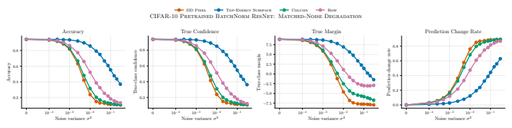
Figure 4 : Effect of noise structure on a pretrained BatchNorm ResNet56 on CIFAR-10. Same- subspace perturbations are substantially less harmful than pixel-, row-, and column-wise noise.
Original paper · CC BY 4.0Toy CNNs with batch normalization, trained on MNIST and Fashion-MNIST, serve as a controlled check in the appendix.
Limitations of the Lipschitz explosion results
The bounds cover batch normalization without mean subtraction, which the authors chose for convenience. Their exact bounds hold on the open set where every column of the input is nonzero. The epsilon-regularized variant BNε is covered only with the same qualitative conclusion, not with the exact bounds.
The exponential lower bounds are proved for linear activations, which the authors chose as a conservative setting. They show the ReLU case in Appendix B.9 and leave other nonlinearities to future work.
The existence proof of Theorem 2.3 is nonconstructive and relies on a probabilistic argument over the weights. The experiments instead select each Wℓ greedily, scanning a grid of candidate rotations to maximize isotropy of the next activation. The Lipschitz check runs at width two, so the empirical validation covers only k equal to 2. The noise experiments cover one pretrained ResNet56 on CIFAR-10 and toy CNNs trained on MNIST and Fashion-MNIST.
They didn't test other pretrained architectures or datasets in the noise experiments.
Paper info
- Authors
- Ashkan Soleymani, Reyhaneh Hosseinpourkhoshkbari, Hadi Daneshmand, Patrick Jaillet
- Venue
- arXiv · Preprint
- First published
- 2026-11-5
- Added
- 2026-11-9
- Updated
- 2026-11-5
- Version
- v1
- arXiv
- 2611.08775
- Category
- cs.LG · cs.AI · math.OC · stat.ML
- Original paper terms
- CC BY 4.0
- What we show
- Paper info, commentary and permitted figures from the original paper
AI commentary is a separate explanation from the original paper and may contain errors. The original paper and figures follow each source's terms of use and any rights noted separately.
Abstract
Can a network look stable at every layer and still be exponentially unstable as a whole? The Lipschitz constant of a neural network is a basic stability quantity appearing in optimization guarantees, generalization bounds, and robustness certificates. Deep networks naturally admit two such notions, input Lipschitzness, measuring sensitivity to data perturbations, and parameter Lipschitzness, measuring sensitivity to weight perturbations. We prove that, for deep networks with normalization layers, with batch normalization as the canonical example, both Lipschitz constants can grow exponentially with depth and hence with parameter dimension, even under strong per-layer norm control such as $\|W_\ell\|_2\le 1$, and already for linear activations. Thus, a mechanism widely used to stabilize training can create severe worst-case instabilities that are invisible locally, i.e., from layerwise norm bounds alone. Parameter-Lipschitz explosion turns Lipschitz-dependent nonsmooth optimization guarantees into exponential-in-dimension bounds for deep normalized networks, while input-Lipschitz explosion makes worst-case Lipschitz-based generalization and robustness certificates vacuous. The latter also yields a concrete rank-separation mechanism for adversarial vulnerability. The theory predicts that perturbations introducing new singular directions should be amplified much more strongly than perturbations at the same noise level that remain within the input's original singular subspace. Experiments on MNIST, Fashion-MNIST, and CIFAR-10 support this prediction, showing that rank-creating perturbations cause substantially sharper drops in accuracy, confidence, and margins than same-subspace perturbations.
Quote from the paper
Ashkan Soleymani, Reyhaneh Hosseinpourkhoshkbari, Hadi Daneshmand, Patrick Jaillet (2026). On Lipschitz Explosion in Deep Neural Networks with Normalization: Consequences for Optimization and Adversarial Robustness. arXiv:2611.08775v1. https://arxiv.org/abs/2611.08775v1
BibTeX
@misc{soleymani2026lipschitz,
  title = {{On Lipschitz Explosion in Deep Neural Networks with Normalization: Consequences for Optimization and Adversarial Robustness}},
  author = {Ashkan Soleymani and Reyhaneh Hosseinpourkhoshkbari and Hadi Daneshmand and Patrick Jaillet},
  year = {2026},
  eprint = {2611.08775},
  archivePrefix = {arXiv},
  url = {https://arxiv.org/abs/2611.08775v1}
}