Paper commentary
From Link Prediction to Linear Community Detection: A Finite-Sample Guarantee for Graph Pretraining
Link prediction pretraining gives a provable guarantee for linear community detection
- Problem Link prediction pretraining works well for graph neural networks, but no finite-sample theory explains why its edge-level loss should yield embeddings that a linear classifier can use for node classes. This gap remains open.
- Method The authors analyze link prediction in a stochastic block model with a bounded GNN encoder and bilinear decoder. They bound classification error by held-out link prediction risk, and add a nearest-centroid classifier whose error tracks that risk.
- Results Small link prediction risk implies small linear community classification error.
Why link-prediction pretraining lacks a downstream guarantee
Link prediction is a standard way to pretrain graph models, and it has worked well even with few labels. Part of the edge set is hidden, an encoder and decoder are trained to predict those edges, and the node embeddings are then reused for downstream tasks. The objective is trained on edges, but the downstream task is defined over nodes, so the two don't line up directly.
A low loss therefore doesn't by itself show that a linear classifier on the embeddings recovers communities. Contrastive learning has results of this kind, which assume that positive pairs share a latent class or lie in one augmentation component. The authors say that, to their knowledge, no finite-sample guarantee of this form exists yet for LP-based graph pretraining.
The authors close this gap with a latent-class assumption, and the stochastic block model plays that role. Without a link between graph structure and labels, embeddings built from the graph couldn't beat a trivial classifier, however well they predict edges. The SBM is the canonical model of such a link, since edge probabilities are set by latent community memberships.
The guarantee they study has the form of a bound on the classification error in terms of LP excess risk, with a term of order Oe(p d/n).
A masked LP setting tied to SBM communities
The guarantee quantifies the held-out LP excess risk of a bounded GNN encoder with a symmetric bilinear decoder, and links it to classification error on the SBM. Without such a link, LP never sees labels, so no classifier on graph-derived embeddings could beat the trivial classifier. The authors study finite-sample SBMs with identifiable communities, so the setting fixes n, K and the block probabilities.
Node pairs are split into a visible set T and a held-out set H, and the held-out fraction is τ in (0,1). The encoder sees only the masked adjacency Aenc, with held-out entries zeroed, while all n nodes stay in the graph. Pairs in T serve the LP training objective, and pairs in H serve only held-out evaluation.
The GNN encoder fθ maps the masked adjacency to a d-dimensional embedding zi for each node i, with d fixed throughout. The general bilinear decoder outputs a score sij equal to a bias plus a bilinear form in the two embeddings, estimating the logit of Pij. The score matrix is therefore a low-rank matrix of logits, which is why the decoder can fit the block structure.
The model class stays bounded because embeddings lie in a ball of radius R and the spectral norm of W is at most Wmax. The experiments use d = 16, R = 1.5 and τ = 0.2 with K = 3 as the baseline.
A few-label nearest-centroid classifier
The few-label classifier starts from a handful of labeled nodes per community and turns them into centroids in the embedding space. Each node is then assigned to the nearest centroid, with distances measured under the positive semidefinite form G = W Z⊤ZW. Because G is positive semidefinite, the rule reduces to a linear decision rule, so the classifier is a linear probe with closed-form weights.
The paper calls this the classical nearest-centroid rule under the data-dependent Mahalanobis metric induced by the learned decoder and embeddings. The cost per node is O(d²), which keeps the probe cheap at inference.
The error bound has an LP-quality floor that adding more labels cannot remove. The number of labels the bound requires falls as the LP risk falls, so a better-trained encoder needs fewer labeled nodes. The bound is the route from LP excess risk to a small plug-in error, and the constants come from the Bernstein-type term on the label sample.
Under a clean-regime condition with En at most πmin Δs² / 144 and mmin at least 16 B log(2K/δ) / Δs, the plug-in error is at most 16 En / Δs².
The same quadratic form supports an unsupervised variant, K-means under G, which needs no labels. The authors show that K-means under G is Euclidean K-means on score profiles, so both problems share the same optimal value. Its misclassification is bounded by (16 + 8κ) En / Δs² when (16 + 8κ) En / Δs² is below πmin, with κ the approximation slack.
The price of dropping labels is the larger constant 16 + 8κ, compared with 4 for the oracle classifier.
Why GIN with spectral positional encoding fits the bound
The approximation residual εapp is the architecture-dependent term, and it has no uniform rate across encoder families. The paper instantiates it only for a graph isomorphism network (GIN) with spectral positional encoding, where it gets the rate Oe(log n/n). Encoder families that don't contain this construction need separate arguments.
The construction is a symmetric matrix built from the oracle logits after subtracting a fitted bias b⋆, which is chosen to minimize the spectral-norm distance to a constant matrix. Its eigendecomposition gives orthonormal eigenvectors, which are zero-padded into R^d to form the node embedding targets u⋆a with norm R. The eigenvalues, zero-padded in the same way, form the bilinear weight W⋆ scaled by R^-2, and the spectral norm bound (A5) keeps ∥W⋆∥op at or below Wmax.
The bilinear identity still reproduces the oracle logits m⋆ab at the community prototypes.
The GIN parameters absorb an orthogonal matrix Ob and implement a readout g that maps the prototypes μ⋆a to the targets u⋆a. The proof then applies the Master Lemma with the Lipschitz constant Lg of the readout bounded by 2R. Since Lg ≤ 2R and rn = o(1), the bound becomes εapp ≤ C′′ log n / n, where the rate uses K log n / n for the prototype error.
Attention-based aggregators such as GAT are input-dependent, and normalized aggregators such as GCN aren't diagonalized by the spectral PE.
The result is an existence statement that gives a witness inside the bounded class. The authors make no optimization claim, so the result doesn't say that gradient descent finds that witness.
Does the theorem chain hold on synthetic SBMs?
The synthetic experiments use symmetric assortative SBMs with K equal to 3 at the baseline, a held-out fraction of 0.2, and embedding dimension 16. The baseline sets pin to 0.10 and pout to 0.04, which gives a community separation of ∆s equal to 0.80. Models train with full-batch BCE under Adam at learning rate 10−3 for 2500 epochs, and the authors report medians over 10 seeds with IQR shading.
Across n, excess risk, held-out score MSE and classification error all fall together, which matches the chain the bound predicts. Classification error falls faster than score MSE.
The authors trace this gap to the worst-case curvature being loose, since the formal bound uses curvature over the whole score range. The typical-curvature proxy 2/µeff ≈36 sits close to the observed ratio of 38.5 at the baseline. For GIN+PE the empirical excess slope of about −0.7 is broadly compatible with the rate of Prop. 10. Random-feature configurations decay only at about −0.3, and they stay above the PE-based ones for n ≥ 1000.
The authors vary ∆s from 0.60 to 1.90 by changing pin while pout stays fixed. Classification error decreases monotonically as ∆s grows, while the population excess changes only mildly, with CV at most 15%. The bound explains this through the geometric factor 4E n/∆2s, since Steps 0 to 2 have no explicit ∆s dependence.
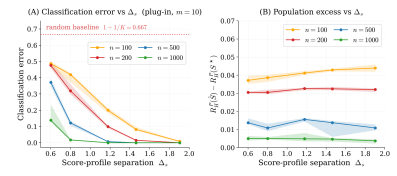
Figure 3 : ∆s sweep (GIN+PE, K= 3 ).(A)Error de- creases monotonically with ∆s at every n.(B)Popula- tion excess varies little across∆ s (CV≤15%).
Original paper · CC BY 4.0 · Ying Chen, Zhangyang Wang, Yixuan He · From Link Prediction to Linear Community Detection: A Finite-Sample Guarantee for Graph Pretraining · Original paper figure · Extracted the figure area from page 9 of the original PDF.The authors also check that LP training adds information beyond the raw spectral input. So LP training adds to the spectral input rather than merely repeating it.
Ablations: where the constants and training break
The ablations separate three parameters, because each one enters the bound in a different way. Wmax sets the bilinear capacity Wmax R2, which controls the approximation residual, and it also sets the score range B that enters µB. B0 bounds the bias and enlarges B, while ρn changes the SBM itself. Cap-ratio 1 is sufficient in Prop. 10, and realizability needs at least cap-ratio (K−1)/K = 2/3.
Some seeds recover even below 2/3, so the authors read a small Wmax as acting mainly through optimization. Very large capacity hurts at small n, with error 0.124 at cap-ratio 10 against 0.020 at cap-ratio 2 for n = 100, and the gap disappears by n = 2000.
Varying ρn changes ∆s by only 13 percent, yet it inflates 2/µB by 32 times. Error is small for ρn ≥ 0.5, partial at ρn = 0.2 with plug-in error 0.41, and near chance for ρn ≤ 0.1. The effective curvature µeff at the baseline is about 0.056, so 2/µeff is about 36 against an observed ratio of 38.5.
A second recipe, AdamW with a bias initialized at the training edge logit, recovers every stalled cell. It overfits at large n, because the excess of GCN+PE decays with slope −0.27 instead of −1.12.
Limitations
They don't prove that gradient descent globally optimizes a nonconvex GNN encoder–decoder, which they call a separate problem that is open for most deep-learning models. Their theorem instead asks what a model with a given LP-risk level guarantees about the linear usability of its embeddings. They don't claim to improve classical SBM recovery rates, and they don't claim LP pretraining beats methods built for SBM recovery, such as spectral clustering or adjacency spectral embedding.
The approximation residual εapp has no uniform rate across encoder families. The authors instantiate it only for spectral-PE GIN, so encoder families outside this construction need separate arguments.
The second training recipe overfits at large n, so the main text keeps the original recipe and uses the second only to diagnose its failures. At K = 3, the excess of GCN+PE decays with slope −0.27 under the second recipe, instead of −1.12, and the classification error at n = 2000 is unchanged. Faster rates would need node-level control, which the authors leave out of scope by design.
Paper info
- Authors
- Ying Chen, Zhangyang Wang, Yixuan He
- Venue
- arXiv · Preprint
- First published
- 2026-11-11
- Added
- 2026-11-13
- Updated
- 2026-11-11
- Version
- v1
- arXiv
- 2611.15778
- Category
- cs.LG · stat.ML
- Original paper terms
- CC BY 4.0
- What we show
- Paper info, commentary and permitted figures from the original paper
AI commentary is a separate explanation from the original paper and may contain errors. The original paper and figures follow each source's terms of use and any rights noted separately.
Abstract
Link prediction (LP) is a standard pretraining objective for graph neural networks (GNNs): hide edges, train an encoder-decoder to predict them, and reuse the node embeddings for downstream node tasks. Despite its empirical success, there is little quantitative theory explaining why an edge-level objective should produce embeddings that are linearly useful for node classification. We study this question in the finite-sample stochastic block model (SBM). For any bounded GNN encoder paired with a symmetric bilinear decoder, we prove a conditional reduction: small population held-out LP excess risk implies small community-classification error for a transductive linear classifier on the learned embeddings. The bound decomposes into an optimization residual, an architectural approximation residual, and explicit statistical terms of order $\tilde{O}(\sqrt{d/n})$ in bounded dense regimes. We further give a constructive few-label classifier: nearest-centroid classification under the positive semidefinite quadratic form $G = W Z^\top Z W$, whose label error is coupled to LP quality. The framework is architecture-agnostic through the approximation residual, and we instantiate this residual as $O(\log n / n)$ for a graph isomorphism network (GIN) with spectral positional encoding and a bilinear decoder. Synthetic SBM experiments validate the theorem chain from LP risk to score error to classification error, and show when the worst-case constants become conservative.
Quote from the paper
Ying Chen, Zhangyang Wang, Yixuan He (2026). From Link Prediction to Linear Community Detection: A Finite-Sample Guarantee for Graph Pretraining. arXiv:2611.15778v1. https://arxiv.org/abs/2611.15778v1
BibTeX
@misc{chen2026from,
  title = {{From Link Prediction to Linear Community Detection: A Finite-Sample Guarantee for Graph Pretraining}},
  author = {Ying Chen and Zhangyang Wang and Yixuan He},
  year = {2026},
  eprint = {2611.15778},
  archivePrefix = {arXiv},
  url = {https://arxiv.org/abs/2611.15778v1}
}