Paper commentary
Paper Plain: Making Medical Research Papers Approachable to Healthcare Consumers with Natural Language Processing
Paper Plain adds plain language guidance to medical research papers
- Problem Healthcare consumers struggle to read medical papers because of dense jargon and no guidance on which passages matter. Earlier aids defined terms or gave summaries, but readers still spent effort on sections that were not useful to them.
- Method Paper Plain keeps the original paper and adds plain language gists beside it. It shows key questions with answer passages, so readers can check a gist first and read the dense text only when it looks relevant.
- Results Median relevance confidence was 4.00 with Paper Plain, compared to 2.50 for the PDF reader. Participants also found Paper Plain easier to read without losing comprehension.
Why dense papers stall non-expert readers
Healthcare consumers turn to the research literature when patient-friendly material doesn't cover the condition or treatment they need. Readers describe medical papers as hard going, and they blame much of that on unfamiliar jargon. Many readers don't know the usual norms for running studies or laying out their write-ups. Sentences can stack several unknown terms, so a reader needs background from outside the paper before the sentence makes sense.
A single paper holds hundreds of such sentences, so the harder problem is finding what matters before spending effort on it. The formative study with 12 non-expert readers found that they struggled to know which parts of a paper to read. They also spent considerable effort on sections that gave them little use. Earlier interfaces defined terms, provided summaries, or answered questions, but the authors argue those aren't enough on their own.
The authors ask how a paper itself can gain new affordances that help readers navigate and judge its contents. Reading interfaces have offered navigation help, term lookup, section summaries and question answering. What readers need is guidance toward useful passages, plus help understanding those passages in context.
Paper Plain pairs key questions with plain language answers, and section summaries sit beside the text. The authors call these plain language summaries gists, presented alongside the passages they describe. A reader can check a gist first and read the dense passage only if it looks relevant.
Barriers seen in the formative study
The formative study involved 12 non-expert readers, each given a fictional diagnosis and a MedlinePlus page before reading papers. Each reader chose from a list of 11 research articles linked from MedlinePlus, and the whole session had 40 minutes. The authors selected those papers from PubMed, keeping only review articles and randomized control trials.
Participants thought aloud or wrote down barriers, and the researcher prompted them every 5 minutes.
Unfamiliar terminology hit nearly all participants, specifically T1–3, 5–8 and 10–12. T4 and T9 didn't report jargon as a barrier, and they often skimmed past terms or inferred them from context. T10 misread the paper because they didn't know that "in vitro" meant pre-clinical, non-human studies. Earlier term definitions wouldn't solve this, because the sheer number of terms makes importance hard to judge.
Dense text was the bigger problem, since terms stacked up in sentences and paragraphs for T1–8 and 11–12. T8 kept going back to earlier acronyms such as QoL, DORIS remission and SLEDAI, which broke the flow of reading.
Knowing what to read was the most widespread barrier, with 11 of 12 participants (T1–3, 5–12) struggling to judge relevance. T2–3 and T5–8 read papers top to bottom and spent effort on results and statistics they later had no use for. T5 found that the Discussion gave an accessible overview of the results, so they skipped technical results sections in later papers.
Readers therefore needed guidance on where to spend effort, not only definitions of terms.
How the four features are built
The key idea is to keep the original text intact and add plain language gists next to it. A reader can read a gist first and commit attention to a dense passage only when it looks relevant. The interface shows a reading guide in a side pane, with key questions, answer previews and pointers into the paper.
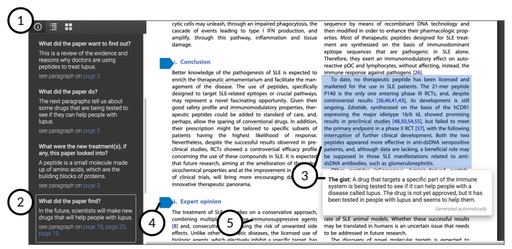
Fig. 1 . Paper Plain helps healthcare consumers consult medical research papers by making their texts more approachable. Shown is the Paper Plain interface and the assistive features it provides to readers. When a paper is opened in Paper Plain, a side pane opens with a reading guide (1), comprising of curated key questions a reader might ask, previews of generated plain language answers, and pointers to where in the paper the reader can find more details. When a reader clicks a question (2), the paper jumps to the passage that provides that answer, accompanied by the plain language answer (answer gist) (3). Readers can also access in-situ plain language summaries for every section of the paper (section gists) by clicking labels next to section headers (4), and definitions of medical jargon sourced from external references by clicking those terms (5).
Original paper · CC BY 4.0 · Tal August, Lucy Lu Wang, Jonathan Bragg, Marti A. Hearst, Andrew Head, Kyle Lo · Paper Plain: Making Medical Research Papers Approachable to Healthcare Consumers with Natural Language Processing · Original paper figure · Extracted the figure area from page 2 of the original PDF.Term definitions start with scispaCy NER, which finds medical terms, and link each term to UMLS or Wiktionary. Many false positives appear, such as 'expert' or 'negative', so the authors filter by word frequency and length. They keep the bottom 80% of terms by word frequency and drop terms of 30 characters or more, which were usually ill-formed.
Wiktionary definitions are kept only when they carry tags such as 'medicine', 'pathology' or 'immunology'.
Section gists cover the lowest-level subsections of a paper. The system joins the first sentence of each paragraph in a section and asks GPT-3 for a plain language summary of that text. The prompt asks for a fifth grade reading level, because that setting gave the most coherent output while still keeping some detail.
The authors feed GPT-3 leading sentences rather than full sections, since GPT-3 tends to copy full sections verbatim. When a summary was hallucinated, repetitive or copied, the authors regenerated it up to five times and kept the most fluent or correct result.
The key questions come from the PICO framework and Cochrane's guidance on plain language summaries, with 8 questions in total. For each question, an extractive QA system trained on BioASQ pulls the answering passages from the paper. Each answering passage is paired with an answer gist, which the reader sees in a tooltip beside the passage.
How the usability study was set up
The usability study recruited 24 Upworkers, 9 male, 1 non-binary and 14 female, and paid each US$15 for the hour-long session. Each participant worked through two scenarios, one for systemic lupus erythematosis (SLE) and one for a herniated disc, both involving a patient who wanted new treatments. For each scenario, the authors selected one paper, [98] for SLE and [8] for a herniated disc, drawn from the papers readers chose in the formative study.
Participants spent 2 minutes on the MedlinePlus page about their diagnosis before opening the paper. They took a short tutorial on Paper Plain, then read each paper for 10 minutes. The researchers told participants their remaining time at 5 minutes and again at 9 minutes. After each paper, participants gave subjective ratings and answered multiple choice questions, and a questionnaire followed both scenarios.
The study compared four variants: the full Paper Plain, Questions and Answers, Sections and Terms, and a PDF baseline. Questions and Answers kept only the Key Question Index and Answer Gists, while Sections and Terms kept only the Section Gists and Term Definitions. Each participant was assigned two of the eight variant-paper configurations, and each paper was seen once.
Variants with and without the guidance features let the authors study how those novel features affected readers.
Participants rated reading difficulty, understanding and relevance after each paper on 1-5 Likert-style scales. Comprehension was the proportion of 14 multiple choice questions answered correctly, with 7 questions for each paper. The authors wrote 15–20 questions per paper, and two practicing physicians helped select 5–7 of them. F-tests checked for any difference across variants, and t-tests compared the fixed-effects between all pairs of variants.
A non-inferiority test checked whether Paper Plain detracted from comprehension, using a t-tost as the lower bound, run with statsmodels.
Ratings against the PDF baseline
The mixed-effects models found differences across the variants for all three ratings, at p below 0.001 after Holm-Bonferroni correction. Paper Plain's estimated fixed-effect difference from the PDF baseline on reading difficulty is -1.983 on the 1-5 scale, with p below .0001. Because the scale measures how hard readers worked, a negative value means Paper Plain felt easier to read.
The reading difficulty gap is the largest of the three Paper Plain comparisons against the PDF baseline.
Median confidence that readers got all relevant information was 4.00 with Paper Plain, compared to 2.50 for the PDF reader. On this scale, 5.00 is the most confident rating. Median self-rated understanding was 3.50 with Paper Plain, compared to 2.00 for the PDF reader baseline. The relevance gain lines up with the knowing-what-to-read barrier, which 11 of the 12 formative participants reported.
In that study, readers went through papers top to bottom and spent effort on sections that later proved less useful.
Most of the effect appears to come from the guidance, since Questions and Answers was rated easier than Sections and Terms. The difference in reading difficulty between Questions and Answers and Sections and Terms is -1.141, with p = 0.0132. Sections and Terms alone doesn't differ from the PDF reader on reading difficulty, at p = 0.4786. Table 2 shows the same pattern for understanding and relevance, with p values of 0.0401 and 0.0183 for Questions and Answers against Sections and Terms.
The ratings come from one 10 minute reading task, so the gap could shift with more time. Participants who had more time might have read the paper through again, which could change these ratings.
Whether comprehension held up
The authors wrote 15 to 20 multiple choice questions for each paper and had two practicing physicians review them. The physicians read the papers without Paper Plain and picked 5 to 7 questions they judged most meaningful for understanding. The final set held 14 questions, 7 for each paper, and each one could be answered from text outside the key question index and answer gists.
The authors wanted the questions to require the full paper, not the guidance layer.
Comprehension was scored as the share of questions a participant answered correctly. The goal was to confirm that Paper Plain didn't detract from comprehension, so the authors ran a non-inferiority test. They implemented the test with the statsmodels package in Python, using the lower bound of a t-tost, which is two independent t-tests. The questions could be answered from information the paper repeats in its abstract, introduction and discussion.
Paper Plain wasn't built to add new information, so the authors didn't expect a large comprehension gain.
Across the study, Paper Plain showed no observable degradation in paper comprehension. Prior augmented reading interfaces haven't shown significant differences in correct answers across conditions [7, 44]. The authors weren't aiming for a comprehension gain here, only for no loss. Plain wording may leave readers feeling they understand more than they do, and the authors list this as future work.
How readers navigated the paper
Eleven of 12 participants with all features clicked a key question and opened an answer gist, averaging 13 key-question clicks and 14 answer-gist openings. Only 8 participants with the full interface clicked a section gist or term definition. Those 8 clicked 7 section gists and 4 term definitions on average, far fewer than the key-question clicks.
In the Sections and Terms variant, 11 of 12 participants clicked a section gist and a term definition. That variant's participants clicked 18 section gists and 5 term definitions on average, so the in-situ tools carried their reading.
Usage of every feature rose after a warm-up of usually the first two minutes, then stayed sustained until the last minute. Participants with the PDF baseline mostly read linearly and got stuck in dense sections such as technical backgrounds. With the key question index and answer gists, readers jumped back and forth through the paper. Without them, participants often read top to bottom, once through.
With the key questions, participants stayed on each paper position for 5.19 seconds on average, with a standard deviation of 7.72. Without them, the average was 3.34 seconds, so the gap is 1.85 seconds, and the spread is wide.
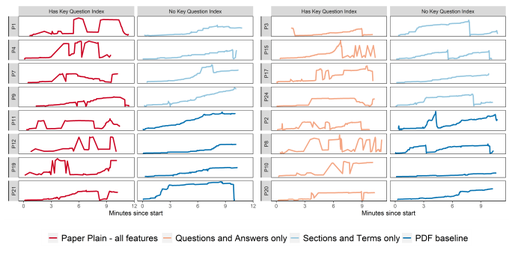
Fig. 8 . Participant’s reading behavior differed when reading one paper with the Key Question Index and Answer Gists and another paper without. Each plot’s y-axis calculates the vertical position of the participant’s viewport relative to total paper length (e.g., the bottom and top of each graph are the beginning and end of the paper, respectively). We observe much more jumping behavior when the Key Question Index and Answer Gists are present.
Original paper · CC BY 4.0Figure 8 shows the same contrast, with much more jumping when the key question index and answer gists are present. The authors designed the key questions to fast-track readers to important information, and the longer dwell times fit that aim. Figure 6 shows feature usage over time, and Figure 7 shows usage across the variants.
What the study does not establish
Recruiting on Upwork meant participants read papers that were not personally relevant to their own health. The reading task lasted 10 minutes, and participants were told their remaining time at 5 and 9 minutes. A reader with more time might have reread the paper or searched for additional information. Some participants said the time limit made them anxious and harder to remember details.
The time limit may also have inflated use of the key questions, because they gave the fastest overview of a paper. With more time, readers might have leaned more on section gists, which helped them explore sections on their own. The authors also noted that differences in comprehension could become more pronounced with more time.
The gists come from a language model, and the prototype relied on human curation to pick the most fluent and correct output out of five. Hallucinated or incorrect text remains a risk in a medical context, which requires algorithmic advances or human oversight. The authors assume such advances are possible, but this study didn't test any detection method.
Simplified text can also over-inflate readers' sense of understanding, a risk the authors flag for future work.
Paper Plain doesn't yet link papers to patient testimonials or to readers' personal circumstances. The usability study used one paper per scenario, covering two diagnoses: SLE and a herniated disc. The key question index would need re-crafting for other domains, since the important questions differ across fields.
Paper info
- Authors
- Tal August, Lucy Lu Wang, Jonathan Bragg, Marti A. Hearst, Andrew Head, Kyle Lo
- Venue
- arXiv · Preprint
- First published
- 2022-2-28
- Added
- 2026-11-6
- Updated
- 2022-2-28
- Version
- v1
- arXiv
- 2203.00130
- Category
- cs.HC · cs.CL
- Original paper terms
- CC BY 4.0
- What we show
- Paper info, commentary and permitted figures from the original paper
AI commentary is a separate explanation from the original paper and may contain errors. The original paper and figures follow each source's terms of use and any rights noted separately.
Abstract
When seeking information not covered in patient-friendly documents, like medical pamphlets, healthcare consumers may turn to the research literature. Reading medical papers, however, can be a challenging experience. To improve access to medical papers, we introduce a novel interactive interface-Paper Plain-with four features powered by natural language processing: definitions of unfamiliar terms, in-situ plain language section summaries, a collection of key questions that guide readers to answering passages, and plain language summaries of the answering passages. We evaluate Paper Plain, finding that participants who use Paper Plain have an easier time reading and understanding research papers without a loss in paper comprehension compared to those who use a typical PDF reader. Altogether, the study results suggest that guiding readers to relevant passages and providing plain language summaries, or "gists," alongside the original paper content can make reading medical papers easier and give readers more confidence to approach these papers.
Quote from the paper
Tal August, Lucy Lu Wang, Jonathan Bragg, Marti A. Hearst, Andrew Head, Kyle Lo (2022). Paper Plain: Making Medical Research Papers Approachable to Healthcare Consumers with Natural Language Processing. arXiv:2203.00130v1. https://arxiv.org/abs/2203.00130v1
BibTeX
@misc{august2022paper,
  title = {{Paper Plain: Making Medical Research Papers Approachable to Healthcare Consumers with Natural Language Processing}},
  author = {Tal August and Lucy Lu Wang and Jonathan Bragg and Marti A. Hearst and Andrew Head and Kyle Lo},
  year = {2022},
  eprint = {2203.00130},
  archivePrefix = {arXiv},
  url = {https://arxiv.org/abs/2203.00130v1}
}