Paper commentary
ALTO: African and Levantine Tech-Facilitated Gender-Based Violence Corpus
Crowdsourced corpus reveals harm detectors miss gendered abuse in three languages
- Problem Harm detectors struggle with online gender-based violence in Levantine Arabic, African French and Swahili. Few labelled datasets exist for these languages, so the models lean on English data.
- Method ALTO is a crowdsourced dataset built with civil society partners and active learning. Annotators, who self-identify as women, label batches chosen by uncertainty and diversity, and encoders are then fine-tuned on them.
- Results Off-the-shelf detectors show poor recall on ALTO. Fine-tuning raised Swahili recall from 0.469 to 0.817 with a multilingual model.
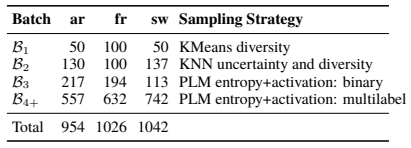
Table 1 : Annotation batch sizes and sampling strategies for Arabic (ar), French (fr), and Swahili (sw). Batches B2–B4+ use a cumulatively growing annotated seed set from previous batches.
Original paper · CC BY 4.0 · Tianwei Zhang, Ivy Njoki Nyagwencha, Zahraa Dirani, Shalini Joshi, Scott A. Hale · ALTO: African and Levantine Tech-Facilitated Gender-Based Violence Corpus · Original paper figure · Extracted the figure area from page 3 of the original PDF.Why harm detectors stall on TFGBV outside English
Existing harm detectors struggle with TFGBV in Levantine Arabic, African French and Swahili because the models and data behind them lean toward English. The paper's TFGBV framework follows UNFPA's three aspects: tech facilitation, gender-based harm, and harm or violence in many forms. Given the volume of online content, the authors argue that automated content moderation is necessary.
These models rest on large corpora, often drawn from publicly available online text including social media. The imbalance also appears in labelled TFGBV resources, where English accounts for 41.3% of available resources. Spanish and Arabic each account for only 12.7% of those resources, which leaves the three target languages with very little.
Hate detection resources for these African and Levantine languages are biased in the same direction.
Most labelled gendered-harm data stops at misogyny and sexism, so harm types such as threats, incitement and doxxing are rarely covered. Let-Mi is the only dataset specifically targeting Levantine Arabic misogyny. The released AfriHate corpus did not contain identity target labels for Swahili at the time of this study. The authors built a new dataset because the paucity of gendered harm detection data in these three languages, used by nearly 500 million people, is the central motivation.
The authors measured this gap by benchmarking Perspective API, GPT-OSS-Safeguard and Learning from the Worst on TFGBV in the three languages. Those off-the-shelf models performed poorly, with distinct misclassification patterns in each language. Error rates were markedly higher in Swahili, and models often missed covert harms across all languages.
Active learning builds the annotated pool
Active learning decides which unlabelled items reach annotators, so each label covers more of the pool. CSO partners ran and promoted the tiplines, which members reached through WhatsApp, Telegram and Facebook Messenger. Engagement with the tiplines was uneven across regions, so keyword sampling on social media boosted the positive instances.
The CSO partners curated the keywords, which were entered manually into the search bar on X. The pool held 8,710 Arabic items, 5,628 African French items and 4,798 Swahili items. Before annotation, the team replaced all user tags and URLs with a special token to protect privacy.
Each round draws a batch Bt from the unlabelled pool U, and annotators label that batch. B1 uses KMeans diversity sampling, drawing 50 Arabic, 100 French and 50 Swahili items. B2 switches to KNN sampling that weighs both uncertainty and diversity, with 130, 100 and 137 items. From B3 onward, a PLM scores candidates with entropy and activation signals, and the seed set keeps growing.
Batch selection combines both signals, as suggested by Monarch (2021). Prediction uncertainty comes from normalized entropy, following Shannon (1948). Diversity comes from model activation uncertainty, following Zhang et al. (2017). Across all batches, the annotated sets total 954 Arabic, 1026 French and 1042 Swahili instances.
Annotator design and label agreement
The authors recruited annotators who self-identify as women, because TFGBV overwhelmingly targets women and girls. They followed Kirk et al. (2023), who recruited trained annotators in a similar way to reduce labelling bias. The reasoning is that standard majority aggregation can obscure the perspectives of the targeted group. Each language had two annotators and one expert, and the expert adjudicated disagreements.
The lead researcher and expert annotators ran training sessions, and a content moderation researcher hosted trauma-mitigation training before annotation began.
Gendered content is a binary label for content directed at or about women, girls, or other vulnerable gender or sexual identities. The label ignores the harm in the content, so the models can learn from harmless gendered references. Harm is coded in a two-tier taxonomy, where Tier 1 types are refined into Tier 2 subtypes. After the first two batches, B1 and B2, the authors met with the annotators to discuss disagreements.
That discussion showed that men targeted with female gendered slurs are gendered but not TFGBV in most cases. The team made an exception for egregious slur use that is likely distressing to readers in the target group.
Krippendorff's alpha for gendered content is 0.399 for Arabic, the lowest of the three languages, compared to 0.661 for French. Tier-1 agreement for Arabic is 0.538 and Tier-2 agreement is 0.627, both described as moderate. Swahili shows higher alpha for Tier 2 than Tier 1, while French shows the reverse. For comparison, Lee et al. (2024) reported alpha between 0.34 and 0.46 for annotating English hate speech.
The text reports 22 Damning instances in Arabic, while Table 2 lists 20 for that label.
Benchmarking off-the-shelf models on ALTO and Bench
The first experiment asks whether existing harm detectors can flag TFGBV in ALTO and in an external benchmark called Bench. Bench combines public datasets that were standardized to binary gendered and harm labels. Both Bench and ALTO are split 80% for training and 20% for testing. The off-the-shelf models include OpenAI models, Vidgen et al.
(2021), and Perspective API, which were chosen for language support and public availability.
LFTW is trained only on English, so the authors translated the collected data into English with the Google Translate API. Averaged across the benchmarked models, F1 falls from 0.675 on ALTO to 0.202 on Bench. Most of this drop comes from lower precision, because Bench has only 7% positive samples against 42.7% in the ALTO test split. Recall regressed less, from an average of 0.682 on ALTO to 0.485 on Bench.
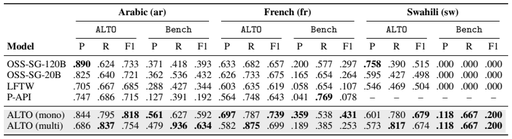
Table 6 : TFGBV-class precision (P), recall (R), and F1 by language on the full ALTO dataset ( n=2,117) and Bench-test. Shaded rows are encoders fine-tuned on ALTO, and their ALTO values are 5-fold CV predictions (inter-fold σ ≤ 0.08). ALTO (mono): monolingual models ALTO (multi): a single multilingual model trained on all three languages. P-API was not evaluated on sw (–). Bold = best per metric.
Original paper · CC BY 4.0On Bench-test Swahili, the off-the-shelf models detect none of the three positive samples.
Arabic and French recall rose from 0.686 and 0.748 to 0.837 and 0.875 after fine-tuning. Swahili has only 3 positive samples in Bench-test, so its Bench metrics have limited statistical power. They didn't test prompt changes for the off-the-shelf models, so the results reflect these models as released.
Fine-tuning gains and the precision trade-off
The second experiment fine-tunes pretrained encoder checkpoints, each with a three-head classification layer for gendered content, harm and TFGBV. Three monolingual models and one multilingual model are trained, and ALTO is scored with 5-fold cross-validation while the Bench training split stays fixed. The ALTO results therefore come from out-of-fold predictions rather than from a single held-out split.
Fine-tuning mainly raises recall, moving Arabic and French from 0.686 and 0.748 with Perspective API to 0.837 and 0.875 with the multilingual model. Swahili recall moves from 0.469 with LFTW to 0.817 with the multilingual model. Precision improves only modestly on ALTO evaluation, while the larger precision gain appears on Bench evaluation.
Multilingual models reach higher recall but lower precision than the monolingual models, which is the trade-off to keep in mind.
Swahili gets the largest absolute F1 gains, 0.17 to 0.18, yet its final performance stays modest for the training size. The authors read this as a sign that improving model pre-training resources matters for TFGBV adaptation. Arabic and French adapted well to the new dialectal data, which the authors tie to their larger pre-training resources.
The same models also show significantly higher FPR on negative gendered items, including items that use a gendered word.
The authors show a French example, 'go facile', which the fine-tuned models flagged. Here the phrase is a reclaimed use of slang for a promiscuous girl, which the authors call an observed failure mode. They didn't test this loss of nuance directly, so it remains a hypothesis in the paper.
Where models miss covert harms
Table 7 breaks errors down by Tier-2 category, using false-negative rates for TFGBV positives and false-positive rates for non-TFGBV items. Animosity is the category that models miss most often, with FNR between 0.33 and 0.66 across languages. The paper describes animosity as a more covert form of harm. Fine-tuning on ALTO lowers that miss rate, and multilingual fine-tuning cuts it further to 0.00 to 0.22.
Monolingual fine-tuning reaches 0.14 to 0.47 on the same category.
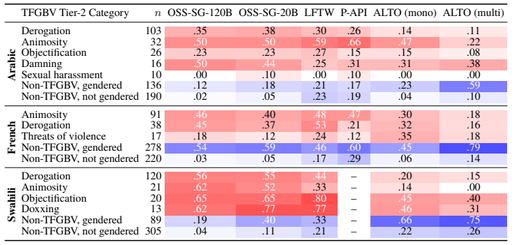
Table 7 : Error rate per tier-2 category where available and model on ALTO-full (5-fold out-of-fold prediction). Red rows: FNR of TFGBV positives. Blue rows: FPR on the non-TFGBV items split by presence of gendered content. Darker shading means more errors and lower error rates are better for all rows.
Original paper · CC BY 4.0Derogation, which the paper calls a more direct insult type, has a lower FNR range across languages. Its FNR runs from 0.26 to 0.38 for Arabic, 0.21 to 0.53 for French, and 0.33 to 0.62 for Swahili. Swahili shows a wider FNR range across all labels, from 0.33 to 0.80, than Arabic at 0.00 to 0.66 or French at 0.12 to 0.47. Existing models struggle most with objectification and doxxing in Swahili, where OSS-SG reaches 0.62 to 0.77.
LFTW reaches 0.77 to 0.80 on those two labels, the highest FNR among the models. The authors read this high error rate as evidence that translated text doesn't convey harmful signals in Swahili.
What bounds the ALTO findings
The binarized labels bound the findings by compressing the Tier 1 and Tier 2 nuance into one gendered and one harm label. The authors chose this because only a few instances had agreed Tier 1 and 2 labels, a trade that raises prediction scores but lowers interpretability. Social media sampling covered only X, so the study leaves out TFGBV on other platforms.
Image and video platforms such as Instagram and TikTok were excluded from the tipline submissions, which narrows the study to text.
Swahili samples mix in Sheng, so the Swahili data isn't purely Swahili. The keyword sampling couldn't guarantee that returned Levantine Arabic and African French samples were exclusively those languages. All annotators were women, so the perspectives of other gender and sexual minorities, such as LGBTQ+ individuals, aren't captured.
The ALTO experiments use 2117 annotations, split 80% for training and 20% for testing. Bench has only 14 Swahili positives in training and 3 in test, so Swahili metrics carry limited statistical power. Annotators reviewed only 20 machine translations per language, and they found that recent and covert TFGBV nuances were often missed.
Data contamination can't be fully ruled out, because the benchmark datasets and models also contained Twitter data. Limiting the sampling to the last two years doesn't guarantee a mutually exclusive sample. Cross-validation results with moderately strong performance suggest that contamination in ALTO may be limited.
Paper info
- Authors
- Tianwei Zhang, Ivy Njoki Nyagwencha, Zahraa Dirani, Shalini Joshi, Scott A. Hale
- Venue
- arXiv · Preprint
- First published
- 2026-11-4
- Added
- 2026-11-6
- Updated
- 2026-11-4
- Version
- v1
- arXiv
- 2611.06706
- Category
- cs.CL · cs.AI · cs.CY · cs.LG
- Original paper terms
- CC BY 4.0
- What we show
- Paper info, commentary and permitted figures from the original paper
AI commentary is a separate explanation from the original paper and may contain errors. The original paper and figures follow each source's terms of use and any rights noted separately.
Abstract
Tech-facilitated gender based violence (TFGBV) is a pervasive online harm affecting women and gender minority groups through its many direct and covert forms. Current models and annotated datasets for gendered harm detection are dominated by data from, and models trained in, Global North languages. In collaboration with civil society organizations (CSOs) from Jordan, Francophone West Africa, and Kenya, we developed a community-led approach to crowdsource culturally and linguistically relevant instances of TFGBV in Levantine Arabic, African French, and Swahili. We annotated the crowdsourced data using active learning to develop a small but performant dataset (N=3022) called ALTO to improve TFGBV detection in the three languages. Through benchmarking and fine-tuning experiments, we show that existing harmful content detection models show poor TFGBV recall within ALTO and improve with fine-tuning. We found that models often miss covert harms across all languages, while error rates are markedly higher in Swahili. We report the experimental results and release the annotation taxonomy, dataset, and trained models.
Quote from the paper
Tianwei Zhang, Ivy Njoki Nyagwencha, Zahraa Dirani, Shalini Joshi, Scott A. Hale (2026). ALTO: African and Levantine Tech-Facilitated Gender-Based Violence Corpus. arXiv:2611.06706v1. https://arxiv.org/abs/2611.06706v1
BibTeX
@misc{zhang2026alto,
  title = {{ALTO: African and Levantine Tech-Facilitated Gender-Based Violence Corpus}},
  author = {Tianwei Zhang and Ivy Njoki Nyagwencha and Zahraa Dirani and Shalini Joshi and Scott A. Hale},
  year = {2026},
  eprint = {2611.06706},
  archivePrefix = {arXiv},
  url = {https://arxiv.org/abs/2611.06706v1}
}