Paper commentary
InstructBLIP: Towards General-purpose Vision-Language Models with Instruction Tuning
- Problem Not stated in the paper.
- Method Instruction-tunes a BLIP-2 model on 13 held-in datasets converted to instruction format, updating only the Q-Former, which also receives the instruction so that the extracted visual features depend on the task.
- Results Reached 119.9 CIDEr on NoCaps for InstructBLIP (FlanT5XL), against 104.5 for BLIP-2 (FlanT5XL), and a 15.0% average relative improvement over that backbone across held-out evaluation.
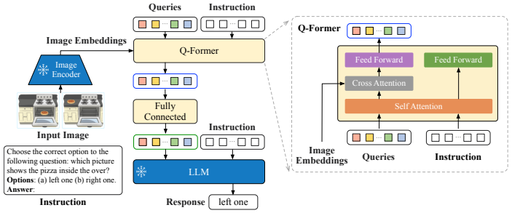
Figure 3 : Model architecture of InstructBLIP. The Q-Former extracts instruction-aware visual features from the output embeddings of the frozen image encoder, and feeds the visual features as soft prompt input to the frozen LLM. We instruction-tune the model with the language modeling loss to generate the response.
Original paper · CC BY 4.0 · Wenliang Dai, Junnan Li, Dongxu Li, Anthony Meng Huat Tiong, Junqi Zhao, Weisheng Wang, Boyang Li, Pascale Fung, Steven Hoi · InstructBLIP: Towards General-purpose Vision-Language Models with Instruction Tuning · Original paper figure · Extracted the figure area from page 5 of the original PDF.Why instruction tuning is harder for vision-language models
Text-only instruction tuning has shown that a language model can follow new instructions, but a vision-language model must also cope with images drawn from many domains. That variety makes it harder for one model to handle tasks it never saw in training, which is the setting the study cares about.
The study asks whether instruction tuning of a BLIP-2-based model can produce zero-shot generalization to datasets and tasks it was not trained on. Earlier work that extended a language model with visual components trained those components only on image caption data, which is too narrow for tasks that need more than visual description.
Building held-in and held-out sets from 26 datasets
The authors gathered 26 public vision-language datasets and converted each into instruction tuning format, grouped into 11 task categories. Thirteen of these datasets are held in for instruction tuning, and thirteen are held out for zero-shot evaluation. Figure 2 shows which datasets fall on each side of the split.
Held-out evaluation covers two situations: datasets whose tasks appear in the training data, and whole task categories that are absent from training, namely visual reasoning, video question answering, visual conversational QA and image classification. Each task receives 10 to 15 hand-written instruction templates, and datasets that tend to have short answers get wording such as short or briefly so the model does not learn to answer tersely everywhere.
LLaVA-Instruct-150K is used without extra templates because its data already has an instruction format. Datasets were chosen so that no evaluation data appears in the held-in training sets, and for scene-text datasets the OCR tokens are added to the instruction as extra information.
How the Q-Former receives the instruction
The model keeps the BLIP-2 layout of a frozen image encoder, a Q-Former with a set of K learnable query embeddings, and a frozen LLM, as Figure 3 shows. The queries cross-attend to the image encoder output, and the K resulting vectors are linearly projected and passed to the LLM as visual soft prompts. The Q-Former is first pretrained in two stages with image-caption data, as in BLIP-2, and the second stage adapts its output to serve as soft visual prompts for a frozen LLM.
BLIP-2 extracts the same visual representations whatever the task, while InstructBLIP feeds the instruction tokens into the Q-Former as well.
Balancing datasets and choosing how answers are produced
Mixing datasets uniformly would over-fit the small ones and under-fit the large ones, so the sampling probability of a dataset is set by the square root of its size. Given D datasets with sizes S_1 to S_D, a sample from dataset d is drawn with probability p_d, computed as the square root of S_d divided by the sum of the square roots of all sizes.
\[ p_d = \frac{\sqrt{S_d}}{\sum_{i=1}^{D}\sqrt{S_i}} \] The authors then adjust some weights by hand, lowering A-OKVQA, which has multiple-choice questions, and raising OKVQA, which needs open-ended generation.
Open-ended tasks such as captioning and open-ended VQA use direct generation, and the generated text is compared with the ground truth. Classification and multiple-choice tasks instead restrict the vocabulary to a candidate list and pick the candidate with the highest log-likelihood, which the vocabulary ranking method does. That ranking is applied to ScienceQA, IconQA, A-OKVQA multiple-choice, HatefulMemes, Visual Dialog, MSVD and MSRVTT.
For binary classification, the positive and negative labels are expanded into sets of verbalizers, such as yes and true for the positive class. For video question answering, four uniformly sampled frames are encoded separately and their features are concatenated before the LLM.
Models and training configuration
Four variants share the same ViT-g/14 image encoder and differ only in the frozen LLM: FlanT5-XL, FlanT5-XXL, Vicuna-7B and Vicuna-13B. Because no BLIP-2 checkpoints with Vicuna were released, the authors pretrained those backbones with the BLIP-2 procedure before instruction tuning. Images are kept at 224 ×224 during instruction tuning and finetuning, and the visual encoder stays frozen in both.
Training uses the LAVIS library, runs for at most 60K steps, and validates every 3K steps, with one checkpoint chosen per model for all datasets. Batch sizes are 192, 128 and 64 for the 3B, 7B and 11/13B models, and the optimizer is AdamW with β1 = 0.9, β2 = 0.999 and a weight decay of 0.05. The learning rate warms up over the first 1,000 steps from 10−8 to 10−5 and then follows a cosine decay to a minimum of 0.
All models were trained on 16 Nvidia A100 (40G) GPUs and finished within 1.5 days.
Zero-shot results on the held-out datasets
The comparison uses CIDEr for NoCaps and Flickr30K, iVQA accuracy for iVQA, AUC for HatefulMemes, MRR for Visual Dialog, and top-1 accuracy for the rest. On NoCaps, InstructBLIP (FlanT5XL) reaches 119.9 CIDEr, against 104.5 for BLIP-2 (FlanT5XL). Averaged across held-out evaluation, InstructBLIP (FlanT5XL) gives a 15.0% relative improvement over BLIP-2 (FlanT5XL).
On the video dataset MSRVTT-QA, the authors report up to a 47.1% relative improvement over the previous best, although the model never saw temporal video data during training. The model size of that smallest variant is given as 4B in the results text and as FlanT5-XL (3B) in the setup section.
For Visual Dialog the authors choose MRR over NDCG, arguing that NDCG favors generic and uncertain answers while MRR favors certain ones, which fits the zero-shot setting better.
What the qualitative examples show
The qualitative examples cover complex visual reasoning, knowledge-grounded description and multi-turn conversation, and in one case the model infers a likely disaster from palm trees in the scene. The authors also argue that long-form answers are not always preferable, and in one comparison InstructBLIP adjusts its response length to the user's intent while the other models write longer and less relevant text.
The comparisons with GPT-4, LLaVA and MiniGPT-4 use responses taken from their papers or official demos, so they are individual examples rather than controlled measurements.
Removing instruction-aware features and data balancing
Each component is removed separately from the FlanT5XL and Vicuna-7B models, and the held-in average is taken over COCO Caption, OKVQA, A-OKVQA and TextCaps. Without instruction-aware visual features, the FlanT5XL held-in average falls from 94.1 to 89.8, and ScienceQA with image context falls from 70.4 to 63.4. The same removal drops the Vicuna-7B iVQA score from 52.2 to 36.8, the largest held-out drop in the table.
The authors attribute the larger drops to datasets that need spatial reasoning, such as ScienceQA, or temporal reasoning, such as iVQA, where the instruction can steer the Q-Former toward informative image regions.
Without balanced sampling, the FlanT5XL held-in average falls from 94.1 to 92.6, and the Vicuna-7B average falls from 100.8 to 98.8. Removing balancing does not hurt every held-out score: the Vicuna-7B IconQA score rises from 43.1 to 43.5, which the table reports as a gain. The authors describe the unbalanced training as unstable, with different datasets peaking at very different training steps.
Instruction tuning or multitask training alone
Two multitask variants are compared with instruction tuning: one trains on plain input-output pairs, and the other prepends a task and dataset identifier to the text. The plain-input variant is evaluated with instructions, except for image captioning, where the authors found better scores when the model receives only the image.
On held-in datasets, instruction tuning and multitask learning perform similarly, which suggests the model fits both input patterns when trained on them. On held-out datasets, instruction tuning gives a clear gain over multitask learning, while multitask learning stays close to the original BLIP-2, and the authors conclude that instruction tuning is the key factor for zero-shot generalization.
All these runs use the BLIP-2 FlanT5XL backbone with identical training settings, so the comparison isolates the training format.
Finetuning as an initialization for single datasets
During finetuning the visual encoder stays frozen and only the Q-Former is updated, which cuts trainable parameters from 1.2B to 188M compared with approaches that also finetune the visual encoder. Across the four downstream datasets in Table 3, InstructBLIP gives better finetuning results than BLIP-2 on each of them. On ScienceQA (IMG), the FlanT5XXL variant reaches 90.7 after finetuning, against 89.5 for BLIP-2 (FlanT5XXL), and the previous best reported in the table is 89.0 for LLaVA.
The authors report state-of-the-art results on ScienceQA (IMG), OCR-VQA and A-OKVQA, while OKVQA is led by PaLM-E with 562B parameters. The FlanT5-based variant is stronger on multi-choice tasks, and the Vicuna-based variant is generally stronger on open-ended generation. The authors attribute this split to the instruction data used for each frozen LLM, since FlanT5 was tuned mainly on NLP benchmarks with multi-choice and classification data and Vicuna on open-ended instruction-following data.
Limitations
InstructBLIP uses off-the-shelf frozen LLMs and inherits their weaknesses, such as hallucinating ungrounded text or producing biased outputs. The authors recommend a separate safety and fairness assessment before any downstream use.
The ablations are run only on FlanT5XL and Vicuna-7B, and Table 2 reports one value per variant without run counts or variance. Finetuning results cover four downstream datasets, and the image resolution is fixed at 224 ×224. The parameter count of the smallest model is stated as 3B in one place and 4B in another, so the size is not fixed in the text.
Paper info
- Authors
- Wenliang Dai, Junnan Li, Dongxu Li, Anthony Meng Huat Tiong, Junqi Zhao, Weisheng Wang, Boyang Li, Pascale Fung, Steven Hoi
- Venue
- arXiv · Preprint
- First published
- 2023-5-11
- Added
- 2026-11-5
- Updated
- 2023-6-15
- Version
- v2
- arXiv
- 2305.06500
- Category
- cs.CV · cs.LG
- Original paper terms
- CC BY 4.0
- What we show
- Paper info, commentary and permitted figures from the original paper
AI commentary is a separate explanation from the original paper and may contain errors. The original paper and figures follow each source's terms of use and any rights noted separately.
Abstract
Large-scale pre-training and instruction tuning have been successful at creating general-purpose language models with broad competence. However, building general-purpose vision-language models is challenging due to the rich input distributions and task diversity resulting from the additional visual input. Although vision-language pretraining has been widely studied, vision-language instruction tuning remains under-explored. In this paper, we conduct a systematic and comprehensive study on vision-language instruction tuning based on the pretrained BLIP-2 models. We gather 26 publicly available datasets, covering a wide variety of tasks and capabilities, and transform them into instruction tuning format. Additionally, we introduce an instruction-aware Query Transformer, which extracts informative features tailored to the given instruction. Trained on 13 held-in datasets, InstructBLIP attains state-of-the-art zero-shot performance across all 13 held-out datasets, substantially outperforming BLIP-2 and larger Flamingo models. Our models also lead to state-of-the-art performance when finetuned on individual downstream tasks (e.g., 90.7% accuracy on ScienceQA questions with image contexts). Furthermore, we qualitatively demonstrate the advantages of InstructBLIP over concurrent multimodal models. All InstructBLIP models are open-sourced at https://github.com/salesforce/LAVIS/tree/main/projects/instructblip.
Quote from the paper
Wenliang Dai, Junnan Li, Dongxu Li, Anthony Meng Huat Tiong, Junqi Zhao, Weisheng Wang, Boyang Li, Pascale Fung, Steven Hoi (2023). InstructBLIP: Towards General-purpose Vision-Language Models with Instruction Tuning. arXiv:2305.06500v2. https://arxiv.org/abs/2305.06500v2
BibTeX
@misc{dai2023instructblip,
  title = {{InstructBLIP: Towards General-purpose Vision-Language Models with Instruction Tuning}},
  author = {Wenliang Dai and Junnan Li and Dongxu Li and Anthony Meng Huat Tiong and Junqi Zhao and Weisheng Wang and Boyang Li and Pascale Fung and Steven Hoi},
  year = {2023},
  eprint = {2305.06500},
  archivePrefix = {arXiv},
  url = {https://arxiv.org/abs/2305.06500v2}
}