Paper commentary
MERF: Memory-Efficient Radiance Fields for Real-time View Synthesis in Unbounded Scenes
- Problem Accurate radiance fields query a network at many samples per ray, and discretized alternatives need too much graphics memory to scale to large scenes at real-time rates.
- Method Stores a scene as a low-resolution voxel grid plus three high-resolution feature planes, optimizes it with hash-encoded, quantization-aware training, and bakes occupied voxels into a browser-renderable form.
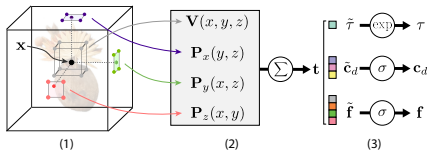
Fig. 2 . Our scene representation. For a location x along a ray: (1) We query its eight neighbors on a low-resolution 3D grid; and we project it onto each of the three axis-aligned planes, and then query each projection’s four neighbors on a high-resolution 2D grid. (2) The eight low-resolution 3D neighbors are evaluated and trilinearly interpolated while the three sets of four high-resolution 2D neighbors are evaluated and bilinearly interpolated, and the resulting features are summed into a single feature vector t. (3) The feature vector is split and nonlinearly mapped into three components: density𝜏, RGB color c𝑑 , and a feature vector f encoding view dependence effects.
Original paper · CC BY 4.0 · Christian Reiser, Richard Szeliski, Dor Verbin, Pratul P. Srinivasan, Ben Mildenhall, Andreas Geiger, Jonathan T. Barron, Peter Hedman · MERF: Memory-Efficient Radiance Fields for Real-time View Synthesis in Unbounded Scenes · Original paper figure · Extracted the figure area from page 3 of the original PDF.Why large scenes stall real-time rendering
Neural radiance fields produce photorealistic novel views, but a volumetric renderer has to query the network at many samples along every ray, and that cost keeps them from running in real time. Discretized volumetric representations cut the query cost, yet they occupy far more graphics memory than a surface does, and a ray through a volume can still demand many samples.
That memory cost is why such methods have mostly been applied to single objects or forward-facing scenes rather than large unbounded ones.
The authors frame the design space around two trade-offs. The first is volume versus surface: purely volumetric models are easy to optimize with gradients and give strong view synthesis, while moving toward a surface makes the representation compact and cheap to draw, at some cost in image quality. The second is memory bound versus compute bound: compact models such as a single MLP or a low-rank decomposition need many operations per query, whereas sparse 3D structures are fast but consume large amounts of graphics memory.
One response is to optimize with a compact model and then bake it into a larger, faster form for rendering. Baking can cost image quality, and fine-tuning the baked result recovers some of it but does not scale, because gradient computation during optimization needs far more memory than rendering does.
A voxel grid plus three feature planes
MERF stores a scene as one low-resolution 3D voxel grid and three high-resolution 2D feature planes, one for each cardinal plane. Keeping the grid coarse and putting the resolution into the planes is how the design limits memory while still resolving fine structure. Each stored location holds C = 4 + K channels, and the experiments use C = 8, with a default grid resolution L = 512 and plane resolution R = 2048.
A continuous feature at a 3D point is the sum \(t(x,y,z) = V(x,y,z) + P_x(y,z) + P_y(x,z) + P_z(x,y)\), where V is trilinearly interpolated from the voxel grid. Each plane term P_x, P_y or P_z is bilinearly interpolated from the plane perpendicular to its axis, so every 3D point reads four neighbors on each plane and eight on the grid. The four terms are summed into a single C-vector before any nonlinearity is applied.
The C-vector is split into density, diffuse color and view-dependence features, and each part gets its own nonlinearity. Density is \(\tau = \exp(\tilde{\tau})\), while color and features pass through the logistic sigmoid, \(c_d = \sigma(\tilde{c}_d)\) and \(f = \sigma(\tilde{f})\), which keeps them within (0, 1). The nonlinearities are applied after interpolation and summation, which the authors tie to greater representational power of grid representations.
Densities give the weights along each ray, the weighted diffuse colors and features are accumulated, and a small view-dependent MLP adds a view-dependent term to the accumulated diffuse color.
Piecewise-projective contraction
Unbounded scenes need a warp that brings far-away content into a finite region, and mip-NeRF 360 does this with a spherical contraction into a radius-2 ball. The warp gives model capacity to content close to the cameras, which matters when a scene mixes nearby and distant objects.
The spherical warp bends straight rays into curves, which makes it expensive to find where a ray enters and leaves an axis-aligned voxel box. Empty space skipping depends on fast ray-box intersections, so this cost matters directly for a real-time voxel renderer.
The proposed contraction is applied coordinate by coordinate, using the L∞ norm \(\|x\|_\infty\) of the point. Inside the unit cube, \(\mathrm{contract}_\pi(x)_j = x_j\). Outside it, a coordinate that is not the maximizing one is divided by \(\|x\|_\infty\), and the maximizing coordinate becomes \((2 - 1/|x_j|)\) times its sign. Projective maps preserve straight lines, so a ray stays piecewise linear and its direction can change only at the boundaries between regions.
Training with hashed grids and quantization
Training needs far more video memory than rendering, because activations are stored for backpropagation and optimizer statistics are kept at higher precision. The authors found that training needs more than twelve times the video memory of rendering. To reduce this, the voxel grid and the 2D planes are parameterized as MLPs with a multi-resolution hash encoding.
Baking MLP outputs onto discrete grids creates a mismatch between training and rendering. During training the MLPs are queried at virtual grid corners and the outputs are interpolated, bilinearly for the planes and trilinearly for the voxel grid, so the optimized model sees the same finite-resolution sampling it will have after baking. The authors contrast this with fine-tuning a baked representation, which needs the whole representation in memory.
Dense samples along each ray also drive training memory, and mip-NeRF 360 handles this with proposal MLPs. A proposal MLP maps positions to densities, which become sampling distributions along rays that are supervised to match the NeRF density, and resampling leaves a small number of samples near visible content. The proposal MLP is too expensive for real-time rendering, so the renderer uses traditional empty space skipping.
For rendering, each channel of the grid is quantized to one byte, but quantizing only after training creates a mismatch that lowers quality. During optimization, values pass through a sigmoid, are rounded to 8 bits by q, and are mapped affinely to [−m, m], as \(\tilde{t}' = 2m \cdot q(\sigma(\tilde{t})) - m\). The authors use \(m = 14\) for densities and \(m = 7\) for diffuse colors and features.
Rounding is not differentiable, so the stop-gradient form of q lets gradients pass as if q were the identity in the backward pass, which the paper calls the straight-through estimator.
Baking only the occupied voxels
After optimization, a binary 3D grid A marks the voxels that matter for rendering. A voxel is a candidate only if it contributed to a training image, so occluded voxels, voxels no training ray samples and voxels with low opacity are excluded. To fill A, the authors render all training rays and collect weighted points, where each weight is the volume rendering weight from the rendering equation.
The eight voxels around a point are marked occupied when both its rendering weight and its opacity exceed 0.005. Opacity is computed with the step size of the real-time renderer rather than the larger steps the proposal MLP often suggests, which culls more aggressively.
Restricting storage to regions the proposal MLP samples avoids the fog-like artifacts and floating blobs that the authors associate with baking pipelines that ignore it.
The three planes and the voxel grid are baked, and the voxel grid is stored block-sparse, keeping only blocks that contain occupied voxels, as in SNeRG. Lower-resolution versions of the occupancy grid are made by max-pooling, and the textures are encoded as PNGs to reduce storage.
Browser ray marching
The viewer is a JavaScript web application built on three.js, based on SNeRG's implementation, and all rendering runs in a single GLSL fragment shader.
Sample positions are checked against the occupancy levels from coarse to fine, and an empty cell at any level lets the ray skip to where it enters the next voxel at that level. The MERF representation is read only where every occupancy level marks the location occupied. Ray marching terminates once the transmittance falls below 2× 10⁻⁴.
Density and appearance are stored in separate textures, and the appearance texture is read only when the density gives nonzero opacity. Optimizing the deferred rendering MLP, through loop unrolling, a memory layout suited to linear access and fast mat4 multiplication, gives an additional 4× speed-up.
Quality on mip-NeRF 360 scenes
The mip-NeRF 360 dataset has five outdoor and four indoor scenes, and reported metrics average the outdoor scenes unless noted otherwise. PSNR, SSIM and LPIPS are used, and Table 1 gives outdoor and indoor values for every method.
Its outdoor PSNR is above NeRF (21.46), NeRF++ (22.76) and Instant-NGP (22.90), and slightly above SVS (23.01). The authors stress that offline rendering quality was not the main focus of the work.
The authors suggest that the indoor scenes contain more artificial materials with strong view-dependent effects, which the shallow decoder MLP designed for real-time rendering cannot model well. Mobile-NeRF was not evaluated on the indoor scenes, so its indoor entries are absent.
The authors attribute the sharper background reconstructions, compared with Mobile-NeRF and Instant-NGP, to the scene contraction function. Figure 6 gives the visual comparison behind this background claim.
What baking and quantization-aware training cost
Table 2 compares four outdoor variants: pre-baking, post-baking, no quantization-aware training, and spherical contraction, with results averaged over all outdoor scenes.
The drop supports keeping quantization-aware training in the pipeline, though it is measured only on outdoor averages.
The authors read this as the piecewise-projective contraction costing no quality while enabling analytic ray-box tests.
Memory scaling against SNeRG++
The memory study varies resolution for both systems. MERF's plane resolution R ranges from 512 to 3072 with grid resolution L of either 512 or 1024, while SNeRG++'s grid resolution ranges from 512 to 2048. Models without any 3D grid are trained as well.
SNeRG++'s video memory rises to multiple gigabytes as its grid grows, whereas MERF scales more gently to higher resolutions. Models without the 3D grid saturate in quality well below the others.
At R = 2048 and L = 512, MERF reaches quality similar to SNeRG++ while using a fraction of the memory.
The authors describe removing the low-resolution 3D grid from MERF as causing a significant loss in quality. Figure 7 shows the visual effect of omitting the grid, where parts of the background go missing.
Frame rate and memory against baselines
Instant-NGP was run on an RTX 3090 at 1920×1080, because its CUDA implementation is tuned for that GPU. Instant-NGP also uses a different view-dependence model and is less portable across devices, so the two groups differ in hardware and model.
MERF runs faster than SNeRG++ in the browser while using about one fifth of SNeRG++'s video memory. Mobile-NeRF reaches higher frame rates than MERF on the MacBook, but it needs twice as much video memory and its PSNR is 1.24 dB lower than MERF's.
On the RTX 3090, Instant-NGP reached 4 FPS, while MERF rendered at frame rates well above 100.
The conclusion puts MERF's outdoor quality 31.6% (MSE) above MobileNeRF's and says MERF needs less than half of its GPU memory. This 31.6% figure is an MSE-based comparison, not the PSNR values of Table 1.
Limitations
Because MERF inherits the view-dependence model of SNeRG, it evaluates view-dependent color once per ray. As a result, it cannot faithfully model view-dependent appearance for rays that cross semi-transparent objects. The tiny MLP has limited capacity, so it may struggle with much larger scenes or with objects that have complex reflections.
Phones and headsets would need further cuts in memory and runtime.
The quantitative evaluation uses only the mip-NeRF 360 dataset. The authors link the indoor shortfall to view-dependent effects that the decoder cannot model. The memory study compares against the authors' improved SNeRG++, not the original SNeRG.
Paper info
- Authors
- Christian Reiser, Richard Szeliski, Dor Verbin, Pratul P. Srinivasan, Ben Mildenhall, Andreas Geiger, Jonathan T. Barron, Peter Hedman
- Venue
- arXiv · Preprint
- First published
- 2023-2-23
- Added
- 2026-11-5
- Updated
- 2023-2-23
- Version
- v1
- arXiv
- 2302.12249
- Category
- cs.CV · cs.GR
- Original paper terms
- CC BY 4.0
- What we show
- Paper info, commentary and permitted figures from the original paper
AI commentary is a separate explanation from the original paper and may contain errors. The original paper and figures follow each source's terms of use and any rights noted separately.
Abstract
Neural radiance fields enable state-of-the-art photorealistic view synthesis. However, existing radiance field representations are either too compute-intensive for real-time rendering or require too much memory to scale to large scenes. We present a Memory-Efficient Radiance Field (MERF) representation that achieves real-time rendering of large-scale scenes in a browser. MERF reduces the memory consumption of prior sparse volumetric radiance fields using a combination of a sparse feature grid and high-resolution 2D feature planes. To support large-scale unbounded scenes, we introduce a novel contraction function that maps scene coordinates into a bounded volume while still allowing for efficient ray-box intersection. We design a lossless procedure for baking the parameterization used during training into a model that achieves real-time rendering while still preserving the photorealistic view synthesis quality of a volumetric radiance field.
Quote from the paper
Christian Reiser, Richard Szeliski, Dor Verbin, Pratul P. Srinivasan, Ben Mildenhall, Andreas Geiger, Jonathan T. Barron, Peter Hedman (2023). MERF: Memory-Efficient Radiance Fields for Real-time View Synthesis in Unbounded Scenes. arXiv:2302.12249v1. https://arxiv.org/abs/2302.12249v1
BibTeX
@misc{reiser2023merf,
  title = {{MERF: Memory-Efficient Radiance Fields for Real-time View Synthesis in Unbounded Scenes}},
  author = {Christian Reiser and Richard Szeliski and Dor Verbin and Pratul P. Srinivasan and Ben Mildenhall and Andreas Geiger and Jonathan T. Barron and Peter Hedman},
  year = {2023},
  eprint = {2302.12249},
  archivePrefix = {arXiv},
  url = {https://arxiv.org/abs/2302.12249v1}
}