論文解説
MERF: Memory-Efficient Radiance Fields for Real-time View Synthesis in Unbounded Scenes
MERF:無限範囲のシーンでのリアルタイムなビュー合成のためのメモリ効率の高い放射輝度場
- 課題 大規模で無限範囲のシーンをブラウザでリアルタイムにレンダリングするには、ボリューム表現のメモリ使用量と、サンプルへの問い合わせのコストを、ともに減らす必要があります。
- 手法 MERFは、低解像度の3Dグリッドと高解像度の2D平面を組み合わせます。さらに、直線を保つcontraction関数と、proposal-MLPを考慮したbakingによって、学習した表現をリアルタイムレンダリング用の形式に変換します。
- 結果 Mip-NeRF 360の屋外シーンの平均で、MERFはPSNR 23.19、SSIM 0.616、LPIPS 0.343を記録しています。MacBook M1 Proの1280×720の条件では、VRAM 524 MBとFPS 28.3を報告しています。
大規模シーンのリアルタイムレンダリングが難しい理由
ニューラル放射輝度場(NeRF)は、複雑な形状と見た目を持つシーンについて、写実的な新規視点合成を可能にしますが、ボリュームレイマーチングの間にニューラル表現へ問い合わせる計算量のために、リアルタイムレンダリングは困難です。離散化したボリューム表現はレンダリング速度を大きく高められますが、ボリュームデータは2D表面の表現より大きく、メモリも多く使うため、大規模なシーンへの拡張が難しくなります。特に、カメラの光線がボリュームを通過するときに多くのサンプルを評価する必要があり、各サンプルへの問い合わせは、計算とメモリ帯域の面でコストが高くなります。この論文は、無限範囲(unbounded)のシーンをブラウザでリアルタイムにレンダリングしながら、メモリ使用量を減らす問題を扱います。
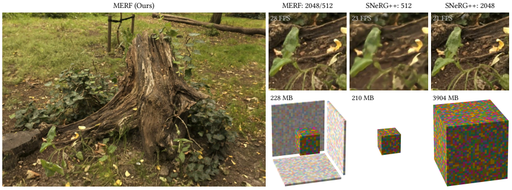
Fig. 1 . Our method, MERF, allows for real-time view synthesis in the browser (framerates shown here are measured on a Macbook Pro M1). We design a volumetric scene representation that is first optimized to maximize rendering quality and then losslessly baked into a more efficient format for fast rendering. As depicted above, this representation uses a combination of a low-resolution 3D grid and a set of higher-resolution 2D planes (spatial extent of each visualization signifies memory consumption). Compared to prior real-time view synthesis methods such as SNeRG++ (our improved version of Hedman et al. [2021]), MERF achieves better image quality for the same amount of compression, matching the output of a SNeRG++ model that is over 17× larger.
出典 · CC BY 4.0 · Christian Reiser, Richard Szeliski, Dor Verbin, Pratul P. Srinivasan, Ben Mildenhall, Andreas Geiger, Jonathan T. Barron, Peter Hedman · MERF: Memory-Efficient Radiance Fields for Real-time View Synthesis in Unbounded Scenes · 論文の図を引用 · 元のPDFの1ページ目から図の部分を抽出しています。疎な3Dグリッドと2D平面を組み合わせた表現
MERFは、低解像度の3D voxelグリッドVと、高解像度の3つの2DグリッドP_x、P_y、P_zを組み合わせて、シーンの密度、拡散色、特徴ベクトルを定義します。ある位置の特徴ベクトルは、3Dグリッドからトリリニア補間した値と、3つの平面からバイリニア補間した値を足して得ます。そのあと、密度、拡散色、ビュー依存の特徴に分け、非線形関数を適用します。著者らは、非線形関数を補間と加算のあとに適用することが、グリッド表現の表現力を高めるのに役立つと説明しています。
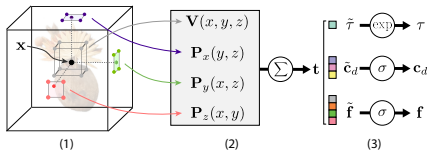
Fig. 2 . Our scene representation. For a location x along a ray: (1) We query its eight neighbors on a low-resolution 3D grid; and we project it onto each of the three axis-aligned planes, and then query each projection’s four neighbors on a high-resolution 2D grid. (2) The eight low-resolution 3D neighbors are evaluated and trilinearly interpolated while the three sets of four high-resolution 2D neighbors are evaluated and bilinearly interpolated, and the resulting features are summed into a single feature vector t. (3) The feature vector is split and nonlinearly mapped into three components: density𝜏, RGB color c𝑑 , and a feature vector f encoding view dependence effects.
出典 · CC BY 4.0 · Christian Reiser, Richard Szeliski, Dor Verbin, Pratul P. Srinivasan, Ben Mildenhall, Andreas Geiger, Jonathan T. Barron, Peter Hedman · MERF: Memory-Efficient Radiance Fields for Real-time View Synthesis in Unbounded Scenes · 論文の図を引用 · 元のPDFの3ページ目から図の部分を抽出しています。直線を保つpiecewise-projective contraction
無限範囲のシーンを有限の領域に収めるために、mip-NeRF 360は球面contraction関数を使います。しかし、この関数は直線を曲線に変えてしまい、空きの空間のスキップに必要な、光線と軸に平行な境界ボックス(AABB)との交差の計算を難しくします。MERFは、座標の最大絶対値をもとに7つの領域に分け、領域ごとにprojective変換を適用するcontraction関数を提案しています。単位キューブの内側は恒等変換で、各領域は直線を直線に写すため、軸に平行な境界ボックスとの交差を標準的な判定で計算できます。実験では、この関数は球面contractionと同程度の性能でした。
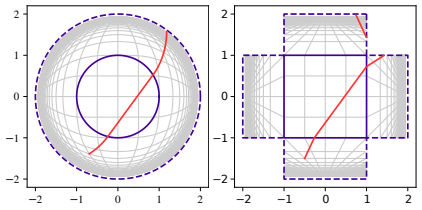
Fig. 3 . A 2D visualization of (a) the spherical contraction function used by Barron et al. [2022]; and (b) our piecewise projective contraction, both applied to the same ray (in red). The spherical contraction maps a straight line to a curve, which makes empty space skipping more expensive, while our contraction maps a straight line to a small number of line segments. The gray lines show the result of applying each contraction function to a regular grid.
出典 · CC BY 4.0 · Christian Reiser, Richard Szeliski, Dor Verbin, Pratul P. Srinivasan, Ben Mildenhall, Andreas Geiger, Jonathan T. Barron, Peter Hedman · MERF: Memory-Efficient Radiance Fields for Real-time View Synthesis in Unbounded Scenes · 論文の図を引用 · 元のPDFの4ページ目から図の部分を抽出しています。学習メモリの削減と量子化を考慮した学習
MERFは、最適化の段階で、低解像度のvoxelグリッドと高解像度の2D平面をmulti-resolution hash encodingでパラメータ化します。この処理により、学習メモリを減らしながら、学習中に微分可能なスパース化ができます。学習したモデルをグリッドにbakeするときに生じる不整合を減らすため、学習中は仮想的なグリッドの頂点でMLPの出力を問い合わせ、バイリニアまたはトリリニア補間で結果を合成します。また、各チャネルを1バイトに量子化する処理を学習中に模擬し、丸め関数はstop-gradientとstraight-through estimatorで微分します。
proposal-MLPを考慮したbakingとリアルタイムレンダリング
学習後は、すべての学習用の光線から重み付きの点を抽出し、重みと不透明度がしきい値0.005を超える点を囲むvoxelを占有されたものとして記録して、バイナリ占有グリッドAを作ります。このとき不透明度は、リアルタイムレンダラのサンプル間隔で計算し、より積極的に取り除きます。占有された2D平面とvoxelグリッドを保存したあと、複数の解像度の占有グリッドへmax-poolingして、空きの空間をスキップします。レンダリングはブラウザのシェーダで行い、密度と見た目のテクスチャを分けてアクセス回数を減らします。著者らは、proposal-MLPを考慮しない従来のbakingは、サンプルされなかった領域の任意の値のために、霧状のアーティファクトを生むと説明しています。
Mip-NeRF 360のシーンでの品質の比較
この検証では、Mip-NeRF 360データセットの屋外シーンの平均で、MERFのレンダリング品質を比較します。論文のTable 1では、MERFはPSNR 23.19、SSIM 0.616、LPIPS 0.343を記録しています。このスコアは屋外シーンの平均であり、屋内シーンではMERFがInstant-NGP、SVS、NeRF++よりやや低いスコアだったと報告されています。著者らは、屋内シーンには人工的な素材と強いビュー依存の効果が多く、浅いデコーダMLPがそれを十分にモデル化できなかった可能性があると解釈しています。
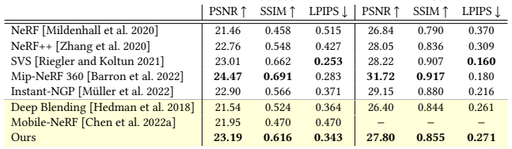
Table 1 . Quantitative results of our model on all scenes from Mip-NeRF 360 [Barron et al . 2022]. Models that render in real-time are highlighted. Mobile-NeRF did not evaluate on the “indoor” scenes, so those metrics are absent.
出典 · CC BY 4.0 · Christian Reiser, Richard Szeliski, Dor Verbin, Pratul P. Srinivasan, Ben Mildenhall, Andreas Geiger, Jonathan T. Barron, Peter Hedman · MERF: Memory-Efficient Radiance Fields for Real-time View Synthesis in Unbounded Scenes · 論文の図を引用 · 元のPDFの6ページ目から図の部分を抽出しています。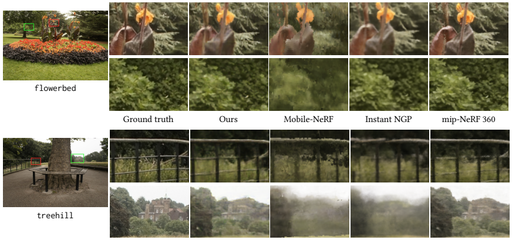
Fig. 6 . Visual comparison between MERF and other view synthesis methods. Mobile-NeRF [Chen et al . 2022a] is the only other real-time method (30fps or better). Instant NGP [Müller et al. 2022] runs at interactive rates (around 5fps) and mip-NeRF 360 [Barron et al. 2022] is an extremely heavyweight offline method (around 30 seconds to render a single frame), representing the current state-of-the-art view synthesis quality.
出典 · CC BY 4.0 · Christian Reiser, Richard Szeliski, Dor Verbin, Pratul P. Srinivasan, Ben Mildenhall, Andreas Geiger, Jonathan T. Barron, Peter Hedman · MERF: Memory-Efficient Radiance Fields for Real-time View Synthesis in Unbounded Scenes · 論文の図を引用 · 元のPDFの10ページ目から図の部分を抽出しています。bakingの前後と量子化を考慮した学習の効果
アブレーション実験では、baking後のモデルがbaking前のモデルとほぼ同じ品質を保てているかを確認します。Table 2の屋外シーンの平均で、Pre-bakingモデルはPSNR 23.20、Post-baking MERFはPSNR 23.19です。量子化を考慮した学習を外したモデルは、PSNRが22.64に下がります。また、球面contractionに替えたモデルはPSNR 23.22を記録し、提案したcontraction関数と同程度の品質でした。
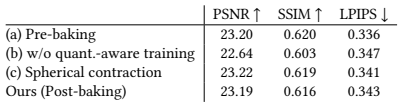
Table 2 . We compare our final model after baking to the model before baking (a) demonstrating that our Proposal-MLP-aware baking pipeline is almost lossless. Omitting quantization-aware training (b) leads to a drop in rendering quality. Our proposed contraction function performs on par with the original spherical contraction function (c), while enabling efficient ray-AABB intersection tests. Results are averaged over all outdoor scenes.
出典 · CC BY 4.0 · Christian Reiser, Richard Szeliski, Dor Verbin, Pratul P. Srinivasan, Ben Mildenhall, Andreas Geiger, Jonathan T. Barron, Peter Hedman · MERF: Memory-Efficient Radiance Fields for Real-time View Synthesis in Unbounded Scenes · 論文の図を引用 · 元のPDFの7ページ目から図の部分を抽出しています。レンダリング速度とVRAMの比較
速度の比較では、MacBook M1 Proで1280×720の解像度でMobile-NeRF、SNeRG++、MERFを測り、RTX 3090で1920×1080の解像度でInstant-NGPとMERFを測っています。MacBookの条件で、MERFはVRAM 524 MB、DISK 188 MB、FPS 28.3を記録しています。SNeRG++はVRAM 4571 MBとFPS 18.7、Mobile-NeRFはVRAM 1162 MBとFPS 65.7を記録しています。この速度の値は、各モデルを該当するハードウェアと解像度で測った結果です。別の条件で測った値と、同じ条件での比較として直接並べて解釈してはいけません。
適用範囲と限界
著者らは、MERFがSNeRGから引き継いだview-dependenceモデルの限界も持っていると述べています。ビュー依存の色はrayごとに1回しか評価されないため、semi-transparentなオブジェクトと交差するrayのビュー依存の見た目を、忠実にモデル化できません。また、小さなMLPは容量が限られているため、より大きなシーンや複雑な反射を持つオブジェクトへの拡張が難しいかもしれません。ボリュームレンダリングを行うので、モバイルフォンやヘッドセットのように熱の制約があるデバイスでは、メモリと実行時間をさらに減らす必要があります。
論文情報
- 著者
- Christian Reiser, Richard Szeliski, Dor Verbin, Pratul P. Srinivasan, Ben Mildenhall, Andreas Geiger, Jonathan T. Barron, Peter Hedman
- 学会・ジャーナル
- arXiv · プレプリント
- 公開日
- 2023年2月23日
- 登録日
- 2026年11月5日
- 更新日
- 2023年2月23日
- バージョン
- v1
- arXiv
- 2302.12249
- カテゴリ
- cs.CV · cs.GR
- ライセンス
- CC BY 4.0
- 掲載内容
- 論文情報・解説・論文の図
この解説は、Refivuの韓国語解説をAIで翻訳したものです。不正確な翻訳や誤りが含まれる可能性があります。論文と図の利用条件は各出典に従います。
アブストラクト
Neural radiance fields enable state-of-the-art photorealistic view synthesis. However, existing radiance field representations are either too compute-intensive for real-time rendering or require too much memory to scale to large scenes. We present a Memory-Efficient Radiance Field (MERF) representation that achieves real-time rendering of large-scale scenes in a browser. MERF reduces the memory consumption of prior sparse volumetric radiance fields using a combination of a sparse feature grid and high-resolution 2D feature planes. To support large-scale unbounded scenes, we introduce a novel contraction function that maps scene coordinates into a bounded volume while still allowing for efficient ray-box intersection. We design a lossless procedure for baking the parameterization used during training into a model that achieves real-time rendering while still preserving the photorealistic view synthesis quality of a volumetric radiance field.
この論文を引用
Christian Reiser, Richard Szeliski, Dor Verbin, Pratul P. Srinivasan, Ben Mildenhall, Andreas Geiger, Jonathan T. Barron, Peter Hedman (2023). MERF: Memory-Efficient Radiance Fields for Real-time View Synthesis in Unbounded Scenes. arXiv:2302.12249v1. https://arxiv.org/abs/2302.12249v1
BibTeX
@misc{reiser2023merf,
  title = {{MERF: Memory-Efficient Radiance Fields for Real-time View Synthesis in Unbounded Scenes}},
  author = {Christian Reiser and Richard Szeliski and Dor Verbin and Pratul P. Srinivasan and Ben Mildenhall and Andreas Geiger and Jonathan T. Barron and Peter Hedman},
  year = {2023},
  eprint = {2302.12249},
  archivePrefix = {arXiv},
  url = {https://arxiv.org/abs/2302.12249v1}
}