論文解説
InstructBLIP: Towards General-purpose Vision-Language Models with Instruction Tuning
InstructBLIP:Instruction Tuningを用いた汎用ビジョン言語モデルに向けて
- 課題 大規模言語モデルの命令チューニングをビジョン言語モデルへ広げ、未知のタスクでもゼロショット汎化を得ることが目標です。
- 手法 事前学習済みのBLIP-2を初期値とし、命令形式のデータでQ-Formerだけをファインチューニングします。命令を考慮した視覚特徴抽出と、データセットのバランスサンプリングを用います。
- 結果 held-outでのゼロショット評価では、BLIP-2より改善したと報告されています。命令を考慮した特徴とバランスサンプリングについてのアブレーション実験の結果も示されています。
汎用ビジョン言語モデルの課題
大規模言語モデルは命令チューニングによって多様な指示に従えるようになりましたが、視覚入力が加わったビジョン言語モデルでは、入力の分布とタスクがはるかに多様です。そのため、同じ方法をそのまま適用するのは難しいです。既存研究はビジョン言語の事前学習に多く注目してきましたが、ビジョン言語の命令チューニングは十分に調べられていませんでした。本論文は、事前学習済みのBLIP-2モデルを基盤に、26個の公開データセットを命令形式に変換して、この空白に取り組みます。重要な変更点は、学習データを命令形式に統一することと、命令を視覚特徴抽出の段階にまで入れることです。
命令を考慮した視覚特徴とデータ構成
InstructBLIPは画像エンコーダとLLMを凍結し、Q-Formerだけをファインチューニングします。Q-Formerには学習可能なクエリ埋め込みが入力され、命令テキストがクエリとセルフアテンションで相互作用して、タスクに合った視覚特徴を抽出します。この特徴はソフトビジュアルプロンプトとして凍結されたLLMに渡されます。命令とともに言語モデリング損失で応答を生成するよう学習します。学習データは13個のheld-inデータセットで構成され、タスクごとに10~15個のテンプレートを使います。データセットのサンプリング確率はデータセットサイズの平方根に比例するよう定められ、一部のデータセットは手作業で重みを調整します。
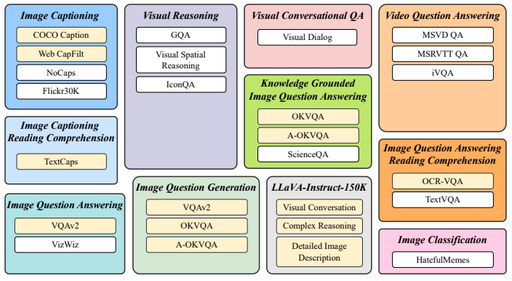
Figure 2 : Tasks and their corresponding datasets used for vision-language instruction tuning. The held-in datasets are indicated by yellow and the held-out datasets by white.
出典 · CC BY 4.0 · Wenliang Dai, Junnan Li, Dongxu Li, Anthony Meng Huat Tiong, Junqi Zhao, Weisheng Wang, Boyang Li, Pascale Fung, Steven Hoi · InstructBLIP: Towards General-purpose Vision-Language Models with Instruction Tuning · 論文の図を引用 · 元のPDFの4ページ目から図の部分を抽出しています。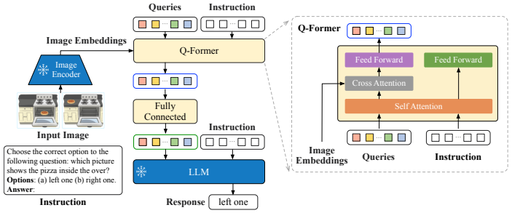
Figure 3 : Model architecture of InstructBLIP. The Q-Former extracts instruction-aware visual features from the output embeddings of the frozen image encoder, and feeds the visual features as soft prompt input to the frozen LLM. We instruction-tune the model with the language modeling loss to generate the response.
出典 · CC BY 4.0 · Wenliang Dai, Junnan Li, Dongxu Li, Anthony Meng Huat Tiong, Junqi Zhao, Weisheng Wang, Boyang Li, Pascale Fung, Steven Hoi · InstructBLIP: Towards General-purpose Vision-Language Models with Instruction Tuning · 論文の図を引用 · 元のPDFの5ページ目から図の部分を抽出しています。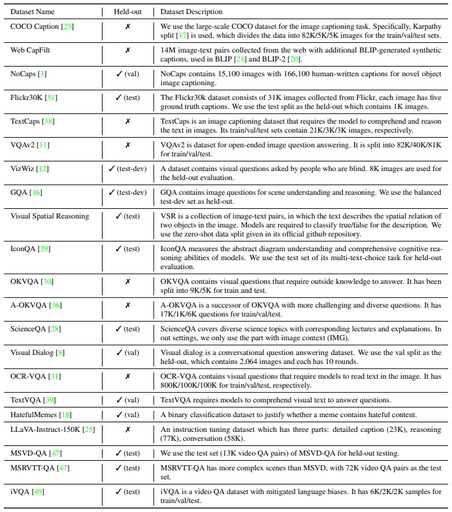
Table 4 : Description of datasets in our held-in instruction tuning and held-out zero-shot evaluations.
出典 · CC BY 4.0 · Wenliang Dai, Junnan Li, Dongxu Li, Anthony Meng Huat Tiong, Junqi Zhao, Weisheng Wang, Boyang Li, Pascale Fung, Steven Hoi · InstructBLIP: Towards General-purpose Vision-Language Models with Instruction Tuning · 論文の図を引用 · 元のPDFの16ページ目から図の部分を抽出しています。ゼロショット結果とアブレーション実験
ゼロショット評価では、held-outの13個のデータセットについて、InstructBLIPをBLIP-2とFlamingoと比較した結果が報告されています。同じFlanT5XLバックボーンでの比較では、著者らは平均相対改善率が15.0%だったと報告しています。アブレーション実験では、命令を考慮した視覚特徴を取り除くと複数のデータセットで性能が下がりました。データのバランスサンプリングを取り除くと学習が不安定になると説明されています。この結果は、そのバックボーンと設定で得られたものです。
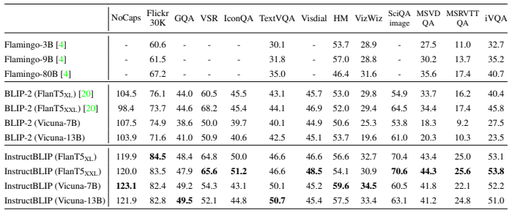
Table 1 : Zero-shot results on the held-out datasets. Here, Visdial, HM and SciQA denote the Visual Dialog, HatefulMemes and ScienceQA datasets, respectively. For ScienceQA, we only evaluate on the set with image context. Following previous works [4, 49, 32], we report the CIDEr score [42] for NoCaps and Flickr30K, iVQA accuracy for iVQA, AUC score for HatefulMemes, and Mean Reciprocal Rank (MRR) for Visual Dialog. For all other datasets, we report the top-1 accuracy (%).
出典 · CC BY 4.0 · Wenliang Dai, Junnan Li, Dongxu Li, Anthony Meng Huat Tiong, Junqi Zhao, Weisheng Wang, Boyang Li, Pascale Fung, Steven Hoi · InstructBLIP: Towards General-purpose Vision-Language Models with Instruction Tuning · 論文の図を引用 · 元のPDFの6ページ目から図の部分を抽出しています。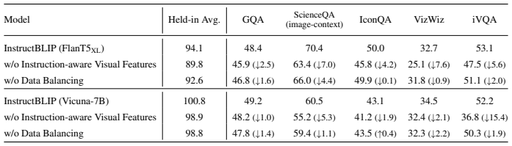
Table 2 : Results of ablation studies that remove the instruction-aware Visual Features (Section 2.3) and the balanced data sampling strategy (Section 2.4). For held-in evaluation, we compute the average score of four datasets, including COCO Caption, OKVQA, A-OKVQA, and TextCaps. For held-out evaluation, we show five datasets from different tasks.
出典 · CC BY 4.0 · Wenliang Dai, Junnan Li, Dongxu Li, Anthony Meng Huat Tiong, Junqi Zhao, Weisheng Wang, Boyang Li, Pascale Fung, Steven Hoi · InstructBLIP: Towards General-purpose Vision-Language Models with Instruction Tuning · 論文の図を引用 · 元のPDFの7ページ目から図の部分を抽出しています。マルチタスク学習との比較
マルチタスク学習は、命令形式を使わずに複数のデータセットをまとめて学習する方法です。BLIP-2 FlanT5XLバックボーンで、命令チューニングとマルチタスク学習を同じ学習設定で比べると、held-inの性能は両者が同程度です。一方、未知のheld-outデータセットでは、命令チューニングの方が大きく改善します。この比較はそのバックボーンと設定に限られます。命令形式が汎化の改善に重要な要因だという解釈は、著者らによるものです。
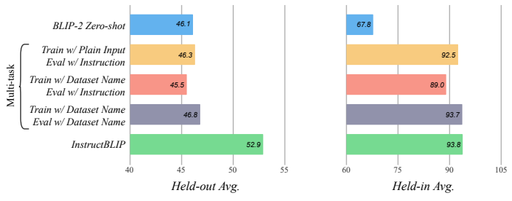
Figure 4 : Comparison of instruction tuning and multitask training based on BLIP-2 FlanT5 XL backbone. For held-in evaluation, we compute the average score across all held-in datasets. For held-out evaluation, we compute the average score across GQA, TextVQA, VSR, HatefulMemes, IconQA, ScienceQA, iVQA, VizWiz.
出典 · CC BY 4.0 · Wenliang Dai, Junnan Li, Dongxu Li, Anthony Meng Huat Tiong, Junqi Zhao, Weisheng Wang, Boyang Li, Pascale Fung, Steven Hoi · InstructBLIP: Towards General-purpose Vision-Language Models with Instruction Tuning · 論文の図を引用 · 元のPDFの8ページ目から図の部分を抽出しています。適用範囲と限界
InstructBLIPは凍結された既製のLLMを使うため、そのモデルが持つ幻覚やバイアスを引き継ぐ可能性があります。著者らは、特定の用途に適用する前に安全性と公平性の評価が必要だと述べています。また、ファインチューニングの結果は、ScienceQAの画像文脈の部分など、特定の設定で得られたものです。
論文情報
- 著者
- Wenliang Dai, Junnan Li, Dongxu Li, Anthony Meng Huat Tiong, Junqi Zhao, Weisheng Wang, Boyang Li, Pascale Fung, Steven Hoi
- 学会・ジャーナル
- arXiv · プレプリント
- 公開日
- 2023年5月11日
- 登録日
- 2026年11月5日
- 更新日
- 2023年6月15日
- バージョン
- v2
- arXiv
- 2305.06500
- カテゴリ
- cs.CV · cs.LG
- ライセンス
- CC BY 4.0
- 掲載内容
- 論文情報・解説・論文の図
この解説は、Refivuの韓国語解説をAIで翻訳したものです。不正確な翻訳や誤りが含まれる可能性があります。論文と図の利用条件は各出典に従います。
アブストラクト
Large-scale pre-training and instruction tuning have been successful at creating general-purpose language models with broad competence. However, building general-purpose vision-language models is challenging due to the rich input distributions and task diversity resulting from the additional visual input. Although vision-language pretraining has been widely studied, vision-language instruction tuning remains under-explored. In this paper, we conduct a systematic and comprehensive study on vision-language instruction tuning based on the pretrained BLIP-2 models. We gather 26 publicly available datasets, covering a wide variety of tasks and capabilities, and transform them into instruction tuning format. Additionally, we introduce an instruction-aware Query Transformer, which extracts informative features tailored to the given instruction. Trained on 13 held-in datasets, InstructBLIP attains state-of-the-art zero-shot performance across all 13 held-out datasets, substantially outperforming BLIP-2 and larger Flamingo models. Our models also lead to state-of-the-art performance when finetuned on individual downstream tasks (e.g., 90.7% accuracy on ScienceQA questions with image contexts). Furthermore, we qualitatively demonstrate the advantages of InstructBLIP over concurrent multimodal models. All InstructBLIP models are open-sourced at https://github.com/salesforce/LAVIS/tree/main/projects/instructblip.
この論文を引用
Wenliang Dai, Junnan Li, Dongxu Li, Anthony Meng Huat Tiong, Junqi Zhao, Weisheng Wang, Boyang Li, Pascale Fung, Steven Hoi (2023). InstructBLIP: Towards General-purpose Vision-Language Models with Instruction Tuning. arXiv:2305.06500v2. https://arxiv.org/abs/2305.06500v2
BibTeX
@misc{dai2023instructblip,
  title = {{InstructBLIP: Towards General-purpose Vision-Language Models with Instruction Tuning}},
  author = {Wenliang Dai and Junnan Li and Dongxu Li and Anthony Meng Huat Tiong and Junqi Zhao and Weisheng Wang and Boyang Li and Pascale Fung and Steven Hoi},
  year = {2023},
  eprint = {2305.06500},
  archivePrefix = {arXiv},
  url = {https://arxiv.org/abs/2305.06500v2}
}