論文解説
Robotic Control via Embodied Chain-of-Thought Reasoning
Embodied Chain-of-Thought Reasoningによるロボット制御
- 課題 学習済みのロボット制御ポリシーは、学習データの外にある場面や物体への汎化が弱いです。VLAは観測から行動へ直接対応する構造のため、言語によるCoTの利点を十分に使えていません。
- 手法 ECoTは、VLAに行動トークンの前で計画、下流タスク、動き、グリッパ位置、物体のバウンディングボックスをテキストとして生成させるように学習させます。この推論データは、既存のロボットデータセットに合成パイプラインで付与されます。
- 結果 ECoTは追加のロボットデータなしで、汎化タスクにおいてOpenVLAより絶対成功率を22%から34%高めました。ナイーブCoTよりも高い結果です。人による自然言語での介入は、最も難しいタスクでさらなる成功率の向上をもたらしました。
学習ポリシーの汎化の限界と推論の必要性
学習されたロボット制御ポリシーは、学習データの外にある新しい場面、物体、指示文で簡単に失敗します。この論文は、インターネットデータで事前学習された視覚言語モデルをバックボーンに使うVLAが、この限界を一部和らげるという点から出発しています。しかしVLAは観測から行動へ直接対応する構造のため、言語モデルが問題を段階的に考えて性能を高める連鎖的推論(CoT)の利点を十分に活用できていません。
言語CoTをそのまま持ち込むと、2つの問題が生じます。1つ目に、オープンソースVLAの小型LLMバックボーンは、プロンプトだけでは複雑な推論を行うのが難しいです。2つ目に、下流タスクに分ける意味レベルの推論だけでは、ロボットが自分の観測と状態に基づいて行動すべき状況を扱いにくいです。したがって問いは、計画と下流タスクに加えて、物体位置、エンドエフェクタ位置、動きのように観測に結び付いた推論も学習させると、汎化タスクで成功率が上がるかどうかです。
エンボディド推論の段階と合成データの生成
ECoTポリシーは、観測画像と作業指示文を受け取り、作業の言い換え、計画、下流タスク、動きの指示、グリッパ位置、物体リストの順にテキスト推論を生成してから、行動トークンを出力します。下流タスクと計画は言語的推論であり、グリッパ位置と物体のバウンディングボックスは観測に結び付いたエンボディド推論です。動きの指示は、低レベルの行動に近い言語指令です。
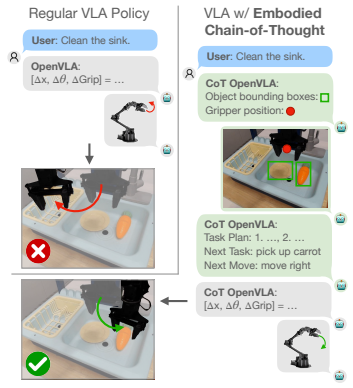
Figure 1 : We propose embodied chain-of- thought reasoning for vision-language-action mod- els (VLAs): prior VLAs directly predict the next robot action given the task (left), we instead train VLA policies to think “step-by-step” (right). Cru- cially, reasoning through low-level visual and em- bodied features like object bounding boxes and gripper positions in addition to purely textual CoT elements like sub-task plans, forces the policy to “think carefully” and “look carefully” before act- ing. Embodied CoT reasoning increases the ab- solute success rate of state-of-the-art OpenVLA policies [7] by 28% in challenging generalization tasks.
出典 · CC BY 4.0 · 論文の図 · 論文のページから図の部分を切り出して表示しています。学習データは人手で注釈を付けず、既存のロボットデータセットに後から推論チェーンを付けて作ります。Prismatic VLMで場面の説明を作り、Grounding DINOで物体のバウンディングボックスを検出します。さらに、ロボットの状態から4段階先までの移動を、テンプレートの動き基本要素に分類します。グリッパの2D位置は、OWLv2とSAMで検出した点と、ロボット状態の3D位置をRANSACで合わせた投影行列から得ます。最後にGeminiがこの情報を受け取り、計画と下流タスクの説明を生成します。この工程はBridge v2データセットの2.5M以上の遷移に適用されました。
推論トークンが増えると制御周期が遅くなるため、計画と下流タスクを複数ステップ固定する同期的な実行と、推論を別のポリシーインスタンスが更新する非同期的な実行の両方を提示しています。
汎化タスクにおける成功率の比較
評価はWidowX実ロボットで行われ、空間関係、未確認の物体、未確認の指示文の軸にわたるタスク群を使いました。OpenVLA(Bridge)とECoTは同じBridge v2データでファインチューニングされているため、2つのポリシーの差はCoT推論を使うかどうかによるものにほぼ近いです。RT-2-Xはより多くのデータで学習されているため、同じ条件とは直接見なせません。
同一分布の時点設定では、ECoTはOcto、OpenVLA、RT-2-X、ナイーブCoTに対する絶対成功率を、それぞれ45%、22%、19%、18%高めました。分布外の時点設定では、Octo、OpenVLA、RT-2-X、ナイーブCoTに対して48%、34%、16%、16%高い結果でした。ナイーブCoTは下流タスクの推論だけを使った変形なので、エンボディド推論の追加的な効果を見るための対照群となっています。
人の介入と設計変形の結果
ECoTの推論チェーンは、失敗の原因を調べるためにも使われます。論文の例では、ポリシーはドライバーの代わりにハンマーを誤認識しましたが、推論チェーンでこの誤りを確認できました。ただし、推論チェーンが実行動作と強く相関しているという観察は失敗分析の補助手段であり、エンドツーエンドのポリシーを完全に解釈できることを保証するものではありません。
人がロールアウト中に自然言語で一度介入すると、ChatGPTが推論チェーンを修正し、そのチェーンを5ステップ固定します。最も難しい評価タスクでは、この介入によってECoTの成功率が48%増えました。一方、non-CoT OpenVLAとRT-2-Xは、同じやり方では同程度の利得を得られませんでした。
分布外の時点サブセットを使った設計変形では、基本のECoTの総合成功率は69%でした。同じ試行のサブセットでは、OpenVLA(Bridge)、RT-2-X、Octoはそれぞれ29%、46%、14%でした。バウンディングボックスを前に移して固定した変形は、推論速度と可視化には有利でしたが、基本モデルより低い結果でした。また、共同学習とファインチューニングの変形も、総合性能を向上させませんでした。
固定された推論構造と実行速度の限界
著者らが挙げた1つ目の限界は、ECoTがタスクに合わせて推論ステップを選ばず、常に固定された順序のすべての推論ステップを実行することです。2つ目の限界は、推論トークンが多いため制御周期が遅くなり、LLMの処理量をさらに高める方法が必要なことです。また、SIMPLER環境では、実ロボット画像との領域差によって推論の品質が落ちた事例も報告されています。そのため結果は、実際のWidowX評価と、その条件の範囲で解釈すべきです。
論文情報
- 著者
- Michał Zawalski, William Chen, Karl Pertsch, Oier Mees, Chelsea Finn, Sergey Levine
- 学会・ジャーナル
- arXiv · プレプリント
- 公開日
- 2024年7月11日
- 登録日
- 2026年11月5日
- 更新日
- 2025年3月6日
- バージョン
- v3
- arXiv
- 2407.08693
- カテゴリ
- cs.RO · cs.LG
- ライセンス
- CC BY 4.0
- 掲載内容
- 論文情報・解説・論文の図
この解説は、Refivuの韓国語解説をAIで翻訳したものです。不正確な翻訳や誤りが含まれる可能性があります。論文と図の利用条件は各出典に従います。
アブストラクト
A key limitation of learned robot control policies is their inability to generalize outside their training data. Recent works on vision-language-action models (VLAs) have shown that the use of large, internet pre-trained vision-language models as the backbone of learned robot policies can substantially improve their robustness and generalization ability. Yet, one of the most exciting capabilities of large vision-language models in other domains is their ability to reason iteratively through complex problems. Can that same capability be brought into robotics to allow policies to improve performance by reasoning about a given task before acting? Naive use of "chain-of-thought" (CoT) style prompting is significantly less effective with standard VLAs because of the relatively simple training examples that are available to them. Additionally, purely semantic reasoning about sub-tasks, as is common in regular CoT, is insufficient for robot policies that need to ground their reasoning in sensory observations and the robot state. To this end, we introduce Embodied Chain-of-Thought Reasoning (ECoT) for VLAs, in which we train VLAs to perform multiple steps of reasoning about plans, sub-tasks, motions, and visually grounded features like object bounding boxes and end effector positions, before predicting the robot action. We design a scalable pipeline for generating synthetic training data for ECoT on large robot datasets. We demonstrate, that ECoT increases the absolute success rate of OpenVLA, the current strongest open-source VLA policy, by 28% across challenging generalization tasks, without any additional robot training data. Additionally, ECoT makes it easier for humans to interpret a policy's failures and correct its behavior using natural language.
論文の図
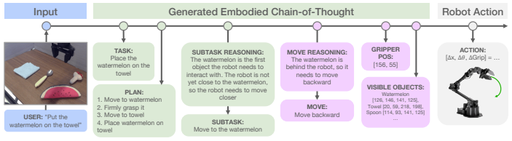
Figure 3 : Steps of our embodied chain-of-thought reasoning. We interleave several intermediate reasoning steps into the mapping from inputs to robot actions. Green: “standard” linguistic chain-of-thought steps that break a given instruction into the required sub-tasks. Purple: Embodied chain-of-thought steps that require grounding the policy’s reasoning in the scene and robot state. Our experiments show that these grounded reasoning steps are key to improving policy performance with chain-of-thought reasoning.
出典 · CC BY 4.0 · 論文の図 · 論文のページから図の部分を切り出して表示しています。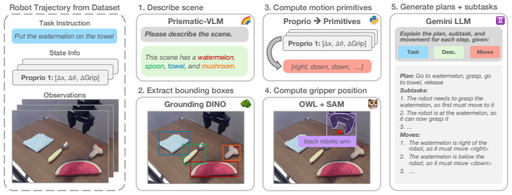
Figure 4 : Our pipeline for generating synthetic embodied chain-of-thought data at scale for a given robot dataset. We use a Prismatic VLM [ 35] to create a scene description (1), and Grounding Dino [ 29] to detect bounding boxes for all objects (2). We then compute templated motion primitives from the low-level robot states (3) and the robot gripper position using OWLv2 [60] and SAM [61] (4). Finally, all information is passed to a large Gemini language model [62] to create the synthetic reasoning chain (5).
出典 · CC BY 4.0 · 論文の図 · 論文のページから図の部分を切り出して表示しています。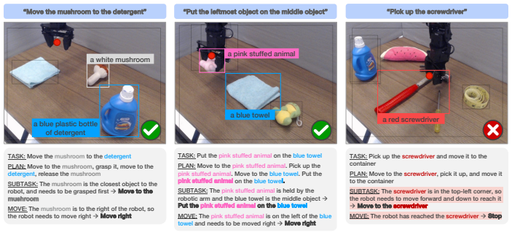
Figure 5 : Qualitative ECoT predictions from our model for two successful trajectories (left, middle) and one failure (right). Irrelevant bounding boxes are greyed out for readability. Left: high-level reasoning and low-level object segmentations are correct, leading to a successful rollout. Middle: the command is correctly rephrased to refer to specific objects (i.e., “the leftmost object” is identified as the pink toy). Right: the hammer is incorrectly identified as a screwdriver, causing the robot to take inappropriate actions.
出典 · CC BY 4.0 · 論文の図 · 論文のページから図の部分を切り出して表示しています。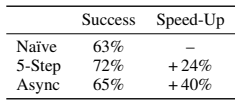
Table 2 : Performance of accelerated CoT inference approaches and their relative speed-ups over the naïve ap- proach, averaged across 3 tasks (25 trials total).
出典 · CC BY 4.0 · 論文の図 · 論文のページから図の部分を切り出して表示しています。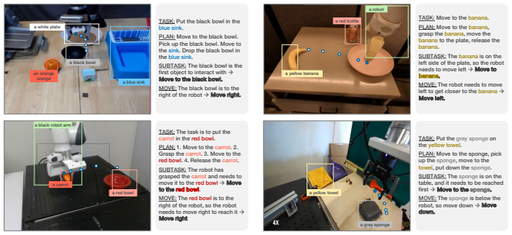
Figure 7 : Our OXE fine-tuned ECoT model can generate reasonings for non-WidowX robots too, despite never having seen reasoning annotations for said embodiment.
出典 · CC BY 4.0 · 論文の図 · 論文のページから図の部分を切り出して表示しています。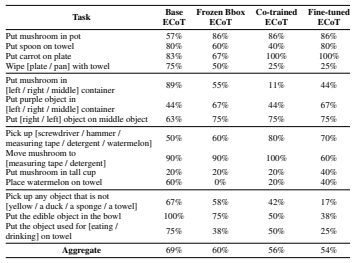
Table 3 : Success rate of ECoT trained with various design choices, as evaluated on a large subset of trials on the harder out-of-distribution view setting. While our base policy performs the best on aggregate (69%), the other approaches achieve higher performance on certain tasks. All policies in this table outperform OpenVLA (Bridge), RT-2-X, and Octo’s performances on the same trial subset (29%, 46%, and 14% aggregate success rates respectively).
出典 · CC BY 4.0 · 論文の図 · 論文のページから図の部分を切り出して表示しています。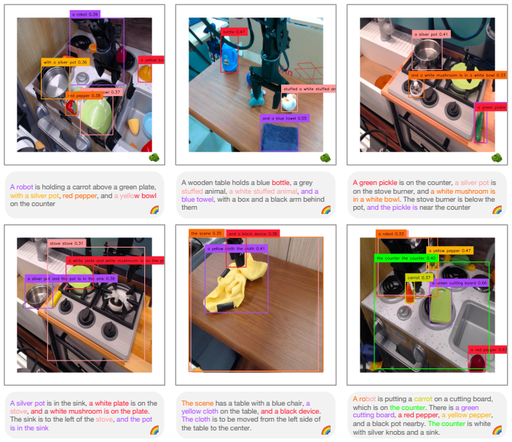
Figure 8 : Examples of captions of observations from the Bridge dataset as generated by our Prismatic VLM, as well as associated bounding boxes generated by Grounding DINO.
出典 · CC BY 4.0 · 論文の図 · 論文のページから図の部分を切り出して表示しています。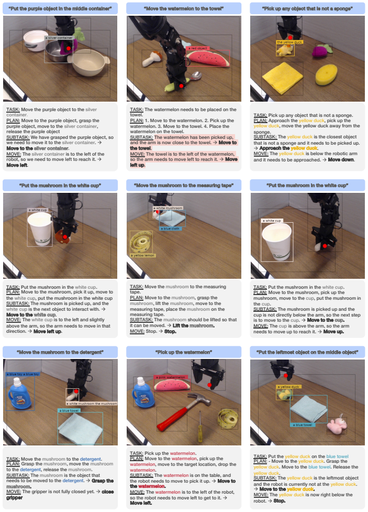
Figure 9 : More qualitative examples of successful and failed chain-of-thought reasonings.
出典 · CC BY 4.0 · 論文の図 · 論文のページから図の部分を切り出して表示しています。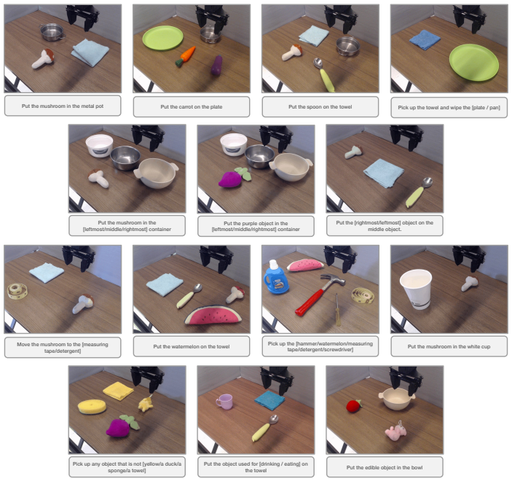
Figure 10 : Example starting scenes and associated prompt for all task types.
出典 · CC BY 4.0 · 論文の図 · 論文のページから図の部分を切り出して表示しています。この論文を引用
Michał Zawalski, William Chen, Karl Pertsch, Oier Mees, Chelsea Finn, Sergey Levine (2024). Robotic Control via Embodied Chain-of-Thought Reasoning. arXiv:2407.08693v3. https://arxiv.org/abs/2407.08693v3
BibTeX
@misc{zawalski2024robotic,
  title = {{Robotic Control via Embodied Chain-of-Thought Reasoning}},
  author = {Michał Zawalski and William Chen and Karl Pertsch and Oier Mees and Chelsea Finn and Sergey Levine},
  year = {2024},
  eprint = {2407.08693},
  archivePrefix = {arXiv},
  url = {https://arxiv.org/abs/2407.08693v3}
}