논문 해설
Robotic Control via Embodied Chain-of-Thought Reasoning
구체화된 사고 연쇄 추론을 통한 로봇 제어
- 연구 문제 기존 학습 로봇 정책은 학습 데이터 밖의 장면과 객체에서 일반화가 약하며, VLA는 관측에서 행동으로 직접 대응하는 구조 때문에 언어 CoT의 이점을 충분히 쓰지 못합니다.
- 연구 방법 ECoT는 VLA가 행동 토큰 앞에 계획, 하위 과제, 움직임, 그리퍼 위치, 객체 경계상자를 텍스트로 생성하도록 학습하며, 이 추론 데이터는 기존 로봇 데이터셋에 합성 파이프라인으로 부착됩니다.
- 주요 결과 ECoT는 추가 로봇 데이터 없이 일반화 과제에서 OpenVLA 대비 절대 성공률을 22%에서 34% 높였고, 나이브 CoT보다도 높았습니다. 사람의 자연어 개입은 가장 어려운 과제에서 추가 성공률 향상을 가져왔습니다.
학습 정책의 일반화 한계와 추론의 필요
학습된 로봇 제어 정책은 학습 데이터 밖의 새로운 장면, 객체, 지시문에서 쉽게 실패합니다. 이 논문은 인터넷 데이터로 사전학습된 시각-언어 모델을 백본으로 쓰는 VLA가 이 한계를 일부 완화한다는 점에서 출발합니다. 그러나 VLA는 관측에서 행동으로 직접 대응하는 구조여서, 언어 모델이 문제를 단계별로 생각하며 성능을 높이는 연쇄적 추론(CoT)의 장점을 충분히 활용하지 못합니다.
단순히 언어 CoT를 가져오면 두 가지 문제가 생깁니다. 첫째, 오픈소스 VLA의 소형 LLM 백본은 프롬프트만으로 복잡한 추론을 수행하기 어렵습니다. 둘째, 하위 과제를 나누는 의미 수준의 추론만으로는 로봇이 자기 관측과 상태에 근거해 행동해야 하는 상황을 다루기 어렵습니다. 따라서 질문은 계획과 하위 과제뿐 아니라 객체 위치, 엔드이펙터 위치, 움직임처럼 관측에 묶인 추론을 함께 학습시키면 일반화 과제에서 성공률이 오르는지입니다.
임베디드 추론 단계와 합성 데이터 생성
ECoT 정책은 관측 이미지와 작업 지시문을 받아 작업 재서술, 계획, 하위 과제, 움직임 지시, 그리퍼 위치, 객체 목록의 순서로 텍스트 추론을 생성한 뒤 행동 토큰을 출력합니다. 하위 과제와 계획은 언어적 추론이고, 그리퍼 위치와 객체 경계상자는 관측에 묶인 임베디드 추론입니다. 움직임 지시는 저수준 행동과 가까운 언어 명령입니다.
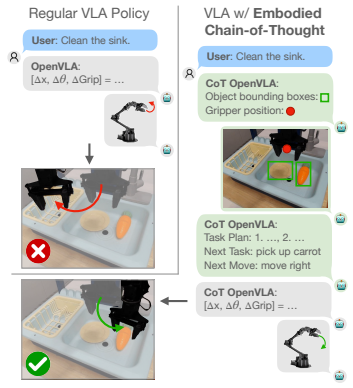
Figure 1 : We propose embodied chain-of- thought reasoning for vision-language-action mod- els (VLAs): prior VLAs directly predict the next robot action given the task (left), we instead train VLA policies to think “step-by-step” (right). Cru- cially, reasoning through low-level visual and em- bodied features like object bounding boxes and gripper positions in addition to purely textual CoT elements like sub-task plans, forces the policy to “think carefully” and “look carefully” before act- ing. Embodied CoT reasoning increases the ab- solute success rate of state-of-the-art OpenVLA policies [7] by 28% in challenging generalization tasks.
원문 · CC BY 4.0 · 원문 그림 · 원문 페이지에서 그림 영역을 잘라 표시했습니다.학습 데이터는 사람이 주석을 달지 않고, 기존 로봇 데이터셋에 사후적으로 추론 체인을 붙여 만듭니다. Prismatic VLM으로 장면 설명을 만들고, Grounding DINO로 객체 경계상자를 검출하며, 로봇 상태에서 4 단계 뒤까지의 이동을 템플릿 움직임 기본요소로 분류합니다. 그리퍼 2D 위치는 OWLv2와 SAM으로 검출한 점과 로봇 상태의 3D 위치를 RANSAC으로 맞춘 투영 행렬로 얻습니다. 마지막으로 Gemini가 이 정보를 받아 계획과 하위 과제 설명을 생성합니다. 이 과정은 Bridge v2 데이터셋의 2.5M 이상 전이에 적용되었습니다.
추론 토큰이 늘면 제어 주기가 느려지므로, 계획과 하위 과제를 여러 스텝 고정하는 동기식 실행과, 추론을 별도 정책 인스턴스가 갱신하는 비동기식 실행을 함께 제시합니다.
일반화 과제에서의 성공률 비교
평가는 WidowX 실제 로봇에서 수행되었고, 공간 관계, 미확인 객체, 미확인 지시문 축의 과제 묶음을 사용했습니다. OpenVLA(Bridge)와 ECoT는 같은 Bridge v2 데이터로 미세조정되어 두 정책의 차이는 CoT 추론 사용 여부에 가깝습니다. RT-2-X는 더 많은 데이터로 학습되었으므로 직접 같은 조건이라고 볼 수는 없습니다.
동일 분포 시점 설정에서 ECoT는 Octo, OpenVLA, RT-2-X, 나이브 CoT 대비 절대 성공률을 각각 45%, 22%, 19%, 18% 높였습니다. 분포 외 시점 설정에서는 Octo, OpenVLA, RT-2-X, 나이브 CoT 대비 48%, 34%, 16%, 16% 높았습니다. 나이브 CoT는 하위 과제 추론만 쓴 변형이므로, 임베디드 추론의 추가 효과를 보여 주는 대조군입니다.
사람 개입과 설계 변형의 결과
ECoT의 추론 체인은 실패 원인을 검사하는 데도 쓰입니다. 원문 예시에서 정책은 드라이버 대신 망치를 잘못 식별했고, 추론 체인에서 이 오류를 확인할 수 있었습니다. 다만 추론 체인이 실행 동작과 강하게 상관된다는 관찰은 실패 분석의 보조 수단이며, 엔드투엔드 정책의 완전한 해석을 보장하지는 않습니다.
사람이 롤아웃 중 자연어로 한 번 개입하면, ChatGPT가 추론 체인을 수정하고 그 체인을 5 스텝 동안 고정합니다. 가장 어려운 평가 과제에서 ECoT는 이 개입으로 48% 성공률 증가를 보였습니다. 반면 non-CoT OpenVLA와 RT-2-X는 같은 방식에서 같은 정도의 이득을 얻지 못했습니다.
분포 외 시점 부분 집합의 설계 변형에서는 기본 ECoT가 종합 성공률 69%를 보였고, OpenVLA(Bridge), RT-2-X, Octo는 같은 시도 부분 집합에서 각각 29%, 46%, 14%였습니다. 경계상자를 앞으로 옮겨 고정한 변형은 추론 속도와 시각화에 유리했지만 기본 모델보다 낮았고, 공동 학습과 fine-tuning 변형도 종합 성능을 올리지 못했습니다.
고정 추론 구조와 실행 속도의 한계
저자들이 밝힌 첫 번째 한계는 ECoT가 과제에 맞춰 추론 단계를 선택하지 않고 항상 고정된 순서의 모든 추론 단계를 수행한다는 점입니다. 두 번째 한계는 추론 토큰이 많아 제어 주기가 느려지며, 추가로 LLM 처리량을 높이는 방법이 필요하다는 점입니다. 또한 SIMPLER 환경에서 실제 로봇 이미지와의 도메인 차이로 추론 품질이 떨어진 사례도 보고되었으므로, 결과는 실제 WidowX 평가와 해당 조건에서 읽어야 합니다.
논문 정보
- 저자
- Michał Zawalski, William Chen, Karl Pertsch, Oier Mees, Chelsea Finn, Sergey Levine
- 학회·저널
- arXiv · 프리프린트
- 최초 공개일
- 2024년 7월 11일
- 등록일
- 2026년 11월 5일
- 수정일
- 2025년 3월 6일
- 버전
- v3
- arXiv
- 2407.08693
- 분류
- cs.RO · cs.LG
- 원문 이용 조건
- CC BY 4.0
- 제공 범위
- 논문 정보, 해설, 허용된 원문 그림
AI 해설은 논문 원문과 별개의 설명이며 오류가 있을 수 있습니다. 원문과 그림은 각 출처의 이용 조건과 따로 표시된 권리를 따릅니다.
초록
A key limitation of learned robot control policies is their inability to generalize outside their training data. Recent works on vision-language-action models (VLAs) have shown that the use of large, internet pre-trained vision-language models as the backbone of learned robot policies can substantially improve their robustness and generalization ability. Yet, one of the most exciting capabilities of large vision-language models in other domains is their ability to reason iteratively through complex problems. Can that same capability be brought into robotics to allow policies to improve performance by reasoning about a given task before acting? Naive use of "chain-of-thought" (CoT) style prompting is significantly less effective with standard VLAs because of the relatively simple training examples that are available to them. Additionally, purely semantic reasoning about sub-tasks, as is common in regular CoT, is insufficient for robot policies that need to ground their reasoning in sensory observations and the robot state. To this end, we introduce Embodied Chain-of-Thought Reasoning (ECoT) for VLAs, in which we train VLAs to perform multiple steps of reasoning about plans, sub-tasks, motions, and visually grounded features like object bounding boxes and end effector positions, before predicting the robot action. We design a scalable pipeline for generating synthetic training data for ECoT on large robot datasets. We demonstrate, that ECoT increases the absolute success rate of OpenVLA, the current strongest open-source VLA policy, by 28% across challenging generalization tasks, without any additional robot training data. Additionally, ECoT makes it easier for humans to interpret a policy's failures and correct its behavior using natural language.
원문 그림
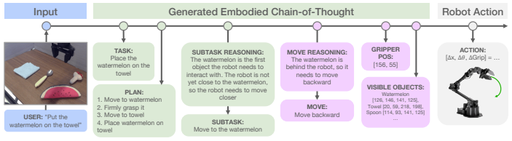
Figure 3 : Steps of our embodied chain-of-thought reasoning. We interleave several intermediate reasoning steps into the mapping from inputs to robot actions. Green: “standard” linguistic chain-of-thought steps that break a given instruction into the required sub-tasks. Purple: Embodied chain-of-thought steps that require grounding the policy’s reasoning in the scene and robot state. Our experiments show that these grounded reasoning steps are key to improving policy performance with chain-of-thought reasoning.
원문 · CC BY 4.0 · 원문 그림 · 원문 페이지에서 그림 영역을 잘라 표시했습니다.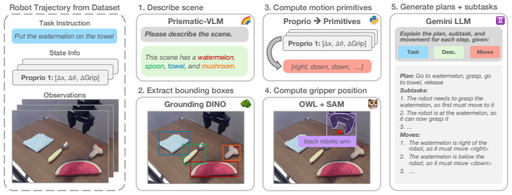
Figure 4 : Our pipeline for generating synthetic embodied chain-of-thought data at scale for a given robot dataset. We use a Prismatic VLM [ 35] to create a scene description (1), and Grounding Dino [ 29] to detect bounding boxes for all objects (2). We then compute templated motion primitives from the low-level robot states (3) and the robot gripper position using OWLv2 [60] and SAM [61] (4). Finally, all information is passed to a large Gemini language model [62] to create the synthetic reasoning chain (5).
원문 · CC BY 4.0 · 원문 그림 · 원문 페이지에서 그림 영역을 잘라 표시했습니다.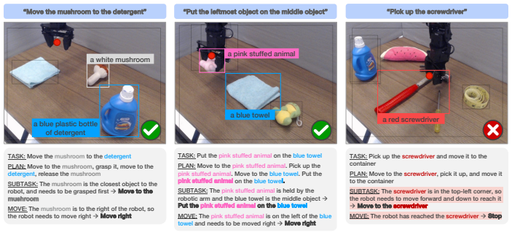
Figure 5 : Qualitative ECoT predictions from our model for two successful trajectories (left, middle) and one failure (right). Irrelevant bounding boxes are greyed out for readability. Left: high-level reasoning and low-level object segmentations are correct, leading to a successful rollout. Middle: the command is correctly rephrased to refer to specific objects (i.e., “the leftmost object” is identified as the pink toy). Right: the hammer is incorrectly identified as a screwdriver, causing the robot to take inappropriate actions.
원문 · CC BY 4.0 · 원문 그림 · 원문 페이지에서 그림 영역을 잘라 표시했습니다.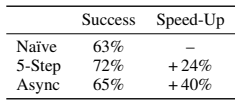
Table 2 : Performance of accelerated CoT inference approaches and their relative speed-ups over the naïve ap- proach, averaged across 3 tasks (25 trials total).
원문 · CC BY 4.0 · 원문 그림 · 원문 페이지에서 그림 영역을 잘라 표시했습니다.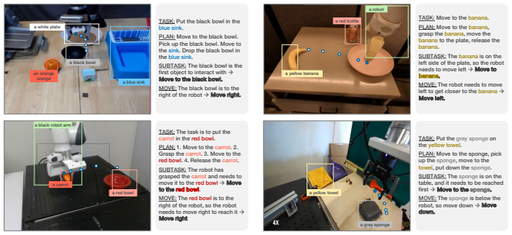
Figure 7 : Our OXE fine-tuned ECoT model can generate reasonings for non-WidowX robots too, despite never having seen reasoning annotations for said embodiment.
원문 · CC BY 4.0 · 원문 그림 · 원문 페이지에서 그림 영역을 잘라 표시했습니다.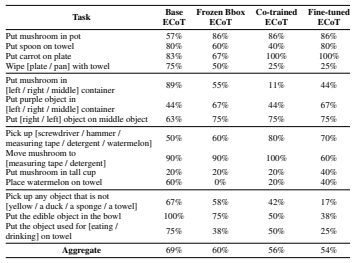
Table 3 : Success rate of ECoT trained with various design choices, as evaluated on a large subset of trials on the harder out-of-distribution view setting. While our base policy performs the best on aggregate (69%), the other approaches achieve higher performance on certain tasks. All policies in this table outperform OpenVLA (Bridge), RT-2-X, and Octo’s performances on the same trial subset (29%, 46%, and 14% aggregate success rates respectively).
원문 · CC BY 4.0 · 원문 그림 · 원문 페이지에서 그림 영역을 잘라 표시했습니다.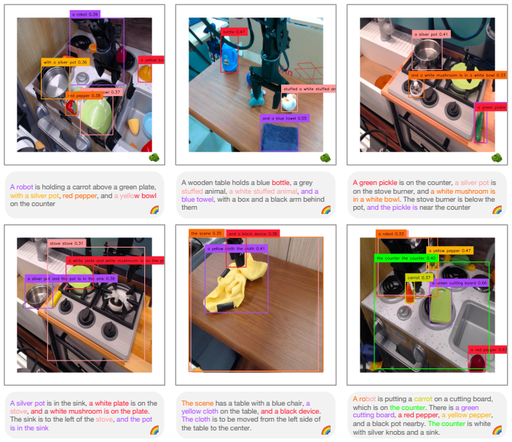
Figure 8 : Examples of captions of observations from the Bridge dataset as generated by our Prismatic VLM, as well as associated bounding boxes generated by Grounding DINO.
원문 · CC BY 4.0 · 원문 그림 · 원문 페이지에서 그림 영역을 잘라 표시했습니다.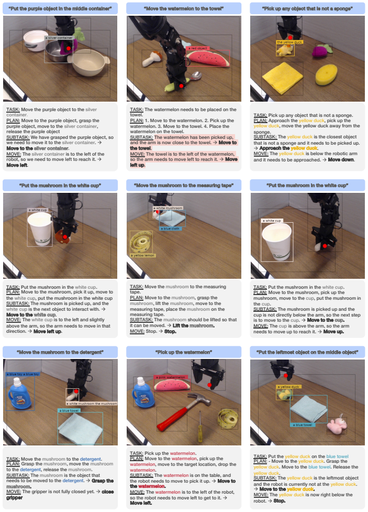
Figure 9 : More qualitative examples of successful and failed chain-of-thought reasonings.
원문 · CC BY 4.0 · 원문 그림 · 원문 페이지에서 그림 영역을 잘라 표시했습니다.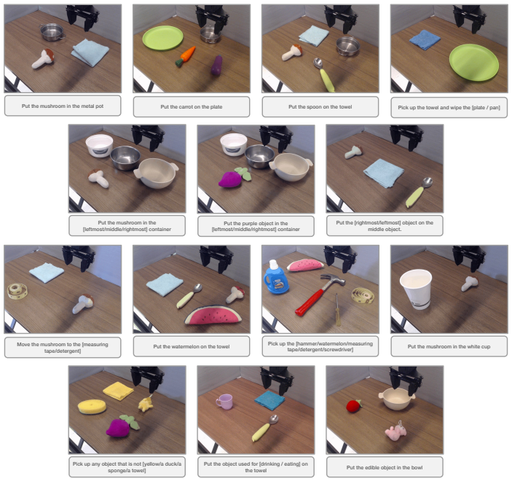
Figure 10 : Example starting scenes and associated prompt for all task types.
원문 · CC BY 4.0 · 원문 그림 · 원문 페이지에서 그림 영역을 잘라 표시했습니다.원문 인용
Michał Zawalski, William Chen, Karl Pertsch, Oier Mees, Chelsea Finn, Sergey Levine (2024). Robotic Control via Embodied Chain-of-Thought Reasoning. arXiv:2407.08693v3. https://arxiv.org/abs/2407.08693v3
BibTeX
@misc{zawalski2024robotic,
  title = {{Robotic Control via Embodied Chain-of-Thought Reasoning}},
  author = {Michał Zawalski and William Chen and Karl Pertsch and Oier Mees and Chelsea Finn and Sergey Levine},
  year = {2024},
  eprint = {2407.08693},
  archivePrefix = {arXiv},
  url = {https://arxiv.org/abs/2407.08693v3}
}