논문 해설
Radar Fields: An Extension of Radiance Fields to SAR
Radar Fields: SAR로 확장한 Radiance Fields
- 연구 문제 SAR 영상 집합만으로 장면의 표면을 학습하려면 광학 radiance field의 적분 구조를 SAR 형성 모델에 맞게 바꿔야 합니다.
- 연구 방법 광선을 따라 적분하던 radiance field를 방위각 평면 안에서 range 거리별로 광선 신호를 합산하는 radar field로 바꾸고, DSM 기반 암묵적 표면과 곱셈 잡음 모델을 사용합니다.
- 주요 결과 DSM 기반 합성 SAR 실험에서 toy 예시와 두 실제 DSM 장면의 표면을 학습했으며, 높이 오차는 지상 픽셀 해상도 기준 10^-2 픽셀 수준으로 보고됩니다.
광학 radiance field를 SAR에 적용해야 하는 이유
Neural Radiance Fields는 광학 영상의 여러 시점에서 장면을 연속 체적 함수로 학습하며, 광선을 따라 색을 적분해 렌더링합니다. 이 논문은 이 틀을 SAR 영상으로 옮기면 어떤 점이 바뀌는지를 다룹니다. SAR는 능동 마이크로파 센서로 구름을 투과해 주야간에 영상을 얻을 수 있어 전 지구 관측에 유리합니다. 그러나 SAR 영상은 광학 영상과 형성 방식이 다릅니다. 광학 영상은 광선 방향의 정보를 쌓는 반면, SAR 영상은 같은 range 거리에 있는 반사체의 응답이 한 픽셀로 합쳐집니다. 기존 SAR 표면 재구성은 간섭계 SAR나 SAR 토모그래피처럼 특정 기하 구성이나 많은 스택을 요구하거나, 단일 영상 기반 깊이 추정처럼 많은 정답 3D 데이터를 요구합니다.
이 논문은 SAR 영상 집합만으로 표면 모델을 학습하는 Radar Fields를 제안하며, 연구 범위는 SAR 영상 생성 모델과 시뮬레이션 데이터에서의 표면 학습으로 제한됩니다.
Radar Fields의 range 적분과 표면 표현
Radar Fields의 핵심 변경은 적분 방향입니다. 광학 radiance field는 식 (2)처럼 한 광선을 따라 N개 점의 색을 가중합하여 픽셀 색을 얻습니다. 반면 SAR 영상에서는 같은 방위각 평면 안에서 같은 거리에 있는 반사가 같은 픽셀로 투영되므로, 제안 방법은 식 (13)처럼 range 샘플 di에서 여러 광선의 신호를 광선 번호 j에 대해 합산합니다. 이때 각 신호는 투과율 Ti,j, 밀도 σi,j, 입사 방향 vj와 법선 ni,j의 내적, 그리고 반사 특성 계수 θ로 구성됩니다. Lambertian 모델은 θ=1로 두는 경우이며, θ가 클수록 specularity가 강한 표면을 나타냅니다.
광선의 샘플 간격은 range 샘플링에 의해 정해지므로 광학 경우처럼 자유롭게 고르지 않으며, 대신 광선 원점을 방위각 평면 안에서 가우시안 잡음으로 흔드는 방식이 NeRF의 무작위 샘플링을 옮긴 기법으로 제시됩니다. 배치는 한 방위각 평면의 광선을 함께 묶는 방식으로 바뀝니다. 표면 표현에서는 DSM을 암묵적 표면 F(x)=z−dsm(x,y)의 형식으로 사용하며, 이 경우 Eikonal 손실 대신 이웃 픽셀 높이 차를 줄이는 정규화 항을 씁니다. SAR 관측에는 Γ(1,1)을 따르는 곱셈 잡음이 있으므로, 학습 때는 잡음 없는 모델 출력이 아니라 잡음이 있는 관측에 맞추는 방식이 사용됩니다.
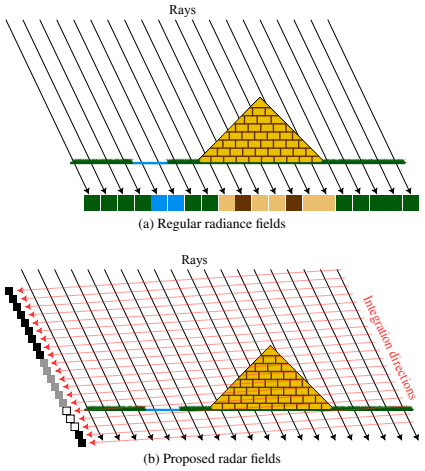
Figure 1 . The difference between the integration process of a clas- sic optical radiance field and the proposed radar field. While the radiance field integrates along each rays (in black), radar fields in- tegrates across rays (in red) in a given azimuth plane. Similarly to radiance fields, radar fields can be optimized from multiple SAR images to recover the underlying surface of the scene.
원문 · CC BY 4.0 · Thibaud Ehret, Roger Marí, Dawa Derksen, Nicolas Gasnier, Gabriele Facciolo · Radar Fields: An Extension of Radiance Fields to SAR · 원문 그림 인용 · 원본 PDF 1쪽에서 그림 영역을 추출했습니다.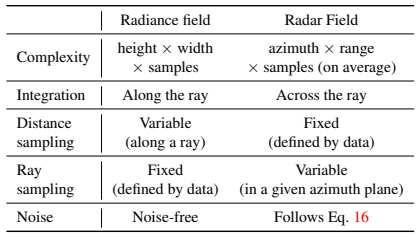
Table 1 . Main differences between regular radiance fields and the proposed radar fields.
원문 · CC BY 4.0 · Thibaud Ehret, Roger Marí, Dawa Derksen, Nicolas Gasnier, Gabriele Facciolo · Radar Fields: An Extension of Radiance Fields to SAR · 원문 그림 인용 · 원본 PDF 5쪽에서 그림 영역을 추출했습니다.시뮬레이션 실험 설정과 결과
검증은 실제 SAR 관측이 아니라 DSM에서 생성한 합성 SAR 영상으로 수행됩니다. 합성 영상은 같은 형성 모델의 식으로 계산한 뒤 마지막에 Γ(1,1) 곱셈 잡음을 더해 만들어집니다. 실험은 다섯 개의 카메라 위치에서 생성된 영상을 사용하며, 모든 실험에 같은 파라미터를 적용했다고 원문이 보고합니다. 학습은 10000 step 동안 진행되고, 초기 학습률 1을 5000 epoch 지점에서 0.1로, 8000 step에서 10^-2로 낮춥니다. 각 배치는 방위각 평면 64개로 구성되며 평면마다 256개의 광선을 샘플링합니다. 기본 설정은 Lambertian 표면(θ=1)입니다. 결과는 피라미드와 원형 더미의 toy 예시, 그리고 후지산과 피톤 드 라 푸르네즈의 실제 DSM 기반 시뮬레이션에서 제시됩니다.
저자들은 높이 재구성 오차가 지상 픽셀 해상도 기준으로 10^-2 픽셀 수준이라고 보고하며, 이 결과가 강한 잡음이 있는 학습 데이터에서도 얻어졌다고 밝힙니다. 비Lambertian 예시에서는 θ를 1로 초기화한 뒤 표면 모델과 함께 학습했다고 보고합니다. 이 결과는 합성 데이터와 제시된 설정에 한정되며, 실제 SAR 데이터로의 일반화는 이 실험에서 확인되지 않았습니다.
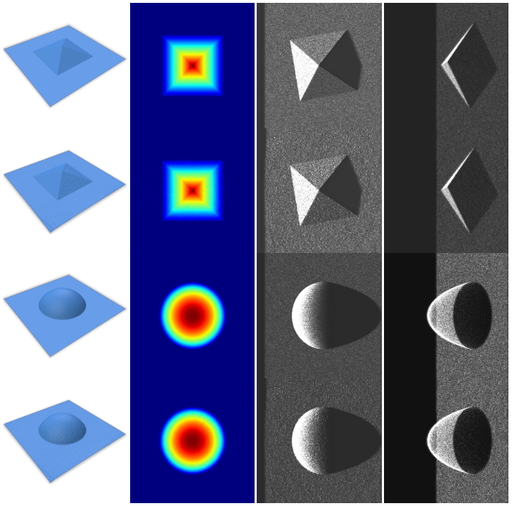
Figure 3 . Results of surface learning using five SAR images on two toy examples. The first represents a pyramid (first row is the ground truth and second row the learned model) and the second a round pile (ground truth in the third row and learned model in the last row). From left to right: visualization of the surface model, DSM corresponding to the surface model, and two images corresponding to two views used during training.
원문 · CC BY 4.0 · Thibaud Ehret, Roger Marí, Dawa Derksen, Nicolas Gasnier, Gabriele Facciolo · Radar Fields: An Extension of Radiance Fields to SAR · 원문 그림 인용 · 원본 PDF 6쪽에서 그림 영역을 추출했습니다.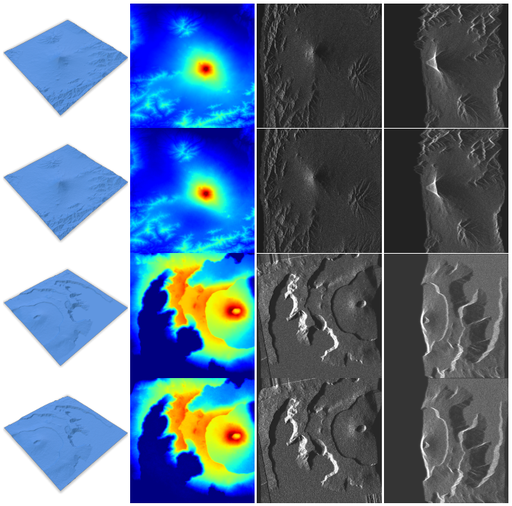
Figure 4 . Results of surface learning using five SAR images on simulated data from two real DSMs. The first represents mount Fuji (first row is the ground truth and second row the learned model) and the second the Piton de la Fournaise (ground truth in the third row and learned model in the last row). From left to right: visualization of the surface model, DSM corresponding to the surface model, and two images corresponding to two views used during training.
원문 · CC BY 4.0 · Thibaud Ehret, Roger Marí, Dawa Derksen, Nicolas Gasnier, Gabriele Facciolo · Radar Fields: An Extension of Radiance Fields to SAR · 원문 그림 인용 · 원본 PDF 7쪽에서 그림 영역을 추출했습니다.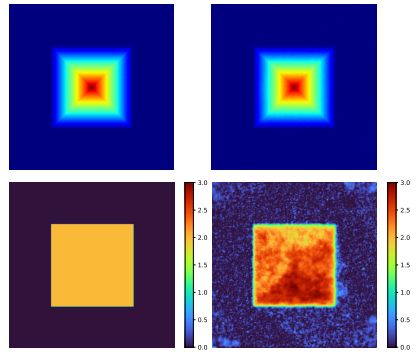
Figure 5 . Example showing that it is possible to learn the θ coeffi- cient (see Eq.(12)) characterizing the surface property (bottom) at the same time as the surface model (top). Left is the ground truth while right is the learned model. The learned model was initialized with θ = 1everywhere.
원문 · CC BY 4.0 · Thibaud Ehret, Roger Marí, Dawa Derksen, Nicolas Gasnier, Gabriele Facciolo · Radar Fields: An Extension of Radiance Fields to SAR · 원문 그림 인용 · 원본 PDF 8쪽에서 그림 영역을 추출했습니다.적용 범위와 남은 한계
이 방법은 방위각 평면마다 zero-doppler 취득과 동등하다는 가정 위에 있습니다. 저자들은 이 가정을 다중 반사가 없는 경우의 한정으로 다룹니다. 다중 반사에서는 신호가 한 번 이상 반사되어 센서에 도달하며, 그 겉보기 위치가 실제 반사 위치와 다를 수 있습니다. 원문은 이 일반적 경우에서 광선이 여러 방위각 평면의 신호에 영향을 줄 수 있으므로, 여러 방위각 평면을 함께 배치해 픽셀을 렌더링해야 하고 이는 현재 방법에서 계산적으로 매우 비현실적일 수 있다고 밝힙니다. 또한 SAR의 위상과 편파 정보는 이번 모델에 포함되지 않았습니다. 저자들은 위상 정보가 고도 정확도를 높일 가능성과 편파 정보가 산란 메커니즘이나 의미 분류에 쓰일 가능성을 향후 과제로 제시합니다.
논문은 이 방법을 시뮬레이션 데이터에서 검증한 개념 증명으로 설명하므로, 실제 SAR 관측과 다중 반사가 있는 장면에서의 성능은 이 논문의 결과 범위 밖입니다.
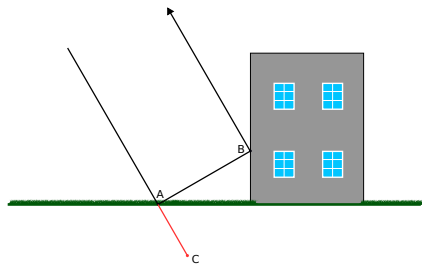
Figure 6 . Example of multiple bounces for SAR signal. The signal is partially reflected inA but also bounces and is reflected a second time in B. This second bounce is sensed as a virtual reflection in C.
원문 · CC BY 4.0 · Thibaud Ehret, Roger Marí, Dawa Derksen, Nicolas Gasnier, Gabriele Facciolo · Radar Fields: An Extension of Radiance Fields to SAR · 원문 그림 인용 · 원본 PDF 8쪽에서 그림 영역을 추출했습니다.논문 정보
- 저자
- Thibaud Ehret, Roger Marí, Dawa Derksen, Nicolas Gasnier, Gabriele Facciolo
- 학회·저널
- arXiv · 프리프린트
- 최초 공개일
- 2023년 12월 20일
- 등록일
- 2026년 11월 5일
- 수정일
- 2023년 12월 20일
- 버전
- v1
- arXiv
- 2312.12961
- 분류
- cs.CV · eess.IV
- 원문 이용 조건
- CC BY 4.0
- 제공 범위
- 논문 정보, 해설, 허용된 원문 그림
AI 해설은 논문 원문과 별개의 설명이며 오류가 있을 수 있습니다. 원문과 그림은 각 출처의 이용 조건과 따로 표시된 권리를 따릅니다.
초록
Radiance fields have been a major breakthrough in the field of inverse rendering, novel view synthesis and 3D modeling of complex scenes from multi-view image collections. Since their introduction, it was shown that they could be extended to other modalities such as LiDAR, radio frequencies, X-ray or ultrasound. In this paper, we show that, despite the important difference between optical and synthetic aperture radar (SAR) image formation models, it is possible to extend radiance fields to radar images thus presenting the first "radar fields". This allows us to learn surface models using only collections of radar images, similar to how regular radiance fields are learned and with the same computational complexity on average. Thanks to similarities in how both fields are defined, this work also shows a potential for hybrid methods combining both optical and SAR images.
원문 인용
Thibaud Ehret, Roger Marí, Dawa Derksen, Nicolas Gasnier, Gabriele Facciolo (2023). Radar Fields: An Extension of Radiance Fields to SAR. arXiv:2312.12961v1. https://arxiv.org/abs/2312.12961v1
BibTeX
@misc{ehret2023radar,
  title = {{Radar Fields: An Extension of Radiance Fields to SAR}},
  author = {Thibaud Ehret and Roger Marí and Dawa Derksen and Nicolas Gasnier and Gabriele Facciolo},
  year = {2023},
  eprint = {2312.12961},
  archivePrefix = {arXiv},
  url = {https://arxiv.org/abs/2312.12961v1}
}