논문 해설
Unsupervised Change Detection for Space Habitats Using 3D Point Clouds
3D 점군을 이용한 우주 거주 모듈의 비지도 변화 탐지
- 연구 문제 라벨 없이 3D 점군만으로 우주 거주지의 장면 변화를 탐지하는 문제를 다룹니다.
- 연구 방법 두 점군을 EM 기반 GMM으로 요약하고 EMD로 변화 클러스터를 반복 선택하는 EM-EMD 방법을 제안합니다.
- 주요 결과 Granite Lab 데이터의 단일 프레임과 재구성 맵에서 객체 출현을 검출했으며, three-object 장면의 Precision과 F1이 가장 높았습니다.
연구 문제와 배경
우주 거주지는 장기간 무인으로 운용되므로, 물체의 출현이나 소실 같은 장면 변화를 자동으로 찾는 기술이 필요합니다. 기존 ISS 분석 소프트웨어는 수동으로 라벨링된 이미지에 의존하며, 의미 기반 방법은 미리 정의된 범주에 속한 물체만 탐지할 수 있습니다. 이미지 기반 방법은 카메라 자세, 3D 모델의 정확도, 조명과 반사율에 민감합니다.
본 논문은 라벨이 없는 3D 점군만으로 두 시점의 장면을 비교하는 비지도 방법을 제안합니다. 이 방법은 미리 본 적 없는 물체도 깊이 데이터만으로 탐지하는 것을 목표로 하며, 연구 범위는 Astrobee 로봇이 Granite Lab에서 수집한 데이터에 한정됩니다.
EM-EMD 방법의 동작
EM-EMD 알고리즘은 두 시점의 점군 S_t0과 S_t를 각각 GMM으로 요약한 뒤, 두 GMM을 비교해 변화 영역을 찾습니다. 입력 점군에는 통계적 이상치 제거 필터와 voxel grid 다운샘플링 필터가 전처리로 적용됩니다.
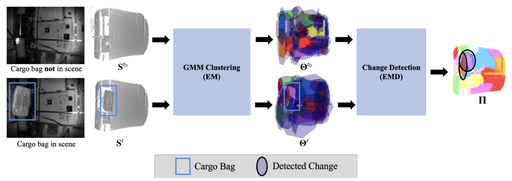
Fig. 1 The EM-EMD algorithm first clusters input point cloudsS𝑡0 and S𝑡 into Gaussian distributions using Expectation-Maximization (EM). Changes are detected using the Earth Mover’s Distance (EMD) to compare the distributions.
원문 · CC BY 4.0 · Jamie Santos, Holly Dinkel, Julia Di, Paulo V. K. Borges, Marina Moreira, Oleg Alexandrov, Brian Coltin, Trey Smith · Unsupervised Change Detection for Space Habitats Using 3D Point Clouds · 원문 그림 인용 · 원본 PDF 2쪽에서 그림 영역을 추출했습니다.GMM 단계에서는 초기 K개의 가우시안 분포를 두고 EM을 수행합니다. 로그우도 식 L(S_t|Θ_t)는 각 점에 대해 여러 분포의 가중 합을 로그로 취한 값이며, EM은 이를 최대화하기 위해 E-step에서 사후 가중치를 계산하고 M-step에서 파라미터를 갱신합니다. 수정된 M-step은 할당된 점이 P/2보다 적은 분포의 가중치를 0으로 만들어 제거합니다. 여기서 P는 한 분포를 정하는 파라미터 수이며 D=3일 때 P = D + D(D+1)/2로 계산됩니다.
최종 분포 수 K*는 MDL 기반 비용으로 정해집니다. 원문의 비용 함수는 −log L(S_t|Θ_t)에 파라미터 수에 따른 벌점 항을 더한 형태로 최소화하는 방식입니다. 이 과정으로 K가 크게 시작해도 사용되지 않는 분포가 정리되어, 초기 K를 세밀하게 튜닝하지 않아도 되는 것이 저자들이 밝힌 동기입니다.
EMD 기반 변화 영역 선택
각 시점의 GMM이 정해지면 두 모델 사이의 Earth Mover's Distance를 계산합니다. EMD는 한 분포의 질량을 다른 분포로 옮기는 최소 작업량을 정규화한 값입니다. 원문 식 (19)는 최적 흐름 F의 총 작업량 Work를 흐름 합으로 나눈 값으로 EMD를 정의합니다.
알고리즘은 Θ_t의 분포 가운데 하나를 제거했을 때 EMD를 가장 많이 줄이는 분포를 골라 변화 집합 Π로 옮깁니다. 이 과정을 EMD가 더 줄지 않을 때까지 반복합니다. 최종 Π는 S_t에서 변화가 일어난 점들을 식별하는 데 사용됩니다. 이 선택은 전역 최적 탐색이 아니라 탐욕적 선택이라는 점을 함께 읽어야 합니다.
데이터 수집과 실험 설정
실험 데이터는 NASA Ames의 Granite Lab에서 Astrobee가 수집했습니다. Granite Lab은 ISS의 시각적 특징을 모사하고 near-frictionless 공기 베어링으로 3자유도 미세중력을 흉내 냅니다. 장면은 다섯 개가 있으며, 첫 장면은 기준이고 나머지 장면에는 Astrobee, 화물 가방, 상자 중 일부가 추가되거나 제거되었습니다.
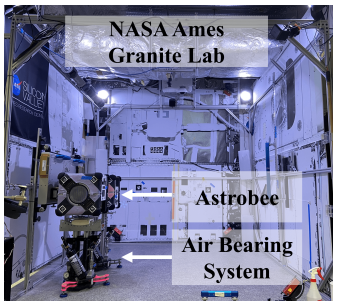
Fig.2 TheGraniteLabatNASAAmesResearchCentersimulatesthevisualenvironmentoftheISSandmimics 3-DOF microgravity by mounting Astrobee on a near-frictionless air bearing carriage. This system is used for testing Astrobee perception, motion planning, and control.
원문 · CC BY 4.0 · Jamie Santos, Holly Dinkel, Julia Di, Paulo V. K. Borges, Marina Moreira, Oleg Alexandrov, Brian Coltin, Trey Smith · Unsupervised Change Detection for Space Habitats Using 3D Point Clouds · 원문 그림 인용 · 원본 PDF 7쪽에서 그림 영역을 추출했습니다.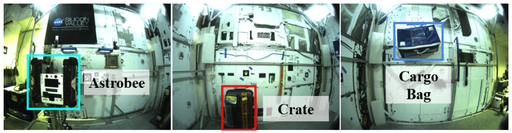
Fig. 3 Three large objects were placed in, moved, or removed from each scene. These images are captured with the NavCam on Astrobee for Scene 5. (Left) An Astrobee was placed near the edge of the scene. (Middle) A crate was placed in one corner of the scene. (Right) A cargo bag was placed in one corner of the scene.
원문 · CC BY 4.0 · Jamie Santos, Holly Dinkel, Julia Di, Paulo V. K. Borges, Marina Moreira, Oleg Alexandrov, Brian Coltin, Trey Smith · Unsupervised Change Detection for Space Habitats Using 3D Point Clouds · 원문 그림 인용 · 원본 PDF 8쪽에서 그림 영역을 추출했습니다.단일 프레임 점군은 HazCam 깊이 영상에서 얻고, 재구성 맵은 NavCam, HazCam과 위치 데이터를 사용해 만들었습니다. 기본 설정은 K_min=1, K=25, τ=10^-5, L=100입니다. 이 값은 본 실험 설정에서 사용한 기본값이며 다른 데이터셋이나 모델에 일반적으로 적용된다고 보기 어렵습니다.
재구성 맵과 단일 프레임 결과
재구성 맵 실험에서 두 물체를 추가한 장면은 한쪽 벽을 따라 변화 영역으로 식별되었습니다. 세 물체를 추가한 장면에서는 화물 가방과 상자가 TP로 검출되었지만 Astrobee는 FN으로 남았습니다. 저자들은 이 실패를 지도 경계의 잡음과 도킹 스테이션이 장면 가장자리에 위치한 점과 관련지어 설명합니다.
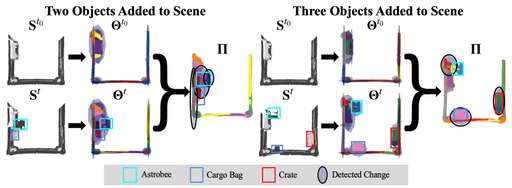
Fig. 4 Scene change detection with the EM-EMD algorithm identifies changes on reconstructed maps of the environment. (Left) Two objects, an Astrobee and cargo bag, are added along one wall of the scene, and this region along the wall is identified as a change region. (Right) Three objects, an Astrobee, cargo bag, and crate, are each placed along separate walls in the scene. The cargo bag and crate are correctly detected areas of change (TP), while significant noise at the map boundary led to a shift in the change region. Astrobee was not correctly identified as a scene change (FN).
원문 · CC BY 4.0 · Jamie Santos, Holly Dinkel, Julia Di, Paulo V. K. Borges, Marina Moreira, Oleg Alexandrov, Brian Coltin, Trey Smith · Unsupervised Change Detection for Space Habitats Using 3D Point Clouds · 원문 그림 인용 · 원본 PDF 8쪽에서 그림 영역을 추출했습니다.단일 프레임 점군 실험에서는 화물 가방과 Astrobee를 각각 한 객체로 두고 두 장면을 비교했습니다. EM이 K*를 [20, 23] 범위로 수렴한 것으로 보고되며, 두 경우 모두 물체가 TP로 식별되고 FP는 보고되지 않았습니다.
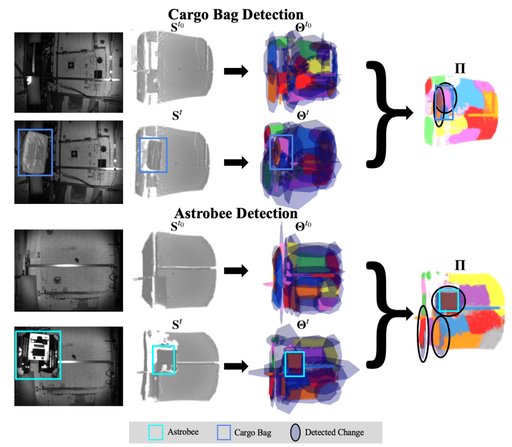
Fig. 5 A cargo bag and Astrobee robot are detected by comparing two single-frame depth images taken at the same location at different times. (Top) Cargo bag detection. (Bottom) Astrobee detection. (1st Stage) Images and input point clouds. (2nd Stage) GMM clustering using EM. (3rd Stage) Change detection using EMD.
원문 · CC BY 4.0 · Jamie Santos, Holly Dinkel, Julia Di, Paulo V. K. Borges, Marina Moreira, Oleg Alexandrov, Brian Coltin, Trey Smith · Unsupervised Change Detection for Space Habitats Using 3D Point Clouds · 원문 그림 인용 · 원본 PDF 9쪽에서 그림 영역을 추출했습니다.초기 K와 PCA 전처리의 영향
초기 클러스터 수 K를 줄이면 물체가 벽과 함께 묶여 재현율이 떨어집니다. K=10에서는 화물 가방이 벽과 함께 군집화되어 FN이 발생했습니다. K가 커지면 물체가 더 많은 분포로 표현되어 검출된 변화 면적이 대체로 줄고, K=50에서는 물체가 조각나기 시작했습니다. 저자들은 K=25가 이 장면에서 출현 탐지, 소실 탐지와 실행 시간의 균형을 가장 잘 맞춘 값이라고 해석합니다.
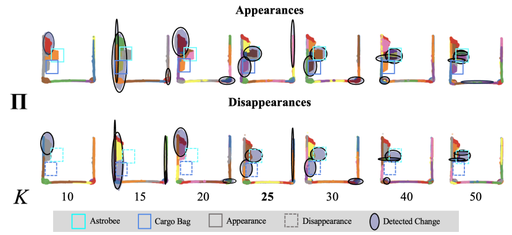
Fig. 6 When varying the initial number of GMM clusters,𝐾, a wider area of the map is generally detected as a change region when fewer clusters are used while a smaller area of the map is generally detected as a change region when𝐾 is larger. The parameter𝐾 = 25provided the best balance for this scene.
원문 · CC BY 4.0 · Jamie Santos, Holly Dinkel, Julia Di, Paulo V. K. Borges, Marina Moreira, Oleg Alexandrov, Brian Coltin, Trey Smith · Unsupervised Change Detection for Space Habitats Using 3D Point Clouds · 원문 그림 인용 · 원본 PDF 10쪽에서 그림 영역을 추출했습니다.PCA는 z 차원을 제거하는 전처리로 사용되었습니다. 원문은 PCA 적용 시 변화가 정확히 검출되었고, 이 테스트 사례에서 전체 변화 탐지 실행 시간이 10% 단축되었다고 보고합니다. 다만 복잡한 ISS 환경에서 차원 제거가 성능에 미칠 영향은 추가 연구가 필요하다고 밝혀졌습니다.
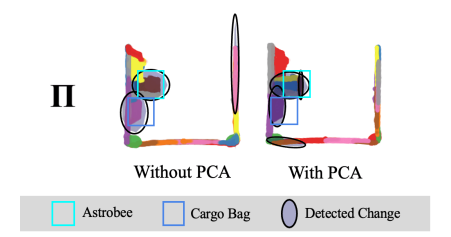
Fig. 7 Applying PCA as a pre-processing step reduces the dimensionality of the point clouds input to the EM-EMD algorithm. The EM-EMD algorithm still accurately detects changes on the PCA-processed data. (Left) Change detection result without pre-processing with PCA. (Right) Change detection result with pre-processing with PCA.
원문 · CC BY 4.0 · Jamie Santos, Holly Dinkel, Julia Di, Paulo V. K. Borges, Marina Moreira, Oleg Alexandrov, Brian Coltin, Trey Smith · Unsupervised Change Detection for Space Habitats Using 3D Point Clouds · 원문 그림 인용 · 원본 PDF 10쪽에서 그림 영역을 추출했습니다.실행 시간과 평가 지표
실행 시간 분석에서 EM 단계가 전체 시간의 대부분을 차지하며, K가 증가함에 따라 거의 선형으로 늘어납니다. 측정은 8코어 3.2 GHz Apple M1 CPU와 8 GB RAM 환경에서 2개 객체 재구성 맵 변화 탐지에 대해 이루어졌습니다.
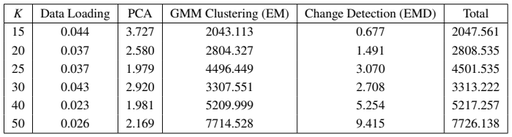
Table 1 Change Detection Runtime [s]
원문 · CC BY 4.0 · Jamie Santos, Holly Dinkel, Julia Di, Paulo V. K. Borges, Marina Moreira, Oleg Alexandrov, Brian Coltin, Trey Smith · Unsupervised Change Detection for Space Habitats Using 3D Point Clouds · 원문 그림 인용 · 원본 PDF 11쪽에서 그림 영역을 추출했습니다.평가 지표는 Accuracy, Precision, Recall, F1입니다. 단일 프레임 점군의 one-object 장면에서 Recall은 1.000, Precision은 0.600, F1은 0.727이었습니다. two-object 장면의 Recall은 0.667, F1은 0.650이고, three-object 장면의 Precision은 0.933, F1은 0.829로 세 장면 가운데 가장 높습니다. 이 수치는 객체 출현 탐지에 대한 것이며, 원문은 소실 탐지 점수가 유사하다고 보고하지만 두 경우를 섞어 평가하지는 않았습니다.
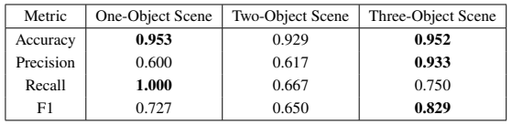
Table 2 Performance by Number of Appearance Objects
원문 · CC BY 4.0 · Jamie Santos, Holly Dinkel, Julia Di, Paulo V. K. Borges, Marina Moreira, Oleg Alexandrov, Brian Coltin, Trey Smith · Unsupervised Change Detection for Space Habitats Using 3D Point Clouds · 원문 그림 인용 · 원본 PDF 11쪽에서 그림 영역을 추출했습니다.한계와 향후 과제
저자들이 밝힌 주요 한계는 EM-EMD가 객체의 출현과 소실을 같은 장면에서 동시에 탐지하지 못한다는 점입니다. 이 문제는 객체 범주를 식별하는 의미 계층을 추가하면 다룰 수 있다고 제시됩니다. 또한 장면 가장자리에서 FP 검출이 생기며, 단일 프레임 점군은 수동으로 맞춘 시각에서 추출되어 정렬 오차가 생길 수 있습니다.
향후 과제로는 실행 시간과 정확도의 균형 분석, 다운샘플링과 필터링 같은 전처리 영향 분석, ISS 재구성 맵에 대한 적용이 언급됩니다. 본 논문의 결과는 Granite Lab 데이터와 이 설정에서 얻은 것이며, ISS 환경에서의 성능은 아직 확인되지 않았습니다.
논문 정보
- 저자
- Jamie Santos, Holly Dinkel, Julia Di, Paulo V. K. Borges, Marina Moreira, Oleg Alexandrov, Brian Coltin, Trey Smith
- 학회·저널
- arXiv · 프리프린트
- 최초 공개일
- 2023년 12월 4일
- 등록일
- 2026년 11월 5일
- 수정일
- 2024년 8월 5일
- 버전
- v3
- arXiv
- 2312.02396
- DOI
- 10.2514/6.2024-1960
- 분류
- cs.RO · cs.CV · cs.LG
- 원문 이용 조건
- CC BY 4.0
- 제공 범위
- 논문 정보, 해설, 허용된 원문 그림
AI 해설은 논문 원문과 별개의 설명이며 오류가 있을 수 있습니다. 원문과 그림은 각 출처의 이용 조건과 따로 표시된 권리를 따릅니다.
초록
This work presents an algorithm for scene change detection from point clouds to enable autonomous robotic caretaking in future space habitats. Autonomous robotic systems will help maintain future deep-space habitats, such as the Gateway space station, which will be uncrewed for extended periods. Existing scene analysis software used on the International Space Station (ISS) relies on manually-labeled images for detecting changes. In contrast, the algorithm presented in this work uses raw, unlabeled point clouds as inputs. The algorithm first applies modified Expectation-Maximization Gaussian Mixture Model (GMM) clustering to two input point clouds. It then performs change detection by comparing the GMMs using the Earth Mover's Distance. The algorithm is validated quantitatively and qualitatively using a test dataset collected by an Astrobee robot in the NASA Ames Granite Lab comprising single frame depth images taken directly by Astrobee and full-scene reconstructed maps built with RGB-D and pose data from Astrobee. The runtimes of the approach are also analyzed in depth. The source code is publicly released to promote further development.
원문 인용
Jamie Santos, Holly Dinkel, Julia Di, Paulo V. K. Borges, Marina Moreira, Oleg Alexandrov, Brian Coltin, Trey Smith (2023). Unsupervised Change Detection for Space Habitats Using 3D Point Clouds. arXiv:2312.02396v3. https://doi.org/10.2514/6.2024-1960
BibTeX
@article{santos2023unsupervised,
  title = {{Unsupervised Change Detection for Space Habitats Using 3D Point Clouds}},
  author = {Jamie Santos and Holly Dinkel and Julia Di and Paulo V. K. Borges and Marina Moreira and Oleg Alexandrov and Brian Coltin and Trey Smith},
  year = {2023},
  eprint = {2312.02396},
  archivePrefix = {arXiv},
  doi = {10.2514/6.2024-1960},
  url = {https://arxiv.org/abs/2312.02396v3}
}