논문 해설
ARF: Artistic Radiance Fields
ARF: 예술적 복사장
- 연구 문제 사진 사실적 radiance field를 2D 스타일 이미지의 예술적 외관으로 바꾸려면, 기하 재구성에 민감한 점 구름·메쉬 대신 radiance field 자체를 스타일화해야 합니다.
- 연구 방법 ARF는 NNFM 기반 스타일 손실과 콘텐츠 보존 항으로 radiance field의 외관을 최적화하고, deferred back-propagation으로 전체 해상도 손실의 메모리 비용을 줄입니다.
- 주요 결과 절제 실험에서 NNFM은 Gram 기반 및 CNNMRF 손실보다 스타일 세부를 더 충실히 옮겼고, 사용자 연구에서 ARF는 Huang et al. 대비 86.8%, Chiang et al. 대비 94.1% 선호를 받았습니다.
사진 사실적 radiance field의 예술적 스타일화 문제
기존 3D 스타일화 방법은 점 구름이나 삼각형 메쉬를 기반으로 하여, 복잡한 실제 장면에서 기하 재구성 오류에 민감합니다. ARF는 이 문제를 피하기 위해 여러 사진으로부터 재구성된 사진 사실적 radiance field 자체를 스타일화 대상으로 삼습니다.
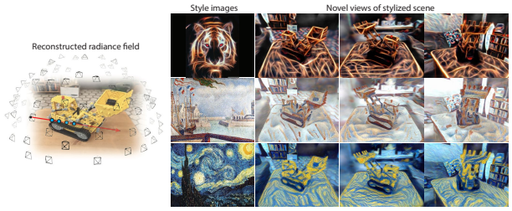
Fig. 1 . We propose ARF, a novel approach for 3D stylization. Our approach utilizes a pre-reconstructed radiance field of a real scene (left) and converts it into an artistic radiance field by matching feature activations extracted from an input 2D style image (middle), leading to high-quality stylized novel view synthesis (right). Our approach produces consistent results across viewpoints; please refer to our supplementary video.
원문 · CC BY 4.0 · Kai Zhang, Nick Kolkin, Sai Bi, Fujun Luan, Zexiang Xu, Eli Shechtman, Noah Snavely · ARF: Artistic Radiance Fields · 원문 그림 인용 · 원본 PDF 2쪽에서 그림 영역을 추출했습니다.radiance field는 3D 위치와 시점 방향을 입력받아 volume density와 RGB 색을 출력하는 표현이며, 차별 가능한 volume rendering으로 임의 시점의 이미지를 만들 수 있습니다. ARF는 이 표현을 한 장의 2D 스타일 이미지에 맞추어 조정함으로써 시점 간 일관성을 유지하는 예술적 novel view 렌더링을 얻고자 합니다.
이 과정에서 두 가지 질문이 생깁니다. 첫째, 스타일 손실로 흔히 쓰이는 Gram 행렬 기반 손실이 스타일 세부 정보를 충분히 옮기는지입니다. 둘째, 전체 해상도 렌더링 이미지에 대해 이러한 CNN 기반 손실을 메모리 제약 아래에서 계산할 수 있는지입니다.
NNFM 손실과 콘텐츠 보존 항
ARF의 핵심 손실은 Nearest Neighbor Feature Matching(NNFM)입니다. 렌더링 이미지 Irender와 스타일 이미지 Istyle에서 VGG 특징 맵 Frender와 Fstyle을 추출한 뒤, Frender의 각 위치 (i, j)의 특징 벡터마다 Fstyle에서 가장 가까운 이웃을 찾습니다. 손실은 다음과 같이 정의되며, N은 Frender의 픽셀 수입니다.
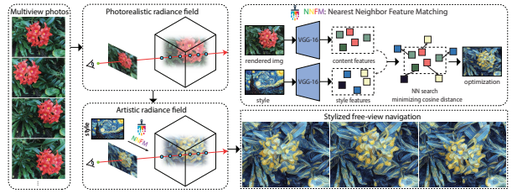
Fig. 2 .Overview of our method. We first reconstruct a photo-realistic radiance field from multiple photos. We then stylize this reconstruction using an exemplar style image through the use of a nearest neighbor feature matching (NNFM) style loss. Once this stylization is done, we can obtain consistent free-viewpoint stylized renderings. We invite readers to watch the supplemental videos to better appreciate our results.
원문 · CC BY 4.0 · Kai Zhang, Nick Kolkin, Sai Bi, Fujun Luan, Zexiang Xu, Eli Shechtman, Noah Snavely · ARF: Artistic Radiance Fields · 원문 그림 인용 · 원본 PDF 5쪽에서 그림 영역을 추출했습니다.\[\ell_{\textrm{nnfm}}(F_{\textrm{render}}, F_{\textrm{style}})=\frac{1}{N}\sum_{i,j}\min_{i',j'} D(F_{\textrm{render}}(i,j), F_{\textrm{style}}(i',j'))\]
여기서 D는 코사인 거리로, D(v1, v2)=1−v1ᵀv2/√(v1ᵀv1·v2ᵀv2)입니다. 즉 각 렌더링 특징을 스타일 특징 공간의 최근접 특징에 가깝게 만듭니다. Gram 행렬이 전체 이미지의 전역 특징 통계를 쓰는 것과 달리, NNFM은 지역 특징 대응을 사용하므로 개별 붓터치 같은 국소 세부를 더 잘 포착한다고 저자들은 설명합니다.
스타일이 지나치게 강해져 내용을 알아보기 어려워지는 문제를 줄이기 위해, 렌더링 특징과 콘텐츠 이미지 특징의 ℓ2 차이를 더합니다.
\[\ell=\ell_{\textrm{nnfm}}(F_{\textrm{render}}, F_{\textrm{style}})+\lambda\cdot\ell_2(F_{\textrm{render}}, F_{\textrm{content}})\]
λ가 클수록 내용이 더 보존되고 작을수록 스타일화가 강해집니다. 스타일화 중에는 초기 사진 사실적 radiance field의 density 구성요소를 고정하고 appearance 구성요소만 최적화합니다. 특징 추출은 사전학습된 VGG-16의 conv3 블록을 사용하며, 이 선택은 다른 블록보다 스타일 세부를 더 잘 포착한다는 원문의 실험에 근거합니다.
deferred back-propagation으로 전체 해상도 손실 계산하기
volume rendering은 픽셀마다 많은 샘플을 합성하므로 메모리 비용이 큽니다. 그래서 많은 방법은 매 반복에서 전체 이미지 대신 희소한 픽셀만 렌더링합니다. 이 방식은 픽셀별로 독립된 ℓ1이나 ℓ2 손실에는 적합하지만, NNFM이나 Gram 손실처럼 전체 이미지의 CNN 특징이 필요한 손실에는 맞지 않습니다.
ARF는 deferred back-propagation으로 이 문제를 해결합니다. 먼저 자동 미분을 끈 상태로 전체 해상도 이미지를 렌더링합니다. 그다음 이미지 손실을 계산하고, 렌더링된 픽셀 색에 대한 손실의 기울기를 캐시합니다. 마지막으로 이미지를 패치 단위로 다시 렌더링하면서 자동 미분을 켜고, 해당 패치의 캐시된 기울기를 연쇄 법칙으로 장면 파라미터에 역전파하여 누적합니다. 이렇게 하면 기울기 계산은 전체 이미지 렌더링 단계에서 패치 재렌더링 단계로 미뤄지며, 메모리 사용량은 전체 이미지 대신 작은 패치를 렌더링하는 수준으로 줄어듭니다.
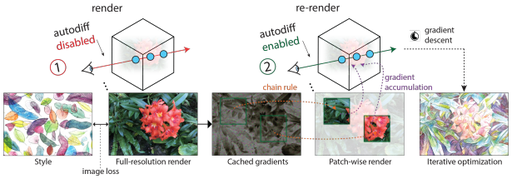
Fig. 3 .Illustration of deferred back-propagation. We first disable auto-differentiation to render a full-resolution image; then we compute the image loss (e.g., a style loss defined by NNFM or by a Gram matrix), and cache its gradients with respect to pixel values of the full-resolution image. Next, we back-propagate the cached gradients to scene parameters and accumulate in a patch-wise manner; for each patch, we re-render it with enabled auto-differentiation, and apply the chain rule to back-propagate the corresponding cached patch gradients to scene parameters for accumulation. This way, we correctly compute the gradients of a loss imposed on the full-resolution rendered image with respect to the scene parameters, with the same GPU memory footprint of rendering a single small patch differentiably.
원문 · CC BY 4.0 · Kai Zhang, Nick Kolkin, Sai Bi, Fujun Luan, Zexiang Xu, Eli Shechtman, Noah Snavely · ARF: Artistic Radiance Fields · 원문 그림 인용 · 원본 PDF 7쪽에서 그림 영역을 추출했습니다.시점 일관적인 색 변환과 학습 설정
NNFM과 콘텐츠 손실만으로는 렌더링 색이 스타일 이미지의 색 조와 어긋날 수 있습니다. ARF는 학습 시점 이미지를 스타일 이미지의 색 통계에 맞춘 뒤 이를 사용해 radiance field를 먼저 사전 최적화하고, 스타일화 최적화 후 다시 학습 시점 렌더링에 같은 색 변환을 적용합니다. 변환은 RGB 공간의 선형 변환 A로, 평균과 공분산이 스타일 이미지와 일치하도록 해석적으로 구합니다.
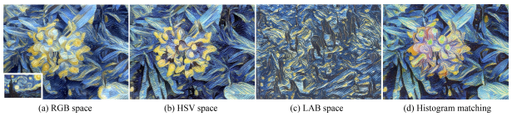
Fig. 10 .Ablation studies of color transfer methods. We execute the color transfer algorithm described in Sec. 4.3 in RGB color space (a); this tends to generate better results than running it in HSV (b) and LAB (c) color spaces, and replacing it with histogram matching (d).
원문 · CC BY 4.0 · Kai Zhang, Nick Kolkin, Sai Bi, Fujun Luan, Zexiang Xu, Eli Shechtman, Noah Snavely · ARF: Artistic Radiance Fields · 원문 그림 인용 · 원본 PDF 19쪽에서 그림 영역을 추출했습니다.구현에서는 Plenoxels를 주로 사용하며 NeRF와 TensoRF에도 같은 기법을 적용했습니다. Plenoxels에서는 구면 조화 함수의 첫 성분만 남겨 시점 의존성을 제거하고, TensoRF에서는 MLP에 입력하는 시점 방향을 0으로 둡니다. 최적화는 10 epoch 동안 학습률을 1e-1에서 1e-2로 지수 감쇠하며 수행됩니다. 콘텐츠 가중치 λ는 전방향 캡처에서 0.001, 360도 캡처에서 0.005로 설정됩니다.
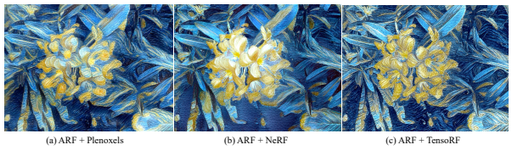
Fig. 8 .Applicability across different radiance field representations. Our ARF method is applicable to a variety of radiance fields representations, including Plenoxels [ 46], NeRF [32] and TensoRF [ 4], in each case producing high-quality 3D stylization results.
원문 · CC BY 4.0 · Kai Zhang, Nick Kolkin, Sai Bi, Fujun Luan, Zexiang Xu, Eli Shechtman, Noah Snavely · ARF: Artistic Radiance Fields · 원문 그림 인용 · 원본 PDF 14쪽에서 그림 영역을 추출했습니다.기준선 비교와 사용자 연구
ARF는 Huang et al.의 점 구름 기반 방법과 Chiang et al.의 암시적 MLP 및 하이퍼네트워크 기반 방법과 비교되었습니다. 비교는 전방향 캡처(Flower, Orchids, Horns, Trex)와 360도 캡처(Family, Horse, Playground, Truck, M60, Train, Real Lego) 장면에서 수행되었습니다.
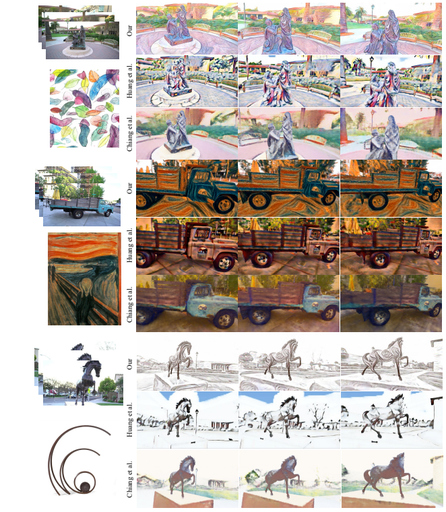
Fig. 5 .Comparison with the baseline methods Huang et al. [ 16] and Chiang et al. [ 8] on real-world Tanks and Temples data. Our results match both the colors and details of the style image most faithfully, while preserving sharp and recognizable content. We invite readers to watch our supplemental videos for better comparisons.
원문 · CC BY 4.0 · Kai Zhang, Nick Kolkin, Sai Bi, Fujun Luan, Zexiang Xu, Eli Shechtman, Noah Snavely · ARF: Artistic Radiance Fields · 원문 그림 인용 · 원본 PDF 12쪽에서 그림 영역을 추출했습니다.정성적 비교에서 Huang et al.은 과도하게 평활화된 결과를 만들고 점 구름 재구성 오류로 잎 같은 기하 구조를 잘 복원하지 못한다고 보고됩니다. Chiang et al.은 전체 색 조만 옮기고 세부 질감을 잘 재현하지 못한다고 보고됩니다.
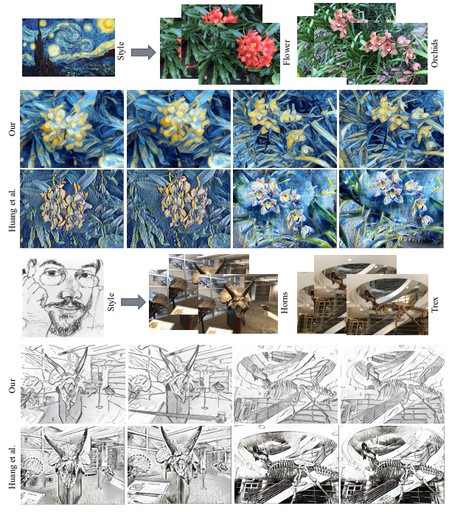
Fig. 4 .Comparison with the baseline method Huang et al. [ 16] on real-world forward- facing data. Our stylized novel views contain significantly more faithful style details. Additionally, the method of Huang et al. [ 16] requires reconstructing meshes from images, an error-prone process. Such errors can impact the quality of stylized novel views, as can be seen in the leaves in the Flower and Orchids scenes, and in ceiling of Trex. In contrast, our method, based on radiance fields, exhibits many fewer geometric artifacts. We invite readers to watch our supplemental videos for better comparisons.
원문 · CC BY 4.0 · Kai Zhang, Nick Kolkin, Sai Bi, Fujun Luan, Zexiang Xu, Eli Shechtman, Noah Snavely · ARF: Artistic Radiance Fields · 원문 그림 인용 · 원본 PDF 11쪽에서 그림 영역을 추출했습니다.사용자 연구는 25개의 무작위 (장면, 스타일) 쌍을 5개 배치로 나누어 수행되었으며, 쌍마다 평균 약 12개의 평가를 받았습니다. 사용자는 ARF를 Huang et al. 대비 86.8%, Chiang et al. 대비 94.1% 선호했습니다. 이 수치는 해당 사용자 연구 설정에서 얻은 것입니다.
절제 실험: 손실과 색 변환의 역할
NNFM 손실의 효과는 Gram 기반 손실 및 CNNMRF 손실과 비교하여 확인되었습니다. 원문에 따르면 NNFM을 Gram 기반 손실로 바꾸면 덜 설득력 있고 아티팩트가 많은 결과가 나타나며, CNNMRF 손실과 비교해도 NNFM이 더 충실한 3D 스타일화를 만듭니다. 이 절제는 손실 함수만 바꾸고 나머지 파이프라인을 유지한 비교입니다.
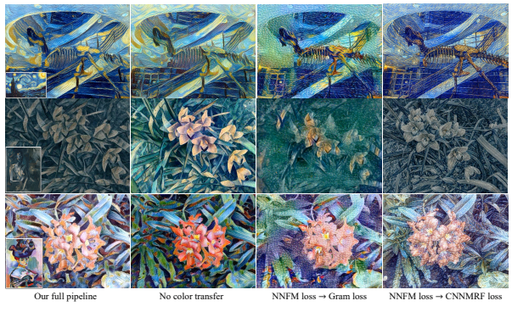
Fig. 7 .Ablation studies of color transfer and NNFM loss. Without color transfer, there is a noticeable color mismatch between the synthesized views and the style image (shown as insets in the first column). Replacing the NNFM loss with the commonly-used Gram loss [11] leads to less compelling results with many more artifacts. Our NNFM loss also generates more faithful 3D stylization results than the prior CNNMRF loss [22].
원문 · CC BY 4.0 · Kai Zhang, Nick Kolkin, Sai Bi, Fujun Luan, Zexiang Xu, Eli Shechtman, Noah Snavely · ARF: Artistic Radiance Fields · 원문 그림 인용 · 원본 PDF 14쪽에서 그림 영역을 추출했습니다.색 변환을 제거하면 합성 시점과 스타일 이미지 사이에 뚜렷한 색 불일치가 나타납니다. 따라서 이 결과는 색 변환이 색 톤 정합에 기여한다는 근거이며, 스타일 세부 정보 자체를 평가한 결과와는 구분해 읽어야 합니다.
또한 VGG-16의 여러 블록 가운데 conv3 블록을 사용한 결과가 다른 블록보다 시각적으로 더 나은 것으로 보고됩니다.
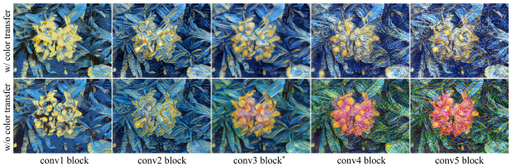
Fig. 9 .Ablation studies of extrating features for losses in Eq. 4 using different layer blocks of the VGG-16 network. We find that conv3 layer block generates more visually pleasing results than other layers.
원문 · CC BY 4.0 · Kai Zhang, Nick Kolkin, Sai Bi, Fujun Luan, Zexiang Xu, Eli Shechtman, Noah Snavely · ARF: Artistic Radiance Fields · 원문 그림 인용 · 원본 PDF 15쪽에서 그림 영역을 추출했습니다.적용 범위와 한계
ARF의 가장 중요한 실용적 한계는 계산 시간입니다. 스타일 이미지마다 최적화가 필요하며, 전방향 캡처에서는 약 3분, 360도 캡처에서는 약 20분이 단일 NVIDIA RTX 3090 GPU에서 걸린다고 보고됩니다. 최적화가 끝난 뒤에는 실시간 렌더링이 가능합니다.
또한 radiance field의 floater 같은 기하 아티팩트가 스타일화 결과에도 나타날 수 있으며, 원문은 이를 밀도 정규화로 줄일 수 있다고 언급합니다. 재구성된 예술적 radiance field는 수동 편집을 지원하지 않는다는 점도 밝혀져 있습니다. 평가는 제시된 실제 장면과 스타일 이미지 조합에서 수행되었으므로, 이 결과를 임의의 장면이나 스타일 전반으로 일반화하지 않습니다.
논문 정보
- 저자
- Kai Zhang, Nick Kolkin, Sai Bi, Fujun Luan, Zexiang Xu, Eli Shechtman, Noah Snavely
- 학회·저널
- arXiv · 프리프린트
- 최초 공개일
- 2022년 6월 13일
- 등록일
- 2026년 11월 5일
- 수정일
- 2022년 6월 13일
- 버전
- v1
- arXiv
- 2206.06360
- 분류
- cs.CV
- 원문 이용 조건
- CC BY 4.0
- 제공 범위
- 논문 정보, 해설, 허용된 원문 그림
AI 해설은 논문 원문과 별개의 설명이며 오류가 있을 수 있습니다. 원문과 그림은 각 출처의 이용 조건과 따로 표시된 권리를 따릅니다.
초록
We present a method for transferring the artistic features of an arbitrary style image to a 3D scene. Previous methods that perform 3D stylization on point clouds or meshes are sensitive to geometric reconstruction errors for complex real-world scenes. Instead, we propose to stylize the more robust radiance field representation. We find that the commonly used Gram matrix-based loss tends to produce blurry results without faithful brushstrokes, and introduce a nearest neighbor-based loss that is highly effective at capturing style details while maintaining multi-view consistency. We also propose a novel deferred back-propagation method to enable optimization of memory-intensive radiance fields using style losses defined on full-resolution rendered images. Our extensive evaluation demonstrates that our method outperforms baselines by generating artistic appearance that more closely resembles the style image. Please check our project page for video results and open-source implementations: https://www.cs.cornell.edu/projects/arf/ .
원문 인용
Kai Zhang, Nick Kolkin, Sai Bi, Fujun Luan, Zexiang Xu, Eli Shechtman, Noah Snavely (2022). ARF: Artistic Radiance Fields. arXiv:2206.06360v1. https://arxiv.org/abs/2206.06360v1
BibTeX
@misc{zhang2022artistic,
  title = {{ARF: Artistic Radiance Fields}},
  author = {Kai Zhang and Nick Kolkin and Sai Bi and Fujun Luan and Zexiang Xu and Eli Shechtman and Noah Snavely},
  year = {2022},
  eprint = {2206.06360},
  archivePrefix = {arXiv},
  url = {https://arxiv.org/abs/2206.06360v1}
}