논문 해설
Point-NeRF: Point-based Neural Radiance Fields
Point-NeRF: 점 기반 신경 방사장
- 연구 문제 NeRF 계열 방법은 장면마다 전역 MLP를 학습하느라 재구성 시간이 길어지는 문제가 있습니다. Point-NeRF는 이 문제를 점 기반 표현으로 완화하려 합니다.
- 연구 방법 Point-NeRF는 MVS 기반 네트워크로 초기 점 구름과 점별 특징을 생성하고, 장면별로 점 가지치기와 성장을 수행합니다.
- 주요 결과 DTU와 NeRF Synthetic 실험에서 Point-NeRF는 짧은 미세 조정으로 기존 방법과 비교 가능한 화질을 보고합니다. 다만 비교 조건과 반복 수에 따라 결과가 달라집니다.
NeRF 계열 재구성의 시간 문제
NeRF는 고품질 novel view synthesis를 보여 주지만, 장면마다 전역 MLP를 긴 시간 학습해야 합니다. 원문은 이 느린 장면별 피팅과 빈 공간에서의 불필요한 샘플링이 재구성 시간을 길게 만든다고 지적합니다. Point-NeRF는 이 문제를 3D 뉴럴 점 구름과 점별 특징으로 volumetric radiance field를 표현하는 방식으로 다룹니다. 논문은 한 장면의 점 필드를 네트워크 순전파로 먼저 얻고, 이후 짧은 장면별 최적화로 화질을 높이는 흐름을 제안합니다.
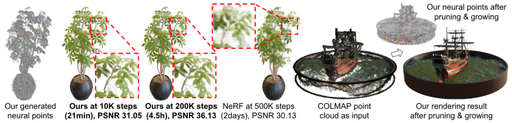
Figure 1 . Point-NeRF uses neural 3D points to efficiently represent and render a continuous radiance volume. The point-based radiance field can be predicted via network forward inference from multi-view images. It can then be optimized per scene to achieve reconstruction quality that surpasses NeRF [35] in tens of minutes. Point-NeRF can also leverage off-the-shelf reconstruction methods like COLMAP [44] and is able to perform point pruning and growing that automatically fix the holes and outliers that are common in these approaches.
원문 · CC0 1.0 · Qiangeng Xu, Zexiang Xu, Julien Philip, Sai Bi, Zhixin Shu, Kalyan Sunkavalli, Ulrich Neumann · Point-NeRF: Point-based Neural Radiance Fields · 원문 그림 인용 · 원본 PDF 1쪽에서 그림 영역을 추출했습니다.점별 뉴럴 특징과 점 기반 radiance field
Point-NeRF는 각 점 i가 위치 p_i, 뉴럴 특징 f_i, 신뢰도 γ_i를 가지는 점 구름 P를 사용합니다. 임의의 3D 위치 x에서는 반경 R 안의 K개 이웃 점을 질의하고, 각 점의 특징을 상대 위치 x−p_i를 입력으로 하는 MLP F로 변환합니다. 이후 역거리 가중 평균으로 특징을 집계하여 f_x를 만들고, MLP R이 시점 방향 d와 함께 radiance를 회귀합니다. 밀도는 점별 MLP T가 σ_i를 예측한 뒤 같은 방식의 가중 집계로 σ를 얻습니다. 이때 각 점의 신뢰도 γ_i가 밀도 기여에 직접 곱해지므로 신뢰도는 점의 밀도 기여를 조절합니다.
MVS 기반 초기 점 필드 생성
초기 점 필드는 여러 시점 이미지로부터 MVSNet 계열의 cost volume 3D CNN으로 깊이 확률 볼륨을 추정하고, 깊이 맵을 3D로 unprojection하여 얻습니다. 점 신뢰도 γ_i는 깊이 확률 볼륨을 점 위치에서 trilinear하게 샘플링한 값으로 정해집니다. 점별 특징은 별도의 2D CNN인 VGG 계열 G_f가 입력 이미지에서 추출한 여러 해상도의 특징을 점에 대응시켜 얻습니다. 원문은 이 전체 생성 과정을 렌더링 손실로 종단간 학습하여, 장면별 최적화 전의 초기 radiance field가 합리적인 가중치에서 출발하도록 한다고 설명합니다.
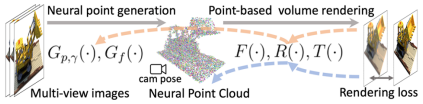
Figure 3 . The dash lines indicate gradient updates for radiance field initialization and per-scene optimization.
원문 · CC0 1.0 · Qiangeng Xu, Zexiang Xu, Julien Philip, Sai Bi, Zhixin Shu, Kalyan Sunkavalli, Ulrich Neumann · Point-NeRF: Point-based Neural Radiance Fields · 원문 그림 인용 · 원본 PDF 4쪽에서 그림 영역을 추출했습니다.
Table 5 . Comparisons between using the extracted image features to initialize the point features (our full model) or using the random initialized features.
원문 · CC0 1.0 · Qiangeng Xu, Zexiang Xu, Julien Philip, Sai Bi, Zhixin Shu, Kalyan Sunkavalli, Ulrich Neumann · Point-NeRF: Point-based Neural Radiance Fields · 원문 그림 인용 · 원본 PDF 12쪽에서 그림 영역을 추출했습니다.점 가지치기와 성장
장면별 최적화 단계에서 저자들은 기존 점 위치를 직접 최적화하면 학습이 불안정하고 큰 구멍을 채우지 못한다고 보고, 점 위치 대신 점 신뢰도와 특징을 최적화하는 방식을 택합니다. 가지치기는 γ_i < 0.1인 점을 10K 반복마다 제거하며, 희소성 손실 L_sparse로 신뢰도를 0 또는 1 가까이로 밀어 줍니다. 성장은 ray marching에서 불투명도 α_j가 가장 큰 shading 위치 x_jg를 찾고, 그 위치가 α_jg > T_opacity이며 가장 가까운 기존 점까지 거리 ϵ_jg > T_dist이면 새 점을 생성합니다. 이 절차는 표면 근처이지만 기존 점에서 먼 빈 영역을 채웁니다.
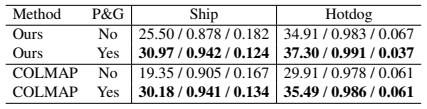
Table 4 . The quantitative results (PSNR / SSIM / LPIPSVgg ) of the Ship and Hotdog scene with or without point pruning and growing (P&G). The improvements are significant when using either our generated points or the point cloud generated by COLMAP [44].
원문 · CC0 1.0 · Qiangeng Xu, Zexiang Xu, Julien Philip, Sai Bi, Zhixin Shu, Kalyan Sunkavalli, Ulrich Neumann · Point-NeRF: Point-based Neural Radiance Fields · 원문 그림 인용 · 원본 PDF 8쪽에서 그림 영역을 추출했습니다.DTU와 NeRF Synthetic에서의 검증
DTU 테스트 세트에서 저자들은 네트워크 직접 추론과 장면별 미세 조정을 비교합니다. 10K 반복 미세 조정에서 PSNR은 30.12, SSIM은 0.957, LPIPS(VGG)는 0.117로 보고되며, 이 결과는 IBRNet의 10K 결과와 비교되어 SSIM과 LPIPS에서 우위를 보입니다. 저자들은 IBRNet이 PSNR에서는 더 높다는 점을 함께 밝힙니다. NeRF Synthetic에서는 20K 반복이 NeRF 200K 결과와 비슷한 수준에 이르고, 200K 반복 결과는 PSNR 33.31, SSIM 0.978, LPIPS(VGG) 0.049로 보고됩니다. 이 수치들은 원문 표의 해당 조건에서만 읽어야 합니다.

Table 1 . Comparisons of our Point-NeRF with radiance-based models [29, 32, 53] and a point-based rendering model [2] on the DTU dataset [18] with the novel view synthesis setting introduced in [8]. The subscripts indicate the number of iterations during optimization.
원문 · CC0 1.0 · Qiangeng Xu, Zexiang Xu, Julien Philip, Sai Bi, Zhixin Shu, Kalyan Sunkavalli, Ulrich Neumann · Point-NeRF: Point-based Neural Radiance Fields · 원문 그림 인용 · 원본 PDF 7쪽에서 그림 영역을 추출했습니다.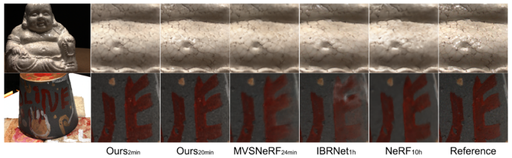
Figure 6 . Qualitative comparisons of per-scene optimization on the DTU dataset [18]. Our Point-NeRF can recover texture details and geometrical structures more accurately than other methods. Point-NeRF also demonstrates superior efficiency. Within two mins, our model trained for 1K steps is already on par with the state-of-the-art methods such as MVSNeRF [8] and IBRNet [53]
원문 · CC0 1.0 · Qiangeng Xu, Zexiang Xu, Julien Philip, Sai Bi, Zhixin Shu, Kalyan Sunkavalli, Ulrich Neumann · Point-NeRF: Point-based Neural Radiance Fields · 원문 그림 인용 · 원본 PDF 9쪽에서 그림 영역을 추출했습니다.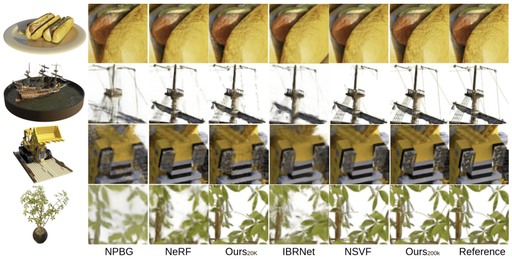
Figure 7 . Qualitative comparisons on the NeRF Synthetic dataset [35]. The subscripts indicate the number of iterations. Our Point-NeRF can capture fine details and thin structures (see the rope on row 2). Point-NeRF also demonstrates superior efficiency. Our model trained for 20K steps already on par with NeRF with 30× faster training time.
원문 · CC0 1.0 · Qiangeng Xu, Zexiang Xu, Julien Philip, Sai Bi, Zhixin Shu, Kalyan Sunkavalli, Ulrich Neumann · Point-NeRF: Point-based Neural Radiance Fields · 원문 그림 인용 · 원본 PDF 9쪽에서 그림 영역을 추출했습니다.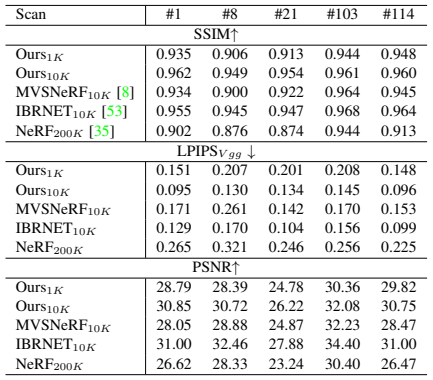
Table 6 . Quantity comparison on five sample scenes in the DTU testing set with the view synthesis setting introduced in [8]. The subscripts indicate the number of iterations during optimization.
원문 · CC0 1.0 · Qiangeng Xu, Zexiang Xu, Julien Philip, Sai Bi, Zhixin Shu, Kalyan Sunkavalli, Ulrich Neumann · Point-NeRF: Point-based Neural Radiance Fields · 원문 그림 인용 · 원본 PDF 12쪽에서 그림 영역을 추출했습니다.적용 범위와 한계
Point-NeRF는 로컬 radiance 표현이므로, 추가적인 배경 NeRF 같은 구성 요소 없이는 unbounded scene의 배경을 처리하지 못한다고 원문에 명시되어 있습니다. ScanNet 실험에서 저자들은 깊이 이미지로 점 구름을 초기화했다고 밝히며, 이는 NSVF가 같은 설정을 사용했기 때문이라고 설명합니다. 또한 MVSNet 점은 배경의 이상치를 줄이기 위해 데이터셋별 필터링을 거칩니다. 렌더링 속도 자체는 본 연구의 주된 최적화 대상이 아니며, 원문은 NeRF보다 빠르다는 점을 빈 공간 샘플링 생략에 따른 결과로 설명합니다.

Table 8 . Quantity comparison on two scenes in the ScanNet dataset [11] selected in NSVF [29]. RMSE is the Root Mean Square Error. Our method Point-NeRF outperforms all state-of-the-art methods in all metrics by substantial margins. We also report the (original/calibrated) SSIM. Our original SSIM uses the Skimage library with dynamic max signal value while several current papers use SSIM with as 1, therefore we also calibrate to their settings. Besides, per other authors’ requests, we also add our method starting with the mesh instead of depth images, and report its results after 100K steps. Since the mesh of Scene 101 is extremely incomplete, we can observe tremendous quality loss.
원문 · CC0 1.0 · Qiangeng Xu, Zexiang Xu, Julien Philip, Sai Bi, Zhixin Shu, Kalyan Sunkavalli, Ulrich Neumann · Point-NeRF: Point-based Neural Radiance Fields · 원문 그림 인용 · 원본 PDF 13쪽에서 그림 영역을 추출했습니다.
Table 10 . We use MVSNet [59] to reconstruct the points and filter them by using background color, then initialize neural points and optimized our Point-NeRF model for 200 thousand iterations.
원문 · CC0 1.0 · Qiangeng Xu, Zexiang Xu, Julien Philip, Sai Bi, Zhixin Shu, Kalyan Sunkavalli, Ulrich Neumann · Point-NeRF: Point-based Neural Radiance Fields · 원문 그림 인용 · 원본 PDF 17쪽에서 그림 영역을 추출했습니다.논문 정보
- 저자
- Qiangeng Xu, Zexiang Xu, Julien Philip, Sai Bi, Zhixin Shu, Kalyan Sunkavalli, Ulrich Neumann
- 학회·저널
- arXiv · 프리프린트
- 최초 공개일
- 2022년 1월 21일
- 등록일
- 2026년 11월 5일
- 수정일
- 2023년 3월 15일
- 버전
- v7
- arXiv
- 2201.08845
- 분류
- cs.CV
- 원문 이용 조건
- CC0 1.0
- 제공 범위
- 논문 정보, 해설, 허용된 원문 그림
AI 해설은 논문 원문과 별개의 설명이며 오류가 있을 수 있습니다. 원문과 그림은 각 출처의 이용 조건과 따로 표시된 권리를 따릅니다.
초록
Volumetric neural rendering methods like NeRF generate high-quality view synthesis results but are optimized per-scene leading to prohibitive reconstruction time. On the other hand, deep multi-view stereo methods can quickly reconstruct scene geometry via direct network inference. Point-NeRF combines the advantages of these two approaches by using neural 3D point clouds, with associated neural features, to model a radiance field. Point-NeRF can be rendered efficiently by aggregating neural point features near scene surfaces, in a ray marching-based rendering pipeline. Moreover, Point-NeRF can be initialized via direct inference of a pre-trained deep network to produce a neural point cloud; this point cloud can be finetuned to surpass the visual quality of NeRF with 30X faster training time. Point-NeRF can be combined with other 3D reconstruction methods and handles the errors and outliers in such methods via a novel pruning and growing mechanism. The experiments on the DTU, the NeRF Synthetics , the ScanNet and the Tanks and Temples datasets demonstrate Point-NeRF can surpass the existing methods and achieve the state-of-the-art results.
원문 인용
Qiangeng Xu, Zexiang Xu, Julien Philip, Sai Bi, Zhixin Shu, Kalyan Sunkavalli, Ulrich Neumann (2022). Point-NeRF: Point-based Neural Radiance Fields. arXiv:2201.08845v7. https://arxiv.org/abs/2201.08845v7
BibTeX
@misc{xu2022point,
  title = {{Point-NeRF: Point-based Neural Radiance Fields}},
  author = {Qiangeng Xu and Zexiang Xu and Julien Philip and Sai Bi and Zhixin Shu and Kalyan Sunkavalli and Ulrich Neumann},
  year = {2022},
  eprint = {2201.08845},
  archivePrefix = {arXiv},
  url = {https://arxiv.org/abs/2201.08845v7}
}