論文解説
CLUE: A Chinese Language Understanding Evaluation Benchmark
CLUE:中国語言語理解評価ベンチマーク
- 課題 英語中心のNLUベンチマークの空白を埋めるため、9つの中国語タスク、大規模な事前学習コーパス、言語学者が作成した診断データセットをあわせて提示します。
- 手法 CLUEは単一文分類、文ペア分類、機械読解のタスクをまとめ、複数の事前学習Transformerをベースラインとして、タスクごとにファインチューニングして比較します。
- 結果 RoBERTa-wwm-ext-largeが平均74.90で最も高いベースラインモデルですが、人間の平均85.09には届いていません。診断データセットでは、最高精度が約61%です。
英語中心ベンチマークの限界と中国語NLU評価の空白
GLUEやSuperGLUEのような英語の自然言語理解ベンチマークは、複数のタスクを一つの評価体系にまとめ、モデルを比較できるようにしました。しかし、こうしたベンチマークの大半は英語に限られており、他の言語で同等の評価体系を作るのは難しいです。CLUEは、この空白を中国語で埋めるために提案されたベンチマークです。論文は、中国語話者が世界人口の約4分の1を占めること、そして中国語が英語や他のインド・ヨーロッパ語と言語学的に大きく異なることを挙げ、中国語専用の評価が必要だと主張しています。
この論文は、評価タスクの集合だけを扱っているわけではありません。事前学習に使う大規模な中国語コーパス、言語学者が作成した診断データセット、リーダーボードとツール群も併せて提示しています。したがって、問題の範囲は、タスク選定、事前学習リソース、診断評価を含む中国語NLU評価の基盤です。
タスク選定の基準と9つのタスク構成
CLUEは9つの中国語自然言語理解タスクで構成されます。タスクの選定は、多様性、適切な難易度、代表性、中国語固有の現象の反映を基準にしました。単一文分類タスクにはTNEWSとIFLYTEKがあり、文ペアタスクにはAFQMC、CSL、OCNLIがあり、機械読解タスクにはCMRC 2018、ChID、C3があります。CLUEWSC2020とCSLは、論文で新たに作成したタスクとして紹介されています。
TNEWSはニュースの見出しを15のカテゴリに分類し、IFLYTEKはアプリの説明を119のカテゴリに分類します。CSLは、論文の要旨とキーワードが与えられたとき、キーワードがすべて元のキーワードかどうかを判定するタスクです。偽のキーワードはtf-idfで生成します。この詳細な構成は、論文の表1とその説明に基づくものです。
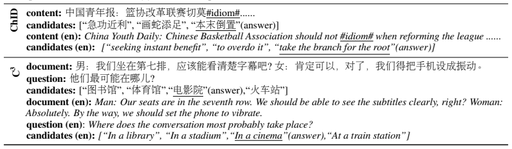
Table 5 : Development set examples from the tasks in CLUE. Bold text represents part of the example format for each task. Chinese text is part of the model input, and the corresponding text in italics is the English version translated from that. Underlined text is specially marked in the input. Text in a monospaced font represents the expected model output.
出典 · CC0 1.0 · 元のPDFの14ページ目から図の部分を抽出しています。事前学習コーパスと診断データセット
事前学習コーパスは、CLUECorpus2020-small、CLUECorpus2020、CLUEOSCARの3つの部分を合わせたもので、合計214 GBの生テキスト、約76 billionの中国語単語規模です。論文によると、このコーパスで2つのALBERTモデルとRoBERTa-largeが事前学習されました。
診断データセットは、中国語の言語学者が直接作成した514の文ペアで構成され、9つの言語現象カテゴリに分かれています。このデータセットは英語の診断データを翻訳したものではなく、最初から中国語で作成されました。評価は自然言語推論の形式で行われ、モデルはOCNLIでファインチューニングしたのち、診断データセットでテストされます。
ベースラインモデルのファインチューニングと性能比較
ベースラインモデルは、複数の事前学習Transformerの上にタスクごとの出力層を追加して、ファインチューニングされます。単一文タスクでは、文をエンコードした後、プーリングされた出力を分類器に渡します。文ペアタスクでは、区切り記号で2文をまとめてエンコードします。機械読解で抽出型のタスクは開始位置と終了位置を予測し、多肢選択型のタスクは候補の文脈ペアを共有分類器でスコア化します。
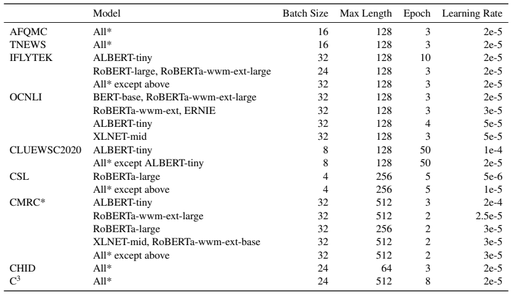
Table 7 : Parameters for fine-tuning. CMRC* presents for CMRC dataset in 2018. All* means ALBERT- tiny, BERT-base, BERT-wwm-ext-base, ERNIE-base, RoBERTa-large, XLNet-mid, RoBERTa-wwm-ext- base and RoBERTa-wwm-ext-large namely. It should be noted that RoBERTa-large is pre-trained with 256 sequence length, which is shorter than 512 length pre-trained for others. So we individually limit the length of RoBERTa-large to 256 for CMRC*, and use the striding text span to relieve this problem. However, this drawback of RoBERTa-large may decrease performances of some datasets whose length can not be effectively cut down, such as C3.
出典 · CC0 1.0 · 元のPDFの15ページ目から図の部分を抽出しています。評価対象には、BERT-base、BERT-wwm-ext-base、ALBERT-tiny、ALBERT-xxlarge、ERNIE-base、XLNet-mid、RoBERTa-large、RoBERTa-wwm-ext-base、RoBERTa-wwm-ext-largeが含まれます。各タスクでは3回ファインチューニングしたあと、開発セットで最も良いモデルを選び、テスト結果を報告しました。CMRC 2018はEMを、残りのタスクは精度を報告しています。結果の表では、RoBERTa-wwm-ext-largeが平均74.90を記録し、人間の平均は85.09です。RoBERTa-wwm-ext-largeとALBERT-xxlargeは、論文で最も優れた2つのモデルとして報告されています。
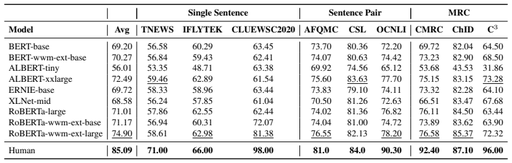
Table 2 : Performance of baseline models on CLUE benchmark. Avg is the average of all tasks. Bold text denotes the best result in each column. Underline indicates the best result for the models. We report EM for CMRC 2018 and accuracy for all other tasks.
出典 · CC0 1.0 · 元のPDFの6ページ目から図の部分を抽出しています。人間の性能とモデルの性能の差
人間の性能は、OCNLI、CMRC 2018、ChID、C3については既存研究が提供した値を使いました。それ以外のタスクでは、アノテーターがテストデータ100件にラベルを付け、多数決の結果を正解と比較しました。アノテーターは、開発セット30件を元にした50のサンプルで訓練を受けました。
結果として、ほとんどのタスクは人間にとって比較的簡単でしたが、TNEWSとIFLYTEKはカテゴリ数が多いため、人間にとっても難しいものでした。最高性能のモデルの平均は、人間の平均より約11ポイント低いと報告されています。著者らは、この差は、モデルと手法をさらに改善する余地が大きいことを意味すると解釈しています。
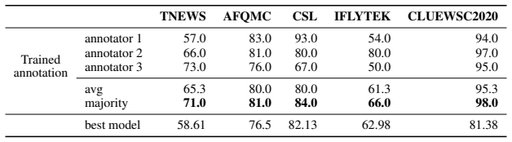
Table 3 : Two-stage human performance scores and the best accuracy of models comparison. “avg” denotes the mean score from the three annotators. “majority” shows the performance if we take the majority vote from the labels given by the annotators. Bold text denotes the best result among human and model performance.
出典 · CC0 1.0 · 元のPDFの7ページ目から図の部分を抽出しています。診断データセットで明らかになった限界
診断データセットでは、BERT-base、XLNet-mid、RoBERTa-wwm-ext-largeをOCNLIでファインチューニングしたのち評価しました。最高精度は約61%と報告されており、全体の精度はBERT-baseが53.5、RoBERTa-wwm-ext-largeが61.5、XLNet-midが54.7です。著者らは、この結果が、モデルが言語学的に難しい問題を解くのに苦労していることを示していると解釈しています。
カテゴリ別では、単調性(monotonicity)が最も難しく、比較級の文でもBERTは苦戦しました。語彙意味カテゴリの一例では、2つの単語が先頭の文字だけ同じで、末尾の文字だけ異なる場合、3つのモデルのうち2つがその違いを無視する傾向を見せました。この診断結果は、診断データセットの9つのカテゴリと3つのモデルに限った観察です。
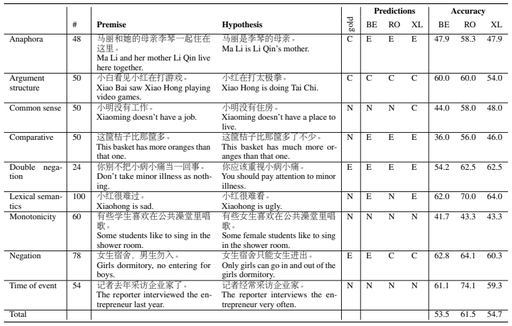
Table 4 : The CLUE diagnostics: Example test items in 9 linguistic categories, with their gold labels and model predictions, as well as model accuracy. E = entailment, N = neutral, C = contradiction. BE = BERT-base, RO = RoBERTa-wwm-ext-large, XL = XLNet-mid.
出典 · CC0 1.0 · 元のPDFの9ページ目から図の部分を抽出しています。結論の適用範囲と残る問い
論文の結論は、CLUEが中国語NLUのための包括的なベンチマークであることと、現在の最新モデルが一部の中国語言語現象を十分に扱えていないことにあります。著者らは、英語のベンチマークではモデルの性能が人間の性能に近づいたものの、CLUEではモデルが人間の推定値より約10%低いと述べています。
ただし、この結果は、CLUEの現在のタスク、指定されたベースラインモデル、提示された設定でのものです。診断データセットは514の文ペアで構成されているため、中国語の言語現象全体を代表しているとは言えません。モデルサイズと性能の関係のような評価方法の拡張は、論文で今後の課題として示されています。
論文情報
- 著者
- Liang Xu, Hai Hu, Xuanwei Zhang, Lu Li, Chenjie Cao, Yudong Li, Yechen Xu, Kai Sun, Dian Yu, Cong Yu, Yin Tian, Qianqian Dong, Weitang Liu, Bo Shi, Yiming Cui, Junyi Li, Jun Zeng, Rongzhao Wang, Weijian Xie, Yanting Li, Yina Patterson, Zuoyu Tian, Yiwen Zhang, He Zhou, Shaoweihua Liu, Zhe Zhao, Qipeng Zhao, Cong Yue, Xinrui Zhang, Zhengliang Yang, Kyle Richardson, Zhenzhong Lan
- 学会・ジャーナル
- arXiv · プレプリント
- 公開日
- 2020年4月13日
- 登録日
- 2026年11月5日
- 更新日
- 2020年11月5日
- バージョン
- v3
- arXiv
- 2004.05986
- カテゴリ
- cs.CL · cs.LG
- ライセンス
- CC0 1.0
- 掲載内容
- 論文情報・解説・論文の図
この解説は、Refivuの韓国語解説をAIで翻訳したものです。不正確な翻訳や誤りが含まれる可能性があります。論文と図の利用条件は各出典に従います。
アブストラクト
The advent of natural language understanding (NLU) benchmarks for English, such as GLUE and SuperGLUE allows new NLU models to be evaluated across a diverse set of tasks. These comprehensive benchmarks have facilitated a broad range of research and applications in natural language processing (NLP). The problem, however, is that most such benchmarks are limited to English, which has made it difficult to replicate many of the successes in English NLU for other languages. To help remedy this issue, we introduce the first large-scale Chinese Language Understanding Evaluation (CLUE) benchmark. CLUE is an open-ended, community-driven project that brings together 9 tasks spanning several well-established single-sentence/sentence-pair classification tasks, as well as machine reading comprehension, all on original Chinese text. To establish results on these tasks, we report scores using an exhaustive set of current state-of-the-art pre-trained Chinese models (9 in total). We also introduce a number of supplementary datasets and additional tools to help facilitate further progress on Chinese NLU. Our benchmark is released at https://www.CLUEbenchmarks.com
この論文を引用
Liang Xu, Hai Hu, Xuanwei Zhang, Lu Li, Chenjie Cao, Yudong Li, Yechen Xu, Kai Sun, Dian Yu, Cong Yu, Yin Tian, Qianqian Dong, Weitang Liu, Bo Shi, Yiming Cui, Junyi Li, Jun Zeng, Rongzhao Wang, Weijian Xie, Yanting Li et al. (2020). CLUE: A Chinese Language Understanding Evaluation Benchmark. arXiv:2004.05986v3. https://arxiv.org/abs/2004.05986v3
BibTeX
@misc{xu2020clue,
  title = {{CLUE: A Chinese Language Understanding Evaluation Benchmark}},
  author = {Liang Xu and Hai Hu and Xuanwei Zhang and Lu Li and Chenjie Cao and Yudong Li and Yechen Xu and Kai Sun and Dian Yu and Cong Yu and Yin Tian and Qianqian Dong and Weitang Liu and Bo Shi and Yiming Cui and Junyi Li and Jun Zeng and Rongzhao Wang and Weijian Xie and Yanting Li and Yina Patterson and Zuoyu Tian and Yiwen Zhang and He Zhou and Shaoweihua Liu and Zhe Zhao and Qipeng Zhao and Cong Yue and Xinrui Zhang and Zhengliang Yang and Kyle Richardson and Zhenzhong Lan},
  year = {2020},
  eprint = {2004.05986},
  archivePrefix = {arXiv},
  url = {https://arxiv.org/abs/2004.05986v3}
}