Paper commentary
Explicitly capturing demonstrator multi-modality for distillation into diffusion policies
Vine sampling lets diffusion policies keep the demonstrator's multi-modal actions
- Problem Standard behavior cloning slides a window over demonstrations, so each observation gets only one recorded action. Diffusion policies trained on this sparse data memorize that one action and lose the demonstrator's diversity.
- Method Vine sampling queries the demonstrator several times from the same visited state, storing k actions per observation. Unlike the sliding window, which keeps only the one path taken, this records the alternatives the demonstrator could have chosen.
- Results On a synthetic task, larger k gives a policy that better matches the demonstrator's conditional distribution, including its multi-modality. On a 2D truck unloading task, the vine policy is closer to the demonstrator and improves best-of-N and expert iteration performance.
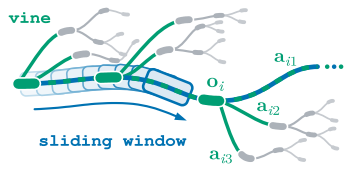
Fig. 2 : The choices that a demonstrator has the capac- ity to take branch along an episode. Sliding window datasets record one action per observation history, while vine datasets record several counterfactual actions at a random subset of observation histories. Gray actions are recorded in neither dataset.
Original paper · CC BY 4.0 · Shao Yuan Chew Chia, Rebecca H. Jiang, Abhinav Agarwal, Andreas Hofmann, Leslie Pack Kaelbling, Russ Tedrake · Explicitly capturing demonstrator multi-modality for distillation into diffusion policies · Original paper figure · Extracted the figure area from page 2 of the original PDF.Why sliding-window data hides the demonstrator's modes
Behavior cloning usually slides a window over each demonstration episode and pairs every observation history with the actions that follow. Each episode records only the one path the demonstrator happened to take, so the alternatives it could have chosen at the same point go unrecorded. The counterfactual actions the demonstrator could have taken at each decision point are absent from the dataset, even though it is stochastic.
Real observations are high dimensional and continuous, and reached states are stochastic, so other episodes rarely repeat an exact observation history. Because the demonstrator's multi-modality is never stored explicitly, the dataset cannot show the policy more than one mode per observation.
Diffusion policies in the sparse-data regime behave like retrieval over their training set, which is why low diversity is the expected outcome.
The same sparse dataset can be fit by a multi-modal policy or by a unimodal policy with a high Lipschitz constant. Some architectures may generalize from nearby observations with different action modes, but the dataset itself stays ambiguous. The authors therefore set out to disambiguate the dataset rather than change the architecture. Prior work reports that Pan et al.
attribute the absence of multi-modality in standard BC policies to data sparsity, since the same policies fit both modes when data are dense.
Vine sampling: several actions from one visited state
Vine sampling changes the dataset by querying the demonstrator several times from one visited state, so that state carries several actions. The paper adapts the vine procedure of Schulman et al., which branches policy rollouts to estimate advantages, and uses the demonstrator's branched actions as behavior cloning training data instead. The sliding window instead pairs each observation history with only the one path the demonstrator took.
Each timestep, with probability p, the expert is queried k times from the current state. The environment is reset between queries whenever an action modifies the state, so every query starts from the same observation. The episode then continues by advancing one replanned action, so the rollout itself still follows a single path. Only these states enter the dataset, and each carries exactly k actions.
Each stored entry groups the observation with its k actions, matching the grouped dataset form used in the analysis.
The sliding window does not capture these counterfactual actions, so the vine dataset is sparser in conditioning space at matched size. It only queries the demonstrator at states the episode actually visits, which suits real-world collection when resets aren't possible.
What more actions per condition does in the synthetic task
The synthetic demonstrator has one informative observation coordinate z and a primary action coordinate y that must fall in one of four intervals shifted by z. The authors sweep k over 1, 10 and 100 at a fixed budget of n·k = 1000, so the number of conditions n falls from 1000 to 10. Each metric is computed from 1000 policy draws per condition, then averaged over conditions.
Because the residual distribution is a mixture of four equally weighted valid modes, a k = 1 dataset stores only one of them at each condition.
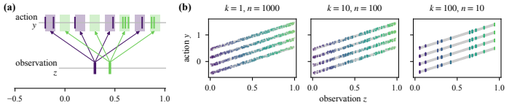
Fig. 3 : (a) Coordinate y of the synthetic task at two observations, with k = 5 actions sampled at each; arrows run from each observation to its four valid modes. (b) Visualization of synthetic datasets with fixed total dataset size n · k = 1000, but varied numbers of observations n, and actions per observations k; gray diagonals show the valid modes of the task. At fixed dataset size, more actions per condition comes at the cost of sparsity in z.
Original paper · CC BY 4.0All three policies memorize, since their draws retrieve nearby training actions while fresh demonstrator draws almost never do. What changes with k is how well the stored actions represent the demonstrator, which the data-collection sampling error (B) on y captures. The data-collection sampling error (B) on y falls as k rises, so the dataset better represents the demonstrator's conditional distribution.
The memorization error (A) stays small at every k, so the policy error closely tracks (B) and falls with it.
The conditional behavior entropy rises from 0 at k = 1 to 1 at k = 100, while the off-support mass is similar across k values. Mode recall@N is substantially higher at larger k. At k = 1, raising N from 10 to 100 barely moves recall, so more inference-time sampling doesn't recover the missing modes. The SD ratio of the k = 10 and k = 100 policies also matches the demonstrator much more closely than the k = 1 policy does.
At held-out conditions, the k = 10 and k = 100 policies keep favorable policy error, entropy, mode recall and SD ratio at every distance d. The k = 1 policy stays a point mass at every distance, while the larger-k policies gradually lose their four-mode structure. Its retrieval there is near zero, so it reaches low policy error by generalizing across conditions rather than by memorizing.
Truck unloading: search and expert iteration
Success requires removing all boxes before the 80s timeout, and the authors also track throughput in pieces per hour. Both methods collect from the same 2,000 problem instances, and their datasets are truncated to 370,000 training samples.
The authors evaluate policies on test-time best-of-N search and on expert iteration, where best-of-N replaces Monte-Carlo Tree Search. They report N = 10 and N = 100 along with the raw policy, which executes predicted actions without search. Policy error and SD ratio are computed at 507 states, each compared against a reference set of 100 draws.
Vine shows superior policy error and SD ratio, which suggests it captures the demonstrator's distribution better than the alternatives. Under best-of-N search, vine yields high success rates and throughput. Its throughput therefore changes little, and the authors attribute this to limited diversity.
Early stopping at the 20k checkpoint raises the SD ratio, but it doesn't mimic the demonstrator's choices as well as vine. More search at N = 100 raises success rate and throughput, yet it stays far from vine. A collapsed distribution gives repeated sampling little coverage to recover. SIME approaches vine's success rate under search but falls short on throughput.
Its noise uses σ = 4, the operating point where the SD ratio is closest to one. PostBC raises the SD ratio and lowers policy error only slightly relative to the sliding window policy. Its raw policy succeeds far less often, because it doesn't add the demonstrator's counterfactual actions. Over expert iteration, vine improves success rate and throughput, although success rate falls slightly at later iterations.
The authors attribute that dip to imperfect distillation and diminishing diversity, since only the base policy uses vine sampling.
Limits of the evidence
The vine results come only from simulation, so the authors could evaluate every method on the same problem instances. Hardware was ruled out for this comparison because the study would be costly at that scale. Best-of-N search and expert iteration also use the simulator to score candidate actions. When the demonstrator doesn't change the world on query, vine sampling needs no environment reset and can run on hardware.
The re-queried plans in that case are never executed, so their quality isn't verified.
The algorithm, as written, requires that the demonstrator can be queried from any visited state s. That change amounts to adding a condition at line 6 of the algorithm.
Vine sampling costs more compute: collecting its dataset took 55 seconds per episode on a 96-core machine. The sliding-window dataset took 1.8 seconds per episode, roughly a 30-fold difference.
The authors leave open whether large robot foundation models operate in this regime, given their data scales and training recipes.
Paper info
- Authors
- Shao Yuan Chew Chia, Rebecca H. Jiang, Abhinav Agarwal, Andreas Hofmann, Leslie Pack Kaelbling, Russ Tedrake
- Venue
- arXiv · Preprint
- First published
- 2026-11-7
- Added
- 2026-11-10
- Updated
- 2026-11-7
- Version
- v1
- arXiv
- 2611.10949
- Category
- cs.RO
- Original paper terms
- CC BY 4.0
- What we show
- Paper info, commentary and permitted figures from the original paper
AI commentary is a separate explanation from the original paper and may contain errors. The original paper and figures follow each source's terms of use and any rights noted separately.
Abstract
The diversity of a distilled diffusion policy's outputs matters beyond how it impacts the policy's success rate. In particular, downstream applications like test-time search and policy improvement require exploration. Thus, we want to distill multi-modal demonstrators into diffusion policies which reproduce their conditional action distributions. Standard data collection for behavior cloning applies a sliding window to demonstration episodes, which pairs unique observation histories with actions. These datasets can be fit by a policy that is either multi-modal, or unimodal with high Lipschitz constant to capture a diversity of actions seen at nearby observation samples. Prior work finds that diffusion policies trained on sparse data learn the latter, memorizing one action per observation. We adapt vine sampling to behavior cloning data collection to resolve this ambiguity: at some states the demonstrator visits, query it $k$ times from exactly the same observation. On a synthetic task, we study how the number of actions per observation, $k$, affects the learned policy, and find that larger $k$ yields a policy that better matches the demonstrator's conditional distribution, including its multi-modality and diversity. On a 2D truck unloading task, vine sampling likewise leads to a policy closer to the demonstrator and substantially improves both best-of-$N$ and expert iteration performance.
Quote from the paper
Shao Yuan Chew Chia, Rebecca H. Jiang, Abhinav Agarwal, Andreas Hofmann, Leslie Pack Kaelbling, Russ Tedrake (2026). Explicitly capturing demonstrator multi-modality for distillation into diffusion policies. arXiv:2611.10949v1. https://arxiv.org/abs/2611.10949v1
BibTeX
@misc{chia2026explicitly,
  title = {{Explicitly capturing demonstrator multi-modality for distillation into diffusion policies}},
  author = {Shao Yuan Chew Chia and Rebecca H. Jiang and Abhinav Agarwal and Andreas Hofmann and Leslie Pack Kaelbling and Russ Tedrake},
  year = {2026},
  eprint = {2611.10949},
  archivePrefix = {arXiv},
  url = {https://arxiv.org/abs/2611.10949v1}
}