Paper commentary
A Sensitivity Framework for Assessing External Validity
A partial identification framework bounds how experimental results transfer to new sites
- Problem Experiments in a few sites rarely pin down how site-level factors change effects elsewhere. Internally valid findings can fail at new sites, and there are fewer sites than site-level variables.
- Method The authors keep every coefficient vector that fits the source sites and the chosen restrictions, and report the lowest and highest target effects as bounds.
- Results Under effect hierarchy, the Bosnia lower bound is 37.1, and the Morocco target needs more extrapolation.
Why a few source sites can't pin down a new site
Experiments run in particular places and times, and the setting where their evidence is used rarely matches the one where it was produced. When treatment effects depend on site-level factors such as institutions, program terms, or local economic conditions, an internally valid finding can fail outside its source sites.
The model is partially linear: site-level variables enter each potential-outcome mean through a linear term, while unit-level heterogeneity stays unrestricted. Each source site gives one mean per treatment arm, and subtracting the mean at site 1 leaves S minus 1 linear equations for each coefficient vector.
The target effect is identified only when the target's site-level difference from site 1 lies in the span of the source site differences. So the authors restrict the coefficients by substantive assumptions and keep every coefficient vector that fits the source means and those restrictions.
The authors ask how far the source trials can reach a new site whose lending environment differs from all of them. The resulting extreme target effects are the partial identification bounds, which the framework reports as an interval rather than a single answer.
Bounds instead of a single answer
The paper replaces a point prediction for the new site with the range of target effects that the source data allow. The model is partially linear: each potential outcome mean is an unrestricted function of unit-level covariates plus a linear term in site-level variables. Site-level coefficients are arm-specific, so the treatment effect depends on the difference between the two arms' coefficient vectors.
The authors keep every coefficient vector that reproduces the source means and satisfies the restrictions, forming a feasible set. The lowest and highest target effects over that set are the partial identification bounds.
A wide interval means substantial uncertainty remains under the stated restrictions. An unbounded endpoint means some extrapolations remain unrestricted by the analyst's choices. An empty feasible set means the restrictions contradict the source evidence.
A two-site toy example shows that the same source evidence can pin down the effect at one target and leave it open at another. A magnitude cap of M = 1 with ρ = 1.2 gives bounds of [τ0 + 0.2, τ0 + 1] at that target.
Relaxing a restriction can only widen the bounds, because it enlarges the feasible set. Tightening a restriction narrows the range, but it can eventually exclude every coefficient vector that fits the source evidence. Restrictions are added one at a time, so the authors can see what each one contributes to the bounds. With unit-level covariates, the same logic carries over after adjusting for X, and the bounds keep their meaning as limits on site-level effects.
Restrictions that limit the extrapolation
The analyst can choose from four families of parameter restrictions: magnitude caps, effect hierarchy, aggregate budgets, and sign or shape rules. A magnitude cap imposes a bound |βa,j| ≤ Mj on each coefficient for chosen constants Mj. In the microcredit application, each site-level variable is scaled by its standard deviation across source sites, so the cap limits the revenue change for a one-standard-deviation change in that term.
The cap is set to one standard deviation of the outcome, and the analyst can vary it to see how the target bounds respond.
Sign and shape rules encode subject-matter knowledge directly, for example a nonpositive direct APR coefficient in the treatment effect.
In that example ρ = 1.2 and M = 1, and the target bounds at (1,0) are [τ0 + 0.2, τ0 + 1].
Adjusting for unit-level covariates
Unit-level covariates X can shape each treatment arm's outcome without restriction, as long as that dependence stays the same across sites. The resulting matrix ΣC is the covariance of the site-level variables that remains after adjusting for X. Whenever the sources leave some directions unidentified, ΣC is singular, which is a property of the population rather than of the sample.
Sampling more units doesn't identify the missing directions, because the singularity comes from the number of observed sites. Substituting these solutions into the target effect splits it into an identified part and an external-validity uncertainty part along the kernel. Regressing each coordinate of C on X separately can add residual components outside the source-site span, which restores full rank in the sample.
Regression error then erases the population indeterminacy and can collapse the feasible set to a single coefficient vector.
The authors avoid this by keeping the fitted residuals inside the source-site span VC. Since C takes one of the values c1 to cS, its conditional mean is a weighted average of the same site profiles, so subtracting it leaves a vector in VC. The framework estimates the full vector of site probabilities with a joint classifier, so the fitted residuals stay in that span.
Keeping the residuals in the span prevents regression error from creating spurious point identification or infeasibility.
After adjustment for X, the restricted feasible set uses the residualized normal equations and the same restriction set R. The partial identification bounds are the extreme target effects over this set, and they reduce to the no-X programs when X is absent.
Preserving rank, then debiasing and pooling
The estimator starts by keeping the fitted site-level residuals inside the span of the source profiles, so the equality system keeps its population rank. The authors estimate the probability of each observed site given X with a joint classifier, then form the conditional mean of C as a weighted average of the observed site profiles. Because the fitted probabilities sum to one, both C and the fitted conditional mean are affine combinations of the source profiles.
Their difference therefore lies in VC exactly, whatever the classifier's estimation error. The reduced equalities use an orthonormal basis BC of VC, which removes the redundant rows while defining the same feasible coefficient vectors. Under the within-span eigenvalue condition in Assumption C, the matrix bΩ is invertible with probability approaching one.
A natural one-step approach optimizes within each fold first and corrects nuisance bias afterward. Nuisance error can make even one fold's constraints infeasible, which leaves no estimate to correct. The authors reverse this order: they debias the objective and source moments with cross-fitted residuals, pool the scores by observation, and solve one program.
The point estimate is the value of the pooled optimization, and it needs no further correction.
Redundant source equations admit multiple dual solutions, so the authors use the dual from the reduced system as the representative. That minimum-norm full dual has a unique population target under the regularity conditions, so the standard error doesn't depend on an arbitrary choice. The influence functions for the source and the target are evaluated at the cross-fitted nuisances, with each bound using its own optimizer and dual.
The authors test the pooling choice with a sign mismatch study across folds under effect hierarchy. A sign mismatch occurs when folds select different optimizing sign patterns for the lower or upper bound. The standard one-step correction withholds an interval when this mismatch happens, even if every fold's problem is feasible. Pooling the corrected inputs before optimizing removes this source of failure.
Sign mismatch at small sample sizes
The sign mismatch problem arises when folds pick different optimizing sign patterns for the direct coefficients, and the one-step correction then withholds an interval.
The authors chose a design where nonlinear nuisance functions are most likely to expose the problem. The bounds are made finite by a box |βa,j| ≤ 2.5 and effect hierarchy at κ = 1, which gives 64 linear programs.
The standard one-step correction has a sign mismatch probability of 0.89 at n = 500, 0.45 at n = 1,000, and 0.11 at n = 2,500. At n = 500, sign mismatch blocks one-step inference in 89 percent of 100 replications, while the pooled estimator permits inference in every replication.
Coverage for the one-step method is poor at the two smallest samples, but it rests on only 11 and 55 replications without mismatch. The gain is therefore one of feasibility rather than coverage, since coverage is similar once the folds agree. This design doesn't compare the methods under a single polyhedron.
Bosnia and Morocco under stacked restrictions
The authors hold out one of the seven microcredit countries at a time and treat the other six as source sites. To measure how far each target lies beyond the observed sites, they subtract the mean source-site profile from the target profile. The component of that difference outside the source-site span is 89% of its length for Morocco and 46% for Bosnia, so Morocco needs more extrapolation.
The authors stack three restrictions in a fixed order, starting from the magnitude cap as the baseline. The magnitude cap bounds the coefficient vector's sup-norm at one standard deviation of the outcome, with each basis column scaled by its source standard deviation. The APR sign restriction makes the APR coefficients in the treatment shift nonpositive, and it leaves the APR squared term and the control arm unrestricted.
The magnitude cap alone leaves both signs unresolved. The APR sign restriction narrows the Bosnia width by 8.9% and the Morocco width by 30.3%, but neither interval has a fixed sign at that step.
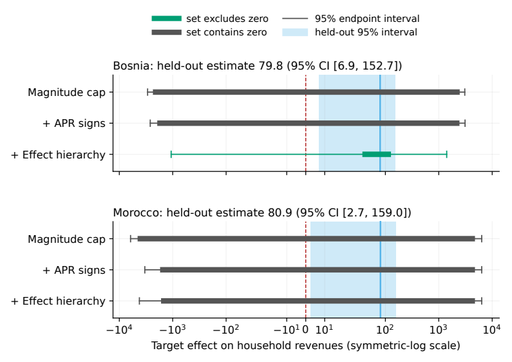
Figure 3 .Successive restrictions for Bosnia and Morocco. We first impose the magnitude cap. We then add the APR sign restriction. We add effect hierarchy last. We use thick bars for the outer identified intervals and thin lines for pointwise 95% intervals for the endpoints. The blue bands are the 95% intervals from the held-out experiments. The APR sign restriction narrows both intervals but does not determine either sign. Effect hierarchy then moves the Bosnia interval above zero. The Morocco sign remains unresolved.
Original paper · CC BY 4.0 · Ariel Boyarsky, Naoki Egami, Hongseok Namkoong · A Sensitivity Framework for Assessing External Validity · Original paper figure · Extracted the figure area from page 20 of the original PDF.Effect hierarchy is the decisive step for Bosnia. In Morocco, effect hierarchy trims the width by only 1.1% and leaves [-1653.1, 4763.4]. So the APR sign rule accounts for most of Morocco's limited reduction, and its sign stays open.
The positive Bosnia set doesn't establish a positive effect with statistical confidence. Across seven cross-fitting partitions, no coefficient vector is feasible in four of them. Morocco's interval contains zero in the same checks.
Does the Bosnia conclusion survive another reading of effect hierarchy
The Bosnia positive result depends on how effect hierarchy is written, and the authors compare two versions of the rule. Under the parent-specific version, the restriction applies only to interactions against their parent direct terms. For example, |βAPR×Loan| ≤ |βAPR| and |βAPR×Loan| ≤ |βLoan| are the only comparisons imposed. That version reduces the width by only 4.3%, and the sign remains unresolved.
The gap between the two versions comes from which comparisons are imposed. A parent-specific rule would skip this comparison, which is why it doesn't identify a sign.
Morocco behaves differently under the reported rule.
The authors also check whether the positive conclusion survives the cross-fitting partition. Across seven cross-fitting partitions, four had no coefficient vector satisfying both the pooled equations and the restrictions. These checks show the positive conclusion still carries substantial sampling uncertainty, and the outer 95% limits for Bosnia include zero.
The authors suggest a ladder of restrictions, added one at a time against a common baseline, to show each restriction's contribution.
Limits of the framework
The framework's main limit is its model: it assumes the additive response structure and doesn't test whether that structure holds. Adding terms to the site-level basis doesn't relax that exclusion. The sensitivity analysis measures the underidentification that remains under the additive model, and it can't assess violations of that model.
Choosing among treatments therefore requires a decision criterion from outside the framework, as in work on treatment choice under partial identification.
The empirical evidence rests on one leave-one-country-out design with six source sites. The simulation study covers one nonlinear design, with 100 replications at each sample size. They didn't test a single polyhedron design, so the comparison with the one-step correction doesn't isolate that case. Morocco's interval contains zero under the same checks, so the framework flags extrapolation there rather than a sign.
The Bosnia sign depends on the form of effect hierarchy, since the parent-specific version leaves the sign unresolved. Under the reported rule the Bosnia interval reaches 37.1 to 163.1 before the APR sign restriction, while the parent-specific rule cuts width by only 4.3%. Because the authors flag this sensitivity, a positive Bosnia conclusion should be read with that dependence in mind.
Open questions include how to build restrictions from data and how to account for the uncertainty in those restrictions.
Paper info
- Authors
- Ariel Boyarsky, Naoki Egami, Hongseok Namkoong
- Venue
- arXiv · Preprint
- First published
- 2026-11-12
- Added
- 2026-11-13
- Updated
- 2026-11-12
- Version
- v1
- arXiv
- 2611.16242
- Category
- stat.ME · econ.EM · stat.ML
- Original paper terms
- CC BY 4.0
- What we show
- Paper info, commentary and permitted figures from the original paper
AI commentary is a separate explanation from the original paper and may contain errors. The original paper and figures follow each source's terms of use and any rights noted separately.
Abstract
Assessing the external validity of experimental results is a pervasive challenge in causal inference as internally valid findings need not generalize beyond sites in which the experiments were conducted. Since the number of sites is often smaller than the number of site-level variables that moderate causal effects, we develop a partial identification framework that lets practitioners assess external validity under a wide range of assumptions that allow extrapolation across site-level variables. Our optimization-driven approach can accommodate any affine family of parameter restrictions, such as interaction terms being dominated by direct effects (the "effect hierarchy principle"). Since standard estimating-equation arguments do not apply in our setting---underspecified parameter directions responsible for partial identification make the covariance matrix singular---we develop a novel debiasing approach for estimands given by constrained optimization problems, giving rise to semiparametrically efficient estimators for our flexible partial identification bounds. We illustrate our approach on multi-site microcredit experiments harmonized by Meager (2019), whose lending environments differ widely in interest rates, loan sizes, and promotion. Holding out one country at a time, we construct external-validity intervals for the held-out country from the remaining source sites and show how our framework connects different extrapolation assumptions to concrete partial identification bounds.
Quote from the paper
Ariel Boyarsky, Naoki Egami, Hongseok Namkoong (2026). A Sensitivity Framework for Assessing External Validity. arXiv:2611.16242v1. https://arxiv.org/abs/2611.16242v1
BibTeX
@misc{boyarsky2026sensitivity,
  title = {{A Sensitivity Framework for Assessing External Validity}},
  author = {Ariel Boyarsky and Naoki Egami and Hongseok Namkoong},
  year = {2026},
  eprint = {2611.16242},
  archivePrefix = {arXiv},
  url = {https://arxiv.org/abs/2611.16242v1}
}