Paper commentary
Small Heads, Strong Decisions: A Controlled Study of Typed-Decision Models
A simple cosine head matches heavier readouts for typed-decision models
- Problem Typed-decision models differ in backbone, data and recipe, so it is unclear which design choices matter.
- Method The cosine head projects the question and each option to vectors, then scores each option by its scaled cosine similarity to the question. Only options of the same question compete.
- Results On Qwen3-0.6B, the 0.5M-parameter cosine head matched the 27M-parameter joint schema head in-domain at half its inference time.
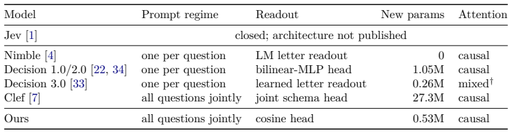
Table 1 : Typed-decision architectures. “New params” counts the readout’s new parameters in our port at hidden sizeH=1024(Qwen3-0.6B), excluding LoRA adapters.
Original paper · CC BY 4.0 · Ritvik Rastogi · Small Heads, Strong Decisions: A Controlled Study of Typed-Decision Models · Original paper figure · Extracted the figure area from page 3 of the original PDF.Why typed-decision designs are hard to compare
Typed-decision models read a state and return a probability distribution over each typed question's options, without generating text. Jev is closed, but several open models have followed, including Nimble, the Decision 1.0 to 3.0 family and Clef. These models differ along two axes, the prompt regime and the readout.
Each head gets its own learning-rate sweep, so the comparison isolates the readout itself. The sweep picks 10−3 for the cosine head, 3× 10⁻⁴ for the joint schema head, 3× 10⁻³ for the bilinear-MLP head and 10−4 for the learned letter readout. The LM letter readout has no head parameters, so it isn't swept.
The main question is whether a more complex head changes in-domain accuracy. On Qwen3-0.6B, every readout reaches 81.3–82.0% in-domain accuracy. The second question is whether one prompt for all questions matches one prompt per question. The authors also run the backbone and training-length checks on the same recipe, with two epochs for backbones up to 4B.
Each run uses one NVIDIA H100 80GB GPU, and the evaluation reports accuracy, ECE and NLL after calibration. Held-out sources are kept separate from the 15 training sources, so the study can separate in-domain fit from transfer.
The cosine head: one logit per option from a normalised cosine
The cosine head lets the backbone do the reading and leaves the head to compare a question's vector with each option's vector. The head reads one hidden state per span: the question span's last token and each option span's last token. Two linear projections without bias map these vectors into a shared width of W = 256, and each projected vector passes through an RMS norm.
Each option's logit is the learned scale times the dot product of its own question's normalised vector and its normalised option vector, divided by W. Only the options of the same question are compared, so the head never mixes information across questions.
The RMS norm rescales each W-dimensional vector to norm √W before its learned per-dimension gain is applied. While the gains are 1, the dot product divided by W is exactly the cosine of the two projected vectors. Normalising after the projections stops vector length from acting as a hidden temperature, which would otherwise grow with activations or span length.
The scale s is a learned scalar initialised to 10 and capped at 100, as in CLIP. Unused option slots get a logit of minus 10 to the power 4 when questions are stacked, so they receive no probability.
The head has 525,825 parameters at hidden size H = 1024 for Qwen3-0.6B, and almost all of them sit in the two projections. The joint schema head on the same backbone has 27.3M parameters, which makes the cosine head a small fraction of that size. The head is trained with the same soft cross-entropy loss as every other model, with LoRA adapters on the backbone.
How one row runs through the joint prompt
The state, every question and every option sit in one chat prompt built from a fixed system instruction and a user turn. Choice options are sorted by id, and a score question lists its rubric levels in order, so the same order sets both logits and targets.
The state comes first, so every question and option token attends to it. The cosine head still scores each question's options independently, even though the backbone links the questions. When a row is too long, only the end of the state is cut, and the schema is kept whole.
During training the backbone's weights stay frozen while LoRA adapters of rank 32 and alpha 64 train on every attention and MLP projection. The loss is a soft cross-entropy between each question's gold distribution and its prediction, averaged over questions rather than rows. The LoRA learning rate is 2 times 10 to the power minus 4, and the cosine head's rate of 10 to the power minus 3 came from a sweep.
Gradient clipping to a global norm of 1 and a warm-up over the first 5% of steps keep the optimiser stable. Sorting rows by length and splitting them into micro-batches of four avoids most padding, and the accumulated gradient equals the full batch gradient.
After training, a head temperature and per-type relative temperatures are fitted on held-out calibration rows. Accuracy is therefore unaffected by calibration, so the authors report ECE and NLL before and after it.
Does head size change accuracy on the joint prompt
On Qwen3-0.6B with the joint prompt, all five readouts land between 81.3% and 82.0% in-domain accuracy. The learned letter readout is 0.61 points lower, with an interval of [-0.85, -0.35] that falls outside the one-point margin.
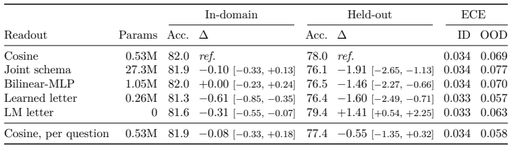
Table 3 : Every readout on Qwen3-0.6B. The cosine head pools both the question and each option by their last token (other poolings: table 6). Accuracy (%) is the unweighted mean over the 15 in-domain sources and over the 5 held-out sources.∆is the paired difference from the cosine head on the same questions, with a 95% bootstrap interval that resamples whole rows (test-set noise only, not seed noise). ECE is after calibration, averaged over sources. All rows use the joint prompt except the last, which gives every question its own prompt with the same cosine head and pooling.
Original paper · CC BY 4.0On the five held-out sources, the joint schema head trails the cosine head by 1.91 points, mostly on AG News and DBpedia. The LM letter readout leads the held-out sources by 1.41 points, and that lead comes from Belebele, with a gain of +9.8 points. Its Belebele lead is the only held-out gap the authors call significant, and they find no other held-out source where it is ahead.
So the held-out gaps reflect individual sources more than a general advantage for one readout. Changing the prompt regime from one prompt per row to one prompt per question leaves in-domain accuracy essentially unchanged.
What one joint prompt saves
The cosine head trains in 6.9 GPU-hours per run and infers at 6.4 ms per row under its own joint prompt. The three per-question readouts take 17.4 to 17.8 GPU-hours and 9.4 to 9.9 ms per row in their native regime. The joint schema head takes 8.7 GPU-hours and 13.6 ms per row, because Clef also encodes the state and all its questions once.
Each design is charged in its own prompt regime, so the per-question costs reflect how those designs were built to run.
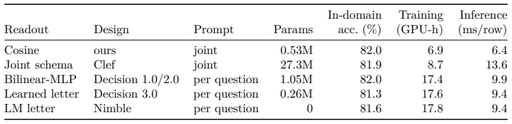
Table 4 : Accuracy and cost of the five readouts on Qwen3-0.6B. Each readout’s cost is charged in its design’s prompt regime: one joint prompt per row, or one sequence per question. Training is the GPU-hours of one run (8,594 steps of 32 rows) on one idle H100, from the median step time. Inference is the average time per row (one text with all its questions, 2.5 on average) with the GPU kept full by length-sorted batches of up to 32k tokens.
Original paper · CC BY 4.0The authors read these costs at equal accuracy, since all five readouts sit between 81.3 and 82.0 percent in-domain. Training time is the GPU-hours of one run of 8,594 steps of 32 rows on one idle H100, taken from the median step time. The authors summarise the joint prompt as 1.6 times faster inference and 2.1 to 2.5 times faster training than one prompt per question.
Figures 6 and 7 plot in-domain accuracy against training time and inference time, with hollow markers for one sequence per question.
Where the LM letter readout's held-out lead comes from
The LM letter readout's held-out lead over the cosine head is +1.41 points, and it sits entirely on Belebele. Belebele is the one held-out source whose options are labelled A to D, and the readout leads it by +9.8 points. Its lead on the other held-out sources isn't significant, so the authors read the gain as a Belebele effect.
To separate the readout from the answer codes, the authors swapped the codes at evaluation only. Uppercase letters gave 76.1% on Belebele, number words 72.3%, lowercase letters 67.4% and symbols 59.3%. The cosine head scored 66.3% on the same questions, so the lead shrinks as the codes change. Symbols fall below the cosine head, which shows the advantage depends on which codes the readout uses.
The authors also trained the LM letter readout with lowercase codes, and it reached 69.2% on Belebele. The authors attribute the advantage to the language model's pre-training prior over answer codes, not to the readout design.
Backbone scale and post-training
Scaling the backbone matters more than the head in this study, because the head was held fixed while the backbone varied. With the cosine head, moving from Qwen3-0.6B to Qwen3-4B raises in-domain accuracy from 82.0% to 85.9%. On the same comparison, held-out accuracy climbs from 78.0% to 88.9%. Held-out, the two heads differ by under two points, with no consistent sign.
Larger backbones keep helping: Qwen3-8B and Qwen3-14B reach 85.8% and 86.6% in-domain with one epoch of training. Those two sizes also reach 89.8% and 90.8% held-out under the same one-epoch protocol. Gemma 4 models fall in the same range, with E2B at 85.0% in-domain and E4B at 86.4%.
For post-training, the authors compared base and post-trained Qwen3 checkpoints with the cosine head at each size. At every size from 0.6B to 14B, the two checkpoints sit within 0.25 points in-domain. Those 8B runs also used different LoRA learning rates, so that gap isn't a clean comparison.
Among four 4B variants, Qwen3-4B-Instruct-2507 and Qwen3-4B-Thinking-2507 both reach 85.9% in-domain, like the hybrid checkpoint. Lowering that rate to 10⁻⁴ let all four train normally, and the authors don't report a separate ablation of the rate's effect beyond that.
Attention direction and pooling in the cosine head
The pooling ablation crosses question pooling and option pooling with causal and bidirectional attention on the Qwen3-0.6B cosine head. Under causal attention, the four pooling combinations differ by 0.3 points in-domain and 1.8 points held-out. Last-token pooling for both spans scores highest on both averages, so the authors kept it as the default.
The small in-domain gaps don't establish statistical equivalence between the poolings.
Bidirectional attention lowers accuracy for every pooling combination. The in-domain drop is about 3.5 to 6.0 points, and the held-out drop is 5.4 to 11.8 points. Changing the option pooling moves held-out accuracy by a smaller 0.6 to 1.8 points. So last-token pooling depends on attention direction, but mean question pooling doesn't close the gap to causal attention.
The largest losses appear on Belebele, where bidirectional accuracy falls by 13.9 to 25.1 points across matched poolings. The authors read this as difficulty adapting contextual representations after the change in attention direction, but they don't isolate the cause. Bidirectional configurations also show higher held-out ECE, between 0.074 and 0.110.
Causal configurations sit at 0.068 to 0.071 on the same held-out measure.
Limits of this evidence
The authors use the full public evaluation splits rather than the report's samples, so their accuracies can't be set against that report. Every run uses seed 1, so the reported intervals reflect test-set noise rather than seed noise. The main comparison trains each readout on Qwen3-0.6B, and the authors don't claim the ranking holds at other scales from that table alone.
The learned letter readout keeps causal attention, so it doesn't reproduce Decision 3.0's full training procedure. The attention ablation in the cosine head therefore doesn't test Decision 3.0 as released. Qwen3-8B, Qwen3-14B and Gemma 4 12B trained for one epoch, which isn't the two-epoch budget the other backbones used. The one-epoch Qwen3-4B run was added to bridge the two protocols, and it shows a drop from two epochs to one.
Held-out ECE for the bidirectional configurations runs from 0.074 to 0.110, above the causal range of 0.068 to 0.071. Lower in-domain ECE under bidirectional attention therefore doesn't carry over to the held-out sources.
Some runs needed a lower learning rate after the default diverged, so those rows aren't on identical training settings. The default LoRA learning rate of 2×10⁻⁴ is listed in the shared hyperparameters, with exceptions marked per table. Per-source results for the readouts appear only in the appendix, so the held-out gaps rest on a few sources.
Paper info
- Authors
- Ritvik Rastogi
- Venue
- arXiv · Preprint
- First published
- 2026-11-11
- Added
- 2026-11-13
- Updated
- 2026-11-11
- Version
- v1
- arXiv
- 2611.15592
- Category
- cs.AI
- Original paper terms
- CC BY 4.0
- What we show
- Paper info, commentary and permitted figures from the original paper
AI commentary is a separate explanation from the original paper and may contain errors. The original paper and figures follow each source's terms of use and any rights noted separately.
Abstract
In September 2026, TypeSafe announced Jev as the first model in its System One category: unstructured state goes in, and typed, calibrated decisions that software can use directly come out. Jev's architecture and training data are unpublished, but many open typed-decision models have followed, including Nimble, the Decision 1.0--3.0 family and Clef. They answer structured questions about a piece of text, such as a yes/no check, a choice among labelled options or a graded score, by reading the text with a language model and scoring the options with a small readout. Each pairs a different readout with a different backbone, training mix and recipe, so it is unclear which design choices matter. We re-implement five readouts and train all of them under one protocol: the same backbone, the same 15 public English training sources, the same recipe with a per-head learning-rate sweep, and the same seed. Our experiments demonstrate that: The complexity of the head does not affect accuracy: on Qwen3-0.6B every readout reaches 81.3--82.0\% in-domain accuracy, and a 0.5M-parameter cosine head, which scores each option by its cosine similarity to the question, matches the 27M-parameter joint schema head adapted from Clef in-domain at half its inference time. Reading all of a text's questions from one prompt also matches one prompt per question in accuracy, with 1.6 times faster inference and 2.1--2.5 times faster training on one H100. The backbone's size matters more than either choice: moving from Qwen3-0.6B to Qwen3-4B adds 4 points in-domain and 11 points on held-out sources, while the base, instruct and thinking checkpoints of the same model tie. We recommend spending effort on the backbone and keeping the head minimal.
Quote from the paper
Ritvik Rastogi (2026). Small Heads, Strong Decisions: A Controlled Study of Typed-Decision Models. arXiv:2611.15592v1. https://arxiv.org/abs/2611.15592v1
BibTeX
@misc{rastogi2026small,
  title = {{Small Heads, Strong Decisions: A Controlled Study of Typed-Decision Models}},
  author = {Ritvik Rastogi},
  year = {2026},
  eprint = {2611.15592},
  archivePrefix = {arXiv},
  url = {https://arxiv.org/abs/2611.15592v1}
}