Paper commentary
ToolTurns: Benchmarking LLM Agents in Multi-Turn Dialogue
ToolTurns tests whether tool agents sustain success across multi-turn dialogue
- Problem Most tool-use benchmarks give one request and score the tool calls that follow. Real users leave out details, so agents must ask questions and handle later requests that depend on earlier turns.
- Method ToolTurns is a benchmark of 2,620 problems spanning 1,827 tools. Instead of answering a complete request, the agent faces a simulated user who withholds details and sends two context-dependent follow-ups.
- Results The best of nine agents resolved 69.6% of individual requests but completed only 39.8% of full dialogues.
Why single-request tool tests fall short
Most large tool-use benchmarks give the model one instruction and score the tool calls that follow. Real requests often leave out a detail such as the sport, the place or the date, so the agent has to ask before it can act. The agent's question and the user's answer shape what the user asks next, so later requests depend on earlier turns.
ToolBench offers broad API coverage, but each problem gives one user instruction and tool steps are not further user turns. ToolDial scores recorded dialogue histories, so the agent never shapes the conversation it is scored on. Stateful benchmarks such as τ-bench and ToolSandbox keep an adaptive user, yet they run inside fixed application environments.
Table 1 lays out how these benchmarks differ in resource size, tool scope, user interaction during evaluation and evaluation target. ToolTurns sits in a different position in that comparison, combining broad tool scope with adaptive clarification and follow-up requests. It covers 2,620 problems, 1,827 tools and 11,004 endpoints across 47 categories.
Each problem runs through an initial request and two adaptively generated follow-ups.
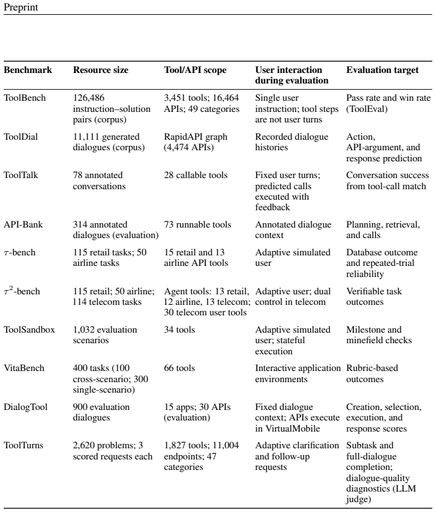
Table 1 : How the evaluation setting differs across benchmarks. ToolTurns combines broad API coverage with adaptive clarification and follow-up dialogue, complementing benchmarks centered on stateful application workflows. Counting conventions for each row are in Appendix A.
Original paper · CC BY 4.0How each underspecified problem is built
Each ToolTurns problem starts from a request that leaves details out, and a simulated user holds those details back until the agent asks for them. A problem is a triple of an initial query, a fixed set of callable endpoints with their schemas, and a hidden goal of slot–value constraints. Each slot names an argument in a tool schema, and its value is what the user has in mind but does not state in the first query.
At each step, the agent either invokes an endpoint, messages the user, or completes the request with a final answer. When the agent asks for clarification, the user simulator reveals the relevant slot values from the hidden goal.
Tool sets start from ToolBench's three retrieval groups, which differ in how their tools relate to one another. G1 holds single-tool sets, G2 holds intra-category multi-tool sets, and G3 holds intra-collection multi-tool sets spanning categories. The authors discard seed sets with fewer than three endpoints, following ToolBench's own filtering.
For G2 and G3, they sample two distinct seed sets with probability 0.5 and combine their endpoints. Endpoint expansion then adds every endpoint of each referenced tool, since a realistic request may need other capabilities of the same tools. GPT-4o-mini writes two vague queries per expanded set, barred from naming tools or APIs. Each query must leave out the details the agent would need to make a call, and comes with 2 to 4 context keywords encoding those omitted details.
The evaluation set contains 2,620 problems that draw on 1,827 distinct tools and 11,004 endpoints. These problems span 47 RapidAPI categories. Each problem exposes 26.5 endpoints on average, while the median is 15.0. Single-tool problems number 1,032, or 39.4%, and multi-tool problems number 1,588, or 60.6%.
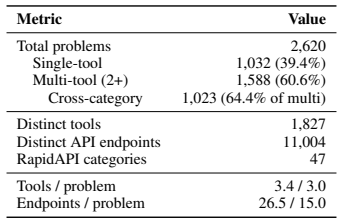
Table 2 : ToolTurns statistics for the 2,620-problem evaluation set. The last two rows report mean / median.
Original paper · CC BY 4.0How the dialogue loop runs between agent, simulator and tools
At each step the agent picks one of three actions: invoke an endpoint, message the user, or complete the request with a final answer. A tool observation is returned for an endpoint call, and a user response is returned for a message to the user. Tool results come from StableToolBench, a cached execution layer that is LLM-simulated on a cache miss.
The simulator never sees tool calls or tool responses, only the user-visible conversation. So it behaves like a person who cannot see the assistant's internal operations.
Each dialogue runs one initial query followed by two follow-up queries, giving three main queries per dialogue. Each main query's sub-dialogue is capped at 10 user-visible messages. If the cap is reached before the agent calls finish or message_user, the agent is forced to conclude that subtask. When that budget is exceeded, the agent gets one synthesis call and is asked to finish from the tool responses it has.
The agent's full view, including tool calls and responses, is carried across turns in a separate list. The user-visible dialogue list holds only the initial query, simulator turns, and the agent's terminating output. The follow-up generator then writes the next request from the dialogue so far, and the agent re-plans its own tool calls. A checker flags candidate user messages against eleven violation types, and a fixer rewrites flagged messages before they enter the conversation.
Task completion versus rubric quality
The authors ran nine agents, four proprietary and five open-weight, against the same user simulator with the checker–fixer pipeline enabled. Table 3 reports each agent's quality aspects, weighted aggregate and task success over the same 2,620 problems.
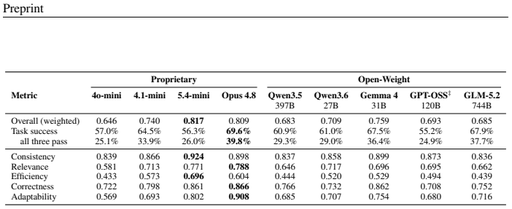
Table 3 : Dialogue quality and task success per agent model, over a shared set of 2,620 problems. Bold denotes the best value per row. Open-weight models are labeled by family with total parameter count below; checkpoints and quantization are in Appendix E. The weighted aggregate, the pooled subtask pass rate, and the stricter all-three-pass rate are defined in §3.4; dialogues and subtasks for which the judge returned an error are excluded. ‡GPT-OSS is also the judge model, so its scores are not judge-independent.
Original paper · CC BY 4.0 · Milad Gholami, Brendan King, Jeffrey Flanigan · ToolTurns: Benchmarking LLM Agents in Multi-Turn Dialogue · Original paper figure · Extracted the figure area from page 7 of the original PDF.Claude Opus 4.8 leads task success, passing 69.6% of subtasks and 39.8% of full three-request dialogues. Pooled subtask pass rates sit between 55–70% for all nine agents, so even the best agent leaves more than three subtasks in ten unmet. Requiring all three subtasks to succeed pushes every model below 40%.
If subtask outcomes were independent, a 69.6% subtask rate would imply an all-pass rate of about 34%, so the observed 39.8% points to successes and failures clustering within dialogues. The authors read this as either harder problems or agents that set up the right tool and context early and keep succeeding.
The rubric and task success rank the models differently: their rankings correlate at ρ = 0.23, while the two task-success definitions correlate at ρ = 0.97. GPT-5.4-mini leads the weighted aggregate at 0.817, yet its task success of 56.3% is second-worst, below GPT-4o-mini's 57.0%. Consistency and efficiency reward locally well-formed tool use, so an agent that issues few coherent calls can score high without resolving the request.
Efficiency carries a 0.20 weight and spreads 0.26 across the nine agents, so it drives most of the aggregate's differences.
The two best open-weight models, GLM-5.2 and Gemma 4, reach 67.9% and 67.5% task success, compared to 69.6% for Opus 4.8. Gemma 4 at 31B is within 0.4 points of GLM-5.2 at 744B, so parameter count predicts little here. Qwen3.6-27B matches Qwen3.5-397B on task success, 61.0% compared to 60.9%, and the authors suggest dialogue and tool-selection behavior explains more than raw size.
Where follow-up requests lose ground
Qwen3.6-27B and Opus 4.8 even recover 2.9 and 3.2 points on the second follow-up.
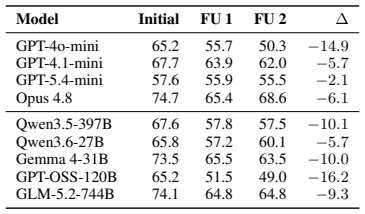
Table 4 : Subtask success rate (%) by position of the main query within the dialogue: the initial query and the two follow-ups (FU 1, FU 2). ∆ is the change from the initial query to the second follow-up. Every model degrades as the dialogue lengthens.
Original paper · CC BY 4.0The pattern alone doesn't isolate a cost of depending on earlier turns, because the judge doesn't see prior-subtask tool evidence. GPT-5.4-mini shows the flattest position profile, but its lowest initial-query score of 57.6% means its smaller decline doesn't show stronger multi-turn ability.
GPT-OSS-120B returns plain text instead of calling finish in 56.1% of its dialogues, which leaves the subtask open. The authors say part of GPT-OSS's decline reflects this protocol non-compliance rather than dialogue ability. Next, the paper tests whether the checker–fixer changes the user turns that drive these trajectories. On 536 rewritten turns, detected defects fall from 335 to 197, and the paired change is −0.257 defects per turn.
Whether the checker–fixer changes user turns
The checker–fixer pipeline revises candidate user messages before they enter the conversation, so its effect can be measured directly. The analysis compares each draft with its revision under identical history, so the pair isolates the change.
On the 536 rewritten turns, detected defects fall from 335 to 197. Among the messages the fixer rewrites, the revision reduces rule-detected defects by 41.2%. The paper treats this as a paired estimate, so a constant detector bias cancels within each pair.
In blind human annotation, annotators preferred the revised turn in 76 of 120 sampled pairs, which is 63.3%. The reported p-value for this human preference is 4.5×10⁻³. The human study is a preference test, so annotators saw two unlabelled candidate messages for each dialogue. The human results and the automatic results come from the same revision step, so they point in the same direction.
Templating is the most frequent trigger, but human preference on those turns is indistinguishable from chance. Dialogue-level rubric scores barely respond to a single turn-level fix, so the rubric doesn't capture this change. The paper reports the scores, violation-type breakdown and detector calibration in Appendix B, and the LLM judge agreement is reported next.
Checking the LLM judge against people
The authors checked whether their LLM judge agrees with human annotators on two kinds of scoring. For binary task success, human and LLM judgments reach substantial agreement, with Cohen's κ = 0.68. That level of agreement is the basis for using an LLM judge to evaluate agents on this task. Across the five dialogue-quality aspects, the agreement is only moderate.
The authors measure it with a quadratic weighted Cohen's κ = 0.53.
The authors attribute the weaker agreement on quality to how hard each quality dimension is to judge. Even so, they still treat the agreement on quality as significant. The judge scores each of the five aspects in a separate call, so each rating is judged on its own terms. Human annotators did not rate task success and quality on the same scale, so the two kappas are not directly comparable.
The conclusion section turns this check into a practical rule for reading the results. Because rubric scores rank models differently from completion, with ρ = 0.23, the authors argue progress must be measured as completion. They don't use the rubric alone to judge whether an agent has improved.
What the limitations of ToolTurns leave open
Measured difficulty in ToolTurns mixes the agent with the simulated user's choices, since the user helps determine each trajectory. Task success is therefore defined against that recorded set of observations rather than against live APIs.
The dialogue-quality rubric and the task-success judge are both LLM judges, so neither is a ground-truth check. Missing provenance can make a judge's rationale incorrect without showing that its final success label is wrong.
The paper doesn't establish that the follow-up drop reflects a cost of conversational dependence, because the judge omits prior-subtask tool evidence. A repaired user turn need not change dialogue-level scores, and Appendix B is where that comparison is made. Simulated users score higher than the filtered human reference set (0.851 vs. 0.772 overall), but turn count and elaboration differ between the two sets.
The gap is therefore not proof that synthetic users are more human. Contextual awareness and clarity score within 0.01 to 0.03 of the human references across all four sets.
Paper info
- Authors
- Milad Gholami, Brendan King, Jeffrey Flanigan
- Venue
- arXiv · Preprint
- First published
- 2026-11-11
- Added
- 2026-11-13
- Updated
- 2026-11-11
- Version
- v1
- arXiv
- 2611.14925
- Category
- cs.CL
- Original paper terms
- CC BY 4.0
- What we show
- Paper info, commentary and permitted figures from the original paper
AI commentary is a separate explanation from the original paper and may contain errors. The original paper and figures follow each source's terms of use and any rights noted separately.
Abstract
Tool-using language models are increasingly deployed in conversational settings, yet most large-scale tool-use benchmarks focus on isolated requests. We introduce ToolTurns, a benchmark of 2,620 problems spanning 1,827 tools and 11,004 API endpoints across 47 categories. Each dialogue begins with an intentionally underspecified request and continues through two context-dependent follow-ups, testing clarification, tool use, and retention of conversational context. We also introduce an open-source user simulator that reveals withheld context through dialogue and generates follow-up requests, with a checker--fixer pipeline for improving its turns. Across nine language models, the best agent resolves 69.6% of individual requests but completes only 39.8% of full dialogues. Under this evaluation protocol, every evaluated model receives lower success scores on follow-up requests than on the initial request, and dialogue-quality rubric scores and task success can rank models very differently. Paired turn-level evaluation shows that the checker--fixer reduces detected dialogue defects, and blind human evaluation favors the revised turns. ToolTurns provides a testbed for evaluating whether agents sustain task success across multi-turn dialogue with tools.
Quote from the paper
Milad Gholami, Brendan King, Jeffrey Flanigan (2026). ToolTurns: Benchmarking LLM Agents in Multi-Turn Dialogue. arXiv:2611.14925v1. https://arxiv.org/abs/2611.14925v1
BibTeX
@misc{gholami2026toolturns,
  title = {{ToolTurns: Benchmarking LLM Agents in Multi-Turn Dialogue}},
  author = {Milad Gholami and Brendan King and Jeffrey Flanigan},
  year = {2026},
  eprint = {2611.14925},
  archivePrefix = {arXiv},
  url = {https://arxiv.org/abs/2611.14925v1}
}