Paper commentary
When Direction Matters: Diagnosing Relational Instruction Following in Dense Retrieval
Dense retrievers often fail when relation direction reverses but entities stay the same
- Problem Dense retrievers handle explicit filters and attribute cues well. They become much less reliable when relevance depends on which entity plays which role in a relation, because the same entities appear in both directions.
- Method SwitchIR is a diagnostic that keeps the query and two hard-negative documents fixed and reverses only the requested relation direction. Unlike earlier benchmarks, no explicit cue can separate the two documents.
- Results Seven neural retrievers averaged 0.986 on Constraint Shift FlipBoth but only 0.015 on Relational Flip ContrastAll. The gap persists on a realistic LLM-assisted variant.
Why cue-based success hides a gap
Dense retrievers are now asked to respect criteria beyond the query, such as filtering conditions, audience constraints, and relation directions. Benchmarks for instruction-aware retrieval mostly vary explicit constraints, user personas, or document-level attributes such as audience, format, and negation. In these benchmarks, relevant and irrelevant documents can often be separated through explicit persona, constraint, attribute, or negation cues.
A model can therefore score well without showing that it binds the roles of the entities involved, because the cues do the work.
The gap is sharpest when two search intents share the same entities and content words but differ in which entity plays which role. This matters because retrievers increasingly sit inside retrieval-augmented generation, conversational search, and personalized assistants, so a wrong direction can feed the wrong evidence downstream.
Relational Flip reverses the target-defining relation, such as “A causes B” versus “B causes A”, while the entities and token inventory stay nearly fixed.
How SwitchIR isolates direction
SwitchIR keeps the query and two mutually hard-negative documents fixed and changes only the instruction, so the retriever must decide which document the instruction prefers. Both candidates are visible under every instruction, so a failure means the model cannot order the two candidates, not that the right one was missing from the pool. The three categories then differ in which cue the retriever has to use to make that decision.
Relational Flip keeps the entities fixed and reverses the relation direction, for example one entity causing the other versus the reverse. Relational Flip spans six relation types: Causal Influence, Temporal Order, Scalar Comparison, Containment/Hierarchy, Directed Action and Transfer/Information Flow.
Each group holds a shared query, a document pair and two instruction sets, and each set has one anchor instruction. Constraint Shift has one instruction per set, while Explicit Filtering and Relational Flip each add an equivalent realization of the same preference. Because all conditions of a group stay in one data split, the equivalent realizations can't leak into training as separate groups.
The controlled set uses templates that hold vocabulary and structure nearly fixed, and it contains 700 groups and 2,700 instruction conditions. The realistic set uses LLM-assisted rewrites that the authors manually reviewed group by group, and it contains 140 groups and 520 conditions.
A condition counts as correct only when the preferred document scores strictly higher, so a tie is an error. PairAcc averages the two anchor preferences, FlipBoth requires both anchors to be correct, and ParaAll and ContrastAll extend these requirements to every realization, with groups weighted equally. Under random choice, PairAcc and FlipBoth have expectations 0.5 and 0.25, and the four-condition ContrastAll has an expectation of 0.0625.
Zero-shot results on both sets
BM25 reaches a Constraint Shift FlipBoth of 1.000 on the controlled set but scores zero on both matched-word categories. So lexical overlap can solve the cue-based control, but it cannot solve either role-binding task. Table 1 lists the controlled-set results for every model.
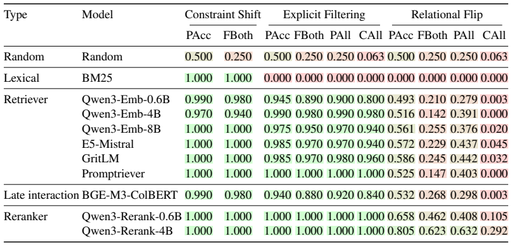
Table 1 : Zero-shot results on the controlled set. PAcc, FBoth, PAll, and CAll abbreviate PairAcc, FlipBoth, ParaAll, and ContrastAll. Random values assume independent uniform selection; rerankers form a separate block.
Original paper · CC BY 4.0Averaged over seven non-reranker neural runs, Constraint Shift FlipBoth reaches 0.986 and Explicit Filtering ContrastAll reaches 0.923. Relational Flip ContrastAll drops to 0.015 in the same average, so the failure goes beyond bag-of-words matching. Models that resolve include and exclude roles still fail to match general relational roles, which the authors use to argue the gap is not an operator problem alone.
Among the embedding and late-interaction retrievers, Relational Flip ContrastAll on the controlled set ranges from 0.000 to 0.045. E5-Mistral reaches the highest value of this group at 0.045, while Promptriever reaches 0.000 on the same measure.
The realistic averages follow the same order: 0.943 for Constraint Shift, 0.679 for Explicit Filtering and 0.084 for Relational Flip. This shows that the drop is not specific to the template wording of the controlled set.
Qwen3-Rerank-4B reaches a Relational Flip ContrastAll of 0.292 on the controlled set and 0.470 on the realistic set. A 0.53 realistic ContrastAll gap to Explicit Filtering remains even for this reranker, so changing the model family alone does not close the gap.
FollowIR p-MRR ranks the models differently: Promptriever has the highest p-MRR at 12.8 but zero controlled Relational Flip ContrastAll. E5-Mistral has a p-MRR of 0.0 and a Relational Flip ContrastAll of 0.045, so the two measures capture different aspects of instruction following.
Why the interaction must beat pair preference
The margin decomposition starts from two instruction-conditioned query embeddings for each relation direction and the normalized embeddings of the two gold documents. Each direction's margin is its gold document's score minus the score of the other document, so the same document pair is scored under both directions. A direction counts as correct only when its margin is strictly positive, so a tied score stays an error under the SwitchIR evaluation rule.
The authors average the two query embeddings into μx and take Δx and Δy as the differences between the two directions. They split the margin into b = μx⊤Δy, the direction-invariant pair preference, and r = ½Δx⊤Δy, the direction-sensitive interaction. Since the margins equal b + r and −b + r, both directions are correct exactly when r > |b|.
The surplus r − |b| equals the smaller of the two margins, so a positive surplus means that realization switches correctly in both directions.
The interaction factorizes into the query direction contrast, the document contrast, and the cosine of their alignment. A large query shift alone doesn't decide success, because even a large query shift or well-separated documents can leave r ≤ |b|. The decomposition is applied pointwise to each group and realization, and comparing mean r with mean |b| is only a descriptive summary.
For the four embedding retrievers, sufficient aligned interaction (r > |b|) occurs for 14.2% to 25.5% of controlled observations and 13.5% to 32.5% of realistic observations. Aligned but insufficient interaction is more common, accounting for 28.8% to 36.9% of controlled observations and 45.5% to 58.5% of realistic observations. Pair-preference dominance is therefore the main zero-shot failure pattern, because direction-sensitive changes are present but their aligned interaction often fails to exceed |b|.
This analysis covers Qwen3-Emb-0.6B, Qwen3-Emb-4B, Qwen3-Emb-8B and GritLM only, with 1,200 controlled and 200 realistic observations per model. A separate realization-stability measure compares the query direction changes of the two equivalent realizations. That measure is distinct from ParaAll, which is computed from the four actual ranking decisions.
Diagnostic training and transfer
Qwen3-Embedding-0.6B and Qwen3-Embedding-4B are fine-tuned with LoRA on controlled training data only. For each training instance, the correct-direction document y+ is ranked above the reversed document y− by a pairwise objective. The loss is a negative log-sigmoid of the score gap between the two documents, divided by a temperature τ. Training includes both query wordings, both document wordings, and both relation directions.
Realistic data never enter training and serve only for outside evaluation.
Checkpoints are selected on controlled development data from that same family. Same-relation evaluation averages six matched train-test conditions, while cross-relation evaluation averages 30 directed unmatched conditions. The 4B model reaches a 99.0% diagonal average on controlled data, so one-family supervision learns the training family well.
Off the diagonal, the average falls to 28.1%, with strong directional asymmetries between families. On realistic data the averages are 65.2% on the diagonal and 26.4% off it.
The leave-one-relation-out protocol holds out one family and trains on 350 controlled groups from the other five. Groups from the held-out family are kept out of both parameter updates and checkpoint selection. Qwen3-Embedding-4B reaches 92.5% controlled and 70.1% realistic held-out ContrastAll, versus 35.7% and 13.5% for the 0.6B model. Its realistic scores range from 17.6% for Containment/Hierarchy to 97.5% for Directed Action.
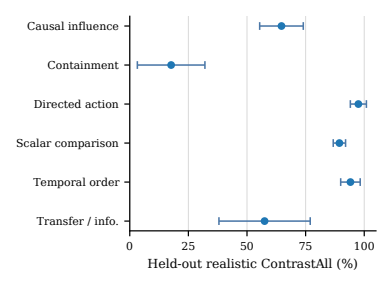
Figure 4 : Relation-family heterogeneity for Qwen3- Embedding-4B on realistic leave-one-relation-out eval- uation. Points show mean ContrastAll over five seeds and error bars show sample standard deviation.
Original paper · CC BY 4.0 · Zhanyu Wu, Richong Zhang · When Direction Matters: Diagnosing Relational Instruction Following in Dense Retrieval · Original paper figure · Extracted the figure area from page 13 of the original PDF.Together, these runs show that the direction rule is learnable and that single-family supervision stays specific to that family.
Limits of the SwitchIR evidence
The zero-shot comparison covers only the listed models, so other retrievers aren't tested here. The training experiments cover only the two Qwen3-Embedding models, Qwen3-Embedding-0.6B and Qwen3-Embedding-4B. The benchmark scores a fixed two-document group, so it measures pairwise decisions rather than corpus-level recall. The realistic set has 140 groups and 520 conditions, which is much smaller than the controlled set's 700 groups.
The realistic rewrites were produced with LLM assistance before the authors reviewed every group manually. The leave-one-relation-out results vary widely on realistic data for the 4B model, with scores from 17.6% to 97.5%. So transfer across relation families isn't uniform, and the 4B average of 70.1% hides that spread.
Paper info
- Authors
- Zhanyu Wu, Richong Zhang
- Venue
- arXiv · Preprint
- First published
- 2026-11-11
- Added
- 2026-11-13
- Updated
- 2026-11-11
- Version
- v1
- arXiv
- 2611.15417
- Category
- cs.IR
- Original paper terms
- CC BY 4.0
- What we show
- Paper info, commentary and permitted figures from the original paper
AI commentary is a separate explanation from the original paper and may contain errors. The original paper and figures follow each source's terms of use and any rights noted separately.
Abstract
Dense retrievers increasingly claim the ability to condition retrieval on natural-language relevance criteria beyond a short query. We identify a specific weakness in this capability: the evaluated models perform well when lexical or attribute cues distinguish the target, but become much less reliable when relevance depends on a directional relation over the same entities. We introduce SwitchIR, a controlled diagnostic that contrasts Constraint Shift and Explicit Filtering with Relational Flip, where the query and document pair remain fixed while the requested relation direction reverses. Across representative embedding and late-interaction retrievers, the primary joint metric is high on the two cue-available controls and consistently low on Relational Flip; the same ordering persists in an LLM-assisted, manually reviewed realistic variant. An exact margin decomposition shows that both directions are correct only when the direction-sensitive query--document interaction exceeds the direction-invariant pair preference. Empirically, direction-sensitive changes are common, but their aligned interaction is usually too weak to overcome that preference. Diagnostic fine-tuning shows that models can learn relational behavior that generalizes across relation families, with stronger generalization in the larger model.
Quote from the paper
Zhanyu Wu, Richong Zhang (2026). When Direction Matters: Diagnosing Relational Instruction Following in Dense Retrieval. arXiv:2611.15417v1. https://arxiv.org/abs/2611.15417v1
BibTeX
@misc{wu2026when,
  title = {{When Direction Matters: Diagnosing Relational Instruction Following in Dense Retrieval}},
  author = {Zhanyu Wu and Richong Zhang},
  year = {2026},
  eprint = {2611.15417},
  archivePrefix = {arXiv},
  url = {https://arxiv.org/abs/2611.15417v1}
}