Paper commentary
Bet Imaginatively, not Historically in Independent-Data Sequential Testing
FLOE bets by averaging leave-one-out payoffs over shuffled data sequences
- Problem Sequential test betting strategies come from adversarial online learning, so they ignore that i.i.d. streams are stationary. They weight old payoffs much like recent ones.
- Method FLOE averages leave-one-out payoffs over shuffled data sequences instead of past critics. It then picks each bet by maximizing average log growth.
- Results FLOE-R raises power over ONS and GRAPA by more than 5% on some problems.
Why betting tests need better bets
Batch p-values lose their meaning once a team keeps testing new data, which is why sequential tests exist. Sequential tests rely on e-values, which are nonnegative variables whose expectation under the null is at most one. If the null is true, the game must be fair, so the player's wealth is not expected to grow. How large each bet is therefore decides how fast that wealth grows.
Most betting strategies come from adversarial online learning, where an adversary may pick the data to hurt the test. Those methods don't use the fact that an i.i.d. stream is stationary, so they weight old payoffs much like recent ones. FLOE instead estimates the e-power of the current critic by averaging leave-one-out payoffs over shuffled, equally likely data sequences.
Because the data are exchangeable, this leave-one-out average is an unbiased estimate of the e-power of νt−1. The authors argue that the e-power should therefore be estimated for the critic the test uses now, not as an average over previous critics. Each leave-one-out payoff V(t)ℓ is computed from a critic trained on all points except Zℓ.
Estimating e-power from leave-one-out payoffs
FLOE replaces the history of critics with hypothetical sequences in which one sample is held out at a time. The authors argue that, because the data are exchangeable, this gives an unbiased estimate of the e-power of the previous critic. Each leave-one-out critic is the MMD maximizer fitted on all samples except the held-out one. Its norm is bounded by one over the square root of 2K, which keeps the payoffs inside the same range as the ERM predictor.
Evaluating a leave-one-out predictor on its held-out pair gives one leave-one-out payoff per sample. The critic built on all t-1 samples is the standard ERM predictor, and its payoff is the one that enters the wealth. FLOE chooses the bet as the value in [0, 1 minus epsilon] that maximizes the average log growth over the leave-one-out payoffs.
\[ \lambda_t = \arg\max_{\lambda\in[0,1-\epsilon]} \frac{1}{t-1}\sum_{\ell=1}^{t-1}\log\bigl(1+\lambda V^{(t-1)}_\ell\bigr) \]
The objective is strictly concave in lambda, so a unique maximizer exists. Bisection finds that maximizer to epsilon accuracy in log2(epsilon) steps, and five or ten steps are enough in practice. Saving the kernel matrix from the previous step keeps each e-power estimate at O(t) cost. Wealth then multiplies by one plus the bet times the ERM payoff, and the test rejects once wealth reaches 1 over alpha.
Theorem 1 shows this wealth stays a valid test under the null and rejects almost surely under the alternative with a characteristic kernel.
Keeping early bets conservative
Early in a stream the ERM payoffs are often negative, so an aggressive bet can shrink wealth before evidence builds up. Figure 1 plots log-wealth on the x-Normal problem for ONS, GRAPA, FLOE and FLOE-R. Poor initial estimates often lead to negative returns, and the regularized FLOE-R bets more conservatively at the start to limit these losses.
The authors define the regularizer through the expected return E[λVt | Ft-1] of a bet, which connects directly to the choice of bets. An (α, β)-regularized set requires that the infimum of the expected return over the set exceeds minus α with probability at least 1 minus β. This condition makes the set reflect how uncertain the predictor is, since the expected profit must not drop too low.
The interval is built from a martingale Bennett-type concentration inequality that uses variance information. The upper end of the interval has a denominator whose first term is expected to decrease with time, so the bet interval increases. The regularization adds no asymptotic cost, since computing the bound at time t takes O(t) time with the saved kernel Gram matrix.
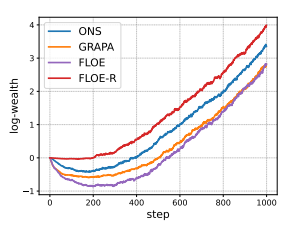
Figure 1 : Wealth of several betting strate- gies (ONS, GRAPA, FLOE) for the x- Normal problem described in Section 4. Poor initial estimates often lead to neg- ative returns, whereas a regularized bet- ting strategy (FLOE-R) minimizes losses by betting more conservatively at the start.
Original paper · CC BY 4.0 · Nathaniel Xu, Feng Liu, Danica J. Sutherland · Bet Imaginatively, not Historically in Independent-Data Sequential Testing · Original paper figure · Extracted the figure area from page 7 of the original PDF.In practice the authors don't penalize the variance estimate, and they use the unpenalized estimate when building the set. This choice drops the finite-sample guarantee, but the authors expect the interval to approximate the theoretical one for large t. They also replace the inverse function with h to the minus one of u, equal to u/3 plus the square root of 2u, a relaxation from Bernstein's inequality.
This replacement still keeps the correct confidence level, because the inverse is at most h to the minus one of u for all u of at least 0.
For the experiments, FLOE-R uses the regularization strength alpha equal to delta0 equal to delta1 equal to 0.1. The Sinusoid, x-Normal and CIFAR-10 vs 10.1 results are reported in Figure 2 against ONS, GRAPA, UP and SR.
Two-sample test power
The problems are Sinusoid with omega = 3.5, x-Normal with correlation magnitude 0.65, CIFAR 10 vs 10.1 and RatInABox.
Every considered test beats the kernel sequential test of Shekhar and Ramdas, which uses online gradient descent for the critic. The authors attribute this gap to the ERM prediction strategy, since ONS alone already outperforms SR.
Among the ERM-based tests FLOE-R matches or beats every competitor in most cases. It raises power over ONS and GRAPA by over 5% on some problems. Without regularization FLOE still beats the other strategies on every benchmark except x-Normal, and sits only slightly below FLOE-R in most cases. The largest regularizer gain is almost 10% on x-Normal.
The authors describe the regularizer as trading some early power for faster wealth growth, which lifts later power. FLOE also beats the universal portfolio baseline, which weights early and late payoffs the same because it is invariant to observation order.
How sensitive the regularizer is to its hyperparameters
The authors first check whether the regularizer depends heavily on the choice of delta, which they vary while holding alpha fixed. They fix alpha at 0.1 and vary delta, which equals delta0 and delta1, between two extremes: 0.01 and 0.5. Figure 3 plots the power difference between FLOE at each delta level and ONS. Across all problems, only the extreme choice delta = 0.01 gives lower power than ONS.
Figure 3 covers delta values of 0.01, 0.05, 0.1, 0.25 and 0.5, with the regularizer tested at each one.
The second ablation keeps delta0 and delta1 at 0.1 and varies alpha between 0.05 and 0.5. The authors show these alpha results in Figure C.5 of the appendix. They choose alpha = delta0 = delta1 = 0.1 as a good middle ground for regularization strength. Parameter choices around 0.1 and above tend to give fairly robust performance. When alpha and delta are very large, above 0.5, the regularizer's impact is minimal.
Extending FLOE to independence testing
The leave-one-out idea behind FLOE does not depend on two-sample testing, so the authors apply it to learning critic functions for independence tests. They apply it to the sequential kernel independence test (SKIT) of Podkopaev et al. (2023). The exact expressions and implementation details are given in Section B, which the authors refer to rather than repeat.
The experiments use independence-testing versions of the Sinusoid, x-Normal and RatInABox problems. For Sinusoid and x-Normal, X and Y are sampled jointly from a 2D distribution with component-wise dependency. Problem and test settings are detailed in Section B.1.
FLOE is compared against GRAPA, ONS and the Universal Portfolio with a Beta(1/2,1/2) prior. Figure 4 plots mean test power across these independence problems, with each test run 1,000 times. FLOE outperforms these baselines even without regularization. The second row of Figure 4 subtracts the performance of UP from each point to make differences easier to see.
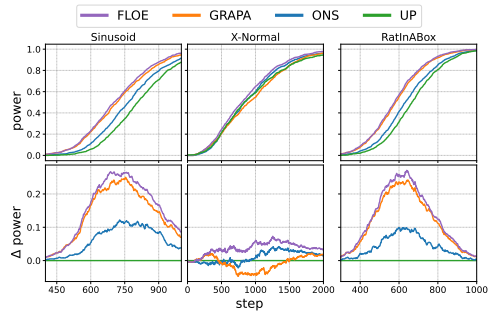
Figure 4 : Mean test power on a variety of datasets; each test is run 1,000 times. The second row subtracts the performance of UP from each point for easier visualization.
Original paper · CC BY 4.0This result supports the claim that the leave-one-out e-power estimate helps beyond two-sample testing. The authors summarize FLOE as simple to implement and computationally efficient for kernel tests.
Where the evidence stops for FLOE
The authors don't test a sharper bound, so the size of this effect stays open.
The variance estimate isn't penalized in practice, so the finite-sample guarantee of the regularized set isn't kept. The authors expect the unpenalized interval to approximate the theoretical one for large t. A practical bound with small enough constants would need to be on the square root of the variance estimator, which the authors didn't derive.
They replace the inverse of phi with h inverse, which still keeps the correct confidence level.
The lengthscale was chosen to optimize the performance of ONS, so FLOE may be under-tuned. The independence experiments report FLOE without regularization, so FLOE-R isn't shown there. Theorem 1, the consistency result, requires a characteristic kernel.
Paper info
- Authors
- Nathaniel Xu, Feng Liu, Danica J. Sutherland
- Venue
- arXiv · Preprint
- First published
- 2026-11-11
- Added
- 2026-11-13
- Updated
- 2026-11-11
- Version
- v1
- arXiv
- 2611.15456
- Category
- stat.ML · cs.LG
- Original paper terms
- CC BY 4.0
- What we show
- Paper info, commentary and permitted figures from the original paper
AI commentary is a separate explanation from the original paper and may contain errors. The original paper and figures follow each source's terms of use and any rights noted separately.
Abstract
Sequential testing avoids some of the many controversies and drawbacks related to traditional batch testing with p-values. In particular, the testing by betting paradigm has developed rapidly in recent years; it frames the level of evidence against the null as the wealth of a player in a betting game. Naturally, how much a player should bet is a key consideration, and should reflect their confidence in what they know about the next observed data point. Much current work uses standard betting strategies developed for adversarial problems. In the stochastic setting, where the observed data is independent and stationary, these approaches may be suboptimal. We propose a simple betting strategy, follow the leave-one-out e-power (FLOE), that exploits the i.i.d. nature of a data stream to estimate the e-power of our current test on the underlying distribution. We average not over the historical evidence collected so far, as generic online learning-based methods do, but instead over the equally-likely possible data sequences we might have seen based on shuffling the data. With an additional principled regularization technique, this simple drop-in method yields substantial improvements in testing performance on a variety of kernel two-sample and independence testing problems.
Quote from the paper
Nathaniel Xu, Feng Liu, Danica J. Sutherland (2026). Bet Imaginatively, not Historically in Independent-Data Sequential Testing. arXiv:2611.15456v1. https://arxiv.org/abs/2611.15456v1
BibTeX
@misc{xu2026imaginatively,
  title = {{Bet Imaginatively, not Historically in Independent-Data Sequential Testing}},
  author = {Nathaniel Xu and Feng Liu and Danica J. Sutherland},
  year = {2026},
  eprint = {2611.15456},
  archivePrefix = {arXiv},
  url = {https://arxiv.org/abs/2611.15456v1}
}