Paper commentary
VACO: Vertex-Aligned Decoding for Dense Hand Contact Estimation from a Single Image
- Problem Direct per-vertex contact predictors decode the whole contact map from one shared query, so contact spreads onto neighbouring vertices that do not touch the object.
- Method VACO gives each MANO vertex its own token, which samples multi-scale ViT features at the vertex's projection from a co-trained WiLoR mesh, and a Transformer decoder maps these tokens to per-vertex contact logits.
- Results Reached an F1-Score of 0.860 on Hi4D against 0.653 for HACO, and a five-benchmark mean F1-Score of 0.699 for the full model.
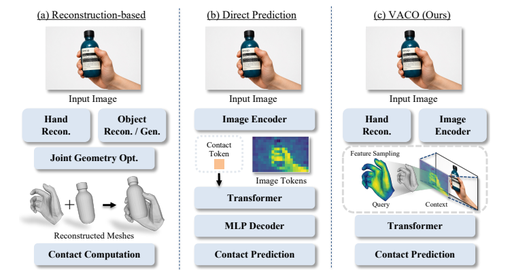
Figure 1 :Dense hand contact paradigms. (a)Geometric proximity after reconstruction.(b)Shared- query direct prediction.(c)V ACO samples image evidence at projected vertices.
Original paper · CC BY 4.0 · Binhong Ye, Jin-Chuan Shi, Tao Liu, Xin Wang, Hao Chen, Chunhua Shen · VACO: Vertex-Aligned Decoding for Dense Hand Contact Estimation from a Single Image · Original paper figure · Extracted the figure area from page 2 of the original PDF.Why one shared query blurs per-vertex contact
The task is to assign a binary contact label to every vertex of a MANO hand mesh from one RGB image, which matters for dexterous robotic manipulation and for AR/VR and digital-human pipelines that re-target grasps. Reconstruction-based methods recover both the hand and the object and derive contact from geometric proximity, so their errors compound when the full object is hard to reconstruct in cluttered scenes.
Direct predictors regress the per-vertex map from pixels, and HACO is the strongest of them, but it decodes all vertices from a single shared query token.
Because the shared query has no per-vertex handle on the image, the decoder never knows where each vertex projects on the image plane. VACO keeps the speed of direct prediction and replaces the shared regression head with a sampling step at projected mesh vertices.
Reading image evidence at each projected vertex
VACO treats the predicted mesh as a spatial scaffold that tells each vertex where to look, and it uses the mesh for nothing else. The backbone is initialized from WiLoR and co-trained, so the same network supplies the mesh and the feature map that the decoder samples. Figure 1 places the three paradigms side by side: reconstruction followed by proximity, shared-query direct prediction, and VACO sampling image evidence at projected vertices.
The raw ViT feature map has the encoder's native patch stride, which is too coarse for vertex-level discrimination, so it is upsampled by a lightweight deconvolutional pyramid into S progressively finer scales. Each vertex is projected with the predicted weak-perspective camera and its feature is read by bilinear sampling at every scale, with the per-scale samples concatenated.
The sampling is written as \\( f^{vit,s}_{v} = \\text{Bilinear}(F^{s}_{vit}, \\pi(v;\\hat{\\pi})) \\), and the concatenation over the S scales forms the vertex feature \\( f^{vit}_{v} \\). The implementation uses S=3 feature scales at strides {1:8, 1:4, 1:2}.
A shallow MLP maps each sampled feature to a D-dimensional token, and a learned embedding for the fixed MANO vertex index is added, so each token carries both local appearance and the identity of its vertex. Each of the N decoder layers first runs self-attention over all V vertex tokens, which lets the decoder capture joint contact patterns such as a power grasp, and then cross-attends to the native-stride feature map so that a vertex can use context such as the object or an occluder.
A shared readout applies one linear head independently to each refined token, giving a logit per vertex, and the contact probability is the sigmoid of that logit. The implementation uses N=4 decoder blocks, H=8 attention heads and hidden dimension D=512.
Class-balanced, multi-level training with reconstruction kept on
Dense contact labels come from a proximity threshold at a per-category value, so the labels are noisy at the level of single vertices, and training the raw V-dimensional output directly is unstable. The logits are therefore aggregated at four resolutions, with V, V2, V3 and J vertex or joint counts, through fixed linear operators, which gives the readout as \\[ \\hat{\\ell}_{r} = R_{r}\\hat{\\ell} \\].
The mesh-downsampling operators follow Bouritsas et al., the joint level uses MANO's joint regressor, and the identity is used at full resolution.
Each granularity is trained with the Vertex-Level Class-Balanced loss, which rescales the binary cross-entropy of each vertex by its historical contact frequency so that the network does not collapse to all-zero predictions. The total loss adds an L1 vertex-mean prior and a mesh-adjacency smoothness term to the four class-balanced terms, and adds the WiLoR reconstruction objective with weight lambda_rec.
Reconstruction stays in the loss so that the shared backbone keeps its pose accuracy while it specializes for contact. The loss weights used are unit weight for the four VCB terms and the reconstruction objective, lambda_reg=0.1 and lambda_smooth=1.0.
During training, the vertices are projected with ground-truth projections that are perturbed with image-plane Gaussian noise, so the decoder does not learn to depend on exact projections. End-to-end fine-tuning of the image encoder through the sampling grid means that gradients reach the specific surface locations that were sampled, which pushes the features toward contact boundaries rather than generic hand structure.
Training pool, benchmarks and metrics
The training corpus covers hand-object grasping, bimanual manipulation, inter-hand and hand-human interaction, hand-face interaction and hand-scene contact. The unified pool is used so that the comparison isolates the architecture from data curation.
In-domain evaluation uses the standard test splits of DexYCB, Hi4D and RICH, which come from dataset families seen in training. Out-of-domain evaluation uses HOT3D and HOCap, both unseen during training. Per-image Precision, Recall and F1-Score are computed on the binary per-vertex mask under the per-category proximity protocol, and every column of Table 1 comes from one checkpoint without per-benchmark fine-tuning.
Three baselines are compared: HACO as released, DECO retargeted to MANO, and FollowMyHold, a reconstruct-then-query method.
Cross-domain contact results
On Hi4D, VACO reaches an F1-Score of 0.860 against 0.653 for HACO, a gain of +20.7 pp on the close hand-human interaction split. The authors relate this largest in-domain gain to the highly occluded hand-human interactions and to reduced cross-finger smearing.
On RICH, F1 rises from 0.781 to 0.840, a gain of +5.9 pp, and Precision improves by +7.7 pp with Recall up by +0.9 pp.
On the held-out HOCap split, F1 is 0.488 against 0.461, a gain of +2.7 pp, which the authors read as robustness to novel viewpoints and bimanual grasps.
DECO performs poorly on these splits, which the authors take to mean that body-scale priors transfer poorly to fine-grained hand contact.
Figure 3 compares the methods qualitatively, and HACO tends to spread contact across neighbouring fingers and the palm where VACO localizes it to the contacting phalanges.
Which parts of the vertex-aligned path carry the gain
The ablations report means over the five benchmarks, with the full model at F1 0.699, and the rows of the table either accumulate changes or modify the full model one at a time. Removing reconstruction co-training lowers F1 to 0.685, a drop of 1.4 pp, and removing projection noise as well lowers it to 0.684.
Freezing the ViT encoder, so that encoder fine-tuning is removed, lowers mean F1 to 0.486, a drop of 21 pp relative to the full model.
A single scale in place of the three-scale pyramid gives F1 0.684, a cost of 1.6 pp that also shifts the operating point toward precision. Replacing decoder self-attention over the vertex tokens with a per-token MLP gives F1 0.678, a cost of 2.1 pp, while the cross-attention to context is kept. The authors treat the last two as refinements on top of per-vertex grounding, and they note that every entry is a single-run point estimate.
Backbone control and scaffold quality
This control omits reconstruction co-training and projection noise, and its sampling locations come from official WiLoR predictions, so the control isolates the decoder and the source of the scaffold rather than the reconstruction recipe.
Inference speed against the baselines
On one RTX 4090, VACO runs at 10 FPS, or 100 ms per image. HACO runs at 19 FPS and DECO at 21 FPS, while FollowMyHold takes about 9 min per image, so VACO is slower than the direct predictors but far faster than the reconstruction baseline.
Using the contact prior in hand-object reconstruction
The gating uses a threshold on the VACO probabilities, and the contact loss is switched on together with the object-hand alignment stage, leaving the other AGILE losses unchanged.
F@5 rises from 12.07 to 15.32 and F@10 from 30.43 to 37.87, with the standard deviations across sequences reported alongside. Only AP14 involves an object instance unseen during training, and the four sequences are the only reconstruction evaluation reported, so the gain is measured on this set alone.
Limitations
Accuracy remains bounded by the predicted scaffold, and under heavy occlusion or truncation the pose and contact errors are coupled. The perturbation sweep covers only the noise regime that was measured.
The formulation is per frame and omits temporal and cross-mesh reasoning, and the proximity-derived labels limit the supervision. The main comparisons use one checkpoint and single-run point estimates, and FollowMyHold is compared on 100 samples per split.
Paper info
- Authors
- Binhong Ye, Jin-Chuan Shi, Tao Liu, Xin Wang, Hao Chen, Chunhua Shen
- Venue
- arXiv · Preprint
- First published
- 2026-11-13
- Added
- 2026-11-16
- Updated
- 2026-11-13
- Version
- v1
- arXiv
- 2611.17755
- Category
- cs.CV
- Original paper terms
- CC BY 4.0
- What we show
- Paper info, commentary and permitted figures from the original paper
AI commentary is a separate explanation from the original paper and may contain errors. The original paper and figures follow each source's terms of use and any rights noted separately.
Abstract
Dense hand contact estimation from a single RGB image is a foundational primitive for dexterous manipulation and 3D interaction analysis. Direct predictors typically decode the entire per-vertex contact map from one shared query, leaving individual vertices ungrounded in the image and smearing contact across adjacent, non-touching surfaces. We present VACO, a vertex-aligned decoder in which each MANO vertex samples local image features at its projected location. A hand-reconstruction backbone, jointly trained for reconstruction and contact, predicts these locations at inference without an auxiliary reconstructor. Training uses noise-perturbed ground-truth projections and end-to-end feature adaptation to improve robustness and contact-sensitive features. A single VACO checkpoint sets a new state of the art on five benchmarks spanning hand-object, hand-human, hand-scene, and bimanual interactions. It improves F1 by +20.7 pp over the strongest prior direct predictor on Hi4D and generalizes to the held-out HOT3D and HOCap, with gains of +5.5 and +2.7 pp. The resulting contact predictions also improve downstream HOI reconstruction.
Quote from the paper
Binhong Ye, Jin-Chuan Shi, Tao Liu, Xin Wang, Hao Chen, Chunhua Shen (2026). VACO: Vertex-Aligned Decoding for Dense Hand Contact Estimation from a Single Image. arXiv:2611.17755v1. https://arxiv.org/abs/2611.17755v1
BibTeX
@misc{ye2026vaco,
  title = {{VACO: Vertex-Aligned Decoding for Dense Hand Contact Estimation from a Single Image}},
  author = {Binhong Ye and Jin-Chuan Shi and Tao Liu and Xin Wang and Hao Chen and Chunhua Shen},
  year = {2026},
  eprint = {2611.17755},
  archivePrefix = {arXiv},
  url = {https://arxiv.org/abs/2611.17755v1}
}