Paper commentary
Where the Error Lives: Separating Lid-Edge and Body-Induced Error in Neural Pressure Prediction for 3D Cavity Flow
- Problem A single full-volume error can hide whether a pressure surrogate resolves the pressure near immersed bodies, because a singular lid-edge pressure dominates the error in a lid-driven cavity.
- Method Adds a body-free, Reynolds-conditioned empty-cavity correction to a frozen 64^3 surrogate lifted to 128^3, then splits the error into lid-edge junction, wall shell and interior regions.
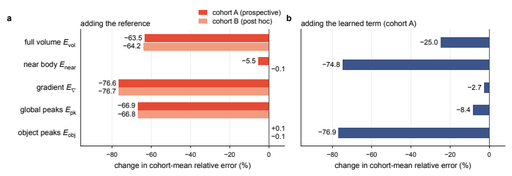
Figure 3 : Metric-level effect of each component: signed change of the cohort-mean relative error, negative is better, as in Table 4.a, Adding the reference to the frozen surrogate (lifted surrogate→ours; cohort Aprospective, cohort Bpost hoc). Bars are ratios of arithmetic cohort means; no confidence intervals are attached to them. Table 4 separately reports intervals for geometry-level geometric-mean ratios, a different estimand. Each cohort has 12 independent geometry groups; capsule-02 dominates the cohort-A near-body mean change, and near-body non- inferiority is not established.b, Adding the learned correction (no-learning control→ours; cohort A,retrospective; cohort means only). Peak-region recall changes by+0.01points in (a) and by+24.1points in (b).
Original paper · CC BY 4.0 · Zirun Zhou, Zhi-Qian Zhang, Yixuan Hong, Guang Liu, Zhigang Liu, Lili Zhang · Where the Error Lives: Separating Lid-Edge and Body-Induced Error in Neural Pressure Prediction for 3D Cavity Flow · Original paper figure · Extracted the figure area from page 11 of the original PDF.Why a global error can mislead
Pressure surrogates for three-dimensional flow are usually judged by one relative L2 error taken over the whole fluid volume.
The question is therefore whether a large global gain from a shared boundary correction says anything about accuracy near the bodies.
A frozen surrogate and an offline reference
It does not predict the pressure directly: it outputs a centered correction to a Reynolds-only background, which is the family-balanced mean of the training pressures. The composition adds no retraining and no CFD at query time, so the surrogate weights stay fixed throughout.
The reference is a centered empty-cavity pressure B128(Re) with no immersed body. It is built from a rank-8 SVD of 17 native-grid empty-cavity solutions for Reynolds numbers from 10 to 997, with modal coefficients interpolated piecewise-cubically in log10 Re. Block averaging over 2×2×2 blocks, followed by the corresponding lift, discards part of this field, and the correction δB128(Re) is exactly that discarded part, given by B128 minus the lift of the block average.
This is a restriction–prolongation residual rather than an optimal representation residual: a least-squares fit through the lift leaves 17.1% of the norm at Re = 10 and 8.4% at Re = 900, while δB128 leaves 21.2% and 10.6%.
The lift is normalized by the fluid mask so that solid fill does not mix into fluid values.
Cohorts, regions and metrics
Cohort A has 60 cases from 12 unseen geometries, and its predictions were sealed with hashes before the CFD truth existed. Cohort B is a second set of 60 cases from 12 further unseen geometries, where the lifted arm is a post hoc reconstruction and only the corrected predictor's absolute scores are prospective. Every result is labelled prospective, post hoc or retrospective, and only two results are prospective.
Six case metrics were predeclared for cohort A: full-volume error Evol, near-body error Enear, gradient error E∇, global peak error Epk, object-peak error Eobj and object-peak recall Robj. A regional error compares the centered prediction with the centered truth over the same region: \( E_R = \|\Pi_F \hat p - \Pi_F p\|_{2,R} / \|\Pi_F p\|_{2,R} \).
The junction has 30,720 cells, 1.5% of the fluid. The split was defined after cohort A had been evaluated, so the regional results are post hoc, and a sensitivity check covers junction widths from 1 to 16 cells.
Pressure energy here means the squared L2 norm of centered pressure, not physical fluid energy. The squared full-volume error splits into a sum over regions of each region's truth-energy share times its squared relative error: \( E_{\mathrm{vol}}^2 = \sum_R s_R E_R^2 \). The truth-energy shares do not depend on the model, while the error-energy shares do, so a large truth share does not by itself place a model's error in that region.
The geometry is the independent unit, so each cohort has 12 units, with its five Reynolds numbers treated as repeated measures. A decision rule was predeclared for cohort A: at least a 10% mean reduction in Evol, E∇ and Epk, at most a 2% mean increase in Enear and Eobj, and at most a 0.01 loss in Robj. Reading those tolerances as non-inferiority margins was a post hoc choice.
Prospective gain on cohort A
On cohort A, adding the reference to the frozen lifted surrogate lowered mean full-volume error from 20.6% to 7.5%, a change of −63.5%. Gradient error fell from 53.5% to 12.5%, and global peak error fell from 21.8% to 7.2%. The reduction shrinks with Reynolds number: Evol falls by 67% at Re = 10 and by 50% at Re = 900.
The one-sided upper bound on the Enear change is +4.28%, above the 2% tolerance, so non-inferiority for Enear in cohort A is not claimed. The decision rule was met in 11 of the 12 geometries.
Object-local scores are somewhat worse on cohort B, with Eobj at 9.7% against 8.4% and Robj at 83.3% against 86.0%.
Where the junction error sits
In cohort A the junction holds 68.6% of the centered truth energy in 1.5% of the fluid, and it holds 95% of the lifted surrogate's squared error. This truth-energy share stays between 66.6% and 69.8% across the tested Reynolds numbers. The gradient and peak effects are also junction effects: the wall shell carries 98.7% of the truth gradient energy, and the 17% of global peak cells that lie in the junction carry 98.9% of the lifted surrogate's peak error.
Away from the edges the lifted and corrected curves agree closely, while in the interior the reference leaves the local error unchanged at every distance from the body.
The junction still holds 75% of the corrected predictor's remaining squared error, because the lifted coarse field sets the error there: 7.8% for the corrected predictor against 1.4% for the reference alone.
Excluding capsule-02 as a post hoc sensitivity check keeps the pooled near-body changes within ±0.5% at every Reynolds number.
Reference alone and rebasing as baselines
In cohort A it also beats the lifted surrogate on all three global metrics: volume 8.9% against 20.6%, gradient 3.6% against 53.5%, and global peaks 3.3% against 21.8%. These comparisons are retrospective diagnostics, so they are not an additional prospective superiority test.
The rebased surrogate replaces the coarse lid-edge representation with the native reference: \( \hat p^{\mathrm{rebase}}_{128}=\Pi_F[B_{128}+L_m(\hat p_{64}-B_{64})] \), where B64 is an empty-cavity CFD solution on the 64^3 grid. Apart from its body-independent term it is identical to the corrected predictor. Full-volume error falls from 7.5% to 3.2% in cohort A and from 7.4% to 2.8% in cohort B, and the junction error falls from 7.8% to 0.7%.
The authors do not claim that this composition is the best use of the reference; it serves as a controlled intervention.
The junction's share of each arm's squared error is model-dependent: 95.1% for the lifted surrogate, 75.4% for the corrected predictor, 1.9% for the reference alone and 4.0% for rebasing.
What the learned term adds
It was built after cohort A had been inspected, so the comparison is retrospective. Relative to this control, the learned correction lowers Enear by 74.8%, Eobj by 76.9% and Evol by 25.0%, and it raises Robj by 24.1 points.
Each component moves the other's region by at most 5.3% in any geometry, so the two components act on largely separate regions.
Measured against that disturbance, the interior near-body error is 24.6% for the corrected predictor, 24.7% for the lifted surrogate and 88.8% for the no-learning control. The correction barely changes this reference-relative body-response error, which remains about 25% in the interior near-body band.
Object-local errors at high Reynolds number
Figure 6 plots object-peak error against peak-region recall for each case, coloured by Reynolds number and shaped by family. At Re = 900 the mean object-peak recall drops to 69.9% in cohort A and 66.3% in cohort B, from over 90% at Re = 10, even though the global error is lowest at Re of 300 or more. The lowest recall is 41.5% in cohort A and 43.6% in cohort B, and both occur in multi-body cases.
The worst object-peak errors are 22.8% in cohort A and 19.7% in cohort B.
Grid, lid and convergence checks
A regularized lid is a profile that vanishes at the lid edges, and it replaces the sharp lid in a separate numerical check.
The residual δB decreases only slowly for the unregularized lid, from 5.5% to 3.9% of its energy at Re = 10.
With the regularized lid the junction holds 51.5% of truth energy, against 68.6% for the sharp lid. The corrected predictor does not help the frozen sharp-lid-trained surrogate under the regularized lid: full-volume error rises from 31.4% to 32.6%. That surrogate, trained on unregularized-lid data, places 93.5% of its squared error in the junction under the regularized lid.
This shift also reflects a change in the boundary condition, so it does not establish a model-independent error mechanism for regularized lids.
The tighter arm converged after 3,460 to 7,245 additional iterations. Tighter test-truth convergence left the reported metric effects essentially unchanged across these 12 cases.
Limitations
The study covers one cavity, one lid speed, one solver and grid pair, and only the five training Reynolds numbers.
Only two results are prospective: the lifted-versus-corrected comparison on cohort A and the absolute cohort-B scores of the corrected predictor.
Reporting recommendations
The recommendation is to report the junction's truth-energy share and each model's junction error share at each Reynolds number and resolution, with the band width given in cells and in physical units. Near-body errors should also be given relative to the body-induced field Π_F[p − B] where an empty-cavity solution B is available, and the lid regularization should be stated.
The partition needs only masks and regional squared-error sums.
The learned field is moved to the finer grid rather than refined, and nothing about the near-body pressure is learned anew. Its target is specific to one solver and one grid, so the correction is not portable by construction.
Paper info
- Authors
- Zirun Zhou, Zhi-Qian Zhang, Yixuan Hong, Guang Liu, Zhigang Liu, Lili Zhang
- Venue
- arXiv · Preprint
- First published
- 2026-11-15
- Added
- 2026-11-17
- Updated
- 2026-11-15
- Version
- v1
- arXiv
- 2611.19741
- Category
- physics.flu-dyn · cs.LG
- Original paper terms
- CC BY 4.0
- What we show
- Paper info, commentary and permitted figures from the original paper
AI commentary is a separate explanation from the original paper and may contain errors. The original paper and figures follow each source's terms of use and any rights noted separately.
Abstract
Can a pressure surrogate score much better globally without better resolving the pressure around immersed bodies? We test this in a three-dimensional lid-driven cavity with an unregularized lid and centered pressure at native $128^3$ resolution. On 60 cases from 12 unseen geometries, with predictions sealed before the CFD truth existed, adding a body-free, Reynolds-conditioned reference correction to the same frozen $64^3$ surrogate lifted to $128^3$ lowers the mean full-volume relative $L_2$ error from 20.6% to 7.5%. In the post hoc regional analysis, the lid-edge junction occupies 1.5% of the fluid but holds 69% of the truth pressure energy and 95% of the uncorrected surrogate's squared error. Interior error changes by just +0.16% relative, and object-local peak error and recall change little on average. Retrospective ablations locate the learned term's contribution in the interior and near the bodies; rebasing on the reference lowers global error further with little change in cohort-mean near-body metrics. Reference-relative body-response error remains about 25% in the interior near-body band. Grid-refinement, lid-regularization and convergence checks delimit the numerical scope. In this benchmark, a large global gain chiefly reflects correction of a shared boundary field, not better resolution of the body response. We recommend reporting regional truth-energy and model-error shares alongside near-body and reference-relative body-response errors.
Quote from the paper
Zirun Zhou, Zhi-Qian Zhang, Yixuan Hong, Guang Liu, Zhigang Liu, Lili Zhang (2026). Where the Error Lives: Separating Lid-Edge and Body-Induced Error in Neural Pressure Prediction for 3D Cavity Flow. arXiv:2611.19741v1. https://arxiv.org/abs/2611.19741v1
BibTeX
@misc{zhou2026where,
  title = {{Where the Error Lives: Separating Lid-Edge and Body-Induced Error in Neural Pressure Prediction for 3D Cavity Flow}},
  author = {Zirun Zhou and Zhi-Qian Zhang and Yixuan Hong and Guang Liu and Zhigang Liu and Lili Zhang},
  year = {2026},
  eprint = {2611.19741},
  archivePrefix = {arXiv},
  url = {https://arxiv.org/abs/2611.19741v1}
}