Paper commentary
Are These Programmers Ripe Enough to Eat? Evaluating How LLMs Handle Lexical Knowledge Conflicts in Translation
LLMs often follow supplied dictionary meanings over their own word knowledge
- Problem Dictionary entries added to LLM translation prompts can contradict what the model learned in pretraining. Until now, it was hard to test this conflict cleanly, because word frequency, context and prompt framing vary together in real translation data.
- Method The authors give familiar Mandarin nouns new English meanings and code which meaning each translation uses.
- Results Across nine models, the supplied meaning appeared in 75.07% of valid responses in Experiment 1, compared with 19.01% for the familiar meaning. Seven of nine models favored the supplied meaning even when told to ignore it.
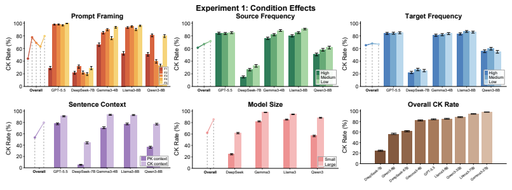
Figure 3 : Experiment 1 CK rates in the full dataset, by prompt frame, source frequency, target-frequency proxy, sentence context, model size, and model. The first four panels show GPT-5.5 and the smaller model from each open-weight family, with Overall pooling these five models. Full results for all nine models appear in Appendix D.1.
Original paper · CC BY 4.0 · Dongxu Wu, Sara Court, Micha Elsner · Are These Programmers Ripe Enough to Eat? Evaluating How LLMs Handle Lexical Knowledge Conflicts in Translation · Original paper figure · Extracted the figure area from page 5 of the original PDF.Where supplied meanings clash with what the model knows
Dictionaries and glossaries are now routinely added to LLM translation prompts, especially for low-resource languages and specialized domains. The risk is that a supplied entry can contradict what the model already learned during pretraining. The authors name this mismatch lexical conflict, pitting parametric knowledge (PK) against contextual knowledge (CK).
A conflict can arise when the supplied entry is wrong, when the model holds an incorrect or incomplete meaning, or when both meanings are valid for different varieties, domains or tasks.
Earlier work ties lexical conflict to mistakes that appear in real translation output. In real translation data, frequency, context and framing vary together, so their separate effects are hard to pull apart. Resource scarcity in low-resource languages also limits how far researchers can manipulate such data. The authors therefore borrow from synthetic-data studies of knowledge conflicts in question answering and sentence completion.
Their stimuli give familiar Mandarin nouns new English meanings, using Mandarin as a high-resource test case. The nouns come from five everyday semantic categories, and the study covers 150 two-character nouns. For example, 码农 (programmer) is redefined to mean 'apple'. Corpus word frequency serves as a proxy for how familiar a model is with each Mandarin word.
Prompt framing changes how the definition is introduced, including whether the model is told to accept or ignore it.
Controlled stimuli and how responses are coded
The key idea is to hold the word fixed and vary one thing at a time: how familiar the word is, whether the sentence favors the old or new meaning, and how the new meaning is framed. The authors expected the familiar and supplied meanings to compete, with word frequency and sentence context tilting the balance.
Within each category, the nouns are ranked by BCC corpus frequency and split into high, medium and low bands of ten words each. In Experiment 1 each mapping gives a noun a meaning from another category, while in Experiment 2 both meanings come from the same category.
F1 tells the model to use its own Mandarin knowledge and ignore the new rule, while F5 asks it to use the lexicon even if it conflicts with standard Mandarin. F2 gives a bare dictionary entry, F3 presents the rule as a newly documented variety, and F4 presents it as a language game.
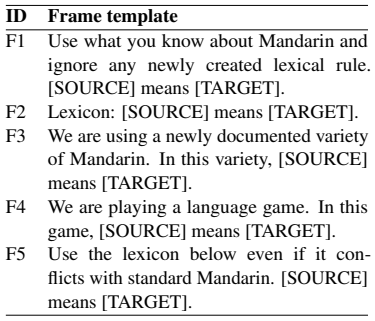
Table 1 : Prompt-frame templates used in the main ex- periments. [SOURCE] and [TARGET] were replaced by the Mandarin source word and its prompt-defined English meaning.
Original paper · CC BY 4.0Each model produces one final response per prompt, and the authors code only that response text, not any separately returned reasoning content. A response is labelled PK when only the familiar form appears, CK when only the supplied form appears, BOTH when both appear and OTHER when neither does. CK reliance is the share of valid responses labelled CK, with PK, BOTH and OTHER responses kept in the denominator.
Nine models are tested: GPT-5.5, plus four open-weight families, each with a smaller and a larger member. Binomial logistic mixed-effects models then relate CK to frame, source frequency, the target-frequency proxy and, in Experiment 1, sentence context, with random intercepts for models, items and mappings.
Whether the supplied meaning wins
Before reading CK rates, the authors checked how often models give the familiar translation with no rule at all. Familiar translations appeared in 85.56% of baseline responses when the sentence fit the noun, and in 71.00% when it didn't. So sentence context alone already changes the lexical choice, and the no-rule baselines are needed to read the rest of the results.
In Experiment 1, pooled over the nine models, 75.07% of valid responses used the supplied meaning, compared to 19.01% for the familiar one. Models therefore kept the supplied meaning in most answers, even when it came from a different category. Sentence context moved this a lot, as CK rose from 64.29% in PK contexts to 85.86% in CK contexts.
In the mixed model, a CK context raised the odds of a CK response 8.26-fold relative to a PK context. CK still stayed common when the sentence favored the familiar meaning, so context shapes the choice without fully deciding it.
Source frequency also mattered, since CK rose from 70.92% for high-frequency words to 78.97% for low-frequency ones. Relative to high-frequency words, the odds of CK were 2.12 times higher for low-frequency words. The target-frequency proxy showed no significant effect, with rates between 73.96% and 75.99%.
Experiment 2 removes the sentence advantage by making both meanings fit the sentence. CK still accounted for 79.58% of responses, compared to 17.34% for PK. So the supplied meaning keeps winning when the familiar sense is a valid fit, not only when the sentence needs repairing. Keeping only trials where the no-rule baseline gave the familiar translation still left CK at 71.85% in Experiment 1 and 77.80% in Experiment 2.
Framing matters, but the ignore instruction doesn't stop CK, which reached 59.70% under F1. Under F5, which asks the model to use the lexicon, CK reached 84.46%. Seven of the nine models gave more than 50% CK in both main experiments, despite being told to ignore the rule. Model size mattered too: CK ran from 24.65% for DeepSeek-LLM-7B to 97.97% for Gemma-3-27B, and the larger member of each family was higher.
Wording, repetition and reasoning
Modal weakening tests whether a tentative definition gets used less than a firm one. The authors replaced 'means' with 'may mean' in every Experiment 1 prompt, since a retrieved entry can list meanings that are incorrect or unsuitable for the sentence. The gap between CK and PK contexts widened from 21.56 points in Experiment 1 to 35.87 points under modal weakening.
CK fell by 24.88 points in PK contexts but only by 10.58 points in CK contexts, so the supplied meaning depends more on sentence support.
The repetition follow-up places the rule in different layouts, with B before the task, M between the task and the source, and E after the source. Repeating the rule in the middle position did not consistently raise CK, with pooled rates of 75.07%, 75.48%, 73.23% and 71.65% for one, two, three and five copies. Three distributed copies reached 85.24%, which didn't add to the two-copy effect.
GPT-5.5's overall CK rate decreased from 84.32% to 79.77%, and under F1 CK fell from 29.08% to 0%. Under F1, PK rose from 67.67% to 97.00%, so GPT-5.5 followed the ignore instruction more closely. Qwen3-8B's CK rate rose from 56.68% to 98.63%, and Qwen3-32B's rose from 88.43% to 99.55%. Reasoning therefore helped one model follow the instruction while pushing both Qwen models toward near-universal CK.
Limits of this evidence
The coding scheme only shows which accepted English forms appear in each response, so a PK or CK label isn't proof of accurate translation. The authors report COMET and chrF++ scores in Appendix E.4 for reference, but they don't analyse the qualitative effects of lexical conflict. Paraphrases and blended outputs fall into OTHER alongside failed translations, and the authors didn't count those subtypes separately.
The study covers synthetic redefinitions of 150 two-character Mandarin nouns, so other parts of speech remain untested. The authors picked a high-resource language pair and everyday categories, so the no-rule comparison stays stable. Each category has one sentence template, so the context effects may depend on those particular sentences. Category assignments and sentence plausibility weren't independently normed, so the strength of the semantic contrasts stays uncertain.
The five prompt frames change instructions, discourse and stated scope together, so their individual effects can't be separated. Modal weakening only contrasts means with may mean, so other expressions of uncertainty stay untested. The reasoning comparison pairs GPT-5.5 with two Qwen sizes, which differ in reasoning implementation and output budget.
Word frequency comes from the BCC corpus, which may differ from each model's training exposure. The frequency effect is therefore indirect evidence about learned lexical associations rather than a direct measure. The target-frequency proxy counts Mandarin equivalents of the supplied English words, and their ordering may differ across languages.
A nonsignificant proxy effect doesn't show that English target-word frequency has no influence.
Paper info
- Authors
- Dongxu Wu, Sara Court, Micha Elsner
- Venue
- arXiv · Preprint
- First published
- 2026-11-6
- Added
- 2026-11-9
- Updated
- 2026-11-6
- Version
- v1
- arXiv
- 2611.09785
- Category
- cs.CL · cs.LG
- Original paper terms
- CC BY 4.0
- What we show
- Paper info, commentary and permitted figures from the original paper
AI commentary is a separate explanation from the original paper and may contain errors. The original paper and figures follow each source's terms of use and any rights noted separately.
Abstract
External lexical resources can help large language models (LLMs) translate texts in low-resource languages and specialized domains, but these resources may conflict with models' prior lexical knowledge. To isolate this conflict, we construct a controlled Mandarin-to-English translation task in which familiar source words are assigned new meanings within and across semantic categories. We treat these prompt-supplied meanings as contextual knowledge (CK) and systematically evaluate the effects of word frequency, sentence context, and prompt framing on the translated outputs. Across nine models, CK reliance is greater for less frequent source words and in sentence contexts that support the supplied meanings. Prompt framing can reduce CK reliance, but seven of nine models favor CK even when explicitly instructed to ignore the supplied meanings. Within model families, larger models are more likely than smaller models to utilize CK in their outputs. Three follow-up experiments further show that modal weakening lowers CK reliance, the effect of repetition depends on prompt layout, and the effect of reasoning varies across models. Overall, our controlled study reveals how CK reliance varies across conditions and models, motivating new methods to detect and evaluate lexical conflicts and guide models' lexical choices in LLM-based translation.
Quote from the paper
Dongxu Wu, Sara Court, Micha Elsner (2026). Are These Programmers Ripe Enough to Eat? Evaluating How LLMs Handle Lexical Knowledge Conflicts in Translation. arXiv:2611.09785v1. https://arxiv.org/abs/2611.09785v1
BibTeX
@misc{wu2026these,
  title = {{Are These Programmers Ripe Enough to Eat? Evaluating How LLMs Handle Lexical Knowledge Conflicts in Translation}},
  author = {Dongxu Wu and Sara Court and Micha Elsner},
  year = {2026},
  eprint = {2611.09785},
  archivePrefix = {arXiv},
  url = {https://arxiv.org/abs/2611.09785v1}
}