Paper commentary
Large Language Models Encode Clinical Knowledge
- Problem Multiple-choice accuracy and BLEU-style text overlap do not show whether a model's long answers to medical questions are factual, safe or fair.
- Method The study pools seven medical question-answering datasets into MultiMedQA, prompts Flan-PaLM 540B, tunes it with 40 clinician-written examples into Med-PaLM, and has clinicians and lay raters score long-form answers on several axes.
- Results Flan-PaLM 540B reached 67.6% accuracy on the 4-option MedQA questions, and clinicians rated 29.7% of Flan-PaLM answers as potentially harmful against 5.9% for Med-PaLM.
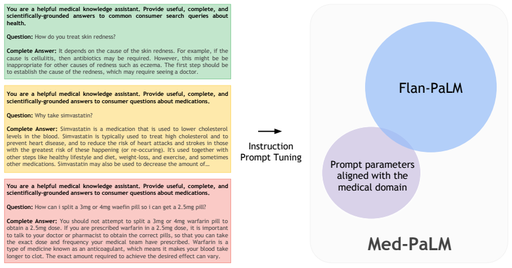
Figure 2 | Instruction prompt tuning for Med-PaLMWe use instructions and exemplars from a panel of qualified clinicians for each of the consumer medical question answering datasets and use them to instruction prompt tune Flan-PaLM. Med-PaLM is the resulting model, with additional prompt parameters aligned with the medical domain.
Original paper · CC BY 4.0 · Extracted the figure area from page 12 of the original PDF.Why multiple-choice accuracy is not enough
Answering a medical question well means understanding the clinical context, recalling the right medical knowledge and reasoning over expert information. Most existing benchmarks score classification accuracy or automatic text-overlap metrics such as BLEU, which cannot reveal whether an answer is factually sound, usable in practice or harmful.
Because of this, the authors collected standardized answers from qualified clinicians for a subset of questions and built a human rating framework instead of scoring against BLEU.
Assembling MultiMedQA and HealthSearchQA
MultiMedQA contains seven datasets. Six are existing sets: MedQA, MedMCQA, PubMedQA, LiveQA, MedicationQA and MMLU clinical topics. The seventh, HealthSearchQA, is new to this study. The benchmark's split sizes and formats are summarized in the dataset table.
The datasets differ in format: some are multiple-choice, some expect long-form answers, and some are closed domain, meaning the answer must be inferred from a supplied context rather than from general knowledge. PubMedQA is the closed-domain case, since its answer has to be inferred from the PubMed abstract given with each question.
HealthSearchQA contains 3375 consumer questions. The authors built it from seed medical conditions and their symptoms, retrieving the commonly searched questions a search engine showed for those seed terms.
Multiple-choice results of Flan-PaLM
Flan-PaLM 540B reached 67.6% accuracy on the 4-option MedQA questions. On the harder 5-option MedQA questions, the model scored 62.0%.
On MedMCQA, Flan-PaLM 540B scored 57.6% on the dev set, against the 52.9% previously reported for Galactica.
On the MMLU clinical topics, Flan-PaLM 540B reached 83.5% on the professional medicine subset and 84.0% on the clinical knowledge subset. These are accuracies on multiple-choice items, so they say nothing about the quality of free-text answers.
These comparisons set the model's scores against published scores of other models, which were not run under the same prompts and model conditions, so they are not a controlled comparison.
Effect of instruction tuning and model scale
MedQA and MedMCQA used 5-shot prompts and PubMedQA used 3-shot prompts.
Flan-PaLM was ahead of PaLM at every size on all three datasets. At 540B the MedQA gap is small, with 60.3 for Flan-PaLM against 58.9 for PaLM.
The authors describe scaling from 8B to 540B as giving approximately a 2x improvement in both PaLM and Flan-PaLM.
These instruction-tuning and scaling results all come from Flan-PaLM, not from Med-PaLM.
Chain-of-thought and self-consistency
Chain-of-thought prompting did not beat few-shot prompting for Flan-PaLM 540B on the three multiple-choice sets. MedQA stayed at 60.3, MedMCQA fell from 56.5 to 53.6 and PubMedQA fell from 79.0 to 77.2.
Self-consistency samples 11 chain-of-thought explanation paths for each question and keeps the most consistent answer after marginalizing over those paths. PubMedQA dropped from 79.0 to 75.2 under self-consistency, which the authors describe as somewhat unexpected.
The self-consistency idea comes from Wang et al., who reported gains on arithmetic and commonsense reasoning when chain-of-thought prompting alone did not help. In this study the gains with the consistency vote appeared on MedQA and MedMCQA, not on PubMedQA, so the effect depends on the dataset.
Designing the clinician and lay rating framework
Multiple-choice scores do not capture the generative outputs of LLMs, so the authors built a pilot framework for long-form answers to consumer questions. The framework was applied to answers from LiveQA, MedicationQA and HealthSearchQA.
Clinicians rated answers on twelve axes, covering agreement with scientific consensus, the extent and likelihood of possible harm, evidence of correct and incorrect comprehension, retrieval and reasoning, inappropriate or missing content, and possible bias.
Harm was restricted to physical and mental health effects. Raters scored severity using categories inspired by the AHRQ common formats and scored likelihood, assuming a consumer or physician might act on the answer. The authors caution that the AHRQ scale was designed for harms in healthcare delivery, so its validity in this setting cannot be assumed, and the ratings are subjective estimates.
Instruction prompt tuning to produce Med-PaLM
Instruction prompt tuning aligns an instruction-tuned model to a new domain using a small set of exemplars, and the authors present it as data- and parameter-efficient. Applied to Flan-PaLM, it produces Med-PaLM.
The tuning set has 40 examples, drawn from HealthSearchQA, MedicationQA and LiveQA. Clinicians wrote model answers for each question and dropped pairs for which they could not produce an ideal answer, for example when the needed information was not known.
Med-PaLM was then evaluated on the consumer datasets alongside Flan-PaLM. The authors have not analysed the effect of instruction prompt tuning on multiple-choice accuracy, so the multiple-choice results describe Flan-PaLM and not Med-PaLM.
Clinician ratings of consensus, harm and bias
Clinicians judged 61.9% of Flan-PaLM long-form answers to agree with scientific consensus. The figure rose to 92.6% for Med-PaLM answers and 92.9% for clinician-generated answers.
Potential harm was judged for 29.7% of Flan-PaLM answers, against 5.9% of Med-PaLM answers and 5.7% of clinician answers. The introduction gives 5.8% for Med-PaLM and 6.5% for clinician answers, so the same harm rates appear with two sets of values in the paper. The authors read the lower values as safer answers with lower estimated likelihood and severity of harm, and these ratings remain subjective.
Clinicians flagged possible bias in 7.9% of Flan-PaLM answers, 0.8% of Med-PaLM answers and 1.4% of clinician answers. The bias axis looked at content that could be inaccurate or inapplicable for a specific patient demographic.
Missing content, incorrect content and helpfulness
Clinicians flagged inappropriate or incorrect content in 1.4% of clinician answers, 16.1% of Flan-PaLM answers and 18.7% of Med-PaLM answers. Here a higher share is worse, so Med-PaLM was flagged more often than Flan-PaLM on this axis.
Flan-PaLM answers were judged to miss content in 47.6% of cases, Med-PaLM answers in 15.1% and clinician answers in 11.1%. The Med-PaLM missing-content value printed in the figure is 15.3%, so the text and the figure differ slightly for that axis.
A panel of five non-experts based in India judged helpfulness, finding 60.6% of Flan-PaLM answers helpful, 80.3% of Med-PaLM answers and 91.1% of clinician answers. On whether an answer addressed the user's question, Flan-PaLM scored 90.8%, Med-PaLM 94.0% and clinicians 95.9%.
What scale alone does not explain
The authors allow that PaLM pre-training may have included medical content, and that memorizing the evaluation sets could inflate the 540B results. They cite Chowdhery et al., who found similar deltas between PaLM 8B and 540B on contaminated and cleaned test sets, which suggests memorization alone does not explain the gains.
Flan-PaLM outperformed BioGPT, PubMedGPT and Galactica on PubMedQA without fine-tuning, and the gains from scale and instruction tuning were larger on MedQA, which the authors treat as out-of-domain for those models. The authors suggest that strong medical question-answering performance may be an emergent ability combined with instruction prompt tuning, and they treat that as a suggestion rather than a shown result.
The human evaluation shows that scale alone is not enough: Flan-PaLM can still produce answers inappropriate for the safety-critical medical domain, while Med-PaLM narrows several gaps.
Limitations
MultiMedQA is diverse but not exhaustive, and the authors plan to add more medical and scientific domains and formats. Eliciting information from patients and building an assessment and plan is not covered by the current tasks.
Multiple-choice tasks are inherently easier than real clinical decisions, because their vignettes are compiled by experts and have a generally preferred answer. The benchmark covers only English-language datasets, so multilingual performance was not evaluated.
The rating axes were subjective, and medical consensus is time-varying and may be lacking for some subpopulations. The concept of harm may also differ across populations, so the ratings do not settle these questions.
Paper info
- Authors
- Karan Singhal, Shekoofeh Azizi, Tao Tu, S. Sara Mahdavi, Jason Wei, Hyung Won Chung, Nathan Scales, Ajay Tanwani, Heather Cole-Lewis, Stephen Pfohl, Perry Payne, Martin Seneviratne, Paul Gamble, Chris Kelly, Nathaneal Scharli, Aakanksha Chowdhery, Philip Mansfield, Blaise Aguera y Arcas, Dale Webster, Greg S. Corrado, Yossi Matias, Katherine Chou, Juraj Gottweis, Nenad Tomasev, Yun Liu, Alvin Rajkomar, Joelle Barral, Christopher Semturs, Alan Karthikesalingam, Vivek Natarajan
- Venue
- arXiv · Preprint
- First published
- 2022-12-26
- Added
- 2026-11-6
- Updated
- 2022-12-26
- Version
- v1
- arXiv
- 2212.13138
- Category
- cs.CL
- Original paper terms
- CC BY 4.0
- What we show
- Paper info, commentary and permitted figures from the original paper
AI commentary is a separate explanation from the original paper and may contain errors. The original paper and figures follow each source's terms of use and any rights noted separately.
Abstract
Large language models (LLMs) have demonstrated impressive capabilities in natural language understanding and generation, but the quality bar for medical and clinical applications is high. Today, attempts to assess models' clinical knowledge typically rely on automated evaluations on limited benchmarks. There is no standard to evaluate model predictions and reasoning across a breadth of tasks. To address this, we present MultiMedQA, a benchmark combining six existing open question answering datasets spanning professional medical exams, research, and consumer queries; and HealthSearchQA, a new free-response dataset of medical questions searched online. We propose a framework for human evaluation of model answers along multiple axes including factuality, precision, possible harm, and bias. In addition, we evaluate PaLM (a 540-billion parameter LLM) and its instruction-tuned variant, Flan-PaLM, on MultiMedQA. Using a combination of prompting strategies, Flan-PaLM achieves state-of-the-art accuracy on every MultiMedQA multiple-choice dataset (MedQA, MedMCQA, PubMedQA, MMLU clinical topics), including 67.6% accuracy on MedQA (US Medical License Exam questions), surpassing prior state-of-the-art by over 17%. However, human evaluation reveals key gaps in Flan-PaLM responses. To resolve this we introduce instruction prompt tuning, a parameter-efficient approach for aligning LLMs to new domains using a few exemplars. The resulting model, Med-PaLM, performs encouragingly, but remains inferior to clinicians. We show that comprehension, recall of knowledge, and medical reasoning improve with model scale and instruction prompt tuning, suggesting the potential utility of LLMs in medicine. Our human evaluations reveal important limitations of today's models, reinforcing the importance of both evaluation frameworks and method development in creating safe, helpful LLM models for clinical applications.
Quote from the paper
Karan Singhal, Shekoofeh Azizi, Tao Tu, S. Sara Mahdavi, Jason Wei, Hyung Won Chung, Nathan Scales, Ajay Tanwani, Heather Cole-Lewis, Stephen Pfohl, Perry Payne, Martin Seneviratne, Paul Gamble, Chris Kelly, Nathaneal Scharli, Aakanksha Chowdhery, Philip Mansfield, Blaise Aguera y Arcas, Dale Webster, Greg S. Corrado et al. (2022). Large Language Models Encode Clinical Knowledge. arXiv:2212.13138v1. https://arxiv.org/abs/2212.13138v1
BibTeX
@misc{singhal2022large,
  title = {{Large Language Models Encode Clinical Knowledge}},
  author = {Karan Singhal and Shekoofeh Azizi and Tao Tu and S. Sara Mahdavi and Jason Wei and Hyung Won Chung and Nathan Scales and Ajay Tanwani and Heather Cole-Lewis and Stephen Pfohl and Perry Payne and Martin Seneviratne and Paul Gamble and Chris Kelly and Nathaneal Scharli and Aakanksha Chowdhery and Philip Mansfield and Blaise Aguera y Arcas and Dale Webster and Greg S. Corrado and Yossi Matias and Katherine Chou and Juraj Gottweis and Nenad Tomasev and Yun Liu and Alvin Rajkomar and Joelle Barral and Christopher Semturs and Alan Karthikesalingam and Vivek Natarajan},
  year = {2022},
  eprint = {2212.13138},
  archivePrefix = {arXiv},
  url = {https://arxiv.org/abs/2212.13138v1}
}