Paper commentary
JARVIS-1: Open-World Multi-task Agents with Memory-Augmented Multimodal Language Models
- Problem Open-world Minecraft agents that plan with LLMs struggle to read multimodal observations, keep long-horizon plans correct, and keep improving over time.
- Method Pairs a multimodal language model planner with self-check, self-explain feedback and a multimodal memory whose retrieved plans are placed in context.
- Results Raised ObtainDiamondPickaxe success to 12.5% with 60 minutes of game play, up from 6.2%.
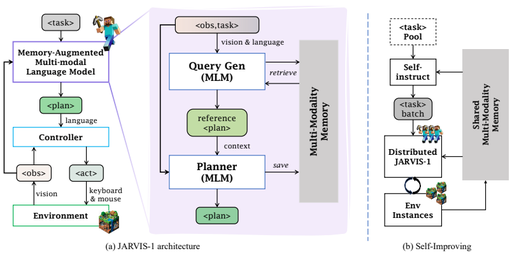
Figure 3 | Architecture of JA RV I S-1 and its self-improving mechanism. (a) JA RV I S-1 comprises a memory- augmented multimodal language model (MLM) that produces plans and a low-level action controller.JA RV I S-1 also utilizes a multimodal memory to store and obtain experiences as references for planning. (b)JA RV I S-1 can strengthen its own planning skills through exploration with its own proposed tasks (self-instruct) and a growing memory that helps with better planning on tasks that has been (partially) visited before.
Original paper · CC BY 4.0 · Zihao Wang, Shaofei Cai, Anji Liu, Yonggang Jin, Jinbing Hou, Bowei Zhang, Haowei Lin, Zhaofeng He, Zilong Zheng, Yaodong Yang, Xiaojian Ma, Yitao Liang · JARVIS-1: Open-World Multi-task Agents with Memory-Augmented Multimodal Language Models · Original paper figure · Extracted the figure area from page 5 of the original PDF.Why open-world Minecraft planning is hard
The authors group the shortcomings of current LLM-driven agents into three issues: weak handling of multimodal perception, weak consistency in long-term planning, and no life-long learning that lets an agent set its own tasks and improve. A plan that is right at the start of a task can stop being right once the biome, the inventory or a tool changes, so the plan has to be revised against the current situation.
In the comparison the authors show, a GPT planner that writes its plan only at the beginning fails ObtainDiamondPickaxe, while human players and JARVIS-1, which plan from time to time, do not fail this way.
Long tasks are harder still: ObtainEnchantingTable contains more than 20 sub-goals, and each one must match exact object names, quantities and preconditions. Because a single failed sub-goal blocks the ones after it, the planner needs interactive feedback during execution rather than a single plan. Since an open world can offer an effectively unlimited set of tasks, the authors argue that retraining a large model for each task is impractical, so experience is kept in memory and used in context instead.
How the planner, controller and memory fit together
JARVIS-1 chains MineCLIP with a language model, and the resulting multimodal language model (MLM) reads visual observations and text to plan. Given a task and the current observation, the agent first asks the MLM for a multimodal query, uses it to fetch relevant past plans, and then has the MLM planner output K short-horizon goals \\(g_1,\\ldots,g_K\\) for the controller to execute.
The controller is goal-conditioned and acts through human-like keyboard and mouse actions, which is why the agent is not given a custom action interface. Figure 3 shows these parts and the learning loop around them, with the MLM, the memory and the controller in one panel and the self-instruct batch of parallel environments in the other.
After a plan has been executed successfully, it is saved to memory together with the task and the situation under which it was planned. Because the memory is only read as context at planning time, the planner's weights are not changed by this experience.
Situation-aware, self-checked and self-explained planning
The MLM serves as a zero-shot planner rather than a symbolic one, because symbolic planners are hard to adapt when observations change over a long task. The observation is first converted to text: item keywords taken from the Minecraft wiki are used with GPT to write descriptive sentences, the MLM selects the sentence that matches the current image, and biome and inventory status are filled in from templates.
The authors find that this composable use of the MLM gives better situation descriptions and less hallucinated planning than end-to-end alternatives.
Self-check runs before execution: the model simulates the plan one step at a time, predicts the inventory after each step and tests whether the goal's precondition holds. This catches a flaw such as digging underground without enough wood before the agent is deep in the cave and has to climb back out.
During execution, environment feedback is fed to the MLM when an action fails, and the self-explain mechanism explains the error and locates the faulty step in the original plan before a refined plan is written. Figure 4 traces this loop, with self-check repairing the initial plan and self-explain handling errors that appear while the refined plan runs.
Unlike methods that depend on human intervention or privileged environment information, this step needs no extra information or design.
Retrieval over the multimodal memory
The authors adapt retrieval-augmented generation so that the knowledge library is the agent's own multimodal memory, and retrieved interaction records serve as demonstrations for planning. In the formula \\( p(y \\mid x) \\approx \\sum_{z \\in \\text{top-}k(p(\\cdot \\mid x))} p_\\eta(z \\mid x)\\, p_\\theta(y \\mid x, z) \\), x is the instruction, y the plan and z a retrieved memory entry, while p_eta is the retrieval model and p_theta the planning model.
The sum runs only over the top-k retrieved entries, so the planning term is conditioned on the retrieved set rather than on the full memory.
The memory is a key-value store. Each key combines the task with the observation at creation time, and each value is a plan that was executed successfully. Several entries can share one task while differing in observation and plan, because plans in Minecraft depend on the situation, so a query has to include the current situation as well as the task.
Query generation via reasoning starts from the instruction and asks the MLM to work backward to the intermediate sub-goals, with the search depth bounded. For the instruction to craft an enchanting table with an empty inventory, the backward search asks for a book, a diamond and obsidian, since these are the needed sub-goals.
Retrieval is two-stage. The CLIP text encoder first keeps the memory entries whose task key is above a confidence threshold, and the visual state embeddings then order these candidates. The visual ranking is written as \\( p_\\eta(z \\mid x) \\propto \\mathrm{CLIP}_v(s_z)^\\top \\mathrm{CLIP}_v(s_x) \\), so the score is an unnormalized similarity between the memory key and the visual query, and the top-k plans become the reference prompt.
Self-instruct exploration and shared experience collection
In each round the MLM judges what the agent can currently do and picks tasks from a task pool, so the agent builds an exploration curriculum for itself. The authors report that the resulting curriculum roughly follows the direction of the Minecraft technology tree. This learning follows the life-long learning schemes used in reinforcement learning research, which the authors cite as inspiration.
To speed this up, candidate task batches are run by several agents in different environments that share one memory, an idea the authors take from speculative execution. Experiences from all agents go into a shared centralized memory, and the next round starts only after the current tasks finish, until the memory reaches a set capacity.
The same learning can continue through the whole game, so more experiences accumulate and give better references for hard tasks such as ObtainDiamondPickaxe. The approach assumes that this extra memory improves planning in context, without any gradient update.
Evaluation setup and task groups
The agent uses the native human interface of Minecraft, running at 20 frames per second, so observation and action spaces resemble those of human players. Tasks come from the Minecraft Universe Benchmark, with more than 200 tasks and no demonstrations provided. The tasks are grouped into 11 groups by recommended Minecraft categories, and Table 1 lists each group's task count, maximum steps, initial inventory, biome and example instruction.
Maximum steps differ by group, and each limit is based on how long human players need for the corresponding task. Each task is run with different seeds, at least 30 tests per task, and the average success rate is reported; group means and variances are also given.
Group success rates against four LLM agents
The baselines are GPT, ReAct, Inner Monologue and DEPS, reproduced to fit the Minecraft specification through prompt and feedback template design and accessed through the OpenAI API with default hyperparameters.
Table 2 shows JARVIS-1 with the highest average success rate in every group it is compared on, and the success rate of all agents falls as the groups move up the technology tree. On the Wood group the average is 88.84 against 80.23 for DEPS, and on Stone it is 88.69 against 69.27. Figure 2 and Table 2 give the group-level picture, and the authors note that reasoning methods and interactive replanning both help over plain GPT prompting.
Iron and Diamond remain hard for every agent, and the authors single out DEPS as the strongest baseline on diamond-related tasks, at a reliability of about 2.5%. Against DEPS without memory, the diamond group average is 8.99% for JARVIS-1 and 2.42% for DEPS, which the authors describe as nearly three times the success rate. JARVIS-1 usually needs two to three rounds of re-planning to produce an executable plan, while DEPS needs more than six, which the authors take to mean fewer tokens and less thinking time.
ObtainDiamondPickaxe over game time
Within 20 minutes, JARVIS-1 reaches 6.22% against 2.5% for the RL-fine-tuned VPT, which the authors describe as more than double. Human players who know the diamond distribution reach approximately 15% for obtaining diamonds and 12% for crafting the diamond pickaxe within 10 minutes.
Extending the game time to 60 minutes (72000 steps) raises JARVIS-1's success rate on the diamond pickaxe from 6.2% to 12.5%. The success rates of the intermediate items on the path to a diamond pickaxe increase as game time passes, which the authors read as continuing skill improvement. Among the curriculum variants, the one using a GPT-generated curriculum finishes the task in the fewest game steps and gives the best 60-minute result.
VPT's success rate barely changes from 2.5% at 20 minutes to 3% at 60 minutes, which the authors attribute to the durability system, since a broken pickaxe forces replanning. JARVIS-1 re-plans from its current inventory when its pickaxe breaks, whereas the VPT-RL behaviour shown there uses inappropriate tools or crafts unnecessary items.
For DEPS, the paper gives a reliability of about 2.5% in one passage and a probability of about 0.59% of obtaining diamonds in another, so these values describe different measures and are kept apart here. The authors attribute the limited number of DEPS replanning rounds to the context limits of its language model.
Effect of the planning LM and the retrieval method
The language model comparison covers ChatGPT, GPT-4, the pretrained LLaMA2 70B and a LLaMA2 13B fine-tuned on Minecraft text, evaluated on a subset of tasks with each run covering 4 epochs and at least 20 seeds. The authors report that ChatGPT, despite having fewer parameters, reaches nearly the same success rates as GPT-4 when memory is used.
The memory ablation uses a baseline without memory, and Figure 7 tracks success as the memory grows across learning stages. After 4 epochs the memory holds 425 successful trajectories, and completion rates for the key items rise as more trajectories are added.
Three retrieval variants are compared on a subset of tasks: text memory, text memory with reasoning and multimodal memory with reasoning. The authors find that reasoning before retrieval improves retrieval accuracy, and that matching on a multimodal state, including vision and symbolic information such as inventory and location, beats text embedding alone.
The multimodal memory with reasoning gives the best success rates among these variants.
Limitations
On diamond tasks the authors locate the main bottleneck in the controller, which does not always execute the short-horizon text instructions produced by the LLM. The authors suggest that plans should be made easier for the controller to execute, or that the controller should follow instructions better.
Several comparisons use subsets of tasks: the language model ablation and the retrieval ablation each run on a subset of Minecraft tasks. The human results for the diamond task cover only 10 minutes of play, because of resource constraints.
The excerpt contains no direct comparison of the memory approach with gradient-based learning on the same tasks, although the authors argue that gradient-based learning would be slow with many new tasks.
Paper info
- Authors
- Zihao Wang, Shaofei Cai, Anji Liu, Yonggang Jin, Jinbing Hou, Bowei Zhang, Haowei Lin, Zhaofeng He, Zilong Zheng, Yaodong Yang, Xiaojian Ma, Yitao Liang
- Venue
- arXiv · Preprint
- First published
- 2023-11-10
- Added
- 2026-11-6
- Updated
- 2023-11-30
- Version
- v3
- arXiv
- 2311.05997
- Category
- cs.AI
- Original paper terms
- CC BY 4.0
- What we show
- Paper info, commentary and permitted figures from the original paper
AI commentary is a separate explanation from the original paper and may contain errors. The original paper and figures follow each source's terms of use and any rights noted separately.
Abstract
Achieving human-like planning and control with multimodal observations in an open world is a key milestone for more functional generalist agents. Existing approaches can handle certain long-horizon tasks in an open world. However, they still struggle when the number of open-world tasks could potentially be infinite and lack the capability to progressively enhance task completion as game time progresses. We introduce JARVIS-1, an open-world agent that can perceive multimodal input (visual observations and human instructions), generate sophisticated plans, and perform embodied control, all within the popular yet challenging open-world Minecraft universe. Specifically, we develop JARVIS-1 on top of pre-trained multimodal language models, which map visual observations and textual instructions to plans. The plans will be ultimately dispatched to the goal-conditioned controllers. We outfit JARVIS-1 with a multimodal memory, which facilitates planning using both pre-trained knowledge and its actual game survival experiences. JARVIS-1 is the existing most general agent in Minecraft, capable of completing over 200 different tasks using control and observation space similar to humans. These tasks range from short-horizon tasks, e.g., "chopping trees" to long-horizon tasks, e.g., "obtaining a diamond pickaxe". JARVIS-1 performs exceptionally well in short-horizon tasks, achieving nearly perfect performance. In the classic long-term task of $\texttt{ObtainDiamondPickaxe}$, JARVIS-1 surpasses the reliability of current state-of-the-art agents by 5 times and can successfully complete longer-horizon and more challenging tasks. The project page is available at https://craftjarvis.org/JARVIS-1
Quote from the paper
Zihao Wang, Shaofei Cai, Anji Liu, Yonggang Jin, Jinbing Hou, Bowei Zhang, Haowei Lin, Zhaofeng He, Zilong Zheng, Yaodong Yang, Xiaojian Ma, Yitao Liang (2023). JARVIS-1: Open-World Multi-task Agents with Memory-Augmented Multimodal Language Models. arXiv:2311.05997v3. https://arxiv.org/abs/2311.05997v3
BibTeX
@misc{wang2023jarvis,
  title = {{JARVIS-1: Open-World Multi-task Agents with Memory-Augmented Multimodal Language Models}},
  author = {Zihao Wang and Shaofei Cai and Anji Liu and Yonggang Jin and Jinbing Hou and Bowei Zhang and Haowei Lin and Zhaofeng He and Zilong Zheng and Yaodong Yang and Xiaojian Ma and Yitao Liang},
  year = {2023},
  eprint = {2311.05997},
  archivePrefix = {arXiv},
  url = {https://arxiv.org/abs/2311.05997v3}
}