Paper commentary
Representational drift in a code model: behaviour settles, which neurons carry it does not
Code model neurons keep changing even after its behaviour settles
- Problem In neuroscience, representational drift means the neurons carrying a representation change while behaviour stays the same. Earlier studies of this in language models used coarse checkpoint spacing and no noise baseline, so membership changes were hard to tell from noise.
- Method Tracks each construct's top 5% neurons across checkpoints, against a noise baseline.
- Results Behaviour on 16 constructs settles within the first 4% of training, while reliance on their carrier neurons grows. No construct's carrier set settles before the last checkpoint, so the pre-registered hypothesis is refuted.
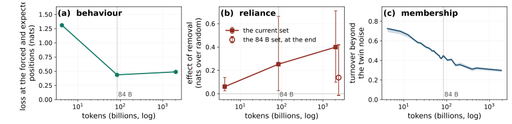
Figure 1 .The three timescales. (a) Behaviour: the median loss at the forced and expected positions of the 16 constructs with marked positions, in nats, at 4.19 billion, 84 billion and 2,034 billion tokens. It falls by 84 billion tokens and is flat afterwards. (b) Reliance: the median effect of removing the current carrier set on that loss, in nats over the mean effect of removing a random set of the same size, with 95% intervals (a percentile bootstrap of the median over the 16 constructs, 10,000 draws). The hollow marker is the set measured at 84 billion tokens, removed at the end; it cannot be separated from a random set (10 of 14 constructs above it). (c) Membership: the median change in the 5% carrier set over 20,000–30,000 steps beyond the twin noise, over 169 constructs, with a 95% band from the same kind of bootstrap (1,000 draws). The dotted line marks 84 billion tokens.
Original paper · CC BY 4.0 · Piotr Wilam · Representational drift in a code model: behaviour settles, which neurons carry it does not · Original paper figure · Extracted the figure area from page 4 of the original PDF.Why carrier sets are hard to track
In that field the animal's behaviour and the readability of the information stay stable throughout. The authors use the term only in that sense, not for drift in a data distribution or in a concept's meaning. Their question is whether the neurons carrying a construct stay put once the model has learned it. A carrier is one of the 5% of neurons that respond most to a construct, measured against the same token outside its role.
Earlier work saw a similar change in a language model during pretraining, but at coarse checkpoint spacing. That work didn't use a noise unit, so its membership changes can't be checked against ordinary variation. Other studies reported universal neurons that persist across seeds, so the published pictures don't yet agree. The paper places these results and its own result in one picture in its related work section.
Without a noise unit, a membership change can't be sorted from the wobble between two readings.
The authors draw the battery twice from one design, so the two readings, called the twins, differ only by noise. The complement of that overlap, 0.16, is the twin turnover. Every change in the carrier set is measured beyond this twin turnover rather than against zero.
A profile, a noise unit and a turnover curve
The measurement starts from one battery of Python prompts, drawn twice from one design, so every change has a noise unit. The two twins' carrier sets overlap by 0.84 within a trained checkpoint, and that disagreement becomes the twin turnover of 0.16. The carriers are the top 5% of neurons by profile entry, so the carrier set holds 7,373 of the 147,456 hidden units across 24 layers of 6,144.
Turnover is the share of a checkpoint's carriers that are no longer in the set at a later partner checkpoint. Figure 2 subtracts the turnover at the earlier checkpoint of a pair, while the settling rule divides by the ceiling at the later one. Because the gap between neighbours grows in period 2, every rate is read within fixed windows of distance, not between neighbours.
The windows are about 1,000, 5,000–10,000, 20,000–30,000 and 50,000–100,000 steps, with medians over the 169 constructs and construct-bootstrap intervals.
Period 1 runs from 4.19 to 84 billion tokens and has a checkpoint every 1,000 steps, giving nineteen pairs of neighbours.
Six metrics are taken for each construct at each checkpoint, and one metric followed across checkpoints forms a curve. The authors wrote their expectation before reading the record: that most carriers stop changing somewhere inside two trillion tokens.
Behaviour settles while reliance grows
The behaviour measure is the loss at the marked positions, where a construct's grammar fixes the next token. After 84 billion tokens it is flat for 20 of 24 series, so the readable positions reach their floor within the first 4% of training.
The reliance measure is the rise in loss when the current carriers are removed, divided by the rise from removing a random set of the same size. That excess is 0.06 nats at 4.19 billion tokens, 0.25 at 84 billion and 0.40 at the end, with construct-bootstrap intervals of [0.02, 0.14], [0.03, 0.66] and [0.10, 0.70]. The excess is above zero for 12, 14 and 14 of the 16 constructs at the three references.
So the model depends more on its current carriers as training goes on, while the behaviour they serve stays flat.
The set measured at 84 billion tokens still has 14% of its members in the current set, and it was tested by removal at the end. Removing it raises the loss by 0.14 nats over random sets, with interval [-0.01, 0.42] and p = 0.09, which is not a separation from random. Against the current set it is 0.28 nats weaker, with interval [-0.77, -0.11].
This is the analogue of the neuroscience finding that task information can stay stable while the neurons carrying it change (Rule et al., 2020).
Membership never settles, and the null can see a settling
The membership hypothesis predicted that the carriers stop changing at some date inside the two trillion tokens. Under the pre-registered rule as corrected, the authors give no construct a settling date in pretraining. All 169 constructs still show a turnover curve that is moving at the last checkpoint. At the end, the change over 20,000 to 30,000 steps is still about twice the twin turnover.
So the hypothesis fixed in advance is refuted on this record.
A count of zero only means something if the rule would have caught a settling. An abrupt settling was detected in 99.1–99.4% of 338 draws at every date from 84 billion to 1.5 trillion tokens. On uninjected series, the rule invented no settling in 338 draws.
The authors tightened the rule after they found four measurement artefacts in their ruler. On the 6% annealing branch, nearly every turnover value sat above the threshold from its first checkpoint, so all 169 constructs appeared to settle there.
The null has limits, though, and the authors state them. The gradual-settling test has no power past about 500 billion tokens. A gradual approach still under way at 1 and 1.5 trillion tokens goes undetected because the record ends there. Within those limits, the zero count rules out settlings that the test could have seen.
How the carrier set moves
The carrier set keeps changing, and its excess turnover over the twin noise slows as training goes on. In period 2, the excess for checkpoints 50,000 to 100,000 steps apart falls from 0.53 to 0.35, and for 20,000 to 30,000 steps it falls from 0.40 to 0.30. The ceilings stay nearly flat, at 0.73 to 0.80 for the 5% set, so the slowing isn't a ceiling effect.
The graded profile slows in the same way, its cosine loss falling from 0.49 to 0.24 against a ceiling of 0.87 to 0.88.
Of 18,034,712 departures from a construct's carrier set between neighbouring checkpoints, 57% return to the same set later. The median absence is 10,000 steps, with quartiles of 2,000 to 58,000, and 39% are back at the next checkpoint. The set as a whole doesn't return, since for 167 of 169 constructs each checkpoint's nearest set is its immediate neighbour.
Neurons move together only about 1.5 times as much as independent neurons with the same persistence would.
To test whether the weights drift freely, the authors compare layer 12 with a free random walk. OpenCoder trains at a constant learning rate of 3 × 10⁻⁴ after a 2,000-step warm-up, so each step moves a parameter by about that rate. If successive steps were independent, D steps under an Adam-family optimiser would move a parameter by eta times the square root of D.
Over 1,000 steps the three matrices move 0.51 to 0.67 of that free-walk distance. Over 20,000 to 30,000 steps the share falls from 0.65 early in training to 0.30 late, so successive steps cancel more as training goes on.
Which candidate causes fit the record
The authors wrote this account once the record had been read, and they didn't pre-register its readings. At forced positions the loss is about 0.09 nats. At expected positions the loss of 0.55 to 0.59 nats matches the battery's continuation entropy of 0.571 nats. At bound-name positions the loss falls from 6.0 nats to 2.5, against a marginal entropy of 5.9.
The open question is why carriers keep changing at forced positions, where the construct's gradient is silent from 4% of training on. For two-layer networks under plain gradient descent, Pashakhanloo and Koulakov (2023) derive a drift that is slower for inputs seen often.
Noise can account for the motion itself, but not for how that motion changes over training. Displacement by new learning gets weak support, with a Spearman correlation of 0.09 that is positive in 18 of 19 pairs. On one run it can't be separated from free diffusion, because new learning and the learning rate change together.
Equivalent implementations fits best of the five, because the readout holds, departed neurons return, and the walk is confined. Weight decay isn't credited as a driver, because the release states no optimiser or decay setting. Causes 1 and 4 read as one picture at two levels, and the causes need not exclude one another. The decisive test would train one model twice on one corpus, once at a constant rate and once with a decaying rate.
Limitations of the drift record
The findings rest on one model, one run and one learning-rate schedule. The record is OpenCoder-1.5B, read once, so a second seed or a second model isn't in it.
The readable positions are the forced grammar of the constructs, not their use, and they are marked for only 16 constructs. The behaviour and reliance claims therefore rest on those 16 constructs.
Where this sits among related results
They attribute the residual loss to gradual representational drift, and Gurnee et al. (2024) define the neurons they measure.
That second result is the nearest reading to this one, though it uses a different instrument.
At neuron level that is a circuit of 20–40 neurons chosen by attribution, whereas this record tracks a 7,373-neuron carrier set.
Bayazit et al. (2026) report consolidation of crosscoder features and of their causal importance. The two results concern different objects, a learned feature and a thresholded set of neurons. What consolidates in this record is the readout, not the units.
Phases have been described in crosscoder features, in the geometry of representations, and in behaviour.
Paper info
- Authors
- Piotr Wilam
- Venue
- arXiv · Preprint
- First published
- 2026-11-6
- Added
- 2026-11-9
- Updated
- 2026-11-6
- Version
- v1
- arXiv
- 2611.09204
- Category
- cs.CL · cs.LG
- Original paper terms
- CC BY 4.0
- What we show
- Paper info, commentary and permitted figures from the original paper
AI commentary is a separate explanation from the original paper and may contain errors. The original paper and figures follow each source's terms of use and any rights noted separately.
Abstract
In neuroscience, representational drift is a change in which neurons carry a representation while behaviour stays the same; we measure its analogue in OpenCoder-1.5B during pretraining, for 169 Python constructs over two trillion tokens at a constant learning rate, with a noise unit on every change, at checkpoints as close as 1,000 training steps. For 16 of the 169, those whose grammar fixes a next token, the loss at those positions reaches its floor within the first 4% of training, while the model's reliance on the neurons carrying them grows to the end: removing them costs 0.06, 0.25 and 0.40 nats more than removing a random set, at 4 billion, 84 billion and 2 trillion tokens. Which neurons carry a construct never settles: for all 169 the carrier set is still changing at the last checkpoint, and an abrupt settling at any date from 84 billion to 1.5 trillion tokens, or a gradual one before 500 billion, would have been detected in 99% of injected cases. The set measured at 84 billion tokens, removed at the end, cannot be separated from a random set, so the function is carried by whichever neurons are current. Up close the change is a persisting pool and a changing sample: a neuron that leaves a construct's set returns at three times the rate of a matched neuron, and no set reassembles. The hypothesis we fixed in advance, that the carriers settle, is refuted; we discuss candidate causes and name the experiment that would separate them.
Figures from the paper
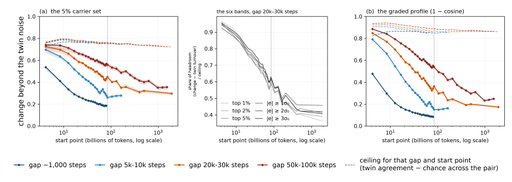
Figure 2 .Change in membership beyond the twin turnover at fixed gaps: medians over 169 constructs by start point, in four windows of the gap, with construct-bootstrap 95% bands; dashed lines are each window’s ceiling (§4.1). (a) The 5% carrier set; below it, the six cuts at 20,000–30,000 steps as shares of their ceilings. (b) The graded profile, as 1−cosine. Dotted line: 84 billion tokens.
Original paper · CC BY 4.0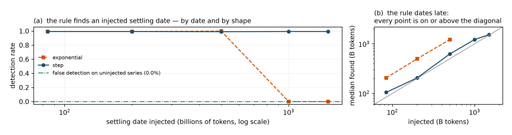
Figure 3 .The power of the null. Settling curves were injected into measured turnover series at five dates, in two shapes, 338 draws a cell. (a) The share detected by the corrected settling rule; the false-detection rate on uninjected series is 0 of 338. (b) The median date found against the date injected. Every point is on or above the diagonal, so the rule dates late and any date it reports is an upper bound.
Original paper · CC BY 4.0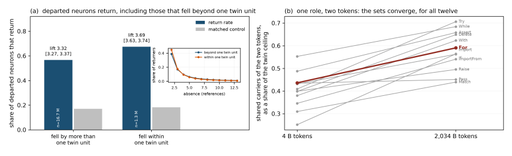
Figure 4 .Two readings of the drift. (a) Returns: the share of neurons that leave a construct’s 5% set and re-enter it at a later checkpoint, against neurons matched on being out of the set at the same moment. Departures are split by whether the neuron’s entry fell by more than its twin difference (16.7 million, 92.5%) or by less (1.3 million); the lifts over the control are 3.32 [3.27, 3.37] and 3.69 [3.63, 3.74]. Inset: the distribution of absence length, in checkpoints, for the two arms. (b) Convergence of a role’s two tokens: for the twelve constructs whose keyword is a different token indented and at module level, the carriers the two tokens’ sets share, as a share of the twin ceiling, at 4.19 billion and 2,034 billion tokens;Foris highlighted.
Original paper · CC BY 4.0Quote from the paper
Piotr Wilam (2026). Representational drift in a code model: behaviour settles, which neurons carry it does not. arXiv:2611.09204v1. https://arxiv.org/abs/2611.09204v1
BibTeX
@misc{wilam2026representational,
  title = {{Representational drift in a code model: behaviour settles, which neurons carry it does not}},
  author = {Piotr Wilam},
  year = {2026},
  eprint = {2611.09204},
  archivePrefix = {arXiv},
  url = {https://arxiv.org/abs/2611.09204v1}
}