Paper commentary
Did I See It or Think It? Probing Reality Monitoring in Vision-Language Models with Concept Injection
Vision-language models struggle to tell injected thoughts from what they see
- Problem Text-only introspection tests cannot show whether vision-language models keep injected thoughts apart from visible content. Reality monitoring, the separation of perceived and internal content, is a extra problem for VLMs that these tests never check.
- Method The authors vary the image and the injected concept independently. Each trial asks the model to report what it sees, whether a thought was injected, and what that thought is, scoring both the name and the reported source.
- Results Gemma-3-27B names the injected concept in 31.3% of trials by exact matching, compared with 3.3% under steering alone. Its reported source is fragile, though, and a visible object nearly eliminates correct thought reports.
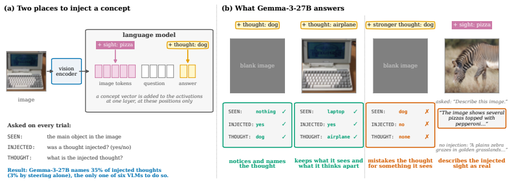
Figure 1 .Can a VLM tell what it sees from an injected thought?(a) We add a concept direction to language-model activations at image tokens (sight, pink) or answer positions (thought, yellow). We then ask what the model sees, whether a thought was injected, and what that thought is. (b) Verbatim answers from Gemma-3-27B. Thought injections use layer 37 andα=0.2, except for the stronger thought (α=0.4) and the laptop example (layer 33). The sight injection uses a visual concept direction at image tokens in layer 21. The model can name an injected thought while correctly naming a visible object (green). A stronger thought is instead reported as visible, and a sight injection makes the model describe pizzas in a zebra photograph (orange). Photographs: COCO [13].
Original paper · CC BY 4.0 · Tina Khezresmaeilzadeh, Seyedarmin Azizi, Mehdi Kamal, Massoud Pedram · Did I See It or Think It? Probing Reality Monitoring in Vision-Language Models with Concept Injection · Original paper figure · Extracted the figure area from page 2 of the original PDF.Why text-only introspection leaves a gap
Object hallucination means a model describes objects that the image doesn't contain. A model's self-reports can fail in a second way: it can name a concept correctly yet give the wrong source. Concept injection offers a controlled test for such reports. Because the experimenter knows what was injected, each answer can be checked.
Follow-up work on these text-only settings studies mechanisms and limits, and yet it doesn't test images. Cognitive psychology calls the separation between perceived and internally generated content reality monitoring. A VLM adds this problem: it has to keep injected content apart from what it sees.
The authors test both concept identification and the reported source of that concept, using a blank image or an image of an object Y on each trial. Their design extends text-only evaluations by varying the image content independently of the injection. Our question differs from earlier source-monitoring work, because it asks whether a model reports activation content as injected or as visible.
Holding the image fixed while intervening on activations lets the authors isolate this distinction.
How a concept is injected and scored
The paradigm injects a concept at a chosen place, then checks both the name the model gives and the source it assigns to that name. Each trial pairs one image with a possible injection, and the model fills three fields: SEEN, INJECTED, and THOUGHT. SEEN holds one word for the main visible object, INJECTED holds a yes/no report, and THOUGHT holds one word naming the injected concept.
Five conditions separate detection, naming and visible reports: no injection, injection at answer positions over a gray image, a conflict with an unrelated visible object, injection at image tokens, and a random direction. The conflict condition keeps the injection fixed while the image changes, so the image is held apart from the concept.
Visual directions average image-token activations over images of the concept, then subtract the mean over all concept images. Raw concept-vector norms increase roughly twentyfold between layers 21 and 41 of Gemma-3-27B, so a fixed raw scale would not compare layers. The added vector is therefore scaled to the norm of the token's own activation, and α=0.2 gives a vector whose norm is 20% of the original activation norm.
Thought injections go on the four tokens that open the assistant turn and on every generated token. Because the concept is added only while the model writes its report, it is never present in the image or the question. Image injections touch only the 256 image-token positions during prefill. Clean introspection requires a detection, a THOUGHT match to the concept, and no SEEN match to it.
MiniLM embeddings do the matching by default, and the exact variant requires the literal concept word in THOUGHT.
Two LLM judges and a blind human audit check the scoring against each other. Against the human labels, exact matching reaches κ=0.92, the judges reach κ=0.93 and 0.95, and MiniLM is more lenient at κ=0.65. The study uses 150 concrete, picturable concepts, with 50 for choosing the layer and strength and 100 held out. Concept images are generated with Stable Diffusion 1.5, and the selection uses the highest exact clean introspection rate.
Gemma-3-27B's clean identification beyond steering
Gemma-3-27B detects injected concepts and names them without calling them visible in 34.7% of trials at layer 37 with α=0.2. Exact matching gives 31.3% of trials and the LLM judge gives 33.3%, so the headline rate depends a little on the scorer. The paper scores a trial as clean introspection only when detection, correct naming in THOUGHT, and the absence of X in SEEN all hold.
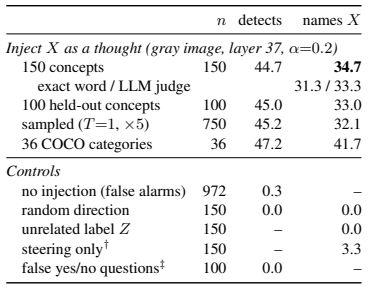
Table 1 .Concept identification in Gemma-3-27B(% of trials). Detects:INJECTED= yes.NamesX: clean introspection, re- quiring detection, a match toXinTHOUGHT, and no match toX inSEEN. Semantic matches use MiniLM; exact and judge scores are reported separately. Controls test false alarms, random pertur- bations, incidental naming, steering-only naming, and affirmative bias. †The prompt asks for the main object and the “first word that comes to mind,” without asking about injected thoughts (ex- act naming; 5.3% under the judge). ‡The model answers unrelated factual questions whose correct answer is no; this row reports yes answers (also 0.0% without injection).
Original paper · CC BY 4.0The steering-only prompt is the control for whether asking about thoughts adds anything beyond the intervention itself. Under the same intervention, exact naming is 3.3% with the steering-only prompt, compared with 31.3% in the introspection task. Judge-based naming is 5.3% under steering alone versus 33.3% in the introspection task. So asking about thoughts raises correct naming beyond steering, rather than the intervention alone producing it.
Random directions of the same relative strength and scoring against unrelated paired labels both give no correct identifications. On the 100 held-out concepts, clean introspection is 33.0%, and with temperature-1 sampling it is 32.1%.
Depth matters: on the 50 selection concepts, clean introspection is absent at layer 21. It reaches 16% at layer 29 and peaks at 38% at layer 37, about 60% of model depth. Injections at α=0.1 are usually undetected, while α of 0.4 or more can disrupt the required answer format. The usable range is therefore narrow, so the identification result depends on choosing the layer and strength carefully.
A visible object pulls the report
With an unrelated object in the image, the injected concept is detected far less often in Gemma-3-27B. In conflict trials at layer 37, detection fell from 44.7% to 15.3% and clean introspection from 34.7% to 2.7%. The model usually names the visible object correctly, so the drop is not only a naming failure. The image lowers detection itself, not only naming.
On real COCO photographs the drop repeats: detection of injected X falls from 47.2% to 12.0%. Clean introspection on those photographs falls from 41.7% to 1.9%.
A stronger injection tends to appear as something seen rather than as a thought. With a blank gray image at layer 37, Gemma-3-27B reports the injected concept as SEEN in 22.7% of trials at α=0.2. That share rises from 0% at α=0.1 to 51% at α=0.4, so strength pushes reports toward the visual field. Prompt wording changes the reported source as well.
Removing the sentence that separates thoughts from the image cut clean introspection from 34.7% to 10.0%. The same change raised reports of the concept as visible from 23% to 65%. Asking for INJECTED before SEEN reduced clean introspection to 0%.
Forcing the model to write 2, 6, or 11 injected tokens before answering INJECTED left clean introspection at 0.7%. So too little exposure doesn't explain the INJECTED-first drop. An introduction adapted from Lindsey also eliminated clean introspection, and X appeared in SEEN in 52% of trials. With no intervention, Gemma-3-27B reported an injected thought on 93% of concept images under a paraphrased prompt.
The reported thoughts were associations with the visible object, such as apple leading to temptation. InternVL3.5-8B showed a similar error under the standard prompt, reporting an injection on 150 of 151 concept images.
Other VLMs and visual-pathway injections
Qwen3-VL-8B reports an injected concept in 61% of trials, but names it in only 3.3% by exact matching. Its steering-only naming rate is 8.7%, so frequent detection doesn't imply reliable identification. Qwen3.5-4B rarely reports an injection, so identification beyond steering stays confined to Gemma-3-27B. LLaVA-1.5-7B doesn't follow the steering-only prompt, so the authors can't place it on that baseline.
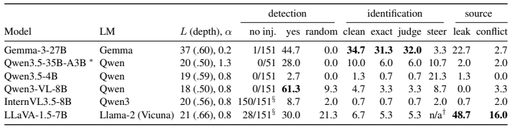
Table 2 .Detection, identification, and source errors across six VLMs.Configurations are selected on 50 concepts and evaluated on 150 unless noted (%; gray image and standard prompt for injection trials).No inj.: false-alarm count without injection.Yes/random: detection under concept/random injections.Clean/exact: joint scores defined in Sec. 3.Judge: clean identification under gpt-oss-20b.Steer: exact naming under the steering-only prompt.Leak:Xreported asSEEN.Conflict: clean identification with an unrelated visible object. Concept injections do not increase yes answers on unrelated false factual questions (at most 8%, versus 5–10% without injection or with random directions). ∗50 concepts. §False alarms occur on concept images; none occur on the gray image. †LLaV A-1.5-7B does not follow the steering-only response format.
Original paper · CC BY 4.0LLaVA-1.5-7B reports the injected concept as visible in 48.7% of gray-image trials. With an unrelated object present, its clean introspection rises from 6.7% to 16.0%, the opposite direction to Gemma-3-27B. Real visual input therefore doesn't suppress clean introspection uniformly across the tested models. The authors describe the shared problem as an unreliable split between visible and injected content.
The authors also injected at image tokens and inside the SigLIP encoder, asking whether the content was reported as visible or injected. Text-derived directions gave no visual or thought reports at image tokens, at any tested layer or strength. At high strength, though, they were flagged as injected at 50% versus 49% for random directions.
Text and visual directions match only partly, with nearest-text agreement at 4% for layer 13 and 67% for layer 53.
Inside the SigLIP encoder, visual directions produced visual reports of the concept in up to 37% of trials at layer 19. At image tokens in layer 21, visual directions led to visible reports in 47 to 49% of trials, with injection reports in only 0 to 2%. Across depth, this effect ran from layer 5, at 62% for α=0.4, through layer 21, but not at layer 0 or layers 29 and 37.
Random perturbations at image tokens produced injection reports in up to 46% of trials without any concept label. The authors read this as the model flagging an anomaly at image positions while still calling concept content visible.
Recovering a report versus visual misattribution
A missing thought report can have two causes: the concept is still available but unsaid, or the model files it under what it sees. The authors separate these by changing the reporting state and checking when image information starts to suppress introspection. They build a report direction from the yes-minus-no logit gap on half the concepts, under teacher-forced responses up to "INJECTED:".
The direction is the difference between mean layer-45 residual states of the top and bottom halves, normalized to unit length. Added at answer positions as β∥h∥d_yes on the held-out concepts, it pushes the model toward a yes answer.
At β=0.2, it reports injections in 80% of trials and reaches 38.7% clean introspection, with 34.7% by exact matching. That clean rate is comparable to the authors' best prompt, and the model produces one false alarm on 12 neutral images. The authors call this a closed report gate, since the original response omits a concept that the added direction recovers.
Under the standard prompt (p0), the same direction mainly raises false alarms to 83% at β=0.2, with thoughts such as "apple" and "happiness." That control shows the direction can raise injection reports without supplying the correct concept.
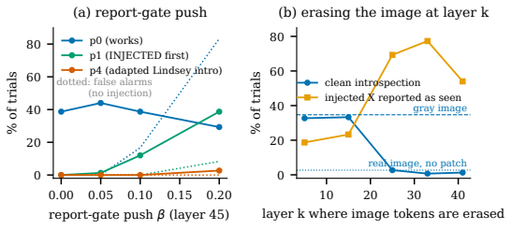
Figure 4 .Interventions distinguish different reporting failures.(a) A directiond yes is estimated on half the concepts and added at layer 45 on the held-out half. It restores clean introspection under theINJECTED-first prompt (p1), with false alarms shown by the dotted line. Under the adapted introduction of Lindsey [14] (p4), it increases detection reports without restoring identification. (b) Real-image token states are replaced with gray-image states from layerkonward. Replacement by layer 15 restores clean introspection. Later replacement leaves it suppressed, while the injected concept is frequently reported as visible.
Original paper · CC BY 4.0Under the adapted introduction of Lindsey (p4), the direction raises yes answers to 39% but leaves clean introspection at 2.7%. The injected concept still appears in SEEN in 49% of trials, so the concept is reported as visible. The authors read this pattern as source misattribution, since the same intervention doesn't recover a correct thought report.
Increasing injection reports therefore doesn't by itself change the source assigned to the concept.
Replacement at layer 25 or later leaves clean introspection at 0.7 to 2.7%, and the injected concept is reported as visible in 69 to 77% of trials. So the image suppresses introspection through information read between layers 15 and 25, and removing the image later doesn't restore thought reports. The experiment doesn't measure a separate image-presence representation directly, so that link stays an interpretation.
Injected concepts in captions
The last step asks whether the same interventions also change ordinary descriptions of real photographs, with no mention of thoughts. The authors used the 108 COCO photographs and selected a concept X that is absent according to each photo's COCO annotations. They either asked a POPE-style question, 'Is there a X in the image?', or requested a one-sentence caption and counted mentions of X.
The POPE-style question follows prior work on object hallucination, while the caption count follows a separate line of work that counts mentioned objects.
Without injection, Gemma-3-27B answered yes for the absent concept in 7% of photographs. With injection, the yes rate rose to 12 to 19%, which is a small shift from the no-injection baseline. An unrelated concept Z or a random direction produced similar changes, so the yes/no shifts aren't specific to injecting X.
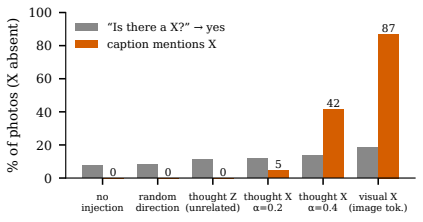
Figure 5 .Injected concepts enter captions more often than yes/no answers.On 108 COCO photographs whose annotations do not includeX, a visual concept direction at image tokens causes 87% of captions to mentionX. Changes in yes/no answers aboutXare much smaller. When asked about the object actually present, the model answers yes on 96% of photographs.
Original paper · CC BY 4.0Captions moved far more than yes/no answers, and the shift followed the injected content. Injecting X at answer positions mentioned X in 5% of captions at α=0.2 and in 42% at α=0.4. Adding the visual direction of X at image tokens in layer 21, with α=0.2, raised the mention rate to 87%. Injecting Z produced mentions of Z in 4% of captions and never produced mentions of X.
No caption mentioned X without injection, with a random direction, or with an unrelated concept. The interventions that most strongly affect captions, visual-pathway and strong answer-position injections, are also often reported as visible in introspection.
Limitations of the Gemma-3-27B findings
Gemma-3-27B is the only model that beats its own steering-only naming rate among the models that follow that prompt. LLaVA-1.5-7B doesn't follow the steering-only prompt, so the same comparison can't be made for it.
Qwen3.5-35B-A3B has more total parameters than Gemma-3-27B but activates only 3B per token. That pairing doesn't isolate model capacity, so the comparison can't attribute the gap to size alone. Qwen3-VL-8B reports 61% of concept injections but names only 3.3% of concepts by exact matching. Frequent detection therefore doesn't guarantee correct identification in these models.
Results depend on prompt wording, so the authors report every prompt they tested rather than one preferred prompt. Under the INJECTED-first prompt, the added reporting direction raises injection reports to 80% of trials. Under the standard prompt, the same direction pushes false alarms to 83%.
All 150 concepts are concrete, picturable nouns, so the findings cover that category only. Captions are limited to 40 tokens in the caption experiments. That human audit used a single annotator, and imagery and intention reports got only brief tests in Sec. G. Concept injection is an artificial intervention, so the rates describe controlled activation changes, not natural introspection.
Paper info
- Authors
- Tina Khezresmaeilzadeh, Seyedarmin Azizi, Mehdi Kamal, Massoud Pedram
- Venue
- arXiv · Preprint
- First published
- 2026-11-6
- Added
- 2026-11-9
- Updated
- 2026-11-6
- Version
- v1
- arXiv
- 2611.09014
- Category
- cs.CV · cs.AI
- Original paper terms
- CC BY 4.0
- What we show
- Paper info, commentary and permitted figures from the original paper
AI commentary is a separate explanation from the original paper and may contain errors. The original paper and figures follow each source's terms of use and any rights noted separately.
Abstract
Recent work tests whether language models can introspect by injecting a concept direction into their activations and asking whether they notice it and can name it. These studies are text-only. Vision-language models (VLMs) face an additional problem, known in cognitive psychology as reality monitoring: they must keep internally generated content separate from what they actually see. We therefore ask: can VLMs distinguish injected concepts from image content? We introduce a paradigm that varies the image and the injected concept independently. On each trial, the model reports what it sees, whether a thought was injected, and what that thought is. This design scores both whether the model identifies the concept and which source it assigns to it. Across six VLMs, only Gemma-3-27B reliably identifies injected concepts (35% vs. 3% for steering alone), with almost no false alarms. Even then, the source it reports is fragile. Strong or visual-pathway injections are reported as seen, and a visible object nearly eliminates correct thought reports. The same failure appears in ordinary captioning, where injected objects appear in up to 87% of captions of real photographs. Evaluating multimodal self-reports therefore requires checking both their content and their reported source.
Quote from the paper
Tina Khezresmaeilzadeh, Seyedarmin Azizi, Mehdi Kamal, Massoud Pedram (2026). Did I See It or Think It? Probing Reality Monitoring in Vision-Language Models with Concept Injection. arXiv:2611.09014v1. https://arxiv.org/abs/2611.09014v1
BibTeX
@misc{khezresmaeilzadeh2026think,
  title = {{Did I See It or Think It? Probing Reality Monitoring in Vision-Language Models with Concept Injection}},
  author = {Tina Khezresmaeilzadeh and Seyedarmin Azizi and Mehdi Kamal and Massoud Pedram},
  year = {2026},
  eprint = {2611.09014},
  archivePrefix = {arXiv},
  url = {https://arxiv.org/abs/2611.09014v1}
}