Paper commentary
Escapingthe instruction blackhole of vision-language-action policies via optimal-transport wormholes
Wormhole relocates robots so committed VLA policies can switch instructions
- Problem Vision-language-action policies commit to one task and absorb new instructions, so the robot finishes the old task or freezes. Static imitation training cannot detect this blind spot, because once the arm's state reveals the task, the instruction adds nothing.
- Method Wormhole is a training-free plug-in that moves the robot instead of re-instructing it. Optimal transport picks an approach-phase state of the new task, a rate-limited traversal carries the arm there, and the unmodified policy takes over.
- Results On LIBERO, Wormhole raises committed-switch success for pi0.5 from 1.2% to 93.1%. This matches or exceeds scripted retreat-and-restart with one fifth of its action discontinuity.
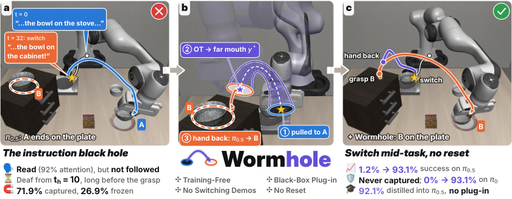
Figure 1 .The instruction black hole and the Wormhole escape.(a) π0.5 on LIBERO is told to fetch the bowl on the stove (A); at ts =32 (star), with the arm at A, it is told to fetch the identical bowl on the wooden cabinet (B). The policy keeps the old task and carries A to the plate (framet=109 and the end-effector path; white: before the switch). The instruction is read but not used: at the last query before the switch the action queries still give it 92% of the attention they gave it att=0 (Fig. 2). Beyond the horizon th =10 , 30–40 steps before the grasp (Fig. 3(a)), vanilla π0.5 is captured in 71.9% and freezes in 26.9% of the committed switches. (b) Wormhole at the switch, drawn in the scene: (1) the policy’s continuations of the old task lead to A; (2) optimal transport between these exits and approach-phase states of successful executions of B selects the far mouthy ∗ (violet star), and a rate-limited traversal carries the arm there (tube: schematic; translucent: the arm when it is handed back); (3) the unmodified policy, queried under the new instruction, grasps B (orange). (c) The same switch with Wormhole, from the same state and noise seed as (a): B ends on the plate, without resetting the arm. Committed-switch success on the test split rises from 1.2% to 93.1% onπ 0.5 and from 0% to 93.1% onπ 0, with no capture (Table 1; retreat-and-restart, which resets the arm, reaches 90.0% and 83.8%), and reaches 92.1% for a π0.5 trained on the switching data of a relocation teacher, with no plug-in at test time (see “Distilling the wormhole into the policy”).
Original paper · CC BY 4.0 · Li, Xuetao, Liu, Chen, Wu, Jing, Liu, Sheng, Li, Miao · Escapingthe instruction blackhole of vision-language-action policies via optimal-transport wormholes · Original paper figure · Converted the paper's own image file from its arXiv HTML version to PNG.Why a switched instruction gets lost
Vision-language-action policies are built on the assumption that the instruction stays fixed for the whole episode. The authors tested this with π0.5 on LIBERO: a switch issued at control step 8 was followed in 7 of 10 trials, while one issued at step 16 was followed only once. In the failed trials the robot finished the old alphabet soup task as if no new instruction had arrived.
The authors call this the instruction black hole, and its event horizon is the point after which a new instruction can no longer change the outcome.
The effect is not a quirk of one run. The gripper closes on the bowl 20 to 40 steps later, so the robot is already committed when the instruction stops working. The failure shows three signatures: capture, freezing and tidal disruption.
Why imitation can't see the problem
Each static demonstration is generated under one instruction, so the imitation loss only checks the actions given that instruction. The authors define the committed region as the set of execution states where the demonstrations leave no doubt about the instruction. Once the arm moves toward one object, its state already reveals the task, so the instruction adds nothing there.
Proposition 1 says a deafened policy, which ignores the instruction inside that region, attains exactly the same imitation loss as the original. So every switch issued in that region is fully absorbed by the deafened policy, and the simplest solution is the one that ignores the redundant input. The authors' linear probe supports the premise: at t=10 it identifies the task on the spatial pair with 96% accuracy for π0 and 100% for π0.5.
Relocating the robot instead
Wormhole leaves the policy untouched and changes the state from which the policy acts. Proposition 2 makes this work: a robot placed inside the committed region of the new task executes that task whatever it reads.
The exits are sampled from the base policy itself, so the method reads the old task's pull from the policy. Optimal transport couples the two sets and picks a far mouth inside the basin of the new task.
Figure 1 shows the black hole in the scene and the three steps of the escape on the spatial pair.
What happens at a switch
At the switch, Wormhole draws N=16 continuations of the old instruction from the current state. The end points of these samples serve as the exits, and they mark where the old task would take the arm.
On the new-task side, the memory holds successful no-switch runs of the new instruction from held-out initial states 20 to 39. Only their approach-phase states are kept as entries, and each entry is weighted by the expected steps needed to complete the new task through it. The weight is proportional to exp(−E/κ), with κ set to 5 steps.
Entropic optimal transport, solved with Sinkhorn iterations and η=0.1, couples exits with entries under a cost that mixes distance and time-to-go. The far mouth y* is the coupling-weighted combination of the entries, and the traversal sends the arm there.
The rate-limited traversal lifts, transits and settles, bounding the change of the pose action per step at r=0.3 and stopping within 2 cm of y*. Once the arm arrives, the unmodified policy resumes under the new instruction.
Does relocation beat the alternatives?
On the spatial test split, the vanilla π0.5 reaches 1.2% committed-switch success and is captured in 71.9% of committed trials. Wormhole reaches 93.1% on both backbones with no captured committed trials, while vanilla π0 completes none of its 160 committed switches. Retreat-and-restart, which resets the arm, reaches 90.0% on π0.5 and 83.8% on π0.
The paired counts separate the two relocations only on π0: 22 switches succeed only with Wormhole and 7 only with the retreat (p=0.008). On π0.5 the counts are 14 and 9 (p=0.41), so the two relocations can't be told apart there. Wormhole's switch discontinuity is 0.32 against 1.49 for retreat-and-restart, so it changes the action at the switch far less.
The action-space bridge steers the motion without moving the robot, and it reaches 14.4–23.1% on π0 and 30.0–33.1% on π0.5. Inference-time remedies do little: contrastive instruction guidance reaches 11.2%, and flushing the queue or re-routing attention stays at 3.8–5.0%.
Why the hand-over point decides the escape
Success falls steeply with that distance: hand-overs within 3 cm succeed in 87.7% of π0.5 trials and 84.3% of π0 trials, while hand-overs beyond 15 cm succeed in 3.4% and 2.5%. This matches the prediction that the robot's hand-back point, rather than the instruction, decides the escape.
The bridge transfers how the entries move but not where they are, so it can't place the robot inside the approach phase.
Letting entries come from after the grasp pushes the far mouth to where the object is carried, and the policy then freezes in 98.8% of switches. Restricting entries to the approach phase keeps success close to the full method: 96.2% at a phase margin of 20, 97.5% for the nearest entry, and 92.5% for the b-weighted entry without OT. Over 315 committed traversals on the test split and 184 on LIBERO-Goal, OT picked a far mouth within 0.5 mm of the b-weighted entry, so the coupling changed little in these scenes.
Training a policy to listen
Remark 1 implies that switching data, rather than more data of one kind, could remove the blind spot, and the authors test that prediction. A grounding token [LOC] is appended to the prefix of π0.5, and its attention over the base-camera patches is supervised toward the referred object. In the attention wormhole, the image tokens are computed without the instruction, so the instruction reaches the actions only through [LOC].
The training data come from an oracle relocation teacher: 596 successful episodes from initial states 20 to 39, of which 477 contain a switch. Trained on these, the attention wormhole reaches 89.4% committed success and behavior cloning reaches 87.5%, while the released policy follows 1.2% in the same region. Pooled over two runs with augmentation, the attention wormhole reaches 90.9% on committed switches, compared to 88.8% for behavior cloning.
The paired difference of 3.5 points is not statistically significant (exact McNemar p=0.089), so the grounded policy is not worse than behavior cloning but not clearly better either.
The distillation figure reports 92.1% committed success without any plug-in, compared to 85.2% for behavior cloning. Hiding [LOC] makes the policy deaf again, and its committed success on the development split falls from 91–96% to 5–20%.
Where the evidence stops
Autoregressive policies weren't evaluated, and no real robot with spoken interruptions was tested.
Late switches release the grasped object, and the authors say a real robot would need an explicit place-or-release step.
The safe-exit data raised it by 2.3 points (not significant) but lowered behavior cloning by 4.0 points (significant).
Paper info
- Authors
- Li, Xuetao, Liu, Chen, Wu, Jing, Liu, Sheng, Li, Miao
- Venue
- arXiv · Preprint
- First published
- 2026-11-25
- Added
- 2026-11-26
- Updated
- 2026-11-25
- Version
- v1
- arXiv
- 2611.34280
- Category
- cs.RO
- Original paper terms
- CC BY 4.0
- What we show
- Paper info, commentary and permitted figures from the original paper
AI commentary is a separate explanation from the original paper and may contain errors. The original paper and figures follow each source's terms of use and any rights noted separately.
Abstract
Vision-language-action (VLA) policies are trained to follow a fixed instruction, yet people change their minds while the robot acts. We identify the instruction black hole: once a VLA policy commits to a task, new instructions are absorbed and the robot completes the old task or freezes. We quantify it with a transmission ratio and an event horizon and prove it is a blind spot of static imitation, which cannot distinguish a policy that listens from a deaf one once the execution state reveals the task. We propose Wormhole, a training-free plug-in that relocates the robot instead of re-instructing it: optimal transport selects an approach-phase state of the new task, a rate-limited traversal carries the robot there, and the unmodified policy takes over. On LIBERO,Wormhole raises committed-switch success of pi to and pi0.5 from at most 1.2% to 93.1%, matching or exceeding scripted retreat-and-restart with one fifth of its action discontinuity.
Quote from the paper
Li, Xuetao, Liu, Chen, Wu, Jing, Liu, Sheng, Li, Miao (2026). Escapingthe instruction blackhole of vision-language-action policies via optimal-transport wormholes. arXiv:2611.34280v1. https://arxiv.org/abs/2611.34280v1
BibTeX
@misc{xuetao2026escapingthe,
  title = {{Escapingthe instruction blackhole of vision-language-action policies via optimal-transport wormholes}},
  author = {Li, Xuetao and Liu, Chen and Wu, Jing and Liu, Sheng and Li, Miao},
  year = {2026},
  eprint = {2611.34280},
  archivePrefix = {arXiv},
  url = {https://arxiv.org/abs/2611.34280v1}
}