Paper commentary
Puzzling-Bench: Evaluating Language Models on 23,777 Human-Written Puzzles with Community-Verified Answers
Language models are tested on 23,777 community-verified puzzles from Puzzling Stack Exchange
- Problem Existing puzzle benchmarks mostly cover one genre or format, such as riddles or logic grids, so a score on one genre says little about the others. String-based grading also agrees poorly with how people judge answers.
- Method Puzzling-Bench is built from Puzzling Stack Exchange, where the asker already knows the answer and marks it accepted. Unlike string matching alone, a two-tier scorer checks normalized answers first and then uses an LLM judge.
- Results GPT-6.1 Sol scored 74.8% on a shared 255-puzzle set, compared to 66.1% for Claude Opus 5.5.
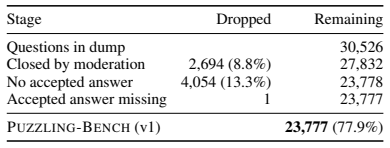
Table 1 : Filtering funnel from the raw dump to PUZZLING-BENCH.
Original paper · CC BY 4.0 · Sharma, Abhinav, Li, Li, Van Nguyen, Chien, Navuluru, Sai Karthik, Ni, Bo, Gao, Xiangbo, Huang, Xiaolei, Zhao, Yue, Ahmed, Nesreen K., Derr, Tyler, Wang, Yu, Chen, Hongjie, Tu, Zhengzhong, Nguyen, Thien Huu, Rossi, Ryan A., Dernoncourt, Franck · Puzzling-Bench: Evaluating Language Models on 23,777 Human-Written Puzzles with Community-Verified Answers · Original paper figure · Extracted the figure area from page 3 of the original PDF.Why puzzle benchmarks are hard to trust
Puzzles are a useful stress test for language models. Each one is short and self-contained, and it has a single human-verified answer. Most existing puzzle benchmarks, though, isolate one genre or format, such as riddles, cryptic crosswords or logic grids. A score on one genre says little about how a model handles the others. Grading adds a second problem, because string-based metrics agree poorly with how people judge whether an answer is right.
Puzzling Stack Exchange offers a different starting point. There, the person who posts a puzzle already knows its answer, and the crowd tries to work it out. The asker marks the correct answer, so acceptance acts as a verification signal rather than a help reply. Each puzzle also comes with spoiler-tagged hints, community tags and a timestamp, so one archive can support several kinds of analysis.
Turning the archive into a benchmark
The authors start from the Puzzling Stack Exchange dump dated 2026-06-30, which holds 30,526 questions. They remove 2,694 questions closed by moderation and 4,054 questions with no accepted answer. Dropping one more puzzle whose accepted answer was missing from the dump leaves 23,777 puzzles, or 77.9% of the questions. No tag-based filter decides what counts as a puzzle, so the site's moderation is the only content filter.
Each record keeps the title, the question text with images replaced by alt-text placeholders, and the full accepted answer. Hints sit in spoiler blocks inside the question, and 4,825 puzzles (20.3%) carry at least one. All puzzles carry community tags, 201 distinct ones, plus a creation date.
Scoring needs a short reference answer, and the first attempt took the first spoiler block of the accepted answer. That shortcut fails on multi-spoiler answers, where the first block is a reasoning step about 10% of the time. The authors therefore asked Claude Opus 4.8 to read the question and full accepted answer and return only the final answer.
The extractor never sees model outputs, so its references stay independent of the models being scored. A human checked 50 extractions, and 46 were correct, two kept explanatory text that was corrected by hand, and two couldn't be verified. On those same 50 puzzles the spoiler-based reference was wrong five times.
Scoring answers with a two-tier judge
Scoring runs in two tiers, and the second tier only runs when the first one fails. The first tier normalizes both strings, maps number words to digits and accepts numeric equality under rational parsing. The second tier is an LLM judge that sees the puzzle, the reference answer, the full accepted answer and the candidate. The judge returns MATCH or NO_MATCH, and it's told not to solve the puzzle or grade the reasoning.
Over 1,540 judged rows, Opus 4.8 and Opus 5.5 agree on 96.4% of verdicts, with Cohen's κ between 0.87 and 0.96 across the nine solvers. No model's score moves by more than 1.6 points across the judges, and the ranking changes only by one adjacent swap of 0.6 points.
All six values sit below one point, for example Opus 4.8 gives Anthropic solvers +0.3 and other solvers -0.4. Under the earlier spoiler-based reference, Opus 4.8's bonus was +1.4. The authors attribute that to fragmentary references leaving the judge room to decide, and a clean reference removes it. The reference itself moves scores too: GPT-6.1 Sol went from 76.0 to 74.8 when the final reference replaced the spoiler-based one.
Which models lead on PILOT-255
Table 4 reports the main PILOT-255 result, with the Opus 4.8 judge as the primary metric. GPT-6.1 Sol scored 74.8%, compared to 66.1% for Claude Opus 5.5. Within the Claude family, Sonnet 5 to Sonnet 5.5 brought no measurable gain, at 49.8 compared to 47.8, within the ±3-point standard error at n=255.
The posting dates give a second check, through a post-cutoff slice of 254 puzzles posted on or after 2026-05-01. Within PILOT-255 that slice has 56 puzzles, and every model scores lower on them than on puzzles from 2020 or earlier. The drop runs from 6 points for Opus 5.5 (66.7 to 60.7) to 24 points for Grok 4.7 (56.5 to 32.0). The authors offer two readings: training exposure may inflate older scores, or recent puzzles may be harder for weaker models.
Opus 5.5, Sonnet 5.5 and Grok 4.7 have cutoffs that extend to June 2026, so their drops can't be read as exposure effects. With a standard error of about 7 points per model, only the three largest drops clear twice their standard error.
On the full text-only set, Claude Haiku 4.5 completed 3,361 puzzles at 25.5%, and Claude Sonnet 5 completed 927 at 50.8%. Under the same spoiler-based reference, Opus 4.8 scored 65.5% on PILOT-255 and 54.5% on its 197 full-set puzzles, a gap of 11 points. Sonnet 5 and Haiku 4.5 land within a point and 4 points of their PILOT-255 figures, so PILOT-255 looks representative for them.
Timeouts change the denominators too. When the authors re-ran and recovered 12 Kimi rows and 26 Grok rows, Kimi fell from 65.0% to 62.9% and Grok from 55.0% to 50.6%.
Hints and images change the scores
The hints are the asker's own spoiler blocks, so the authors reran two models with them removed to see what they add. Opus 5.5 loses 15.0 points on its hinted puzzles. The loss concentrates on puzzles with two or more hint blocks, where GPT-6.1 Sol drops 23.5 points on 17 puzzles. So the hints carry real signal on the puzzles that have them, and those drops sit well above that noise.
Both models score well below their PILOT-255 text accuracy, but the category mix differs, so that gap isn't a like-for-like comparison. The authors score against text reference answers throughout, although 57 of the 100 accepted answers also contain an image.
Where the models fail together
On the 193 puzzles that no model errored on, Opus 5.5 fails 73% of the time when GPT-6.1 Sol fails, compared to a 28% base rate. An oracle that picks the best model for each puzzle reaches 91.2% on that common set. Opus 5.5, the second-best single model, adds only one puzzle at the fifth step.
The complementary coverage comes from the previous generation, not from the current second-best model. Within a family the newer model solves most of what its predecessor solved: Opus 5.5 solves 112 of Opus 4.8's 127 puzzles. The overlap is high but not nested, so a newer model can miss puzzles its predecessor solved.
The authors read this as models solving plain riddles well and missing puzzles that hide information in their presentation.
Limits of the evidence
All three judges are frontier models, so a puzzle with a wrong reference, or a candidate all three misread, is scored wrong by each. The reference extractor matched a human on 46 of 50 samples, and three puzzles fall back to the spoiler-based reference.
The earlier harness B runs had unbounded reasoning, while harness A used medium effort, so cross-harness comparisons such as Opus 4.8 versus Opus 5.5 carry that confound. PILOT-255 has a standard error of about 3 points and the post-cutoff slice about 7, so smaller differences aren't interpretable.
The image pilot evaluates only puzzles that have text reference answers. Whether these scores track general reasoning rather than puzzle-specific skill isn't established here.
Paper info
- Authors
- Sharma, Abhinav, Li, Li, Van Nguyen, Chien, Navuluru, Sai Karthik, Ni, Bo, Gao, Xiangbo, Huang, Xiaolei, Zhao, Yue, Ahmed, Nesreen K., Derr, Tyler, Wang, Yu, Chen, Hongjie, Tu, Zhengzhong, Nguyen, Thien Huu, Rossi, Ryan A., Dernoncourt, Franck
- Venue
- arXiv · Preprint
- First published
- 2026-11-25
- Added
- 2026-11-26
- Updated
- 2026-11-25
- Version
- v1
- arXiv
- 2611.34331
- Category
- cs.CL · cs.AI · cs.LG
- Original paper terms
- CC BY 4.0
- What we show
- Paper info, commentary and permitted figures from the original paper
AI commentary is a separate explanation from the original paper and may contain errors. The original paper and figures follow each source's terms of use and any rights noted separately.
Abstract
We introduce Puzzling-Bench, a benchmark of 23,777 puzzles with community-verified answers drawn from the Puzzling Stack Exchange archive (2014-2026): riddles, ciphers, logic grids, lateral-thinking problems, wordplay and recreational mathematics, a third of them with images. Every puzzle carries the answer accepted by its author, a short reference answer taken from it (LLM-extracted for the evaluation sets and checked on a 50-puzzle human review), the author's own hints, community tags and a creation date, so that the benchmark supports hint ablations, category analysis and a rolling post-cutoff slice (254 puzzles posted after the training cutoff of six of the nine models we evaluate, including the best one) as a contamination check. We evaluate nine frontier and open models with a two-tier scorer (normalized exact match, then an LLM judge) and validate the judge with three judges from two model families: they agree on 95-97% of verdicts (kappa 0.82-0.96), move no model by more than 1.6 points, and show no own-family preference. The best model, GPT-6.1, reaches 74.8% on a shared 255-puzzle set; a hard core of 17 puzzles defeats all nine models; model failures are strongly correlated, and the second-best model contributes a single puzzle to a greedy ensemble, yet an oracle over all nine reaches 91%. On a 100-puzzle multimodal pilot, withholding the question's image costs the two best models 24 and 35 points. We release the dataset, the scoring pipeline and all per-row provenance.
Quote from the paper
Sharma, Abhinav, Li, Li, Van Nguyen, Chien, Navuluru, Sai Karthik, Ni, Bo, Gao, Xiangbo, Huang, Xiaolei, Zhao, Yue, Ahmed, Nesreen K., Derr, Tyler, Wang, Yu, Chen, Hongjie, Tu, Zhengzhong, Nguyen, Thien Huu, Rossi, Ryan A., Dernoncourt, Franck (2026). Puzzling-Bench: Evaluating Language Models on 23,777 Human-Written Puzzles with Community-Verified Answers. arXiv:2611.34331v1. https://arxiv.org/abs/2611.34331v1
BibTeX
@misc{abhinav2026puzzling,
  title = {{Puzzling-Bench: Evaluating Language Models on 23,777 Human-Written Puzzles with Community-Verified Answers}},
  author = {Sharma, Abhinav and Li, Li and Van Nguyen, Chien and Navuluru, Sai Karthik and Ni, Bo and Gao, Xiangbo and Huang, Xiaolei and Zhao, Yue and Ahmed, Nesreen K. and Derr, Tyler and Wang, Yu and Chen, Hongjie and Tu, Zhengzhong and Nguyen, Thien Huu and Rossi, Ryan A. and Dernoncourt, Franck},
  year = {2026},
  eprint = {2611.34331},
  archivePrefix = {arXiv},
  url = {https://arxiv.org/abs/2611.34331v1}
}